
JRF Newsletter
Can We Rely on the Quality of Police Interrogations?
Last edited: 2026-07-27
Preface
One of the most important events in the legal community in the first half of 2017 was undoubtedly the National Judicial Reform Conference. Convened by President Tsai Ing-wen, this conference set the direction for many major judicial policies in Taiwan. To establish a sound conference model as a reference for the official proceedings, the JRF promoted the National Judicial Reform Movement in 2016, attempting to forge an ideal conference process. However, due to scheduling delays, subsequent overlaps with the official timeline, and a shift of public attention and opinions toward the official proceedings, coupled with the JRF's limited resources to simultaneously manage the public movement and monitor the official conference, the JRF decided to allocate its resources to participating in, monitoring, and translating the official National Judicial Reform Conference. Consequently, the National Judicial Reform Movement has come to an end, and the meeting materials completed thus far are being released for official reference. While these meeting materials are still imperfect, we expect them to serve as a baseline for the official National Judicial Reform Conference preparatory materials.
Although the content of the meeting materials from the third stage of the National Judicial Reform Movement is complex, the issues raised within are critical to judicial reform. Therefore, based on these materials, we have rewritten them into an article introducing how the quality of police interrogations in Taiwan can be improved.
The police are the front line of criminal justice, and their handling of cases heavily influences the quality of the criminal justice system. Unfortunately, Taiwan's judicial reform has thus far placed most of its energy and resources into reforming trial procedures and the judges, prosecutors, and lawyers surrounding trials, while paying insufficient attention to police-related reforms. We hope that this will help generate greater focus on police-related reforms during the course of the National Judicial Reform Conference.
Torture in Major Criminal Miscarriages of Justice Since the Lifting of Martial Law
In several major miscarriages of justice in Taiwan, police torture is often evident. Take, for example, the officially exonerated Su Chien-ho (蘇建和) case. Su Chien-ho was accused of committing murder along with three accomplices; subsequent crime scene reconstruction and evidence indicated that Wang Wen-hsiao (王文孝) acted alone. Yet, Su Chien-ho initially confessed to the crime because he was subjected to torture:
"The police took out an electric baton, uttered profanities, and said, 'We've prepared so many good treats for you to enjoy, and you still won't confess.' That electric baton was about a foot and a half long. After pressing it, the front made a crackling electric sound, and they said, 'I'll ask you one more time, did you go commit the crime?' I said no... Then they used the electric baton to sweep across both of my thighs. It hurt so much that I kept screaming... One police officer said, 'Just shocking his thighs is useless, he won't confess that way. Shock his genitals...'"
Similarly, in the death penalty miscarriage of justice in the Cheng Hsing-tse (鄭性澤) case and the Chiou Ho-shun (邱和順) case, issues of police torture were also present.
Regarding the issue of torture, Taiwan's Code of Criminal Procedure has undergone several important amendments, such as requiring audio and video recording throughout the interrogation of a defendant; requiring the prosecutor to prove that a confession was made of free will if the defendant raises an objection of improper interrogation; and establishing that statements obtained through police questioning are generally inadmissible as evidence for conviction, among others.
Changes in Police Interrogation Practice After the Millennium[1]
However, these blatant and severe acts of torture mostly occurred in the 1990s. Consequently, some believe that police in Taiwan currently investigate cases based on evidence and do not coerce confessions from defendants. However, this assertion actually needs to be more clearly distinguished across the following different levels:
-
Do Taiwanese police still torture today?
If we search judgments from district courts nationwide in 2016 using "torture" as a keyword, there were 7 cases[2] in which the defense raised an objection of torture, specifically alleging beatings. However, none of the torture objections were accepted by the courts. The methods used by courts to verify whether torture occurred include: police testimony, reviewing police interrogation discs, and inspection reports from detention centers or doctors. In short, while torture objections exist, proving whether torture actually occurred remains difficult.
-
Do Taiwanese police employ improper interrogation methods short of torture?
If we search 2016 district court judgments using "improper interrogation" or "improper questioning" as keywords, we find that there are still other improper interrogation methods that do not constitute torture, with 6 cases recognized by the courts[3]. Among them, the most outrageous scenario is arguably found in Taiwan New Taipei District Court 104-Yi-138 Criminal Judgment, where "police officers dressed as a ghost to scare the defendant."
Taiwan New Taipei District Court 104-Yi-138 Criminal Judgment

Before making the police interrogation record, the police officers informed the defendant that the soul of the victim, Wu I-ling (吳依玲), had possessed one of the officers, stating to the officer that she had been smothered to death by the defendant, while exhibiting intimidating behaviors such as shaking their upper body and shoulders and making hiccuping sounds, causing the defendant to feel fear... Upon this court's review of the video (and audio) disc of the police interrogation on September 11, 2015:
The defendant initially repeatedly stated only that he had agreed with the victim to commit suicide together and did not smother the victim to death...
The police officer leading the questioning... stated... "Someone compelled me to come," and slightly leaned forward while loudly declaring, "I'm telling you for real, don't you!", whereupon the defendant abruptly changed his statement to: "Fine, she was smothered to death by me on September 8"; moreover, during the questioning, the police officer frequently made abnormal sounds such as "li-eh", "li-lyu~ xiao~ gua~ xu", "yi-yong", "die~ die, eh!~ die, eh~", "lv-e~", "lio", "liu", with a frequency dense enough to exceed normal hiccups caused by being overly full after a meal, and placed a photograph of the victim at the time of death on the interrogation table, subsequently demanding the defendant view the photograph to identify the murder weapon pillow. Looking at the entire process of the police recording the statement, the content of the conversation between the defendant and the officers, the officers' objective body movements and sounds produced, and the fact that the defendant suddenly changed his testimony shortly after the officer stated "Someone compelled me to come," it is evident that prior to recording the police statement, the officers must have indeed used the guise of ghosts and spirits to inform the defendant that he should confess to smothering the victim to death, and because the defendant was repeatedly threatened in this manner by the officers, and upon seeing the officers' bizarre behavior during questioning and the victim's photograph, he developed fear and thus undoubtedly overturned his previous statements.
Admittedly, some may argue that with only 6 related cases a year, the problem of police using improper interrogation methods is merely sporadic. However, three major issues here suggest that the actual dark figure may be much higher.
-
Pre-interrogation interviews lack emphasis on audio and video recording
Although Taiwan currently mandates that the interrogation of defendants must be audio and video recorded throughout, in practice, a "pre-interrogation interview" takes place prior to the formal recording. During the pre-interrogation interview, it is difficult to examine what the police actually said to the defendant. In 2016, there were at least 7 cases[4] where defendants clearly argued that the police had threatened and induced them prior to the formal interrogation, demanding they confess to certain details, while the police denied this, resulting in a he-said-she-said situation. Furthermore, there was also a case where the court found no improper interrogation, but very uniquely attached the transcript of the examination, which shows that both parties seemingly discussed what to say prior to the formal interrogation, but the defendant "failed to get his story straight."
Taiwan Taipei District Court 103-Yi-1003 Criminal Judgment
Q: Why did you come to this precinct or the Xindian Precinct police station today?
A: To assist with the investigation.
Q: No, what matter are you here for? Let's speak plainly, not assisting with the investigation.
A: I came to the police station because of the car.
Q: Saying it like that is wrong. Your car, come on, your car was impounded by the police, right?
A: Yes.
…
Q: Because you knew you couldn't get away, the car was at the scene, your name?
A: Yes.
Q: I want you to say it. Did the police catch you? Or did the police surround you? Or did you realize you wouldn't have a car this way? -
Adopting a "defendant-focused" camera perspective may cause courts to overestimate the voluntariness of confessions
Currently, police interrogations in Taiwan tend to adopt a recording perspective focused on the defendant, an approach that may cause people to overestimate the voluntariness of confessions.
The camera perspective bias in psychology has been verified by a series of laboratory studies. When observers focus their gaze on a specific subject, they tend to attribute the cause of the action to internal factors of the subject themselves. Therefore, compared to camera angles aimed at the interrogator or aimed simultaneously at both the defendant and the interrogator, the recording method tended toward in Taiwan—where the camera is aimed at the defendant—makes observers more likely to perceive the defendant's confession as voluntary and thus conclude they are guilty. Moreover, camera perspective bias appears not only in ordinary people but also in judges and law enforcement officers with extensive interrogation experience.
-
Legal practice may lack sufficient understanding of improper interrogation methods
While psychology has achieved considerable research outcomes regarding "police-induced confessions," the judicial practice sector may lack sufficient understanding thereof.
"Police-induced confessions" are related to psychological research on "false confessions." False confessions here primarily refer to self-incriminating false statements made by defendants. The causes of false confessions can be broadly divided into factors personal to the interrogate and situational factors. The primary personal factor is psychological vulnerabilities. Psychological vulnerabilities can be roughly divided into four major categories: 1. Mental disorders, including mental illness, learning disabilities, and personality disorders; 2. Abnormal psychological states, such as anxiety, mood disturbances, phobias, bereavement, intoxication, or alcohol/drug withdrawal symptoms; 3. Intellectual functioning, such as borderline IQ; and 4. Personality traits (such as suggestibility, compliance, and acquiescence). In addition, being "young" (under 15 years of age) is also a risk factor for false confessions similar to the aforementioned psychological vulnerabilities. These characteristics or psychological states easily lead people to provide inaccurate, unreliable, or misleading statements under certain circumstances. If the police fail to notice that the person being interrogated has the aforementioned psychological vulnerabilities during questioning, they may elicit false confessions without realizing it.
Situational factors primarily refer to interrogation methods. Ordinary people often feel that an innocent defendant would only make a false confession under unbearable pressure, but this is not necessarily the case, especially when the defendant possesses the aforementioned psychological vulnerability factors. So-called "pressure" does not necessarily require explicit violence; psychological pressure created through prolonged interrogation, closed or unfamiliar spatial environments, aggressive questioning, deception, and repetitive questioning can all prompt a defendant to confess. In addition to negative pressure, false confessions can also be induced through mechanisms akin to positive reinforcement, such as obtaining promises, feeling trusted, or being able to leave sooner. Pressure and reinforcement can also be combined.
From the perspective of false confessions, any interrogation method capable of being induced by the police to produce a false confession is improper and should be reformed.
However, as can be seen from judgments, our courts' current definition of "improper interrogation" sometimes still remains at the level of judges observing whether the dialogue between the police and the defendant consists of "one question and one answer" or "continuous questioning." Furthermore, in order to admit police interrogation confessions as evidence for conviction, courts have even tolerated police conducting interrogations while a defendant is experiencing withdrawal symptoms.
Taiwan Taoyuan District Court 102-Su-33 Criminal Judgment
The defendant... argued: During both police interrogations, I was just undergoing drug withdrawal, and the police took my statement while I was uncomfortable...
Even though the defendant Cheng Yung-fu (鄭永福) showed signs of unclear speech due to falling asleep multiple times during the questioning process, once awakened by the police, he was able to clearly account for details upon further questioning without interruption... Therefore, the confession made by the defendant Cheng Yung-fu during the police interrogation was unquestionably made voluntarily.
Methods to Improve the Quality of Police Interrogations in Taiwan
-
Comprehensive Recording
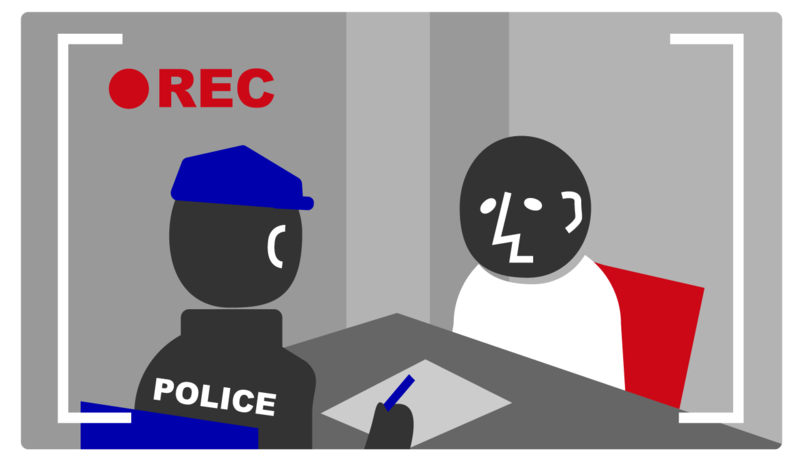
Audio and video recording the interrogation process itself[5] helps remind police to avoid improper interrogation methods. Specifically, the following practices are recommended:
- Pre-interrogation interviews should also be included in the recording.
- The camera lens should be aimed at both the defendant and the interrogator simultaneously.
- For more comprehensive practices on improving interrogation recordings, refer to the Innocence Project's "Implementing Electronic Recording of Custodial Interviews."
An example of a more comprehensive recording practice: Always make a backup!
Taiwan Miaoli District Court 104-Jian-Shang-78 Criminal Judgment
The defendant in this case claimed to have been subjected to improper questioning involving coercion and fraud during the police interrogation. Although the prosecutor requested the examination of the police interrogation disc, the record confirms that the police interrogation disc was not attached to the case file upon transfer. This court verified it and noted that the witness, namely the handling police officer Yeh Tung-hao (葉東浩), testified in court: "I remember the disc was attached inside when the case was transferred. Later, the court clerk contacted me, but because too much time has passed, I can no longer find this data on my voice recorder."
Among the three aforementioned practices for comprehensive recording, the one currently generating more discussion in Taiwan is whether "pre-interrogation interviews should also be included within the scope of audio and video recording." Opinions on this matter are divided into pros and cons. The main reason for the affirmative side is to subject all investigative processes to review, protecting both the defendant and the police. The negative side argues that pre-interrogation interviews should retain unrecorded space. There are two reasons for the negative stance: First, recording makes interrogation techniques lack flexibility; second, recording causes defendants anxiety, preventing them from building a trusting relationship with the police.
The negative side's first reason actually highlights the necessity of recording pre-interrogation interviews. Whether this so-called "flexibility" is, in reality, resorting to tactics skirting the edge of illegality is prone to controversy. The second reason is somewhat intriguing: Does failing to record indeed foster better trust with the defendant? It may indeed be a matter of police practical experience that some defendants are more willing to "tell the truth" when unrecorded. The trouble, however, is that only the contents of the formal interrogation can serve as admissible evidence; therefore, whatever the defendant says while unrecorded cannot be used directly. Moreover, what becomes even more problematic is that the "methods" used by police to make defendants willing to speak the truth may still be controversial.
Some police officers might say that this is difficult to implement in practice. Because there are many opportunities to speak with a defendant from arrest to the start of interrogation, do all of these count as pre-interrogation interviews and require recording? Many conversations start abruptly; how is it possible to record all of them?
A: It must be emphasized here that the focus is on avoiding prior coordination with the defendant on how to answer. Pre-interrogation interviews must not be used as a pretext to evade scrutiny of the interrogation process. Therefore, in other situations, if a defendant is willing to speak, the police may converse with them without needing to record everything.
Assuming that pre-interrogation interviews indeed need to be recorded, the next question is: Is there a way to build rapport with defendants and get them to "tell the truth" under recorded conditions? The answer is: Yes, if you do not presuppose that what the defendant says must conform to the truth determined by the police. This involves a shift in the entire investigative mindset, which will be explained later.
British Miscarriage of Justice Experience: Secret Consultations Between Lawyers and Defendants Prior to Formal Interrogation Are Important
In Britain, there was a miscarriage of justice where detectives told the defendant prior to formal interrogation that they already knew the whole truth and that he couldn't escape. With no lawyer holding a private consultation with the defendant prior to the formal interrogation, the defendant confessed to the crime during the formal interrogation while his lawyer was present. When given the opportunity to have a private consultation with his lawyer after the interrogation ended, the defendant retracted his confession and told his lawyer everything. Consequently, because the confession had already been made and no problems were apparent, no one believed the defendant's innocence despite his later retraction. The case was ultimately successfully overturned based on DNA evidence.
See Gudjonsson, Gisli, and James Mackeith (1994). "Learning disability and the Police and Criminal Evidence Act 1984. Protection during investigative interviewing: A video-recorded false confession to double murder." Journal of Forensic Psychiatry 5.1: 35-49.
-
Moving from "Interrogation" to "Investigative Interviewing"
Taiwan's practical sector is relatively familiar with "interrogation," but lacks understanding of "investigative interviewing." "Interrogation" presupposes that the interrogator knows certain truths of the crime or the direction of the truth, and emphasizes how to make the interviewee utter statements aligning with the interrogator's preconceived direction. Conversely, "investigative interviewing" presupposes that the interviewer's preconceptions may not necessarily be correct; thus, it emphasizes adopting an open-minded approach to gathering information, striving to avoid inducing or distorting the interviewee's answers through one's own preconceptions.
British Experience: Traditional Interrogation is Unfit for Use
Introducing investigative interviewing into police practice can draw on British experience. Due to miscarriages of justice, the UK passed the Police and Criminal Evidence Act (PACE) in 1984, which mandates that police audio-record all questioning and provides guidelines for questioning defendants, emphasizing that the goal of questioning is to gather information rather than merely extract confessions, thereby requiring the avoidance of coercive questioning techniques. Following the passage of PACE, researchers listened to recordings to understand how police interviewed defendants. They found that while police tended to employ non-coercive questioning methods, if a suspect denied involvement—even in the absence of evidence—police might still resort to several persuasive questioning methods, including repetition, silence, accusing the suspect of lying, commenting on the suspect's body language, and appealing to sympathy for the victim.
Researchers argued that these strategies themselves are not effective methods for inducing confessions because if a suspect denies the allegations, they are unlikely to change to a confession based on these techniques. However, due to the police's poor ability to identify vulnerable interviewees, such persuasive methods may prompt certain compliant interviewees to provide false confessions.
Under these circumstances, unless one secretly continues to employ contemporary interrogation methods clearly recognized as improper, questioning methods legally permitted can no longer effectively compel normal people to confess. Furthermore, encountering vulnerable interviewees risks inadvertently eliciting false confessions. How to develop new, effective interview methods for gathering high-quality information has become a major challenge for the British police. We can see that similar dilemmas exist in Taiwan: many interrogation methods that were effective in extracting confessions in the past, such as torture and coercion, can no longer be used. Moreover, the introduction of full audio and video recording has forced the interrogation process to be scrutinized. Reforming interrogation methods is a challenge that must be faced sooner or later.
British Countermeasure: Establishing the PEACE Interviewing Model
To cope with the situation where old interrogation methods had to change, the UK decided in 1992 to introduce investigative interviewing—namely, the PEACE interviewing model—into police practice. The theoretical foundation of the PEACE interviewing model derives from psychology, adjusted in combination with investigative practice. The PEACE interviewing model encourages police to adopt an open attitude and interview defendants ethically, with the goal of increasing the quality and quantity of information gathered. For an introduction to the PEACE model, refer to the UK College of Policing's explanation.
On How to Make Interviewees Confess: Rapport Building
In investigative interviewing training, how to build rapport with interviewees is a crucial component. Through rapport building, interviewees become more willing to make statements, thereby potentially providing a confession.
Building rapport means maintaining a sincere, open attitude, being approachable, willing to listen, and caring about the interviewee's feelings and well-being. Rapport building takes time, and this relationship must be maintained throughout the entire interview process.
Research shows that police officers who sincerely and warmly help defendants understand their legal rights, and who are adept at expressing empathy, are also more likely to gain the defendant's cooperation.
Walsh, Dave, and Ray Bull (2012). "Examining rapport in investigative interviews with suspects: Does its building and maintenance work?." Journal of Police and Criminal Psychology 27.1: 73-84.
The greatest difficulty in introducing investigative interviewing into police practice lies in how to teach police interviewing skills and have them actually apply those learned skills to their work. Therefore, continuous and systematic training and supervision are necessary, which will inevitably trend toward professional certification.
The First Step in Introducing Investigative Interviewing: Start with Vulnerable Witnesses!
Although the investigative interviewing discussed here primarily concerns defendants, the best way to introduce this approach is actually to start by interviewing vulnerable witnesses. The reason is that witnesses have less adversarial friction with the police, and there is a corresponding demand for it. Taiwan's Sexual Assault Crime Prevention Act stipulates that child witnesses should be assisted in questioning by forensic interviewers when necessary, which is essentially a similar regulation. The targets of forensic interviewer training include social workers, psychologists, and educators; such professionals naturally do not view interviewees with an adversarial attitude. A more practical pathway for training professionals can begin with professionals on the periphery of the judiciary, gradually expanding to the police, and moving from witnesses to defendants.
-
Improvement of the Work Environment
A high-pressure, clearance-oriented work environment easily leads police to choose traditional interrogation methods and even evade full recording, because traditional methods make it easier to quickly obtain the confessions desired by the police. The trouble is that the police may fail to clearly realize the extremely high probability of generating miscarriages of justice throughout this process. This is because they are convinced they have grasped the truth, failing to realize they have fallen into the trap of cognitive bias.
Therefore, establishing reasonable workloads and reforming complementary measures such as the excessively clearance-oriented case performance evaluation system are also imperative.
A Bizarre Phenomenon in Taiwan's Police World: The Case Performance Evaluation System
The case performance evaluation system refers to key work targets issued by the National Police Agency, which carry special performance metrics, subjecting the performance of individual police bureaus to evaluation (formerly demanded by the National Police Agency, now potentially demanded privately by police bureaus). Each project lasts as long as a month or as short as a few days. For example, if this month's key work target is cracking down on illicit firearms, frontline officers must find every possible way to solve firearm-related cases during this period. This may implicitly encourage officers to "cultivate cases" or fabricate false ones.
A joke in the police world goes: In the past, to earn performance metrics, everyone "found guns in trash cans"; later, superiors banned finding guns in trash cans. So everyone started finding guns by riverbanks or bus stops instead.
What is bizarre about the case performance evaluation system is: How is it that specific cases happen to be discovered and solved right in this particular week? What happens if that particular type of case simply doesn't occur during this period?
Extension: Similar Issues May Not Be Limited to the Police
Although this article discusses actual police interrogation practices as its subject matter, investigators bearing interrogation responsibilities in Taiwan also include investigators from the Investigation Bureau and prosecutors. Whether these investigative personnel also experience situations similar to those mentioned in this article is worthy of attention. Since conditions across different occupations may not be entirely identical, we will not elaborate further here.
We are able to present a description of the current status regarding the police because reformers within the system are willing to provide information and cooperate with us. We also take this opportunity to say to other types of investigative practitioners: If you resonate with the contents mentioned in this article and are willing to provide us with more information, please be sure to contact us.
Footnotes
[1] In Taiwan, the questioning stage by police is typically called "questioning" (詢問) suspects, while the questioning stage by prosecutors is typically called "interrogation" (訊問) defendants, reflecting the different legal powers of police and prosecutors. In this article, "interrogation" is used to correspond to the English concept of interrogation, making the contrast clearer when entering the comparison between interrogation and investigative interviewing. The term "defendant" is used instead of "suspect" because this article cites several judgments where individuals initially referred to as "suspects" in the earlier stage later became "defendants." To avoid confusing readers when seeing "defendant" and "suspect," the term "defendant" is used uniformly.
[2] Using the "Law Source" judgment search engine, with the date restricted from January 1 to December 31, 2016, and the keyword set to "torture." Case numbers where defendants raised torture objections include: Taiwan Taipei District Court 103-Yi-786 Criminal Judgment, Taiwan Taipei District Court 103-Su-654 Criminal Judgment, Taiwan Shilin District Court 105-Yi-614 Criminal Judgment, Taiwan Yilan District Court 104-Su-356 Criminal Judgment, Taiwan Taoyuan District Court 103-Shen-Su-1932 Criminal Judgment, Taiwan Kaohsiung District Court 105-Yi-122 Criminal Judgment.
It should be noted that this data search likely still contains omissions, such as defendants not knowing to raise a torture objection or using different vocabulary to describe the matter. Similar situations may also occur in subsequent searches for cases where defendants raised objections of "improper interrogation."
[3] Taiwan New Taipei District Court 104-Yi-138 Criminal Judgment, Taiwan Shilin District Court 104-Chung-Su-12 Criminal Judgment, Taiwan Taoyuan District Court 104-Yi-1096 Criminal Judgment, Taiwan Changhua District Court 105-Su-234 Criminal Judgment, Taiwan Tainan District Court 104-Su-174 Criminal Judgment, Taiwan Tainan District Court 103-Su-797 Criminal Judgment.
[4] Taiwan Taipei District Court 102-Su-415 Criminal Judgment, Taiwan Taipei District Court 102-Su-353 Criminal Judgment, Taiwan Taipei District Court 104-Su-103 Criminal Judgment, Taiwan New Taipei District Court 105-Jian-Shang-287 Criminal Judgment, Taiwan New Taipei District Court 104-Su-1170 Criminal Judgment, Taiwan Taoyuan District Court 102-Su-33 Criminal Judgment, Taiwan Kaohsiung District Court 105-Su-207 Criminal Judgment. In 4 of these cases, defendants claimed that while smoking outside with the police, the officers took the opportunity to threaten and induce them.
[5] This article primarily discusses issues concerning the interrogation of defendants, but let us briefly mention witness interrogation here. Currently, Taiwanese police practice generally records the interrogation of defendants as a rule, but recording witness interrogations is not necessarily guaranteed. Considering that improper interrogation methods may also be used when questioning witnesses, police questioning should actually be recorded regardless of whom they are questioning.
This article is an AI-generated translation of the original Chinese text. In the event of any discrepancy, the Chinese version shall prevail.