
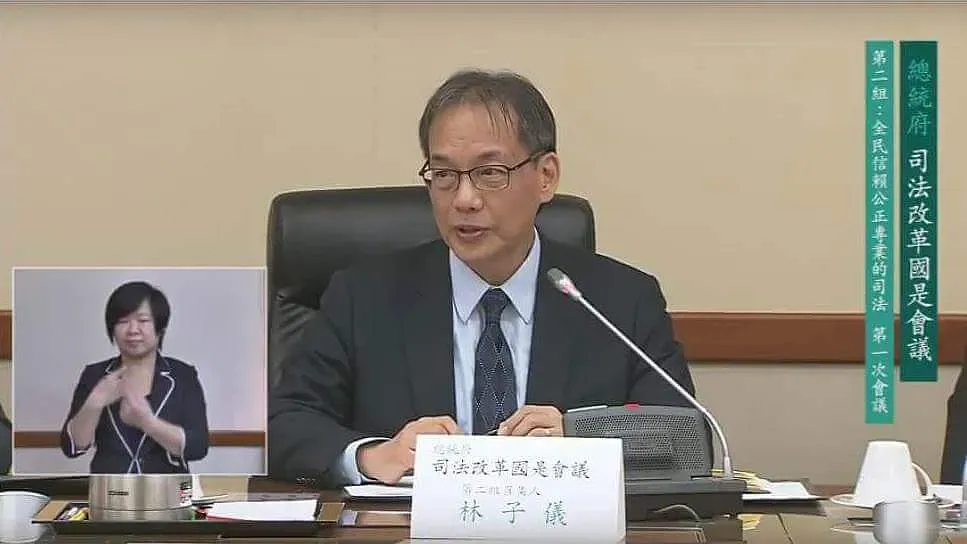
Brief Notes: 1st Meeting of the 2nd Division of the Presidential Office's National Congress on Judicial Reform
Last edited: 2026-07-27
-
Every division in the National Congress has its own purpose. The core concept of the 2nd Division is to make judicial judgment outcomes fair and trustworthy, and to drive change to achieve this. The purpose of the 3rd Division is to make judicial trials efficient. The 4th Division aims to build a cordial, friendly judicial system that the public does not fear, addressing the public's general fear and apathy toward the judiciary.
-
The President of the Judicial Yuan stated during the meeting:
Regarding Issue 2-3:
- For point 7, "Reviewing the appeal system to prevent surprise final judgments that overturn an acquittal into a conviction," the Judicial Yuan will propose legislative research to provide remedies for such situations;
- For point 8, "Reviewing the implementation of collegiate panels across all court levels," this is an execution issue, and the Judicial Yuan will find ways through judicial administration to require courts to implement it;
- For point 9, "Revitalizing trial dates and procedures, implementing centralized trials and consecutive hearings to enhance trial efficacy," the Judicial Yuan will also work hard to study its implementation;
- For point 10, "Reviewing the system where the Administrative Litigation Act takes stay/non-stay of execution as the principle," the Judicial Yuan will conduct its own research;
- For point 11, "Reviewing the grounds and standards for provisional attachment," the Judicial Yuan will strive to respond;
- For point 12, "Reviewing compulsory execution procedures," and point 14, "Evaluating non-litigation appeals regarding companies to the Supreme Court," the Judicial Yuan has also taken them back for research.
Regarding Issue 2-4:
- For point 1, "Establishing specialized courts/divisions to try related cases, such as commercial, labor, and tax cases," the Judicial Yuan originally intended to take this on, but will respect the committee members' opinions and keep this issue in the National Congress for resolution;
- For point 2, "Evaluating the formulation of special litigation procedures for labor cases to enhance litigation efficacy," this issue originally belongs to the major policies of the Judicial Yuan and execution has already begun;
- For point 3, "Evaluating the increase in the number of judges and investigators for family cases, and strengthening performance evaluation standards for family court judges," the Judicial Yuan will also implement this;
- For point 4, "Reviewing the operation of administrative courts," although it is a broad issue, the Judicial Yuan indicated it will take it back for research.
-
Regarding the issue of "transforming the Judicial Yuan into a trial-only organ," the Judicial Yuan will base its evaluation of feasibility on Judicial Yuan Interpretation No. 530 and the conclusions of the 1999 Judicial Reform Conference, aiming to implement gradual reforms over the next 3-5 years.
-
The Chairperson stated that the Judicial Yuan will execute or study the two sub-issues of Issue 2-2, points 7, 8, 9, 10, 11, 12, and 14 of Issue 2-3, and points 2, 3, and 4 of Issue 2-4. It will also present the progress and research conclusions prior to the concluding meeting of the National Congress. Research reports concerning the review of administrative court operations, the transformation of the Judicial Yuan into a trial-only organ, and the unification of judicial administration will be submitted in advance.
-
The Chairperson stated that this National Congress is an extra-institutional design, functioning as an advisory unit to the President. In the long run, it will still be necessary to enact legislation to establish a judicial reform organization, or for the Judicial Yuan and the Ministry of Justice to set up internal units for implementation. This can be discussed in subsequent meetings.
-
This division resolved to add the issue of "Reviewing the relationship between politics and the judiciary."
-
The second divisional meeting of this division will discuss the constitutional adjudication system (constitutional complaint system), which is closely related to the people's constitutional rights. On March 20, discussions will cover the reform of the composition and staffing of the courts of final instance, as well as item 2 of Issue 2-3, "Reform of civil and criminal appeal procedures."
Attachments
- Verbatim Transcript of Meeting Speeches
-
Issue List of the 2nd Division
No. Issue Sub-issue 2-1 Establishing a human-rights-friendly, efficient, and transparent Grand Justices' interpretation procedure - Establishing a constitutional complaint system for judicial decisions
- Establishing a transparent Grand Justices' interpretation system: open and transparent case management, and online publication of applications upon receipt
- Enhancing the efficacy of Grand Justices' interpretation procedures: increasing assistant staffing, amending voting thresholds, and disclosing the authoring justice
- Normalizing oral arguments
2-2 Vesting of judicial policy-making power
(Reform of the dual judicial administration system)- Transforming the Judicial Yuan into a trial-only organ
- Unifying judicial administration
2-3 Building efficient and streamlined court organization and procedures - Reform of the composition, staffing, and selection procedures of courts of final instance
- Reform of civil and criminal appeal procedures
(including mandatory defense and representation systems) - System of dissenting opinions in judgments of courts of final instance
- Merger of the Commission on the Disciplinary Sanctions of Public Functionaries and the Supreme Administrative Court
- Exempting judicial organs from the Central Government Total Staffing Act
- Rationalization of litigation costs and prevention of frivolous litigation
(such as reviewing situations of using criminal pressure for civil disputes, evaluating the feasibility of including attorney fees in litigation costs, and conditional compensatory systems in criminal litigation) - Reforming the appeal system to prevent surprise final judgments that overturn an acquittal into a conviction
- Reviewing the implementation of collegiate panels across all court levels
- Revitalizing trial dates and procedures, implementing centralized trials and consecutive hearings to enhance trial efficacy
- Reviewing the system where the Administrative Litigation Act takes stay/non-stay of execution as the principle
- Reviewing the grounds and standards for provisional attachment
- Reviewing compulsory execution procedures
- Reviewing the litigation mechanism for administrative penalties
(such as ensuring high administrative fines are collectible) - Evaluating opportunities for non-litigation appeals regarding companies to be brought to the Supreme Court to unify legal interpretation
2-4 Building specialized courts/divisions - Establishing specialized courts/divisions to try related cases, such as commercial, labor, and tax cases
- Evaluating the formulation of special litigation procedures for labor cases to enhance litigation efficacy
- Evaluating the increase in the number of judges and investigators for family cases, and strengthening performance evaluation standards for family court judges
- Reviewing the operation of administrative courts
- Administrative courts directly ordering the original disposition authority to issue an administrative disposition according to the plaintiff's application contents, etc.
This article is an AI-generated translation of the original Chinese text. In the event of any discrepancy, the Chinese version shall prevail.
