
The Banality of Evil: Reflections on the Hearing for the March 24 Executive Yuan Occupation Case
Last edited: 2026-07-27
Photo / Alysa Chiu
※ This article is republished with the author's consent.
The March 24 Executive Yuan incident stemmed from the March 18 occupation of the Legislative Yuan, which had been ongoing for five days. On March 23, then-President Ma Ying-jeou held his first press conference to issue a public statement. Rather than positively responding to the demands raised by the movement's participants, he reiterated the importance of the Cross-Strait Trade in Services Agreement and emphasized that the students were illegally occupying the Legislative Yuan.
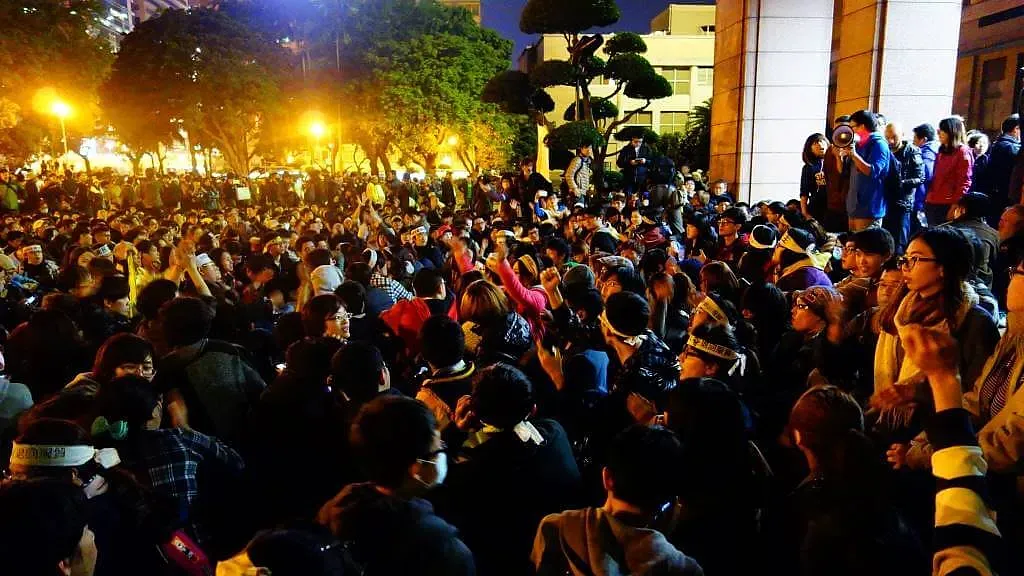
Disappointed and indignant that the president failed to directly address the student movement's demands, posts calling on the public to occupy the Executive Yuan appeared online on the evening of March 23. Although they were soon taken down, crowds began streaming into the Executive Yuan. By around 8:00 PM, they had occupied the front plaza and building of the Executive Yuan, marking the beginning of the March 23 Executive Yuan occupation incident.
Upon learning that citizens had occupied the Executive Yuan, then-Premier Jiang Yi-huah instructed the police to clear the Executive Yuan before the start of business hours in the morning. To clear the building, the police began forcibly evicting the sit-in protesters in the early hours of March 24. A total of 132 citizens who entered the Executive Yuan to stage a sit-in protest were indicted by prosecutors. Although the Executive Yuan withdrew charges of trespassing and property damage on May 20, 2016, 21 individuals remain unjudged as they were prosecuted under public prosecution charges such as incitement.
The day before yesterday was my final court hearing for the March 23 Executive Yuan occupation case. I originally thought it would only involve closing arguments and wrap up quickly. However, before the session, my lawyer told me it might take a long time because there were four witnesses, and the judge wanted to finish hearing all of them in one go.
After the session started, looking at the witness information on the screen, I realized that all four witnesses were police officers who had been on duty at the Executive Yuan that day, serving as squad leaders, platoon leaders, or deputy platoon leaders. They were witnesses requested by the prosecution to prove that I had 'incited' the crowd to 'commit a crime'—specifically, the crime of 'trespassing'—at the scene that day.
Throughout the court session, the more I thought about it, the more surreal it felt. The events of March 23 and 24 were somehow being 'proven' criminal by the police who participated in them, rather than the reverse—with the police who used violence that day being subjected to legal investigation.
Listening to these police officers take the stand one after another to give testimony and undergo questioning and cross-examination by prosecutors and lawyers, I fell helplessly into anger and irritation, despite previously thinking I had no anger left toward the police.
The testimony of these police officers repeatedly brought to mind the German philosopher Hannah Arendt's concept of "the banality of evil."
Whenever a police officer took the witness stand, my lawyer would ask them a question: "When you were at the Executive Yuan, did you converse with the crowd at the scene? Did you try to understand why they went there that night?"
Every single police officer answered that they did not understand, nor had they ever tried to understand. That was not their job. Their job was to follow the orders of their 'superiors' to go to the scene, disperse the crowd, and arrest the person who was 'holding a microphone and a loudspeaker' and 'inciting others to commit a crime.'
The witnesses all stated that they saw Mr. Wei Yang holding a microphone, inciting and agitating the crowd at the scene. When the lawyers asked them, "Could you specifically state how Mr. Wei Yang agitated and incited them?" these police officers could only vaguely claim that I wanted the crowd to "stay and occupy the Executive Yuan." However, the crowd at the scene reached nearly 10,000 people at one point, almost all of whom had arrived spontaneously. Why was that? Were they all "incited and agitated"? These police officers never once tried to understand. To them, a group of people occupying the Executive Yuan, coupled with someone holding a microphone, constituted a relationship of "incitement and being incited."
In fact, by the early hours of March 24, as the police eviction operation grew increasingly intense, the microphone at the scene was almost completely out of power, and the only functioning megaphone had a volume that was virtually negligible amid the chaotic noises of the Executive Yuan plaza. The loudest sound at the scene was the chant shouted by thousands of protesters: "Withdraw the Trade Agreement, Defend Democracy." This was also the very reason these people were present at that scene that night—not because anyone incited them, but because they held clear ideals and demands.
Yet, the on-site commanders and police officers did not listen to what the crowd was shouting. Even though these massive chants echoed relentlessly in their ears, they neither looked nor listened. Their sole focus was to "find someone holding a microphone and arrest him."
After each witness finished testifying, when the judge asked me, "Does the defendant have any questions for the witness?" I desperately wanted to ask them one question: Did you hit anyone that night?
Every police officer who came to court, took the witness stand, and was asked whether they understood why the crowd occupied the Legislative Yuan or whether they had conversed with the citizens, replied: "I do not understand that," "That is outside the scope of my duties," "That is not my job," "That is not something I could decide; it was decided by the on-site commander," and "I did not converse with them, nor do I understand why they came."
If that is the case, then I would like to ask: Did you hit anyone? How can you determine that these people are "committing a crime" and then subject them to violence while operating under a state of "non-understanding"?
The bureau chief does not need to understand why these people came to occupy the Executive Yuan. The captains, platoon leaders, and deputy platoon leaders do not need to understand why these people wanted to occupy the Executive Yuan, and frontline police officers need to understand even less. They do not need to understand anything at all, yet they can declare "you are committing a crime," evict you, and beat you.
Is this not absurd? These police officers executing the eviction operation did not hear the people's voices, nor did they want to hear them, even though those voices were ceaseless. They only saw what they wanted to see, heard what they wanted to hear; they only saw that someone was occupying the Executive Yuan, saw that someone was holding a microphone to preach, and heard their superiors telling them, "This is a crime; arrest and disperse these people."
Such testimony truly sends chills down my spine. Whether in Nazi Germany or during Taiwan's White Terror era, defenses of this kind are completely familiar. In human history, the greatest evil does not stem primarily from how incompetent or malicious those in power may be, but always from this kind of connivance, apathy, blind obedience, and the alienation and rupture of individuals from their own conscientious judgment. This is the banality of evil. Everyone says, "I was simply doing what my superiors told me to do," without ever questioning whether doing so is right—just doing it anyway. "It is not my responsibility; my superiors asked me to do it."
Perhaps even Fang Yang-ning would say that Jiang Yi-huah told him to do it. Who knows?
Imagine a scenario: if a police officer today sees two strangers fighting on the street, would the police officer not step in to stop them, ask, "What happened?" and try to understand? Or would they immediately assume one of them is "committing a crime"? If police officers will try to understand even ordinary civilian disputes, then why did the police believe that when so many people occupied the Executive Yuan, they did not need to understand anything before claiming that these people were "committing a crime"?
Going through this court session, I truly felt despair regarding how law enforcement officers—the police—handle large-scale protests. One of the police officers stated that he participated in the first phase of my arrest that night, and while recounting the process, he even emphasized that before carrying out the arrest, they "specially removed their police vests so they wouldn't be recognized." An officer could state such an action—which clearly violates the Police Powers Enforcement Act—so matter-of-factly in court is astounding.
Furthermore, the police officer testifying at the scene claimed that the March 23 occupation was an unapplied-for, illegal assembly and demonstration. The lawyer immediately cited Judicial Yuan Interpretation No. 718 issued on March 21, 2014, and asked the officer if he was aware of this interpretation. Interpretation No. 718 ruled that the provisions of the Assembly and Parade Act concerning the application for assembly and parade permits were unconstitutional because they failed to exclude "urgent and spontaneous assemblies and parades," and that "urgent and spontaneous assemblies and parades" should be regarded as basic human rights. To everyone's astonishment, the prosecutor immediately objected, stating that "police officers are not legal professionals and do not need to know Interpretation No. 718." The defense lawyer retorted that police officers are law enforcement personnel and naturally need to know these laws. The police officer responded that this interpretation was handed down on March 21, while the Executive Yuan occupation occurred on March 23, and "there was a time lag for police units to receive this information."
At that moment, I didn't know whether to laugh or cry. A Judicial Yuan Interpretation with such profound significance for citizens' rights to assembly and demonstration, as well as for the enforcement direction of police units, was somehow not immediately educated and propagated by police agencies. Could it be that at the exact moment the March 23 Executive Yuan occupation occurred, Jiang Yi-huah and Fang Yang-ning, who issued the eviction orders, were unaware of this interpretation?
Returning to the charge against me in this case: "inciting others to commit a crime."
First of all, this is a legal provision that severely infringes upon citizens' freedom of speech. According to the prosecutor's closing brief, "So-called incitement in criminal law encompasses anything that induces another person to form the resolve to commit a certain act, or encourages and abets someone who has already resolved to commit a certain act." In other words, if I independently decide to do something today, and you tell me, "Alright, I support you in doing this," or even if you do it together with me, it should constitute the crime of incitement. By this standard, during March 18 or March 23, countless people in Taiwan would have committed the crime of incitement.
Moreover, this charge completely ignores the agency of the people. Looking back from March 18, during the anti-CSSTA movement or even earlier social movements, Taiwan's societal discontent and public grievances had already been accumulating due to various controversial policies—including land expropriation, forced evictions, labor exploitation, or controversial economic and trade agreements involving sovereignty concerns like the CSSTA. Citizens observed that the operation of this country had gone awry, felt angry and dissatisfied, and rose up in protest because they felt that "society should not operate this way." This was a manifestation of the public's autonomous consciousness. The surge of public grievance is an objective fact; the numerous controversial policies over the years are objective facts; Chang Ching-chung passing the CSSTA in 30 seconds on March 17 is also an objective fact. The crowds who stood up in protest reflected an objectively existing "social discontent." To claim that all of this was "incited" is, in my view, an insult to the protesting masses: Are you now denying my anxieties about daily life? Are you denying the hardships and judgments I have personally experienced?
On the evening of March 23, upon learning that the Executive Yuan had stated it would definitely complete the eviction, we held a press conference at the Executive Yuan site, appealing to the Executive Yuan and the on-site police commanders. I stated that I heard the Executive Yuan was determined to carry out an eviction tonight, but the on-site commanders had the ability and the opportunity to choose not to let blood be shed at the scene. Taiwan had the chance to witness another wave of democratization since the democratization of the 1980s—that is, if we peacefully navigated this night and allowed the government to resolve the issue through sincere communication. "A revolution aims to overthrow a system, but it does not necessarily have to involve bloodshed." Revolution means fundamentally subverting certain structures or overturning certain operational logics; it does not have to be accomplished through bloodshed. Suppose the Executive Yuan had been willing not to evict that night and instead chose to spend time talking with the crowd at the scene, understanding why they came and what solutions they were willing to accept—this would have been a monumental event in Taiwan's democratization. However, that night, Jiang Yi-huah and the on-site commanders discarded this possibility; they chose to order an eviction.
I must emphasize that under such circumstances, in order to maintain so-called "legal order," the Executive Yuan chose to order a forced eviction. This not only placed the lives and safety of the crowd and police officers at risk, but also subjected the on-site commanders and police officers to moral and legal risks of harming citizens. Who on earth was inciting crime? I believe the ones inciting crime were undoubtedly Ma Ying-jeou, Jiang Yi-huah, and Fang Yang-ning.
After nearly three years of judicial proceedings, the March 24 Executive Yuan occupation case is scheduled to render its judgment on April 10. Aside from expressing my gratitude for the selfless dedication and pro bono representation of countless public interest lawyers, I also urge everyone to pay close attention to this upcoming verdict. We insist that all participants' actions on that day were an exercise of the right of resistance, and therefore they should be acquitted. Furthermore, regarding the state violence and excessive use of force by the police that night, we must continue to pursue the accountability of relevant commanders and violent officers, so that transitional justice for this movement can be realized.
This article is an AI-generated translation of the original Chinese text. In the event of any discrepancy, the Chinese version shall prevail.