
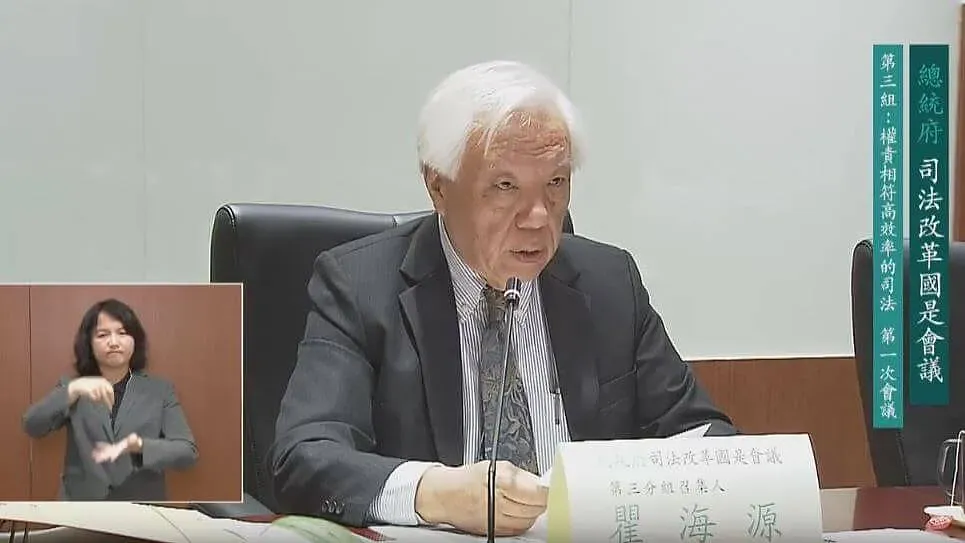
Brief Notes: First Meeting of the 3rd Working Group of the Presidential Office's National Judicial Reform Conference
Last edited: 2026-07-27
-
This meeting lasted over 4 hours, with almost all remarks made by legal professionals; the total speaking time for non-legal members was likely less than half an hour.
-
There was intense debate over whether to agree that the Ministry of Justice (MOJ) should take charge of and handle the two sub-issues: 'The Role and Positioning of Prosecutors' and 'Organizational Review of the Prosecutorial System':
-
The MOJ and some scholars insisted that the MOJ take charge, with reasons roughly as follows:
- The purpose of convening the National Judicial Reform Conference is to build consensus. However, regarding the organization and positioning of prosecutors, the legal community has argued for decades without reaching a definitive conclusion. If the MOJ does not first submit a report, the meeting will devolve into everyone speaking their own mind without connecting.
- Current laws already contain very clear provisions regarding the positioning of prosecutors under the Judges Act. Other committee members (the opposing side) argue that the positioning of prosecutors will affect oversight, which is actually an issue of functional law (the Code of Criminal Procedure).
- The conclusions of the National Judicial Reform Conference carry strong endorsement effects. If prosecutors are characterized as administrative officials, it may spawn serious problems of political interference in case handling.
-
Committee members on the opposing side argued roughly as follows:
- Organization and positioning will have a cascading effect on the scope of prosecutorial powers, and consequently on how oversight should be conducted. Therefore, it was also recommended that the issue of 'integration of investigation and prosecution' be discussed concurrently. (However, Minister Chiu Tai-san argued that the 'integration of investigation and prosecution' only involves the allocation of human resources and saw no need for simultaneous discussion.)
- Organizational positioning may drive institutional reforms, and it is inappropriate for an interested party like the MOJ to have the final say on its own.
-
Observations on the Reasons for Intense Debate:
On the eve of the working group meeting, the MOJ had already held a press conference and issued a press release proposing several institutional reform suggestions. Within the National Judicial Reform Conference, it evidently hoped to narrow the scope of discussion in the working groups, avoiding potential discussions beyond its preferences as much as possible—hence its forceful statements during the first meeting. The opposing side ultimately demanded that the MOJ submit a report as soon as possible to allow working group members to engage in substantive discussion.
-
-
The working group resolved to delete the issue of 'Single-Copy Indictment':
The initial voting result was 10:9. According to the procedural rules, a majority (11 votes) was required for passage. The convener voted in favor of deletion, casting the decisive vote.
-
Discussion on Item 3-4: Review of the Professional Division of Labor among Prosecutorial, Police, and Investigation Personnel
Working group members reached a consensus to discuss designing a mechanism with the authority to handle minor offenses (leaning toward adding a tier between police and prosecutors, similar to German district prosecutors) so that prosecutors can focus on investigating major cases.
-
Next Meeting Anticipated Discussions
-
Agenda Sequencing
- Priority 1: Investigation of environmental cases
- Priority 2: Diverse recruitment of judges and prosecutors, oversight, and a review of the functions of evaluation committees
-
Working group members suggested inviting civil society organizations long dedicated to environmental cases and evaluations to attend the meeting as observers and present reports
-
Issue List for the Third Working Group
| No. | Issue | Sub-issue | Meeting Conclusion |
| 3-1 | Enhancing the transparency and efficiency of the prosecutorial system |
|
|
| 3-2 | Reviewing the appointment, oversight, and retirement benefits of judges and prosecutors |
|
|
| 3-3 | Professionalism and professional ethics of attorneys |
|
|
| 3-4 | Reviewing the professional division of labor among prosecutorial, police, and investigative personnel |
|
|
Attachments
- Issues Regarding Reform Proposals and Implementation Schedules Formulated Separately by the Judicial Yuan and the MOJ (Document No.: 3-1-Disc.3)
- Written Opinion of Committee Member Yu Po-hsiang (Document No.: 3-1-Disc.3)
- Written Opinion 1 of Committee Member Lin Meng-huang (Document No.: 3-1-Disc.3)
- Written Opinion 2 of Committee Member Lin Meng-huang (Document No.: 3-1-Disc.3)
- Written Opinion of Committee Member Ch'en Jui-jen (Document No.: 3-1-Disc.3)
- Diverse Appointment and Oversight of Judges and Prosecutors (Opinions of the Judicial Yuan) (Document No.: 3-1-Disc.4, 5)
- Diverse Appointment of Judges and Prosecutors (Opinions of the MOJ Academy) (Document No.: 3-1-Disc.4)
- Oversight and Elimination of Prosecutors, and Review of the Functions of the Prosecutors Evaluation Committee (Opinions of the MOJ) (Document No.: 3-1-Disc.5)
This article is an AI-generated translation of the original Chinese text. In the event of any discrepancy, the Chinese version shall prevail.
