
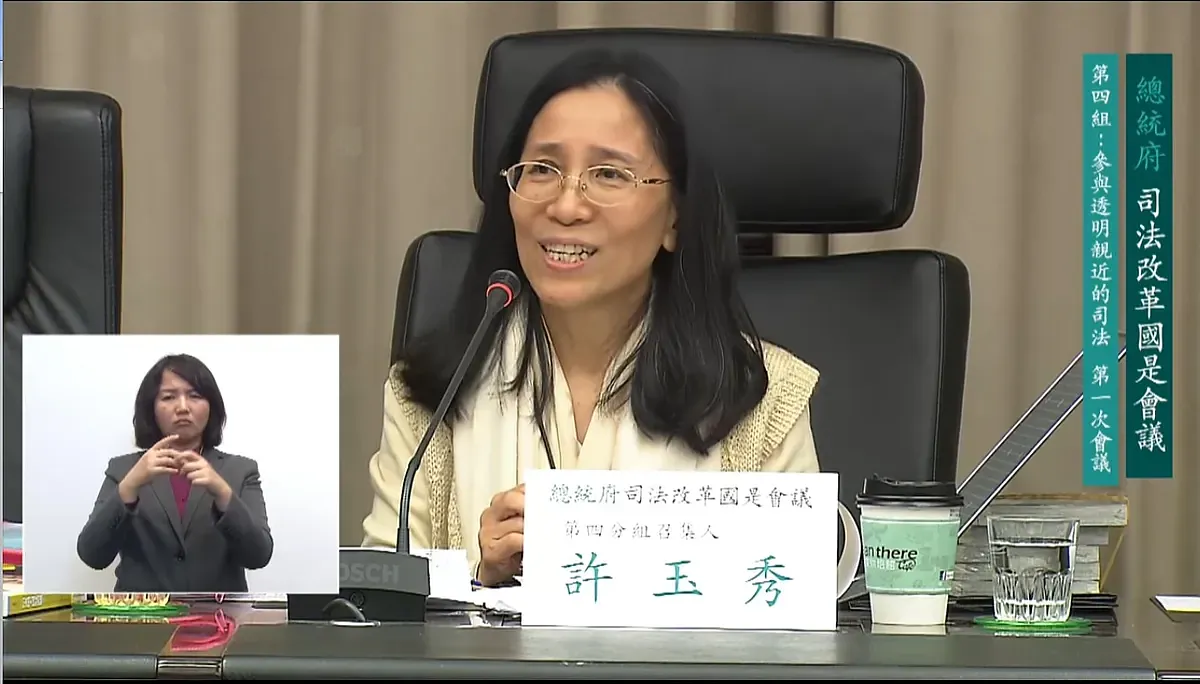
Brief Notes: First Meeting of the Fourth Working Group of the Presidential Office's National White Paper on Judicial Reform
Last edited: 2026-07-27
-
This meeting lasted for about 4 hours, with lawyers and non-lawyers speaking for roughly equal amounts of time. Chairperson Hsu Yü-hsiu actively integrated the agenda items. The meeting also released a significant amount of discussion materials in advance of the February 21 meeting, including preliminary discussions within this Working Group's LINE chat group[1].
-
Pre-meeting controversies:
-
Should we continue using the LINE group for preliminary discussions before meetings and publishing them online?
Regarding this issue, about four members raised objections at the scene. The main reason was that LINE discussions might prevent members busy with work from participating in a timely manner, potentially marginalizing the opinions of some members. However, these objections were not endorsed by the chairperson, who instead asked the objectors to propose a better communication tool[2]. As for how committee members would conduct preliminary research on respective sub-issues and invite relevant experts to report, a considerable degree of discussion had already taken place on LINE prior to this meeting.
-
Steering Committee Black Box[3]? All representatives recommended by the Taiwan Bar Association failed to be elected:
Member Wu Kuang-lu specifically mentioned that regarding lawyer representative seats, they were clearly inferior to judges in each working group, who had 2 seats recommended by the Judicial Yuan, and prosecutors, who also had 2 seats recommended by the Ministry of Justice. However, the 2 lawyer seats were not recommended by the Taiwan Bar Association (TBA), indicating that the National White Paper on Judicial Reform did not respect the TBA, even though only the TBA can represent lawyers nationwide.
The chairperson explained that this was a staff clerical error because the TBA is the unit responsible for electing lawyer representatives via ballot, not a recommending unit. However, the staff made a mistake and sent a notice asking the TBA to make recommendations, rendering those recommendation lists invalid rather than having recommendations ignored.
-
-
The system of public participation in trials will not be discussed in the first three meetings of this subcommittee:
This meeting substantively discussed the system of public participation in trials, with the Judicial Yuan and the Ministry of Justice each giving 5-minute reports, and Member Lin Chao-chün submitting a written opinion of about 5 pages. However, it was evident that the content of the reports from the Judicial Yuan and the Ministry of Justice could not provide effective assistance to the working group members.
Given the high controversy surrounding this issue, all members resolved to hold a public hearing on March 25 from 13:30 to 17:30. Members from all five groups will also be invited to attend, hear expert opinions, and hear reports from experts designated by the Judicial Yuan, the Ministry of Justice, and civil society organizations.
-
Working Group members to conduct preliminary research on various issues
-
Division of labor among Group 4 members:
- Yen Chueh-an: 4-1 Training, Examination, and Professional Training of Legal Professionals
- Lin Chao-chün: 4-2-1 Public Participation in the Judiciary
- Lee Nien-chu: 4-2-2 Alternative Dispute Resolution Mechanisms
- Chang Wei-chih: 4-3 An Open and Transparent Judiciary
- Kao Ju-ping: 4-4 A Judiciary Close to the People
-
Working group members will conduct preliminary research on each issue beforehand, and following expert briefings, Q&A sessions will be used to highlight key points for the group.
-
-
Expected agenda for the next meeting
-
The second meeting on 3/10 will discuss 4-3 "An Open and Transparent Judiciary" and 4-4 "A Judiciary Close to the People," especially "Reform of Judicial Documents and Judicial Language" and "Live-streaming of Court Trials."
-
The third meeting on March 24 will discuss alternative dispute resolution mechanisms under 4-2 "Public Participation in the Judiciary" and 4-1 "Training, Examination, and Professional Training of Legal Professionals."
-
Footnotes
[1] 2017/2/24 Meeting and Attachments: https://justice.president.gov.tw/newinfo/20
[2] Chairperson Hsu Yü-hsiu: "I am someone who spares no effort in pursuing fashion. If there is something newer that needs to be learned, I love it very much!".
[3] Response clarifying the black-box Steering Committee list in meeting attachment 3: https://drive.google.com/file/d/0B6TWrTRQWn8FU0JXWnBYOEw2QWM/view
Attachments
- Minutes of the Fourth Working Group Meeting on 2017.02.13
- [LINE] Chat Logs of the Fourth Working Group of the Judicial Reform National Conference
- Response regarding the Steering Committee Black Box (?)
- Issue Intent Drafting Q&A (Submitted by the Ministry of Justice) (Data No.-4-1-Disc-4)
- Issue Intent Drafting Q&A (Submitted by the Judicial Yuan) (Data No.-4-1-Disc-4)
- Issue Intent Drafting Q&A (Submitted by Assistant) (Data No.-4-1-Disc-4)
- Written Opinion of Member Kao Ju-ping (Data No.-4-1-Disc-4)
- Written Opinion of Member Yen Chueh-an (Data No.-4-1-Disc-4)
- Non-prosecution / Public Participation in Prosecutorial Power, Public Participation in Trials / Centered on State Financial Conditions and Human/Material Resource Burdens (Ministry of Justice Opinion) (Data No.-4-1-Disc-5)
- Public Participation in the Judiciary (Lay Participation and Jury Systems of Trial) (Judicial Yuan Opinion) (Data No.-4-1-Disc-5)
- An Essay on the Reclassification of Public Participation in Trials — Beyond Lay Participation and Jury Systems (Draft) (Written Opinion of Member Lin Chao-chün) (Data No.-4-1-Disc-5)
Issue List of the Fourth Working Group
| No. | Issue | Sub-issue | Meeting Conclusion |
| 4-1 | Training, Examination, and Professional Training of Legal Professionals |
|
|
| 4-2 | Public Participation in the Judiciary |
|
|
| 4-3 | An Open and Transparent Judiciary |
|
|
| 4-4 | A Judiciary Close to the People |
|
|
This article is an AI-generated translation of the original Chinese text. In the event of any discrepancy, the Chinese version shall prevail.
