
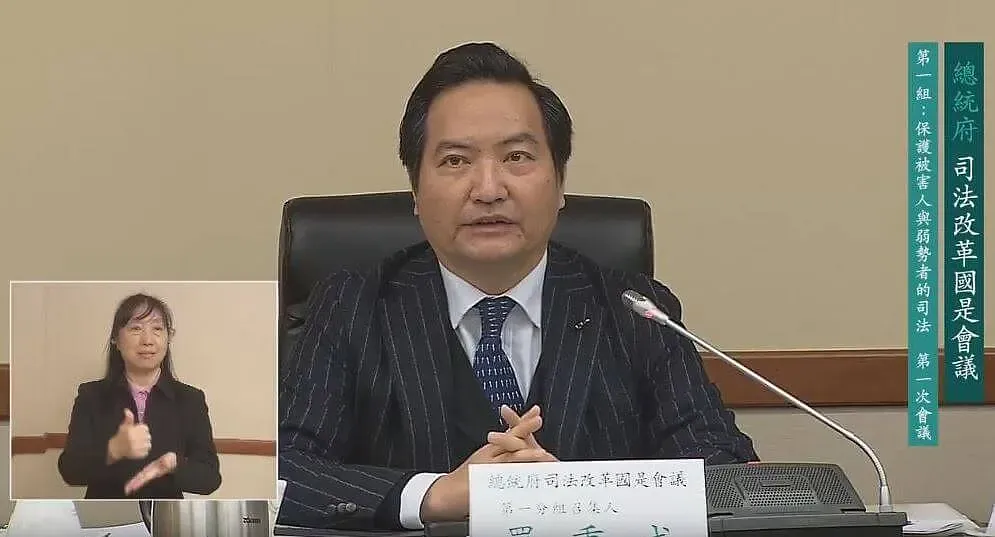
Brief Notes: The First Meeting of Division 1 of the Presidential Office's National Congress on Judicial Reform
Last edited: 2026-07-27
-
This meeting lasted for two and a half hours. Committee members began with self-introductions and wrote down their expectations for the National Congress on Judicial Reform.
- Li Chen-hui: Safeguarding the vulnerable and realizing equality
- Mao Sung-ting: Proper diagnosis is necessary before prescribing the correct remedy
- Juan Wen-hsiung: People-oriented
- Lin Yu-shun: Legal principles, reasoning, and human sentiments. Hopefully, laws are built upon reasonable and rational deliberation and stem from social customs and practices. Only legislate what is achievable, and do not make empty promises. Hopefully, laws uphold the dignity of the judiciary.
- Shih Ping-hui: Knowing full well it cannot be done, yet persisting anyway
- Chang Wen-chen: Judicial reform that expands public participation
- Ch'en Lung-ch'i: This is a judicial reform meeting that truly resonates with people.
- Huang Sung-li: Focus on key points, discuss thoroughly, make clear recommendations, and find the methodology for judicial reform
- Ts'ai Chiung-tun: Moving forward firmly until the day we finally reach our destination
- Hsieh Shih-min: Hopefully this is the last judicial reform meeting, allowing the judicial justice system to purify itself
- Chao I-shan: Fairness and justice
- Huang Chih-hao: Constructing an evidence- and science-based judicial reform
- Ch'en Min-yuan: Establishing a pluralistic legal system
- Yao Ch'ung-lüeh: Equipping prosecutors with sufficient resources to maximize their effectiveness
- Lin Chao-chen: Never forget our original intention
- Lin Chih-feng: Redress grievances and punish the wicked, help the weak and support the vulnerable
- Li Chun-i: People-oriented
- Wang Wei-chün: Proactive, single-window service, illuminating the long, dark nights of victims
- Wang Wan-yü: Respect and empathy
- Lo Ping-cheng: How to change the "shitty" destiny of the judiciary—let's pull together and make the life of the law shine brightly
-
Professor Lin Chao-chen of the Graduate Institute of Journalism at National Taiwan University served as the deputy convener of the division (with attorney Lo Ping-cheng serving as the convener).
-
The chairperson agreed that members may invite scholars and experts from civil society to attend and report, or members may serve as reporters themselves.
-
A chairperson's rule was added: when non-lawyers and lawyers raise their hands at the same time, non-lawyers shall be given priority to speak.
-
After a motion is voted on, opposing opinions may be presented at the press conference.
-
Before the meeting, the division surveyed members regarding their priorities for each topic. Following discussion in the meeting, the agenda was scheduled as follows:
- Tuesday, March 14: Scheduled discussion on 1-4, "Forensic Science, Appraisal Mechanisms, and Expert Witnesses"
- Tuesday, March 28: Scheduled discussion on 1-5, "Non-disclosure of Investigation, Media Influence on Trials, and Privacy Protection"
- Tuesday, April 18: Scheduled discussion on 1-3, "Protecting the Situation of Vulnerable Groups in the Judiciary"
- Tuesday, May 2: Scheduled discussion on 1-1, "Protecting Crime Victims"
- Tuesday, May 16: Scheduled discussion on 1-2, "Reducing Wrongful Convictions and Strengthening Relief Mechanisms"
-
Prior to the meeting, the division had divided labor regarding various topics. However, following meeting discussions, it was decided to adopt open groups where members can freely participate in discussion, and sub-issues will not be pre-filtered by groups.
-
Sub-issue 1-1-3, "Evaluating the Participation of Crime Victims in Criminal Procedure," and 1-1-4, "Evaluating the Participation of Crime Victims in Parole Procedure," are incorporated into 1-1-1, "Strengthening Systemic Safeguards for Crime Victims Before and After the Initiation of Criminal Proceedings," for joint discussion. Sub-issue 1-1-5, "Reviewing the Effectiveness of the Crime Victims Protection Association," was changed to "Reviewing Crime Victims Protection Mechanisms" to broaden the scope of discussion.
-
The division established a "Legal School" program, in which attorney Huang Chih-hao is responsible for explaining the legal issues within each topic and recording videos to be published online for members and the public to view.
-
The chairperson requested that discussions during the meeting be stated in plain language as much as possible, and during this meeting, took the lead in asking reporters from the Judicial Yuan and the Ministry of Justice to present their reports on sub-issue 1-1-3, "Evaluating the Participation of Crime Victims in Criminal Procedure," in plain language.
-
The division petitioned the Preparatory Committee to consider adding topics such as "Pluralistic Legal Systems," "Judicial Officers Overwork," and "Judicial Officers Accepting Bribes."
Topic Sequencing
| Meeting Time | Discussion Topic | Related Sub-issues (Ordered by priority; red indicates highest priority, gray indicates secondary priority) |
| Tue, Mar 14 | 1-4: Forensic Science, Appraisal Mechanisms, and Expert Witnesses | 4-1: Integrate scientific appraisal mechanisms such as forensic medicine, lie detection, and forensic science to enhance the technology and application of science in solving cases, and strengthen the judiciary's ability to discover the truth 4-2: Improve rules of evidence and evaluate the establishment of an expert witness system |
| Tue, Mar 28 | 1-5: Non-disclosure of Investigation, Media Influence on Trials, and Privacy Protection |
5-2: Review the balance between the non-disclosure of investigations and the accused's right to be informed of the investigation process 5-1: Prevent inappropriate media reporting or trial by public opinion (including the evaluation of the offense of obstructing judicial impartiality) 5-3: Judicial documents should consider enhancing the privacy of parties involved to prevent personal data leaks |
| Tue, Apr 18 | 1-3: Protecting the Situation of Vulnerable Groups in the Judiciary | 3-1: Construct a judicial system, services, and software/hardware environment that actively assists the vulnerable and is gender-friendly (e.g., strengthening interpretation resources) |
| Tue, May 2 | 1-1: Protecting Crime Victims |
1-1: Strengthen systemic safeguards for crime victims before and after the initiation of criminal proceedings (Scope encompasses 1-3: Evaluating the participation of crime victims in criminal procedure; 1-4: Evaluating the participation of crime victims in parole procedure) 1-2: Formulate standard operating procedures for informing, explaining, and referring relevant supportive resources to parties involved after an incident occurs 1-5: Review crime victims protection mechanisms 1-6: Review and strengthen restorative justice (e.g., evaluating the addition of restorative procedures as a condition for probation or suspension of prosecution) |
| Tue, May 16 | 1-2: Reducing Wrongful Convictions and Strengthening Relief Mechanisms |
2-1: Review retrial and extraordinary appeal systems 2-2: Review the review mechanism for final cases (e.g., review the implementation guidelines for the review of final judgment documents, evaluate compensation mechanisms for miscarriages of justice, and establish a transitional justice court, etc.) 2-3: Evaluate the establishment of an independent criminal review mechanism outside the judiciary |
Attachments
- Division 1 Issue Description (Summary Version) (Ministry of Justice) (Data Code-1-1-Disc4)
- Division 1 Issue Description (Summary Version) (Judicial Yuan) (Data Code-1-1-Disc4)
- Evaluating the Participation of Crime Victims in Criminal Procedure (Views of the Judicial Yuan) (Data Code-1-1-Disc4)
- Evaluating the Participation of Crime Victims in Criminal Procedure (Views of the Ministry of Justice) (Data Code-1-1-Disc4)
- Taipei Bar Association Proposal Materials_Public Hearing on the Crime Victim Litigation Participation System (Data Code-1-1-Disc4)
- Issue 1-1-3 Attachment 1: Notice of Litigation Rights for Crime Victims and Informants
- Issue 1-1-3 Attachment 2: Precautions for Testifying as a Witness in Criminal Cases
- Issue 1-1-3 Attachment 3: Important Matters for the Protection of Sexual Assault Crime Victims During Trial Proceedings
- Issue 1-1-3 Attachment 4: Summons Notice for Accompanying Persons in Sexual Assault Crimes
- Issue 1-1-3 Attachment 5: Supplementary Explanation on Summoning Sexual Assault Victims in the Capacity of Witnesses
This article is an AI-generated translation of the original Chinese text. In the event of any discrepancy, the Chinese version shall prevail.
