
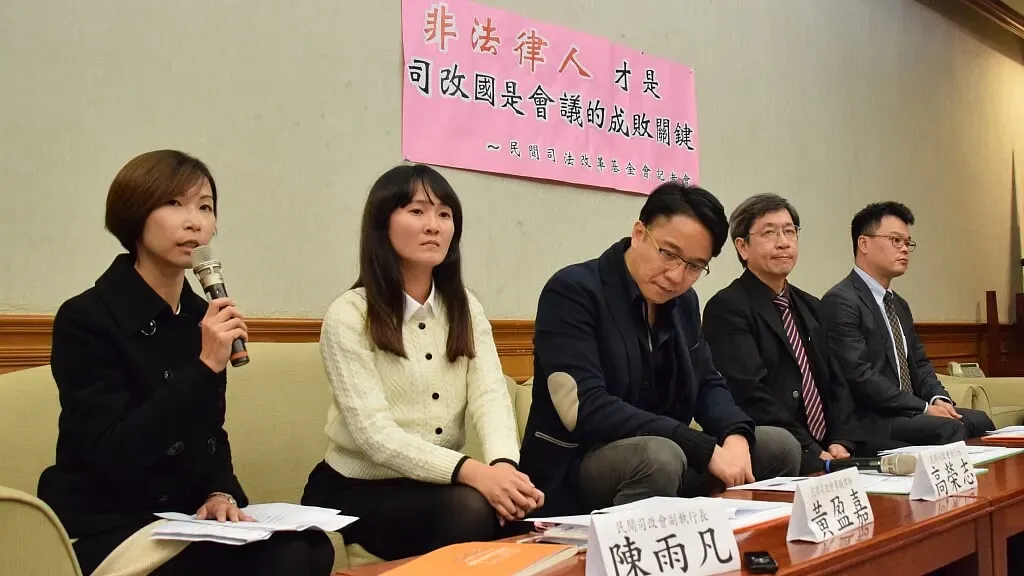
"Non-lawyers" are the key to the success or failure of the National Congress on Judicial Reform
Last edited: 2026-07-27
As the working group meetings of the National Congress on Judicial Reform are in full swing, related judicial reform issues are increasingly attracting public attention. The most prominent feature of this judicial reform congress is the introduction of a majority of non-lawyer members to participate. Non-lawyer members possess rich knowledge and experience in their respective professional fields. If non-lawyer members are to contribute their expertise in the meetings, the prerequisite is to enable non-lawyer members to clearly understand the issues and controversies, and to foster a meeting procedure suitable for discussion.
The Judicial Reform Foundation has closely observed the proceedings of each working group meeting, recorded the discussion process of each issue, as well as the participation status of non-lawyer members, and produced statistical charts on the speaking proportion of non-lawyer members. We propose the following four recommendations on how to make the meetings more successful and further facilitate non-lawyer members in contributing their expertise:
-
Enable Substantive Participation by Non-Lawyers
-
"Problem → Cause → Improvement Method": Establish "Mini-Classrooms" in Each Working Group
The first working group of the group meetings resolved to establish a "Mini-Classroom". When an issue involves legal terminology, members act as explainers to produce plain-language understandable YouTube videos and disseminate them externally, enabling the public to understand what the issue is about.
We suggest that the organizing committee pass a resolution for all groups to follow this model in establishing "Mini-Classrooms". A mini-classroom should first explain that the issue being discussed in the meeting stems precisely from what "problem" might exist in the judiciary, what the "cause" of this problem is, and present the different "solutions" proposed by various parties to address the cause of the problem, along with the pros and cons of each solution and corresponding supporting measures, while providing academic papers and other materials or research for reference.
For example: Regarding the issue of "whether to adopt the single-indictment-pleading principle" (起訴狀一本主義), it must first be made clear to non-lawyers that the judicial "problem" this issue aims to solve is that judges in criminal justice often give a biased impression right at the start of a trial; and one of the "causes" of the problem may be that, at the very beginning of the trial, the judge first accesses the complete case file and evidence provided by the prosecutor that is unfavorable to the defendant, thereby unconsciously generating prejudice against the defendant. Next, addressing the cause of the problem, possible "improvement methods" are proposed. The practice under the single-indictment-pleading principle is: after the prosecutor indicts the defendant, the case files and evidence serving as the prosecution's proof are not initially transferred to the court; instead, only a single, thin indictment is handed over to the court (the Japanese term "ippon" means a single piece of paper), merely informing the court of the most basic criminal facts. Evidence and information are gradually presented to the judge one by one during the trial process as the prosecution and defense engage in debate. In addition to the single-indictment-pleading principle, what other possible alternative improvement solutions exist, as well as the supporting measures for each solution and what "side effects" they might entail, must also be explained.
-
Maintain a Balance in Speaking Proportions Between Non-Lawyers and Lawyers as Much as Possible
Based on the verbatim transcripts of the group meetings released by officials, we calculated the word count of each member's statements, first deducting the word counts of the chairperson, institutional staff, and unidentified speakers in the transcripts. We then categorized members into two groups: those acting in the capacity of lawyers (including judges, prosecutors, defense attorneys, and legal scholars) and those acting in the capacity of non-lawyers (including non-legal professional scholars, civil society organization personnel, and active proponents), and plotted pie charts accordingly.
Speaking Proportion of Working Group 1
Speaking Proportion of Working Group 2
Speaking Proportion of Working Group 3
Speaking Proportion of Working Group 4
(This chart tallies the word count of statements made by working group members and organizing committee members. Lawyers include judges, prosecutors, defense attorneys, and legal scholar members; non-lawyers include non-legal professional scholars, civil society organization personnel, and active proponents, excluding the chairperson, institutional staff, and unidentified speakers in the verbatim transcripts.)
According to the charts, the proportions of non-lawyer speaking time are: Group 1: 38%, Group 2: 44%, Group 3: 12%, Group 4: 28% (transcripts for Group 5 have not yet been published and are temporarily omitted). It is clearly observable that in certain groups, the speaking and participation status of non-lawyer members is relatively low. Although non-lawyer members account for a majority of the meeting attendees, this has not translated into a corresponding speaking status in the meetings. Since this congress has introduced non-lawyer participation, how to maintain a balanced speaking proportion between non-lawyers and lawyers and enable non-lawyer members to contribute their strengths in the meetings will become the critical factor in determining the success of the National Congress on Judicial Reform.
-
Establish a Communication Platform to Help Non-Lawyer Members Understand Issues
We suggest that each working group establish a "communication platform" to assist non-lawyer members in raising questions and receiving answers through the platform, enabling non-lawyers to clearly understand various issues via the platform before the meetings begin. Only when non-lawyer members clearly understand the issues and controversies can they engage in substantive discussion during the meetings and fulfill the value of inviting non-lawyers to participate.
-
Make Issue Materials Accessible and User-Friendly
How to make the judiciary approachable to the people is also a key issue discussed in the national congress. We believe that making the judiciary approachable should start right from the national congress. All materials presented in the meetings should be drafted in plain and easily understandable language, avoiding unnecessary professional terminology or esoteric wording as much as possible, thereby fulfilling the objectives of promoting participation and achieving civic legal education.
-
-
Meetings Must Showcase Diverse Perspectives
Regarding issues authorized by the working group meetings to be researched by the Judicial Yuan and the Ministry of Justice, if these issues involve stakeholders or civil society organizations that have long monitored these issues, they should be invited to attend the meetings, or at least invited to submit written reports, so that the meetings can introduce diverse perspectives and achieve the objectives of broadening participation and broadly gathering opinions from all sides.
-
All Issues Should Be Discussed
The issues listed in the national congress issue agenda are all judicial problems raised by the public or various institutional organizations during the first stage, and they should not be arbitrarily shelved. Therefore, if an issue is resolved to be deleted in a working group meeting or fails to be discussed in time, subsequent solutions must be prepared. For example, transferring them to other groups for discussion, scheduling additional meetings, or at the very latest, discussing mechanisms for how to handle them subsequently during the concluding plenary meeting, so that the issues can continue to be addressed.
-
Any Meetings Involving Resolutions Should Be Open and Transparent
We have found that in addition to formal working group meetings, some groups have actively held additional "pre-meetings" or "sub-group mini-meetings". While we affirm the efforts and contributions of the members, we also suggest that any meetings that may involve making resolutions should follow the open and transparent requirements of formal working group meetings. In addition to releasing video records, the materials provided to members during the meetings should also be made publicly available online for external supervision and review.
Attending Representatives
Lin Yung-sung (Attorneys at Law) / Chairperson, Judicial Reform Foundation
Lin Chun-hong (Attorneys at Law) / Standing Executive Commissioner, Judicial Reform Foundation
Chen Yu-fan (Attorneys at Law) / Deputy Executive Officer, Judicial Reform Foundation
Huang Ying-chia (Attorneys at Law) / Full-time Attorney, Judicial Reform Foundation
Kao Jung-chih (Attorneys at Law) / Executive Officer, Judicial Reform Foundation
Press Contact
Judicial Reform Foundation Executive Officer Kao Jung-chih (02)2523-1178
This article is an AI-generated translation of the original Chinese text. In the event of any discrepancy, the Chinese version shall prevail.