
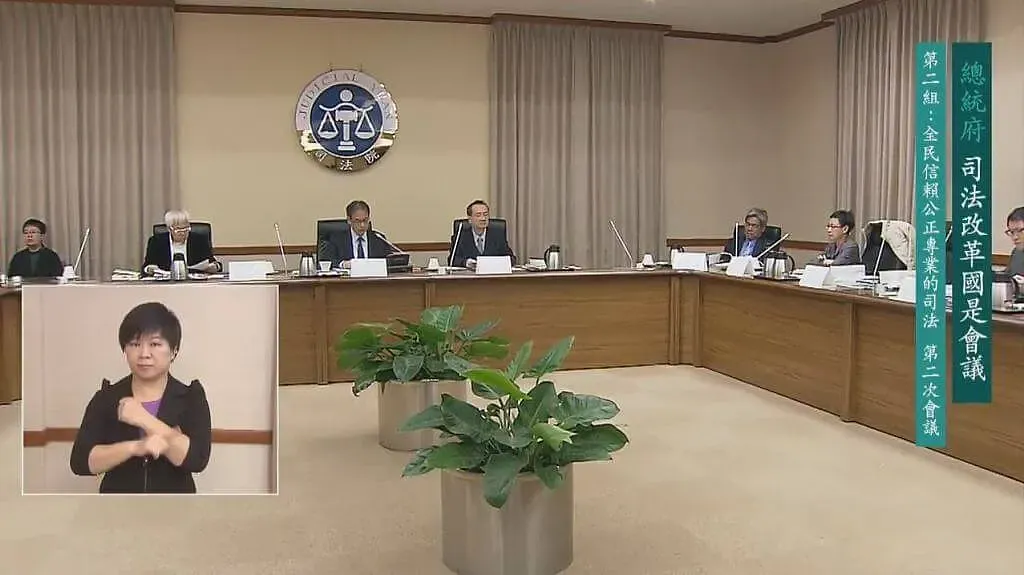
Brief Notes: Second Meeting of the Second Division of the Presidential Office's National Judicial Reform Conference
Last edited: 2026-11-03
Resolutions of this Meeting
-
Added the topics of "Reviewing the Relationship Between Politics and the Judiciary" and "Establishing a Judicial Policy Research Institution."
- The panel unanimously resolved to adopt the establishment of a constitutional review system for judicial judgments, subject to complementary measures. The Judicial Yuan is tasked with drafting these measures—such as case-selection methods, decision-making procedures, whether to render judgments directly, and standing to file petitions—to be presented and finalized at the next meeting.
-
The panel resolved that regarding the attribution of judicial policy-making power and the dual judicial policy system (including transforming the Judicial Yuan into a judicial adjudication organ and centralizing judicial administration), the Judicial Yuan shall submit a report five days prior to the fourth division meeting for the reference of division members.
-
Chairperson Lin Tzu-yi served as the spokesperson to publicly announce the conclusions of the panel meeting upon its conclusion.
-
The upcoming meeting will discuss "transparency and efficacy enhancement of the Grand Justices' interpretation system," "normalization of oral arguments," "composition, headcount, and selection procedures of the court of last resort," and "reform of civil and criminal appeal procedures."
-
Relevant experts may be invited to attend and report on topic discussions, subject to the prior consent of more than half of the members. To save time, potential candidates may be discussed within the email group.
-
The ordering of topic discussions shall be proposed by individual members prior to the next meeting, compiled by the staff, and reported at the next meeting.
Summary of Discussion Process
-
Member Hsü宗力 (Hsu Tsung-li) spoke, noting that whether to allow the Constitutional Court to review the constitutionality of judgments rendered by courts of last resort is purely a policy consideration. Although the Act Adjudicating Cases by the Grand Justices does not currently permit this, Interpretation No. 242 was issued in the past, declaring a Supreme Court judgment unconstitutional. This opened a door previously unopened by law, though the door was subsequently shut. Whether the constitutional consciousness of courts of last resort is sufficiently high to provide people with adequate constitutional protection is the key factor in determining whether this system is needed.
-
Member Lin Chih-chung stated that, based on his litigation practice experience, discussing the Constitution with ordinary court judges still feels very distant. Following the passage of the Enforcement Act of the Two Covenants, lawyers frequently cite matters concerning the protection of rights, but ordinary courts maintain a distant relationship with the Constitution and still lack legal discourse on it in their judgments. If a constitutional review system for judgments is established, ordinary courts will begin to contemplate the Constitution; otherwise, they risk being challenged in the future. This can effectively strengthen judges' constitutional consciousness. The U.S. Supreme Court is vested with the discretionary power to select cases, and our country should likewise adopt this complementary measure, allowing the Grand Justices to select cases of significant constitutional import for adjudication, thereby preventing a heavy caseload from paralyzing the Grand Justices.
-
Member Cheng Yü-shan stated that, based on the protection of people's rights, he supports this system, but care must be taken to ensure the system complies with the Constitution (Article 5 of the Additional Articles of the Constitution). In response, Member Hsü Tsung-li replied that the power to interpret the Constitution under Article 78 of the Constitution naturally includes the power to interpret whether a judicial judgment violates the Constitution. Whether to adopt a constitutional judgment system is purely a policy consideration; introducing it requires only a statutory amendment, not a constitutional amendment.
-
Member Huang I-pi inquired whether the reasons for opposition previously cited in a 2015 press release issued by the Judicial Yuan in response to the demands of civil society groups still exist, and requested the President to provide a detailed explanation.
-
Member Hsü Tsung-li responded that an insufficient number of legal assistants (currently only one assistant per Grand Justice) requires statutory amendments to increase staff (the Judicial Yuan Organization Act explicitly stipulates one assistant). Furthermore, the current two-thirds threshold for Grand Justices' resolutions is too high, both of which have hindered the issuance of past interpretations. The threshold should be lowered to one-half, mirroring other nations, to increase the number of resolutions or interpretations produced. Additionally, to prevent this system from becoming a fourth instance, screening standards must be established by emulating other nations: the Grand Justices may only review cases where the court of origin failed to recognize the fundamental rights conflict within the case, or where the Supreme Court recognized it but committed a gross error in balancing principles. Accepted cases in Germany account for only 1–2% of petitions. Although discussions exist in Germany regarding the necessity of this system, the member emphasized that prevailing academic opinion in Germany still holds that the system possesses value and necessity.
-
Member Fan Li-ta inquired that since Supreme Court judgments may carry suspected unconstitutionality, making it necessary to review their judgments, how would the constitutional review system for judgments operate if the judicial system transitions in the future to a pyramidal adjudication system where the Judicial Yuan is transformed into the Supreme Court and the Grand Justices' Council ceases to exist?
-
Member Hsü Tsung-li replied that if the Judicial Yuan becomes a trial organ in the future, the constitutional judgment system will no longer exist. This system is needed precisely because of the coexistence of multiple adjudication systems under the current framework. The system can be implemented on a trial basis first, followed by further evaluation to determine whether its goals and cost-effectiveness have been achieved.
-
Member Wu Ch'ung-li expressed concern that accepting only 1–2% of cases might lead to poor public reception and could create a new litigation class where only the influential or wealthy have the means to pass the Grand Justices' case selection, worrying that those with resources are more likely to utilize this system. Members Lin Chih-chung and Huang I-pi responded that once this system is established, numerous public interest organizations will assist disadvantaged individuals in accessing this resource.
-
Member Ho Fei-peng opined that judges are trapped within legal technicalities, remaining too distant from the Constitution when adjudicating cases and rarely contemplating human nature and basic social common sense. If all three tiers of adjudication are trapped in this technicality, an extra-systemic constitutional judgment review system is needed to provide relief.
-
Member Chang Chü-fang stated that cultivating judges' constitutional consciousness is also a key priority.
-
Member Wu Hsün-lung stated that the Supreme Court's self-correction efficacy is poor, and therefore supports establishing a constitutional judgment system.
-
Member Chang Sheng-hsing opined that this system does not fully enhance the protection of people's rights; rather, it increases the burden of litigation on the public. Litigation involves two opposing parties; when one party wins, it means the other party loses. The party that loses because of this system will inevitably distrust the system. He hoped people would not paint this system in overly rosy terms, and that when introducing it, its pros and cons should be clearly explained to society.
-
Member Sun Yu-lien supports the system, but noted that how cases are accepted and reviewed, and how to prevent people from using it as a tool to overturn judgments, are technical problems that must be resolved.
-
Member Tsai Pi-yü supports the system, but noted that the Judicial Yuan previously issued a press release expressing opposition, citing Interpretation No. 553 to state that constitutional review of judgments falls outside the scope permitted by that interpretation, and asked for clarification. The member suggested that within less than two years, the Judicial Yuan has shifted its major policies, and should issue an official public statement so the public can understand. Grand Justices are political appointees; after this system passes and the voting threshold is lowered, attention must be paid to criticisms regarding selective case handling, and the issue of political intervention must be squarely addressed. Member Lin Ming-hsin responded that Interpretation No. 553 has its own context, as it reviewed whether a borough warden's term-extension administrative disposition was unconstitutional—the Grand Justices' review should not extend to whether specific administrative dispositions are unconstitutional, which differs from the issue currently discussed. The Judicial Yuan's view at the time was problematic, conflating the two matters. Member Hsü Tsung-li expressed agreement with this view.
-
Member Li Nien-tsu expressed that this system does not add a fourth instance, but rather reduces a fifth instance, allowing citizens to be adjudicated directly by the Grand Justices and saving them from going through the courts an extra time. He also believes it cannot be deduced from the Constitution that the Grand Justices are barred from reviewing individual cases, and constitutional interpretation inherently carries political risks; the Grand Justices can also decline to hear political questions, so there is no need to worry on behalf of the Grand Justices.
-
Member Hsü Yü-hsiu expressed that if a constitutional review system for judgments exists, the extraordinary appeal system can be abolished.
-
Member Hsü Tsung-li stated that in Germany, original judgments are rescinded and remanded for retrial rather than having the court render judgments directly.
-
Member Lin Ming-hsin opined that this system can indeed reduce litigation costs and burdens for the public because under the current constitutional interpretation system, the Supreme Court does not necessarily have to rescind the original judgment; whereas under the constitutional review system for judgments, the original judgment would be annulled by the Grand Justices. However, he expressed reservations regarding whether the Grand Justices should render judgments directly. Member Chang Sheng-hsing stated that if judgments cannot be rendered directly, individual cases still cannot obtain relief. Member Li Nien-tsu stated that under the U.S. Supreme Court system, the Grand Justices may decide whether to render judgments directly or remand the case for a retrial, both of which can reduce the tiers of adjudication.
-
Member Chang Sheng-hsing stated that in Germany, after Supreme Court judgments were annulled, Supreme Court judges publicly opposed the system, which instead undermined public trust in judicial credibility. He agreed that the system can increase judges' constitutional consciousness, but its pros and cons should be clearly explained when introducing it, without giving the public false imaginations.
-
Member Li Chien-liang explained that constitutional complaints in Germany were first established by statutory provisions before being written into the Constitution, thus avoiding any unconstitutionality issues. Member Lin Ming-hsin also agreed with this view, suggesting that incorporating constitutional complaints into the German Constitution served a declarative function.
-
Member Fan Li-ta stated that if this system is approved, he hopes the Grand Justices are vested with the power to render judgments directly; otherwise, it merely increases the litigation torment for the public.
-
Member Hsü Tsung-li stated that once passed, this system will be implemented on a trial basis for four to five years, and its efficacy will be studied after operating for a period.
-
Member Huang I-pi stated that if case-selection criteria are verifiable, accepting even 1–2% of cases remains acceptable to the public. Member Wang Wen-ling stated that to prevent political intervention, comprehensive complementary measures can also be designed, such as requiring Grand Justices to remain neutral when adjudicating cases. Member Wang Chin-shou stated that opportunities should be given to disadvantaged groups rather than using this as a reason to oppose the constitutional complaint system from the outset; instead, complementary measures for litigation assistance must be established.
-
Member Hsü Yü-hsiu stated that even under a constitutional review system for judgments, a public interest litigation system should be established. She further noted that a constitutional complaint system could also discipline ordinary court judges to embrace the Constitution through constitutional annulment.
-
Member Ho Fei-peng inquired whether the constitutional complaint system will ultimately be able to render judgments directly. Member Lin Ming-hsin stated that rendering judgments directly must be approached with great caution; otherwise, all judgments might as well be handled by the Grand Justices. From the perspective of the separation of powers, how to maintain a balance between ordinary courts, the Grand Justices, the legislative power, and the executive power must be considered. It is inappropriate to rashly adopt direct adjudication across the board; distinctions should be made according to the types of litigation.
-
Member Tsai Pi-yü proposed complementary recommendations: First, dispatch candidate judges to serve as Grand Justices' assistants. Newly appointed judges are often criticized as young and inexperienced, or grassroots judges are criticized for lacking constitutional consciousness; serving as Grand Justices' assistants would resolve these problems and subsequently instill constitutional consciousness into first-instance court judgments so they are not annulled in the future, creating a virtuous cycle. Second, to prevent abusive petitions, mandatory legal representation should be required, and attorneys must also possess specific qualifications.
Meeting Attachments
- Establishing a Constitutional Review System for Judgments: Topic Description (Document ID: 2-2-Tao-2)
- Introduction to Oral Arguments in the U.S. Supreme Court (Member Wu Hsün-lung) (Document ID: 2-2-Tao-2)
- Embracing the Constitution, the People Need the "Constitutional Review of Judgments" System! (Member Lin Chih-chung) (Document ID: 2-2-Tao-2)
- Opinions on Establishing a Constitutional Review System for Judgments (Member Cheng Yü-shan) (Document ID: 2-2-Tao-2)
- Establishing a Constitutional Review System for Judgments (Opinions of the Judicial Yuan) (Document ID: 2-2-Tao-2)
- Establishing a Constitutional Review System for Judgments: Supplementary Explanations on Matters Inquired by Members (Judicial Yuan) (Document ID: 2-2-Tao-2)
- Establishing a Constitutional Review System for Judgments: Appendix to Supplementary Explanations on Matters Inquired by Members (Judicial Yuan) (Document ID: 2-2-Tao-2)
Supplementary Materials
- The Biggest Constitutional Beef: "Constitutional Complaint" ~ Press Conference on the Public's Demand for a "Constitutional Complaint" System (JRF Press Conference)
- Judicial Yuan's Press Release in Response to the JRF's June 17 Press Conference on "The Public Demands a 'Constitutional Complaint' System" (Judicial Yuan)
- Grand Justices' Interpretation No. 242
This article is an AI-generated translation of the original Chinese text. In the event of any discrepancy, the Chinese version shall prevail.
