
Review: The First Meeting of the Fifth Division of the Presidential Office's National_-_Judicial Reform Conference
Last edited: 2026-07-27
Meeting Summary
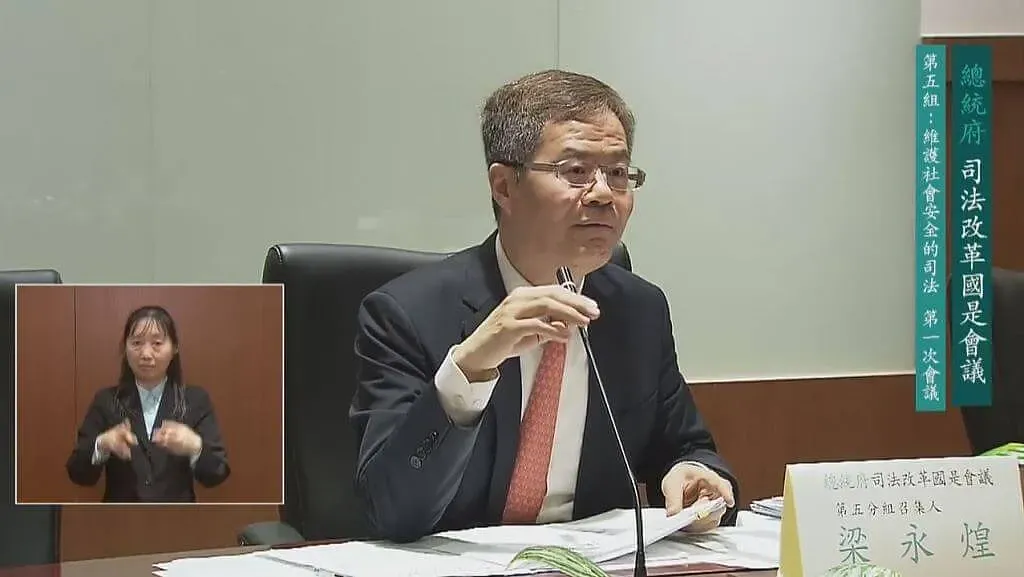
The first meeting of the 5th Subgroup of the Presidential Office's National Judicial Reform Conference, "Judiciary for Maintaining Social Safety," focused on agenda planning and design, and the working methods of each subgroup, in addition to electing the deputy convener (Hsu Shih-feng / Judge of the High Court) and announcing procedural rules.
The second meeting is scheduled for March 16 to discuss Agenda 5-1, Prison Administration Reform, and will invite the Agency of Corrections under the Ministry of Justice and the Ministry of Health and Welfare to attend and express their views. The remaining meeting dates are March 30, April 20, May 4, and May 18, and additional meetings may be called.
Agenda 5-2, "Review of Drug Policies," was changed to "Review of Policies on Drug, Substance Abuse, and Mental Illness Crimes." Agenda 5-3 now focuses on or includes "Private Sector Anti-Corruption," "Establishment of Sentencing Guidelines," "Corporate Crime," and "Investigation Management," and Agenda 5-5, "Review of the Judicial System Friendly to Children, Youths, and Gender," has been added.
Agenda 5-1 on prison administration reform is overseen by the first working group, with Committee Member Lu Ying-chieh serving as convener. The second working group is responsible for Agenda 5-2 on drug policies, with Committee Members Ch'en Hung-ta and Chou Su-hsien serving as conveners. The third working group is responsible for discussing Agenda 5-3 on combating crime, with Committee Member Lin Chih-chieh serving as convener. The fourth working group is responsible for Agenda 5-4 on crime prevention and management, with Committee Member Chang Kuang-ming serving as convener. The fifth working group is responsible for Agenda 5-5, with Committee Member Lai Fang-yu serving as convener.
The sub-issues under the five major agendas of this subgroup are currently listed as follows:
| Number | Agenda | Sub-issues |
| 5-1 | Prison System Reform |
|
| 5-2 | Review of Criminal Policies on Drugs, Substance Abuse, and Mental Illness Crimes |
|
| 5-3 | Effective Crime Fighting |
|
| 5-4 | Crime Prevention and Management |
|
| 5-5 | Review of Judicial Systems Friendly to Children, Youths, and Gender |
|
Comments
Strictly speaking, this meeting did not enter into substantive discussions on the various issues, but there are several topics worthy of our continued attention and reflection:
-
Based on the data available so far, it is not yet possible to precisely grasp the historical context of how the subgroups and issues of the National Judicial Reform Conference were formed. Given limited time, issues may need to be prioritized to avoid simplifying discussions on certain topics. For instance, the sub-issue under Agenda 5-3, "Review of the Penal System," after discussion in this meeting, may focus on the formulation of sentencing guidelines. While discussing sentencing guidelines is indeed crucial, the original discussion of the penal system might encompass more than just sentencing guidelines, including other penal systems such as fines or community service. If the focus narrows down to sentencing guidelines, will it fail to review other penal systems?
-
The discussion of the agenda at this meeting shows that "social safety" is not a concept that can be defined very precisely, or rather, different people have different imaginations or concerns regarding the concept of "social safety." This makes the issues to be handled by this subgroup increasingly complex. Judging from the given agenda, this discussion on social safety focuses on topics such as "crime prevention," "combating crime," "treatment of offenders," and "treatment of victims," and the 5th Subgroup also hopes to strengthen the dimensions of gender friendliness and victim subjectivity. However, social safety is not only related to criminal policy but also closely tied to social policy, especially given that many inmates in prisons come from socioeconomically disadvantaged environments. Although criminal causes stem partly from individual free will, the influence of social structures and conditions on an individual's choice to turn to crime cannot be ignored. Therefore, how to connect criminal policy with social policy will be an issue worthy of close attention, and we look forward to more sparks in subsequent discussions on more concrete topics.
-
This article agrees with several committee members who mentioned that this subgroup meeting should review heavy-penalization policies. As some members pointed out, even after imposing harsher punishments for drunk driving, the effect remains minimal while exacerbating prison overcrowding. New countermeasures are indeed needed in this regard. This article believes that futile heavy-penalization policies merely cause prison overcrowding, not only failing to achieve their objectives and depriving custodial sentences of their effectiveness, but also overwhelming prison management personnel. The current agenda includes discussions on heavy-penalization policies for drugs; if these heavy-penalization policies can be reviewed and improved all at once, thereby alleviating prison overcrowding, it is believed that correctional facilities will have more space to implement prison administration improvements.
-
In addition, while striving to combat crime effectively, ineffective crime-fighting measures should also be reviewed concurrently. Ineffective crime-fighting measures not only risk interfering with people's freedoms, but also needlessly increase the grueling burden and costs on police and related law enforcement personnel, ultimately preventing resources from being effectively invested where they are actually needed.
-
Reform must be grounded in a clear grasp of factual contexts and current conditions before proposing relevant problem-solving guidelines. Therefore, the disclosure of all relevant facts and data is extremely important. As Committee Member Lin Wen-wei stated, everything discussed in this group is closely related to "people," especially the actual conditions of individuals under institutional treatment, which should be truly and realistically seen. Consequently, he advised that the 5th Subgroup should visit correctional institutions directly to understand the on-site situation. Indeed, through actual observation, one can better experience the three-dimensional reality and operational status of correctional facilities on the ground. Other committee members also hope that relevant competent authorities will provide relevant data and invite relevant experts to attend, hoping to clarify the actual operational status of correctional institutions such as prisons. It is also hoped here that even after the National Judicial Reform Conference concludes, the competent authorities will continue to make relevant data public so that citizens can continuously review and supervise the actual operation of the judiciary.
Finally, after the National Judicial Reform Conference maps out a new blueprint, the likelihood of relevant competent authorities implementing the conference resolutions is well worth ongoing supervision by the citizens of our country. For example, regarding prison health and medical services, the concluding observations of the international human rights experts on the Covenants in 2013 suggested that these services should be overseen by the Ministry of Health and Welfare. Civil society organizations have also continuously and earnestly hoped and called upon the Ministry of Health and Welfare to shoulder this responsibility over the past few years. However, after several years, the Ministry of Health and Welfare—expected to shoulder this heavy burden—still lacks strong shoulders to take on this responsibility. It is quite obvious that the issues handled by this subgroup involve not only the Ministry of Justice, but also the Ministry of Health and Welfare, the Ministry of Education, and others. For various social safety issues that urgently require enhanced communication among competent authorities, how to break down institutional silos and truly engage in horizontal communication and cooperation to implement reform countermeasures is something we will continue to watch.
This article is an AI-generated translation of the original Chinese text. In the event of any discrepancy, the Chinese version shall prevail.
