
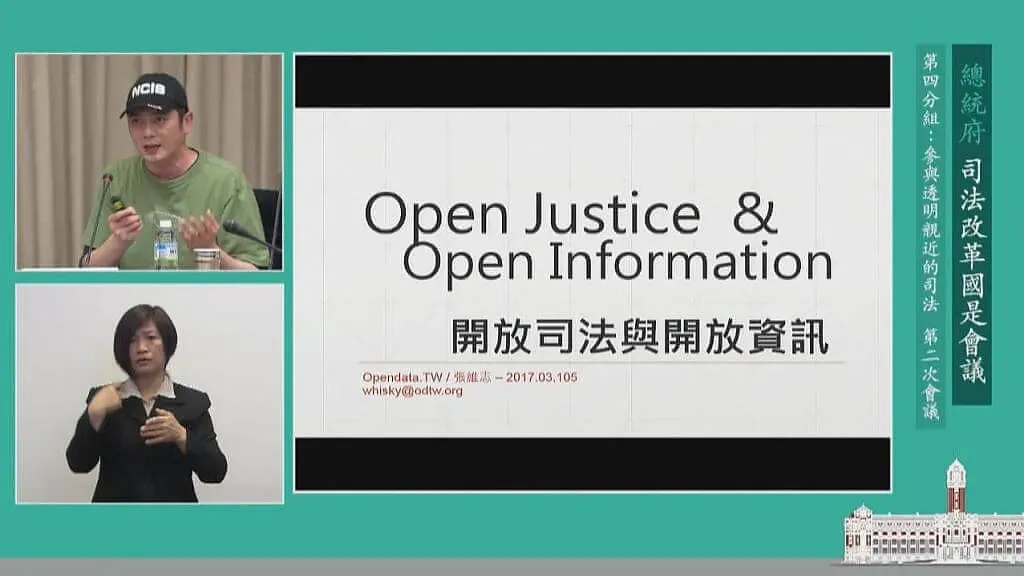
Brief Notes: Second Meeting of the 4th Working Group of the Presidential Office's National Szu-Fa-Kai-Ge Conference
Last edited: 2026-11-03
Resolutions of This Meeting
-
Approved court broadcasting for oral arguments in the Constitutional Court of the Grand Justices, the Supreme Court, and the Supreme Administrative Court. (Passed with 18 votes)
-
Approved court broadcasting for fact-finding trials under specific circumstances. It is recommended that the Judicial Yuan study the scope and conditions for court broadcasting, such as considering the following types of cases: first- and second-instance cases of district courts, high courts, high administrative courts, and the Intellectual Property Court concerning: (1) civil and criminal election cases, (2) criminal corruption cases, (3) cases harming the public interest (such as major economic cases), (4) litigation and class actions involving vulnerable groups and marginalized cultures, (5) cases of high constitutional controversy and major political attention, and (6) all cases from high administrative courts, especially food safety, environmental protection, and tax law cases, and to submit a report to the 4th Working Group by the 5th meeting (April 28, 2017). (Passed with 11 votes, including 1 vote from the chairperson)
-
Approved that regarding the issue of the public accessing lawyer market information, the Ministry of Justice shall draft concrete and clear policy directions and regulatory recommendations, to be submitted for discussion at the 5th meeting on April 28. (Passed with 13 votes)
Summary of Discussions on Various Issues
-
4-3-2 Research and Adoption of Judicial Sunshine and Transparency
Regarding this issue, Committee Member Chang Wei-chih was responsible for reporting and assisting the chairperson in presiding over the meeting. This issue was discussed for about 70 minutes, with legal professionals being the primary speakers. This was likely because information retrieval systems, especially the Judicial Yuan's judgment information retrieval system, are mainly used by legal professionals, who are more aware of the shortcomings of existing judgment information retrieval systems.
Committee Member Chang Wei-chih stated: Both the Ministry of Justice and the Judicial Yuan almost entirely lack the concepts of open government and information management. He also mentioned that the information traffic of the information retrieval systems of the Judicial Yuan and the Ministry of Justice linked to social networking sites is extremely low, indicating that legal information retrieval systems are not user-friendly, and very few netizens pay attention to them. Committee Member Chang emphasized that the Ministry of Justice and the Judicial Yuan should be able to define which information cannot be disclosed pursuant to the Personal Data Protection Act and which information can be disclosed, and should be able to establish a user-friendly information management system so that netizens can quickly and correctly find answers to any legal questions through the information management system.
Committee Member Ch'en Hsien-yu clarified: He mentioned that judges have an internal version of the legal information retrieval system, while the general public can only use the external version. The internal version can consolidate judgments of all instances together and does not conceal personal data. Since the current external version only uses keywords to mask personal data, there are indeed some misuses where non-personal data is masked, which is an area that can be improved in the future.
Committee Member Li Nien-tsu: Regarding whether there are judgment summaries when the public searches for judgments, is it the policy of the Judicial Yuan to be information-friendly? Is the policy of the Judicial Yuan to facilitate searches by ordinary people? Which judgment information should be concealed? Committee Member Li feels that the Judicial Yuan should answer these questions.
Committee Member Ch'en Shu-lan: The information provided by the Ministry of Justice and the Judicial Yuan primarily serves legal professionals, but important legal information for non-legal professionals should also be made public. Have the Ministry of Justice and the Judicial Yuan considered whether non-legal professionals are also very interested in such legal information?
Committee Member Wu Kuang-lu and Committee Member Lai Yueh-mi: Both have discovered instances of erroneous information in legal information retrieval systems, such as Judgment A citing data from Case C, or the online information of Judgment C stating that the plaintiff won the lawsuit, while the written information of Judgment C states that the plaintiff lost the lawsuit. Such erroneous information should be reviewed.
Committee Member Tsai Yuan-shih: The primary discussion should focus on whether the Judicial Yuan and the Ministry of Justice can create an information system with a single window.
Committee Member Lin Chao-chun: Regarding the management of legal information retrieval systems, in the United States, they are mainly managed by private companies; perhaps the Judicial Yuan could also consider commissioning private companies for management.
Lin San-yuan, Deputy Director-General of the Department of Administrative Litigation and Discipline of the Judicial Yuan: Because the Director of the Department of Information Management had another schedule and could not attend the meeting, he was unable to express an opinion on the management of legal information retrieval systems.
Lin Pang-liang, Director of the Department of Prosecutorial Affairs of the Ministry of Justice: The Department of Information Management will make data that complies with the Government Information Disclosure Act and the Personal Data Protection Act public as much as possible. Conviction rates and statistical analyses in annual reports should all be searchable.
Chairperson Hsu Yu-hsiu: Why didn't the Judicial Yuan and the Ministry of Justice ask if they didn't understand the topic to be reported today? We are not here to interrogate you; we are prepared to let you convince us. You actually don't need much reform, just some minor adjustments, but if we find that you do need to be reformed, it proves that we indeed need this National Judicial Reform Conference. Statistical data must be prepared with a purpose, but it seems your purposes cannot connect with the needs of the people. Please, the Ministry of Justice and the Judicial Yuan, do not treat each other with an attacking or defensive mindset; only through open, candid, and sincere cooperation can we successfully accomplish the judicial reform entrusted to us by the people.
-
4-3-1 Research and Formulation of Court Trial Broadcasting
This issue was discussed for about 100 minutes. Not many non-legal participants took part in the discussion, and non-legal participants primarily used the supervision of judges as the basis for supporting court broadcasting. Legal professionals, on the other hand, were less supportive of broadcasting fact-finding trials due to considerations of party privacy and collusion, but believed that broadcasting legal-review trials was more feasible. After discussion, non-legal participants were also persuaded and realized that court broadcasting does indeed pose risks to party privacy and collusion, and agreed that fact-finding trials should have more conditions set to prevent the risks of party privacy and collusion.
Committee Member Li Nien-tsu: Disagreed that the Judicial Yuan outsourced the pros and cons analysis to scholars without setting any objectives for court broadcasting. The Judicial Yuan should not summarily dismiss court broadcasting solely on the grounds of the parties' right to privacy.
Committee Member Wu Kuang-lu: It is inappropriate for the Judicial Yuan to merely list factors to be considered, such as victims' perceptions and defendants' right to privacy; it should clearly explain the pros and cons analysis to the members of the National Judicial Reform Conference.
Committee Member Lin Chao-chun: Regarding court broadcasting: It should be further distinguished between legal-review and fact-finding trials, as well as civil and criminal cases for discussion. Legal-review trials involve less isolated interrogation, collusion, and party privacy, making court broadcasting more feasible. Court broadcasting is, in principle, permitted in the United Kingdom and the United States, but is largely impermissible in fact-finding trials.
Committee Member Lin Chang-ching: Court broadcasting should help supervise judges, increase public trust in the judiciary, and educate the public on legal knowledge. Whether these objectives are what we want to pursue in the discussion of court broadcasting is open for everyone to discuss.
Committee Member Ch'en Shu-lan and Committee Member Chang Ching: Jointly compiled the following: (1) civil and criminal election cases, (2) criminal corruption cases, (3) cases harming the public interest (such as major economic cases), (4) litigation and class actions involving vulnerable groups and marginalized cultures, (5) cases of high constitutional controversy and major political attention, and (6) all cases from high administrative courts, especially food safety, environmental protection, and tax law cases, which should be broadcasted without affecting the privacy of the parties.
Committee Member Hsieh Ming-chu and Committee Member Ho Cheng-cheng: After listening to the discussions of various members, they also felt that comprehensive court broadcasting is inappropriate, but believed that court broadcasting under specific circumstances, while taking into account the privacy of the parties, can help supervise the trial proceedings of judges.
Committee Member Ch'en Chin-hsien: Expressed disagreement with comprehensive court broadcasting.
Committee Member Ch'en Hsien-yu: Court broadcasting would negate the effect of isolated interrogation because isolated persons might learn what other witnesses and defendants have said in court through court broadcasting. Court broadcasting carries the risk of allowing defendants to collude. Court broadcasting would also allow the public nationwide to constantly screenshot and use images of the parties' privacy and distressing matters, trapping them in those distressing images for the rest of their lives.
Committee Member Tsai Yuan-shih: Since court broadcasting may cause the public to continuously remember the privacy and distressing images of the parties, do the parties have a "right to be forgotten" that they can assert? In some criminal cases, defendants hope to use crimes to attract national attention; will court broadcasting precisely satisfy the wishes of criminal defendants? Will court broadcasting expose the investigative methods of police and prosecutors, making it difficult to effectively investigate crimes next time?
Lin San-yuan, Deputy Director-General of the Department of Administrative Litigation and Discipline of the Judicial Yuan: Japan and Germany completely ban court broadcasting, the UK Supreme Court permits court broadcasting in some cases, while fact-finding trials are completely banned. US federal courts completely ban court broadcasting, and only state courts permit it with the judge's consent. Court broadcasting may make witnesses and expert witnesses hesitant about appearing in court, create hesitation regarding whether parties should testify about private matters, cause parties to use court broadcasting to make litigation statements inciting the national public, and cause images of parties' private matters to be continuously circulated. The Judicial Yuan plans to hold seminars on April 28 and May 5, 106 [2017], to discuss the permissibility of court broadcasting. It is not yet possible to elaborate on current potential reform directions.
Written Opinion of the Ministry of Justice: In principle, it is not very agreeable to court broadcasting. Attending court as an observer does not permit audio or video recording. If court broadcasting is solely based on saving people the fatigue of traveling for observation, it is not very appropriate. Court cases mostly involve party privacy and are unsuited for court broadcasting. Court broadcasting may also lead to trial by media/public.
-
4-3-4 Public Disclosure of Information in the Legal Market to Enhance Lawyer Service Quality
This issue was discussed for about 60 minutes. Non-legal participants had little discussion, and the main speakers were Committee Member Li Nien-tsu and reporting researcher Chang Yung-jian of Academia Sinica. There seemed to be a general consensus that finding a good lawyer among lawyer information is difficult. Regarding this view, the Ministry of Justice and the Judicial Yuan also held a highly consistent perspective.
Committee Member Wu Kuang-lu: Public disclosure of lawyer information may lead to exaggerated information and provide opportunities for lawyer advertising and soliciting business, which violates lawyer ethics. Regarding the public disclosure of legal market information, it is hoped that this group discussion can invite the Taiwan Bar Association to report.
Committee Member Hsieh Ming-chu: Japan also has a clear, private lawyer information network and can make lawyer fees public.
Lin Li-ying, Director of the Department of Comprehensive Planning of the Ministry of Justice: Both Germany and America have inquiry networks established by public and private sectors; even if established by private webpages, they allow free searches for lawyers' specialized fields, practice areas, seniority, or even specific client reviews. In the future, 1. specialized fields (which can be coordinated with the professional certification system to register professional certifications held by lawyers), 2. litigation experience (including years of experience, number of entrusted cases, case types), 3. records of remuneration received for entrusted cases, etc., can be provided for public inquiries. 4. Additionally, with the consent of the individual, a mechanism for public evaluation of lawyers by clients, judges, and prosecutors may be established, which could perhaps be stipulated in the Attorney Regulation Act after discussion with the bar association, requiring the bar association to establish a website for public disclosure.
Lin Pang-liang, Director of the Department of Prosecutorial Affairs of the Ministry of Justice: Whether lawyer information can be stipulated in the Attorney Regulation Act and require the bar association to establish an information system to increase the degree of lawyer information disclosure requires further discussion with the bar association.
Written Opinion of the Judicial Yuan: Currently, there is the Ministry of Justice's "Lawyer Management System" and the privately established "Lawyers Rating Web", but those two information systems only log information such as bar association registration, court, years of practice, number of cases, related news, and handling experience, and cannot substantially help clients judge whether a lawyer possesses a certain specialty or service quality, nor do they contain information on professional backgrounds, case searches, or disciplinary data. Nowadays, most people hire lawyers by word of mouth. It is suggested that the Ministry of Justice can refer to the approach of medical personnel explaining relevant medical processes in hospitals, and formulate standard templates for lawyers to explain rights and obligations matters and litigation processes to clients, for lawyers to use, prompting clients to understand their own rights and strengthening lawyers' responsibilities.
-
Full Disclosure of Indictments, and Inclusion of the Indicting Prosecutor's Name in Criminal Judgments
Regarding this issue, since both the Ministry of Justice and the Judicial Yuan agreed to the full disclosure of indictments and the inclusion of the names of prosecuting prosecutors (including investigating prosecutors and public prosecutors) in criminal judgments, with disputes only regarding the timing of the full disclosure of indictments, attending committee members all expressed support. However, due to time constraints, this issue was left for future discussion at another meeting.
Incidental Matters
-
The chairperson stated that the reports from the Judicial Yuan, the Ministry of Justice, and expert scholars must be submitted to all committee members for review by March 18, one week prior to the public hearing.
-
The public hearing on March 25 from 13:30 to 17:30 will likely choose the venue of the Supreme Court. As for whether to simultaneously open a live broadcast or release the audio and video recordings afterwards, the chairperson stated that these issues will be decided at the 5th Preparatory Committee meeting on March 13.
-
Regarding whether to penalize improper use of court broadcasting footage or contempt of court behavior using the live broadcast site, and whether to establish a crime similar to contempt of court in the United States, a vote was originally intended, but considering that these matters should first be assigned to the Judicial Yuan for study, no resolution was made after some discussion.
-
Regarding the unanimous decision of the Ministry of Justice and the Judicial Yuan to fully disclose indictments and record the prosecutor's name in judgments, attending committee members all expressed support. As for the timing of publishing indictments, it will continue to be discussed at another meeting.
Scheduled Discussions for the Next Meeting
The next meeting is scheduled to be held on March 24, discussing three issues: plain language for judicial documents, legal training, and alternative dispute resolution (ADR) mechanisms.
Meeting Attachments
Issue 4-3 Open and Transparent Judiciary
- Issue 4-3 Meaning Explanation Q&A (Judicial Yuan Opinion) (Data No.-4-2-Disc 1)
- Issue 4-3 Meaning Explanation Q&A (Ministry of Justice Opinion) (Data No. 4-2-Disc 1)
- Issue 4-3-1 Research and Adoption of Court Trial Broadcasting (Judicial Yuan Opinion) (Data No.-4-2-Disc 1)
- Issue 4-3-3 Inclusion of the Indicting Prosecutor's Name in Criminal Judgments (Judicial Yuan Opinion) (Data No.-4-2-Disc 1)
- Issue 4-3-4 Public Disclosure of Information in the Legal Market (Judicial Yuan Opinion) (Data No.-4-2-Disc 1)
- Issue 4-3-4 Attachment (Judicial Yuan Opinion) (Data No.-4-2-Disc 1)
- 4-3-1 Research and Adoption of Court Trial Broadcasting (Ministry of Justice Opinion) (Data No.-4-2-Disc 1)
- 4-3-2 Research and Adoption of Judicial Sunshine and Transparency (Ministry of Justice Opinion) (Data No.-4-2-Disc 1)
- 4-3-3 Public Disclosure of Indictments (Ministry of Justice Opinion) (Data No.-4-2-Disc 1)
- 4-3-4 Talking Points on Public Disclosure of Legal Market Information (Ministry of Justice Opinion) (Data No.-4-2-Disc 1)
- Statistics of Judicial Mailbox Cases Handled by Various Departments and Offices of the Judicial Yuan from 2012 to 2016 (Submitted by the Judicial Yuan) (Data No.-4-2-Disc 1)
- Global Information Network Traffic Analysis (Submitted by the Judicial Yuan) (Data No.-4-2-Disc 1)
- Statistics of Legal Information Retrieval Systems (Submitted by the Judicial Yuan) (Data No.-4-2-Disc 1)
- Feasibility and Necessity of Court Broadcasting from American and Taiwanese Experiences (Written Opinion by Associate Professor Yang Chih-chieh) (Data No.-4-2-Disc 1)
- Reflections on Taiwan's Court Information Disclosure System from the US Court Information Disclosure System (Written Opinion by Professor Yang Chih-chieh) (Data No.-4-2-Disc Code)
- Public Attitudes, Understanding, and Misunderstandings Regarding Hiring Lawyers (Written Opinion by Associate Research Fellow Chang Yung-jian) (Data No.-4-2-Disc Code)
- Issues Regarding Whether Lawyers Rating Web Violates Relevant Laws_National Bar Association_Ministry of Justice Letter Ruling (Provided by Committee Member Chang Wei-chih) (Data No.-4-2-Disc 1)
- Introduction to Lawyers Rating Web (Provided by Mr. Chuang David, Person in Charge of Lawyers Rating Web) (Data No.-4-2-Disc 1)
- Individual Opinions of the 4th Group 2017.02.21 (Written Opinion by Committee Member Wu Kuang-lu) (Data No.-4-2-Disc 1)
- Individual Opinions of the 4th Group (II) 2017.02.23 (Written Opinion by Committee Member Wu Kuang-lu) (Data No.-4-2-Disc 1)
- 20170302 Wu Kuang-lu Opinions (III) (Written Opinion by Committee Member Wu Kuang-lu) (Data No.-4-2-Disc 1)
- Individual Opinions of the 4th Group (IV) 2017.03.07 (Written Opinion by Committee Member Wu Kuang-lu) (Data No.-4-2-Disc 1)
- Individual Opinions of the 4th Group (V) 2017.03.07 (Written Opinion by Committee Member Wu Kuang-lu) (Data No.-4-2-Disc 1)
- Study on the Improvement of the Government Information Disclosure Act (Provided by Committee Member Chang Wei-chih) (Data No.-4-2-Disc 1)
- 4-3-2 Research and Adoption of Judicial Sunshine and Transparency (Judicial Yuan Opinion) (Data No.-4-2-Disc 1)
Issue 4-4 A Judiciary Close to the People
- 4-4 Meaning Explanation Q&A (Judicial Yuan Opinion) (Data No.-4-2-Disc 2)
- 4-4 Meaning Explanation Q&A (Ministry of Justice Opinion) (Data No. 4-2-Disc 2)
- Issue 4-4-1 Reform of Judicial Documents and Judicial Language (Judicial Yuan Opinion) (Data No.-4-2-Disc 2)
- Issue 4-4-2 Strengthening Civic Legal Education (Judicial Yuan Opinion) (Data No.-4-2-Disc 2)
- Talking Points for Reform of Judicial Documents and Judicial Language (Submitted by the Ministry of Justice) (Data No.-4-2-Disc 2)
- Issue 4-4-2 Strengthening Civic Legal Education (Ministry of Justice Opinion) (Data No.-4-2-Disc 2)
- Colloquialization of Judgments (Written Opinion by Committee Member Chiang Yuan-ching) (Data No.-4-2-Disc 2)
- Taiwan Taoyuan District Court - Criminal - 104 Shen-Yuan-Yi-Chi No. 8 (Provided by Committee Member Chiang Yuan-ching) (Data No.-4-2-Disc 2)
- Taiwan Tainan District Court - Criminal - 105 Yi No. 754 (Provided by Committee Member Chiang Yuan-ching) (Data No.-4-2-Disc 2)
- Issue 4-4-1 Question Bank for Interrogating Judge Ch'en Chin-hsien (Written Opinion by Committee Member Chiang Yuan-ching) (Data No. 4-2-Disc 2)
- Issue 4-4-1 Judicial Yuan Question Bank (Written Opinion by Committee Member Chiang Yuan-ching) (Data No.-4-2-Disc 2)
- Issue 4-4-1 Ministry of Justice Question Bank (Written Opinion by Committee Member Chiang Yuan-ching) (Data No.-4-2-Disc 2)
- Plain Language Judgments (Written Opinion by Committee Member Ch'en Chin-hsien) (Data No.-4-2-Disc 2)
- Compilation of Plain Language Judgments by Judge Ch'en Chin-hsien (Data No.-4-2-Disc 2)
- Comparison Table of Same Legal Provisions Across the Strait 222 (Provided by Committee Member Wu Kuang-lu) (Data No.-4-2-Disc 2)
- Criminal Judgment 1 (Provided by Committee Member Wu Kuang-lu) (Data No.-4-2-Disc 2)
- Criminal Judgment 2 (Provided by Committee Member Wu Kuang-lu) (Data No.-4-2-Disc 2)
- Civil Judgment (Family Matters) (Provided by Committee Member Wu Kuang-lu) (Data No.-4-2-Disc 2)
- Civil Judgment (Damages) (Provided by Committee Member Wu Kuang-lu) (Data No.-4-2-Disc 2)
- Judicial Credibility in Adjudication (Provided by Convener Hsu Yu-hsiu) (Data No.-4-2-Disc 2)
References
- Compilation of Examples of Popularized Adjudication Documents (I), published by the Judicial Yuan (2002)
- Compilation of Examples of Popularized Adjudication Documents (II), published by the Judicial Yuan (2010)
Report Matters
This article is an AI-generated translation of the original Chinese text. In the event of any discrepancy, the Chinese version shall prevail.
