
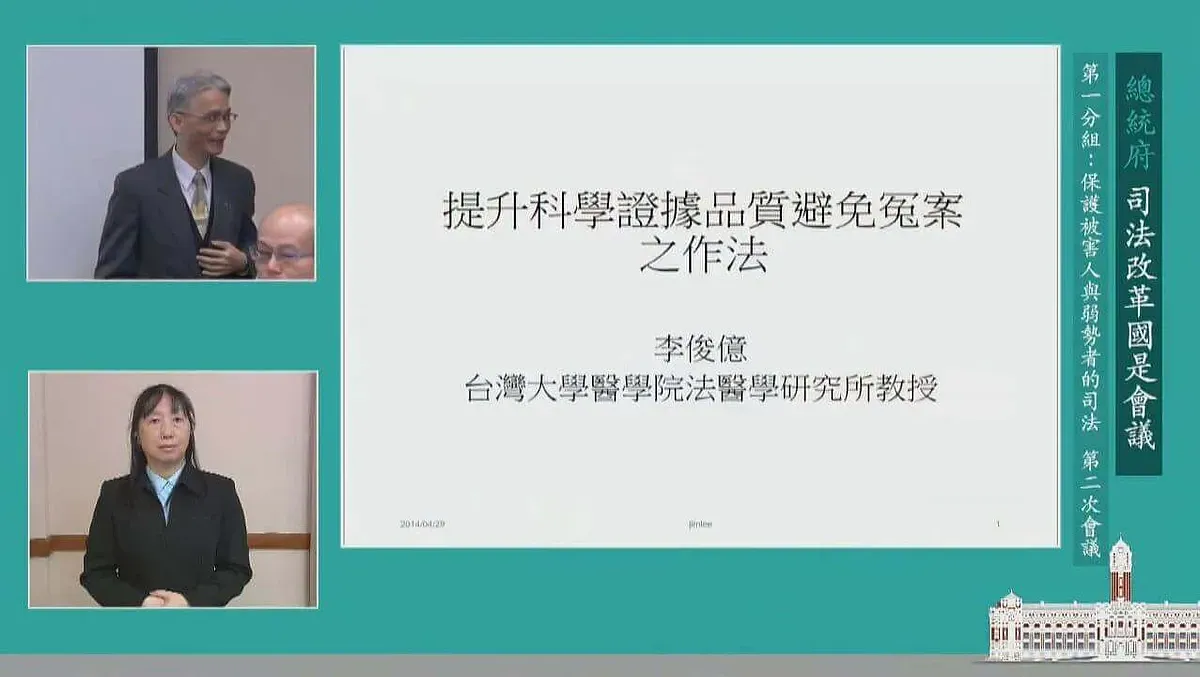
Brief Notes: Second Meeting of the First Working Group of the Presidential Office's National Judicial Reform Conference
Last edited: 2026-07-27
-
This meeting lasted for three and a half hours, focusing on the discussion of "whether to establish a national-level judicial science education organization," and ultimately resolved to continue discussions on the morning of Saturday, April 8.
-
A total of four committee members submitted three proposals to this meeting.
-
It was resolved that committee member Ch'en Lung-ch'i's proposal "Establish Regulations for Evidence Custody" be incorporated into the joint proposal of three committee members, Li Chün-i, Chao I-shan, and Huang Chih-hao.
-
Original proposals 1-4-1 ("Integrate scientific appraisal mechanisms such as forensic medicine, lie detection, and scientific forensics to enhance the technology and application of science-based case handling, and strengthen the judiciary's ability to uncover the truth") and 1-4-2 ("Improve rules of evidence and evaluate the establishment of an expert witness system") were incorporated into the proposal of member Huang and the other two members. The order of discussion follows the order of the proposal by member Huang and his colleagues.
- Subject 1: Establish a national-level judicial science organization to promote judicial science policies and elevate the quality of scientific appraisals.
- Subject 2: Popularize judicial science education; construct a comprehensive system for judicial science.
- Subject 3: Enact a unified code of evidence; strengthen the regulatory effect of excluding improperly obtained evidence, implement the burden of proof, and exclude lie detection as trial evidence to strengthen judicial practitioners' fact-finding capabilities and enhance public trust.
-
-
The schedule for this working group's "preparatory and interim meetings" is confirmed as follows:
- Saturday, April 8: First additional meeting
- Saturday, April 15: Second additional meeting
- Saturday, May 13: Third additional meeting
-
Key Discussion Points
-
Units such as the Ministry of Justice, the Investigation Bureau of the Ministry of Justice, and the Criminal Investigation Bureau of the National Police Agency under the Ministry of the Interior did not support the establishment of a national-level organization, citing concerns over professional bias or professional monopoly. The Judicial Yuan and the Institute of Forensic Medicine expressed no specific opinion.
-
Committee member Huang Chih-hao responded that the "national-level judicial science organization" referred to in the proposal is not intended to be a supreme national forensic agency, but rather an organization responsible for judicial science policy, judicial science education, laboratory accreditation, professional certification and licensing, and the review of flawed reports. The organization would not execute tasks hands-on, but would serve solely a managerial function.
-
Currently, the domestic review standard for laboratories is limited to the most basic ISO17025 accreditation process. Specialized forensic work, such as ballistic analysis, lacks professional review standards.
-
The original proposal was amended via a motion to read: "Establish the 'Consultative Committee for Promoting Judicial Science Policy and Education' under the Executive Yuan."
- To track whether meeting resolutions are implemented, the motion specifically requested that the committee be established under the Executive Yuan.
- Regarding the placement of the committee, one side argued it should be established under the Judicial Yuan to ensure its independence, while the other side argued it should be established under the Executive Yuan to comply with constitutional norms.
- Committee member Huang Chih-hao suggested that the three subjects proposed this time should be reviewed together before confirming how the "national-level organization" should be established.
-
Meeting Resolutions
The first additional meeting on Saturday, April 8, will discuss Subjects 2 and 3, which were not reported today, and will hold a vote after discussion.
Meeting Attachments
Committee Member Proposals
- Joint Proposal 1-4 by Three Members (Member Li Chün-i, Member Huang Chih-hao, Member Chao I-shan) (Document No.: 1-2-Discussion-3)
- Supplementary Explanation for Li Chün-i's Proposal (Member Li Chün-i) (Document No.: 1-2-Discussion-3)
- Ch'en Lung-ch'i's Proposal dated March 14, 2017 (Member Ch'en Lung-ch'i) (Document No.: 1-2-Discussion-4)
Supplementary Materials Provided by Member Li Chün-i
- Urgent Issues and Recommendations for Forensic Science in Taiwan (Member Li Chün-i) (Document No.: 1-2-Discussion-3)
- The Investigation Bureau's Circular Reasoning Regarding the Fatal Scientific Evidence in the Chiang Kuo-ch'ing Wrongful Execution Case (Member Li Chün-i) (Document No.: 1-2-Discussion-3)
- The Fatal Scientific Evidence in the Chiang Kuo-ch'ing Wrongful Execution Case (Member Li Chün-i) (Document No.: 1-2-Discussion-3)
- An Analysis of the Fatal Scientific Evidence in the Chiang Kuo-ch'ing Wrongful Execution Case (Member Li Chün-i) (Document No.: 1-2-Discussion-3)
- Response to Repercussions Regarding the Fatal Scientific Evidence in the Chiang Kuo-ch'ing Wrongful Execution Case (Member Li Chün-i) (Document No.: 1-2-Discussion-3)
- Reviewing Miscarriages of Justice to Prevent Miscarriages of Justice—Insights from the Non-Prosecution Disposition Received by the Author of "The Fatal Scientific Evidence in the Chiang Kuo-ch'ing Wrongful Execution Case" (Member Li Chün-i) (Document No.: 1-2-Discussion-3)
Materials Provided by Member Huang Chih-hao
- Judicial Science (Member Huang Chih-hao) (Document No.: 1-2-Discussion-4)
- Judicial Science (and Pseudoscience) in Wrongful Convictions (Document No.: 1-2-Discussion-4)
Materials Provided by Member Lin Yü-shun
- The Expert Witness—Taking Lie Detection as an Example (Member Lin Yü-shun) (Document No.: 1-2-Discussion-4)
- Scientific Judge vs. Expert Witness (Member Lin Yü-shun) (Document No.: 1-2-Discussion-4)
Materials from Courts and Ministries
- 1-4-1 (Judicial Yuan) (Document No.: 1-2-Discussion-3)
- 1-4-2 (Judicial Yuan) (Document No.: 1-2-Discussion-4)
- 1-4-1 PPT on Integrating Scientific Appraisal Mechanisms (Ministry of Justice) (Document No.: 1-2-Discussion-3)
- 1-4-1 Integrating Scientific Appraisal Mechanisms (Ministry of Justice) (Document No.: 1-2-Discussion-3)
- Methods to Enhance Scientific Forensic Capabilities (Investigation Bureau, Ministry of Justice) (Document No.: 1-2-Discussion-3)
- Methods to Enhance Scientific Forensic Capabilities (Institute of Forensic Medicine, Ministry of Justice) (Document No.: 1-2-Discussion-3)
- Methods to Enhance Scientific Forensic Capabilities (Criminal Investigation Bureau, National Police Agency, Ministry of the Interior) (Document No.: 1-2-Discussion-3)
- Explanatory Materials on Lie Detection and Forensic Personnel in Response to Inquiries by Member Lin Chao-chen (Investigation Bureau, Ministry of Justice) (Document No.: 1-2-Discussion-3)
- Clarifications on Committee Members' Questions (Institute of Forensic Medicine, Ministry of Justice) (Document No.: 1-2-Discussion-3)
Supplementary Basic Concepts Related to Issues
- The Framework and Issues of Taiwan's Code of Criminal Procedure / Recorded and Provided by Member Huang Chih-hao of the First Working Group
- What is the Lay Participation System? / Recorded and Provided by Member Huang Chih-hao of the First Working Group
Report Items
Report on the resolutions of the Preparatory Committee meeting on Monday, March 23, as follows:
- Working Group 5 added "5-5 Review of Juvenile and Gender Judicial Systems," which may overlap with issue 1-3 "Protecting the Situation of Vulnerable Groups in the Judiciary." If necessary, joint meetings of the two groups will be convened.
- Working Group 3's issue "3-1-3 Adopting the Principle of a Single Indictment (Non-transfer of Dossiers and Evidence)" has been transferred to Working Group 4 for discussion.
- Working Group 2 added two major issue categories: "2-5 Severing the Entanglement Between Politics and the Judiciary to Maintain Judicial Neutrality" and "2-6 Establishing a Judicial Policy Research Institution."
- Additional meetings shall be uniformly named as "[X] Working Group [X] Additional Meeting."
- Working Group 4 will hold its first additional meeting on March 25 to discuss the "System for Public Participation in Trials" (public hearing).
- Working Group 2 plans to invite all committee members to visit the courts and prosecutors' offices.
Other Items:
- Regarding the issue of "Rational Use of Judicial Resources," each working group shall form opinions during their respective discussions, after which the Preparatory Committee will convene cross-group joint meetings to issue a systematic integration report.
- Regarding Indigenous judicial issues, they fall within the scope of 1-3 "Assisting Vulnerable Groups."
- It is recommended that the audio and video materials for this group's Legal Small Classroom be embedded into this working group's audiovisual platform at the Presidential Office.
This article is an AI-generated translation of the original Chinese text. In the event of any discrepancy, the Chinese version shall prevail.
