
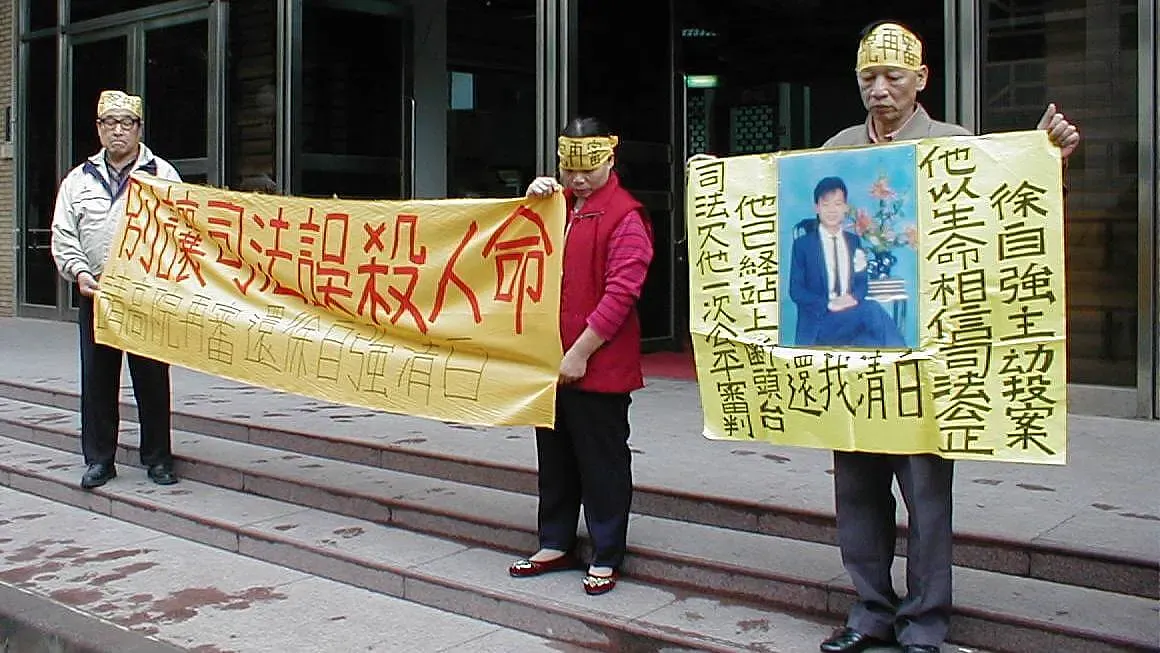
Constitutional Interpretation Petition for Hsuch Tzu-chiang - The Constitutionality of Accomplice Confessions Mutually Corroborating One Another
Last edited: 2026-11-03
Pursuant to Article 5, Paragraph 1, Subparagraph 2 and Article 8, Paragraph 1 of the Law Adjudication by the Grand Justices of the Judicial Yuan, a constitutional interpretation is hereby petitioned, with the relevant matters stated as follows:
I. Purpose of Requesting a Constitutional Interpretation
It is requested to interpret: Where a defendant denies the crime, but two or more co-defendants or accomplices both confess and accuse the defendant of committing the crime, whether criminal precedents of the Supreme Court such as 31-Shang-2423, 46-Tai-Shang-419, 30-Shang-3038, 73-Tai-Shang-5638, and 74-Tai-Fu-10, which permit courts—in the absence of any other independent corroborating evidence sufficient to prove the defendant's crime other than the co-defendants' or accomplices' confessions (i.e., evidence that does not merely enhance the credibility of a confession, but constitutes the essential facts of the criminal offense)—to directly use the aforementioned multiple accomplices' or co-defendants' confessions to mutually corroborate one another as evidence to convict the defendant, have infringed upon the criminal defendant's constitutional right to life and fundamental right of access to court, and violated the principle of due process of law required by the Constitution.
II. Nature and Background of the Ambiguity and the Constitutional Provisions Involved
-
The petitioner and defendant, Hsuch Tzu-chiang, was previously prosecuted by the Shihlin District Prosecutors Office under the 84th-Year-Tan-Zi Nos. 8775 and 9718 in a case involving kidnapping for ransom. After being placed on the wanted list, the defendant voluntarily surrendered himself on June 24, 1996 to explain the situation. However, the Shihlin District Court, under 84th-Year-Chung-Su-Zi No. 33 and 85th-Year-Chung-Su-Chi-Zi No. 3, judged the defendant Hsuch Tzu-chiang of jointly and intentionally committing kidnapping with the intent to ransom and intentionally killing the victim, sentencing him to death and depriving him of civil rights for life. Dissatisfied, the defendant appealed successively. After the Supreme Court remanded the case for the fifth time, the Taiwan High Court, despite revoking the original judgment under 88th-Year-Chung-Shang-Geng-(5)-Zi No. 145, still sentenced the defendant for jointly and intentionally committing kidnapping with the intent to ransom and intentionally killing the victim, sentencing him to death and depriving him of civil rights for life. The defendant appealed, and the Supreme Court dismissed the appeal under the 89th-Year-Tai-Shang-Zi No. 2196 judgment, finalizing the case.
-
Constitutional provisions involved: The right to life, the right of access to court under Article 16 of the Constitution, and the principle of due process of law.
III. Grounds for Requesting Constitutional Interpretation and Petitioner's Stance and Views on the Case
The views expressed on the application of laws and regulations by Supreme Court precedents and judgments, when cited by judges in final and conclusive adjudication, may become the subject of constitutional review:
As clearly stated at the outset of the reasoning for Judicial Yuan Interpretation No. 374: "Article 5, Paragraph 1, Subparagraph 2 of the Law Adjudication by the Grand Justices of the Judicial Yuan provides that where rights guaranteed by the Constitution are unlawfully infringed, and after instituting legal proceedings in accordance with statutory procedures, a constitutional interpretation may be petitioned regarding ambiguities over whether the laws or orders applied in final and conclusive adjudications contravene the Constitution. The term 'orders' referred to herein is not limited to orders in a formal sense or those using statutory names (such as the provisions of Article 3 of the Standards of Central Legal Statutes); any regulations issued by central or local authorities within their statutory powers, or views expressed on the application of regulations (such as official letter rulings issued by competent authorities regarding regulations), although not legally binding on independently judging judges, constitute orders referred to in the aforementioned statutory provisions if cited by judges in final and conclusive adjudications, and may become the subject of constitutional review, as repeatedly held in previous interpretations by this Court (Interpretations Nos. 216, 238, 336, etc.). As for judicial authorities expressing their views on the application of laws outside of specific concrete cases, under the current system there are two types: precedents and resolutions. Precedents challenged by the people as unconstitutional have long been reviewed as if they were orders (refer to Interpretations Nos. 154, 177, 185, 243, 271, 368, and 372, etc.). Resolutions of the Supreme Court were originally intended merely as a reference for judges within the court handling cases and did not possess inevitable binding force; while they cannot be equated with precedents, since the making of resolutions has a statutory basis (Article 78 of the Court Organization Act and Article 32 of the Supreme Court Operational Regulations) and represents the legal views of the Supreme Court, if cited by judges in adjudications, they must naturally also be recognized as equivalent to orders, allowing people to petition this Court for interpretation in accordance with the aforementioned laws, which is stated first." Thus, it is clear. The views of criminal precedents such as Supreme Court 31-Shang-2423, 46-Tai-Shang-419, 30-Shang-3038, 73-Tai-Shang-5638, and 74-Tai-Fu-10 were cited by the criminal judgment serving as the cause of this petition—namely, Supreme Court 89-Tai-Shang-Zi No. 2196—thereby infringing upon the petitioner Hsuch Tzu-chiang's constitutionally protected right to life and fundamental right of access to court:
-
Supreme Court precedents such as 31-Shang-2423, 46-Tai-Shang-419, 30-Shang-3038, 73-Tai-Shang-5638, and 74-Tai-Fu-10 permit courts—in the absence of independent corroborating evidence other than the confessions of co-defendants or accomplices sufficient to prove the defendant's crime—to directly rely on the mutual corroboration of multiple co-defendants' or accomplices' confessions to establish the defendant's guilt:
-
Supreme Court criminal precedent 31-Shang-2423 states: "While statements made by a co-defendant disadvantageous to themselves may be adopted as evidence of another co-defendant's crime, such disadvantageous statements must, pursuant to the provisions of Article 270, Paragraph 2 of the Code of Criminal Procedure, still be investigated alongside other necessary evidence to ascertain whether they conform to the facts, and it is naturally impermissible to rely solely upon such statements to establish the factual finding of another co-defendant's crime." Although this recognizes that co-defendants' confessions accusing other co-defendants may be adopted as evidence to establish a defendant's crime when corroborating evidence exists to prove conformity with facts, it fails to impose limitations on the qualification, scope, and degree of corroborating evidence.
-
Subsequently, the same court's precedent 46-Tai-Shang-419 stated: "While statements made by a co-defendant disadvantageous to themselves may be adopted as evidence of another co-defendant's crime, such disadvantageous statements must be free of flaws and, when investigated from other aspects, conform to the facts before they may be adopted to establish the factual finding of another co-defendant's crime." This merely reiterated the intent of the same court's precedent 31-Shang-2423; without making any additions or enhancements, it failed to clarify the qualifications, scope, and degree of corroborating evidence required for a co-defendant's confession accusing another.
Although Supreme Court precedent 30-Shang-3038 stated: "The so-called necessary evidence naturally refers to that which is related to the criminal facts; if a defendant's confession is abruptly overturned merely on immaterial points, the judgment can hardly be said to be lawful." The same court's precedent 73-Tai-Shang-5638 stated: "While a defendant's confession may not be used as the sole evidence to establish a crime and must be proven by corroborating evidence to be truly in conformity with facts, the corroborating evidence referred to here is not required to prove all the facts constituting the elements of the crime; as long as it can corroborate that the confessed crime is not fictitious and can guarantee the truthfulness of the confessed facts, it is sufficient. Furthermore, what can be used for corroboration, even if it cannot directly deduce the commission of the crime by the defendant, still cannot be said not to constitute corroborating evidence if, when comprehensively judged together with the defendant's confession, it is sufficient to establish the criminal facts." Supreme Court precedent 74-Tai-Fu-10 further stated: "Article 156, Paragraph 2 of the Code of Criminal Procedure provides that even if a defendant has confessed, other necessary evidence must still be investigated to ascertain whether it conforms to the facts. The legislative purpose is to use corroborating evidence to guarantee the truthfulness of a confession; that is, by the existence of corroborating evidence, to limit the evidentiary value of a confession. The so-called corroborating evidence refers to evidence other than the confession itself that is sufficient to prove that the criminal facts confessed possess a considerable degree of truthfulness. Although what is corroborated need not encompass all the facts, it must be sufficient—through the mutual utilization of the corroborating evidence and the confession—to engender conviction regarding the criminal facts before it qualifies." While these three precedents may provide a certain degree of clarification regarding the scope and degree of corroborating evidence required for a co-defendant's confession concerning their own crime, they fail to resolve the problems concerning the qualifications, scope, and degree of corroborating evidence required for a co-defendant's confession involving joint crime with others, especially:
Where the confessions of two or more co-defendants or accomplices accuse the defendant of a crime, can these multiple co-defendants' or accomplices' confessions—in the absence of other corroborating evidence independent of the aforementioned confessions—mutually corroborate each other and directly serve as evidence to establish the defendant's crime based on these multiple confessions?
If there is only corroborating evidence for the co-defendant's confession regarding their own crime, but a lack of corroborating evidence for the co-defendant's confession regarding joint crime with others, can the portion of the co-defendant's confession involving another's crime be adopted? None of these can be gleaned from the pathways of resolution provided in the aforementioned three precedents.
Precisely because the aforementioned Supreme Court precedents 30-Shang-3038, 73-Tai-Shang-5638, and 74-Tai-Fu-10 all failed to place limitations on the qualifications, scope, and degree of corroborating evidence required for a co-defendant's confession involving joint crime with others, our judicial practice has insidiously come to permit courts—in cases where a defendant denies the crime and there is a lack of independent corroborating evidence other than the confessions of co-defendants or accomplices—to directly use the confessions of two or more co-defendants or accomplices accusing the defendant to mutually corroborate each other, and further to directly use these multiple confessions as evidence to establish the defendant's guilt. In this regard, there is Supreme Court criminal judgment 88-Tai-Shang-Zi No. 380, which states: "Furthermore, an accomplice's confession and disadvantageous statements that do not bear a co-defendant relationship with the defendant also constitute a type of evidence. If free of flaws and supported by corroborating evidence proving they truly conform to facts, they may still be adopted as the basis for establishing the defendant's criminal facts; the so-called corroborating evidence refers to evidence other than the confession or disadvantageous statements themselves that is sufficient to prove that the confessed criminal facts possess a considerable degree of truthfulness. The confessions or disadvantageous statements of two accomplices who do not bear a co-defendant relationship with the defendant may also mutually corroborate each other." This can be verified as such.
-
-
The cause of the present petition—namely, Supreme Court final and conclusive criminal judgment 89-Tai-Shang-Zi No. 2196—is precisely a case where, amidst the petitioner Hsuch Tzu-chiang's denial of the crime and a lack of corroborating evidence independent of the confessions of co-defendants Huang Chun-ch'i and Ch'en I-lung, the court directly used the confessions of the aforesaid two co-defendants accusing Hsuch Tzu-chiang of joint criminality to mutually corroborate each other, and thereby established Hsuch Tzu-chiang's guilt:
The Control Yuan previously produced an investigation report on this case, pointing out numerous errors in the determination of facts and application of law in the final judgment of this case. Section 6, Paragraph 3 of that investigation report, "Summary of Analysis of Defendant Hsuch Tzu-chiang's Alleged Involvement and Evidence in the Court's Determination," analyzes the alleged involvement and supporting evidence of defendant Hsuch Tzu-chiang determined in the final judgment by tabulating them respectively under "Co-defendants' Confessions and Investigation/Trial Records" and "Indirect Evidence or Auxiliary Evidence." As can indeed be seen from the table, throughout the entire criminal process—from the planning of this case, tailing the victim, stealing a car as an instrument for the crime, scouting the route and murder location, preparing the instruments of crime, waiting for the victim, kidnapping, returning to the kidnapping scene to wipe away fingerprints, to extorting ransom from the victim's family—the final judgment determined that Hsuch Tzu-chiang participated in all of them. However, the supporting evidence relied upon consisted solely of the confessions and investigation/trial records of co-defendants Huang Chun-ch'i and Ch'en I-lung. Those cited by the final judgment as indirect evidence or auxiliary evidence could at most only prove that Hsuch Tzu-chiang had a relationship of relatives and friends with the other two co-defendants (which Hsuch Tzu-chiang admitted during trial) and had rented sky-blue passenger car No. FF-4831 as a backup from Hsu Shih-en, head of Jih-sheng Company—facts unrelated to the essential facts constituting the kidnapping for ransom crime determined by the final judgment of this case. In other words, they were incapable of serving as necessary evidence independent of the co-defendants' confessions and sufficient to prove Hsuch Tzu-chiang's participation in the crime of this case.
The Prosecutor-General of the Supreme Prosecutors Office filed extraordinary appeals three times for this case, all of which were dismissed. Among them, extraordinary appeal brief 91-Fei-Shang-Zi No. 109 stated: "Upon examination, apart from the confessions of co-defendants Ch'en I-lung and Huang Chun-ch'i, there are no other specific evidentiary items and human witnesses sufficient to prove that defendant Hsuch Tzu-chiang was involved in the criminal facts of this case. Furthermore, apart from consistently and resolutely denying the offense from the beginning, defendant Hsuch Tzu-chiang has an alibi for the time when the other defendants killed the victim. Moreover, defendant Hsuch Tzu-chiang never made any ransom calls, as can be verified by the seized tape recordings. Therefore, how can Hsuch Tzu-chiang's involvement be established? In other words, the aforementioned disadvantageous confessions concerning Hsuch Tzu-chiang's involvement actually contain much that does not conform to facts and cannot serve as the basis for establishing his involvement." This also corroborates that this case was determined on the sole basis of the confessions of co-defendants Ch'en I-lung and Huang Chun-ch'i, in the absence of other specific evidentiary items and human witnesses.
Professor Huang Chao-yi, a scholar from our country, also analyzed and pointed out regarding where the corroborating evidence for Hsuch Tzu-chiang's alleged involvement in this case lay:
The confessions of co-defendants Huang Chun-ch'i and Ch'en I-lung accusing Hsuch Tzu-chiang of participating in the conspiracy lacked corroborating evidence: He stated: "However, conversely, in the absence of other relevant corroborating evidence, one must not strain to infer the subjective aspect of the criminal (knowledge or conspiracy) based merely on contradictory or ambiguous confessions. In the relevant plots of this case, co-defendants Ch'en I-lung and Huang Chun-ch'i once confessed that 'Hsuch Tzu-chiang participated in the prior conspiracy.' However, if one refers to Huang Chun-ch'i's interrogation record of August 19, 1996, regarding whether Hsuch Tzu-chiang ever participated in the conspiracy, Huang Chun-ch'i stated 'I do not know'; furthermore, referring to Huang Chun-ch'i's interrogation record of August 30, 1996, he stated again, 'I told him [referring to the offender Hsuch] that we were going to collect a debt; my older brother asked him to go.' Based on Huang Chun-ch'i's self-contradictory confessions, it is evidently discoverable that it is impossible to determine whether Hsuch Tzu-chiang knew about the case beforehand (lack of knowledge). Moreover, according to the fact that Huang Chun-ch'i once flatly denied planning the crime process at Hsuch Tzu-chiang's place, and Ch'en I-lung also stated that he did not know it was kidnapping for ransom, it can be even more determined that they did not conspire to commit the crime at Hsuch Tzu-chiang's rented apartment. Hsuch's rented apartment had no direct relationship with whether or not there was a conspiracy to commit the crime; that is, the fact of renting an apartment cannot become corroborating evidence for the conspiracy, and naturally the fact of renting an apartment cannot be used as the basis for Hsuch's participation in the conspiracy or knowledge of this case."
The confessions of co-defendants Huang Chun-ch'i and Ch'en I-lung accusing Hsuch Tzu-chiang of purchasing the murder tools also lacked corroborating evidence: He stated: "Examining the facts of joint murder confessed by Ch'en I-lung and Huang Chun-ch'i, Ch'en I-lung stated during police interrogation that 'the three bottles of sulfuric acid, one roll of wide yellow adhesive tape, and five pairs of transparent gloves were all bought by Hsuch Tzu-chiang (purchased at a certain pharmacy in Kueishan Township).' However, later, Ch'en I-lung and Huang Chun-ch'i repeatedly stated in the court of first instance, the court of second instance, and successive remand retrials that 'they do not know who bought the sulfuric acid, gloves, and adhesive tape, and only know they were brought by Huang Ming-ch'üan.' This part cannot confirm that the offender Hsuch purchased the relevant tools used for the murder. Furthermore, Ch'en I-lung explicitly testified that during the police interrogation, he was instigated by the police, who said, 'Since Hsuch Tzu-chiang lives there, just say it was Hsuch Tzu-chiang.' From this content, it can be known that Ch'en I-lung's confession during police interrogation regarding the purchase of goods was induced by the police and was not true." "Examining further, the court believed that Huang Ming-ch'üan and three others, while tailing Huang Chun-shu, purchased two round-nosed shovels at a hardware store in Hsichih Town and carried them together to the aforementioned ravine, digging a pit 60 centimeters deep, 90 centimeters wide, and 140 centimeters long to serve as a place to bury the body; during this period, Huang Chun-ch'i, Ch'en I-lung, and Hsuch Tzu-chiang went to the 'Ti-Yi-Chia' military surplus store in Taipei to purchase a small long knife and handcuffs. However, because the shovels, small long knife, and handcuffs mentioned have not been found to date, they cannot be used as corroborating evidence to corroborate preparation for the crime."
The fact that Hsuch Tzu-chiang rented a car is also insufficient to serve as corroboration for the confessions of co-defendants Huang Chun-ch'i and Ch'en I-lung accusing him of participating in the ransom act: He stated: "During the process in which Huang Chun-ch'i and Ch'en I-lung carried out the ransom, whether the fact that the offender Hsuch rented a car to provide transportation for the ransom can constitute corroborating evidence of actual participation in the ransom act is subject to controversy. This is because during the execution of the ransom act in this case, the offender Hsuch registered the car rental in his own name, and did so more than once. According to the rule of general experience, such car rental behavior by the offender Hsuch obviously should be no different from ordinary car rental behavior; otherwise, how could he expose his own flaws and leave criminal records that allowed police personnel to easily trace him? Therefore, in the absence of other favorable physical evidence and other favorable corroborating evidence, to jump to the conclusion that the offender Hsuch's car rental had a close relationship with the ransom act truly lacks persuasiveness."
In summary of the above analysis, the confessions of co-defendants accusing Hsuch Tzu-chiang of committing the crime in this case had absolutely no corroborating evidence; yet the court used these confessions to mutually corroborate each other, which has distorted the original intent of the corroboration rule and runs counter to constitutional procedural guarantees:
He stated: "The attitude adopted in Hsuch's case is no different from the views of general practice; it relied on the statements of co-defendants Huang Chun-ch'i and Ch'en I-lung to determine that the offender Hsuch was one of the joint principals. That is, upon investigation, apart from the confessions of Huang Chun-ch'i and Ch'en I-lung, there are no other specific evidentiary items, human witnesses, or other corroborating evidence sufficient to prove that the offender Hsuch was involved in the criminal facts of this case. Furthermore, apart from denying the offense from the beginning, the offender Hsuch has an alibi for the time when the victim was killed, and never made a ransom call; I have no idea how his involvement in the crime was judged... The doubt existing in the offender's case also lies here: he denied the crime from the beginning, yet in the absence of other specific evidentiary items, he abruptly relied on the confessions of defendants Huang Chun-ch'i and Ch'en I-lung as the primary basis to establish his guilt. That is, the primary basis for whether the offender Hsuch was involved was through the mutual use of the confessions of Huang Chun-ch'i and Ch'en I-lung to determine the offender Hsuch's crime, completely ignoring the defendant's own defense and distorting the original meaning of the corroboration rule. In other words, regarding whether the offender Hsuch was involved, there was no other specific corroborating evidence for the respective confessions made by Huang Chun-ch'i and Ch'en I-lung. Their confessions were already problematic in themselves, yet the court used the confessions of these two problematic accomplices to mutually corroborate each other to establish another person's involvement, which can be said to violate the legal requirements of the corroboration rule, constituting a major procedural illegality, and furthermore violating the procedural guarantees required by the Constitution."
-
The cause of the present petition—namely, Supreme Court criminal judgment 89-Tai-Shang-Zi No. 2196—dismissed the petitioner Hsuch Tzu-chiang's appeal by citing the aforementioned Supreme Court criminal precedents such as 31-Shang-2423, which permit courts, in the absence of independent corroborating evidence, to directly rely on the mutual corroboration of co-defendants' confessions to establish a defendant's guilt:
Since this case was one where, in the absence of any other corroborating evidence sufficient to prove Hsuch Tzu-chiang's participation in the crime, the court directly used the confessions of two co-defendants accusing Hsuch Tzu-chiang of joint criminality to mutually corroborate each other and thereby established Hsuch Tzu-chiang's offense; and when Hsuch Tzu-chiang appealed this to the final factual instance—namely, the Taiwan High Court 86-Chung-Shang-Geng-(5)-Zi No. 145 criminal judgment—he criticized in his reasons for appeal that the judgment violated Supreme Court precedent 31-Shang-2423, Supreme Court criminal judgment 89-Tai-Shang-Zi No. 2196 ignored this and held: "Upon examination, the original judgment has exhausted its investigative efforts regarding the evidence concerning the crimes of the appellants and others, and in punishing and sentencing the appellants and others, it has further detailed the evidence relied upon and the reasons for its determination. The arguments made are also entirely consistent with the materials in the record. The exercise of its discretionary powers in selecting evidence and judging evidentiary probative value, as well as the exposition of legal applications and the explanation of reasons for sentencing to death, do not run counter to the rules of evidence and logic. Its lawful punishment and sentencing of the appellants and others, upon careful review, contain no errors under the law." Thus, although the final judgment did not specifically cite and indicate the case numbers in the reasoning column, it undoubtedly approved and cited the aforementioned view of Supreme Court precedents such as 31-Shang-2423, which permits courts—in cases where a defendant denies the crime and lacks independent corroborating evidence—to directly use the confessions of multiple co-defendants or accomplices to mutually corroborate each other, and thereby determine the defendant's guilt, subsequently dismissing the petitioner Hsuch Tzu-chiang's appeal.
-
The petitioner Hsuch Tzu-chiang's constitutionally protected right to life and fundamental right of access to court have thereby been infringed, and the due process of law required by the Constitution has been violated:
The death penalty is a measure by which the state deprives a person of their right to life, and it may only be executed pursuant to legal procedures that are materially and substantially just:
Although our Constitution does not explicitly enshrine the right to life, this is because a person's life is the prerequisite for enjoying all freedoms and rights; thus, the framers of the Constitution took it as a matter of course that the right to life is protected by the Constitution, rendering an explicit constitutional provision unnecessary.
Furthermore, looking at Article 3 of the Universal Declaration of Human Rights: "Everyone has the right to life, liberty and security of person." Article 6, Paragraph 1 of the International Covenant on Civil and Political Rights also explicitly stipulates: "Every human being has the inherent right to life. This right shall be protected by law. No one shall be arbitrarily deprived of his life." From these international human rights instruments, it is even more apparent that the right to life is the core of all basic human rights of humanity and a fundamental principle recognized by all civilized societies; our country naturally cannot stand outside of this.
"Full protection of the people's freedom of person is the prerequisite for exercising other freedom rights protected by the Constitution, and constitutes an important fundamental human right. Therefore, Article 8 of the Constitution makes detailed provisions for the protection of personal freedom. Paragraph 1 of that article stipulates: 'Personal freedom of the people shall be guaranteed. Except for the arrest of flagrante delicto as otherwise provided by law, no arrest or detention shall be made by judicial or police organs in accordance with statutory procedures. No interrogation or punishment shall be made by other than a court in accordance with statutory procedures. Arrest, detention, interrogation, or punishment not in accordance with statutory procedures may be resisted.' This means that any disposition restricting the people's freedom of person falls within the scope of constitutional reservation to a certain extent, and regardless of whether one possesses the status of a criminal defendant, all are protected by the aforesaid provisions. Except for the arrest of flagrante delicto provided by law, procedures stipulated for other matters must also be prescribed by law, and the contents enacted by the legislature must be substantively just and comply with the conditions prescribed in Article 23 of the Constitution; this constitutes institutional protection of personal freedom." The above intent is clearly stated in the reasoning for this Court's Interpretation No. 384. Regarding the people's enjoyment and exercise of other freedom rights, the right to life is even more basic a prerequisite than personal freedom, which goes without saying. Therefore, a fortiori, when the state deprives people of their right to life through the death penalty, it must do so pursuant to legal procedures that are materially and substantially just, as can be seen by reference to Amendment V of the United States Constitution, which states: "No person shall... be deprived of life, liberty, or property, without due process of law," and Article 31 of the Japanese Constitution, which explicitly stipulates: "No person shall be life or liberty deprived, nor any other criminal penalty imposed, except according to procedure established by law." This makes it even clearer.
When facing criminal prosecution, the right to receive a trial conducted by a court in accordance with due process of law is the core connotation of the people's constitutionally protected right of access to court:
Regarding the specific connotation of the right of access to court protected by Article 16 of our Constitution, the reasoning for this Court's Interpretation No. 256 states: "Article 16 of the Constitution provides that the people shall have the right of access to court, aiming to ensure the people's rights and interests to institute legal proceedings in accordance with statutory procedures and receive a fair trial." This has revealed that when a person faces criminal prosecution, the right to receive a trial conducted by a court in accordance with materially and substantially just legal procedures constitutes the core of the sphere of protection of the people's fundamental right of access to court. As can be seen from the text of this Court's Interpretation No. 436: "As for the institutionalization of military trial judgments, the Constitution does not set forth explicit provisions; while it may be prescribed by law, what is exercised by military trial organs also constitutes a kind of the state's penal power, and its initiation and operation must comply with the minimum requirements of due process of law..." This makes it even clearer.
The presumption of innocence is the primary principle embodying the constitutional principle of due process of law within criminal proceedings, and in turn guides the specific connotations of other criminal procedural principles, including the confession rule:
Article 11, Paragraph 1 of the Universal Declaration of Human Rights provides: "Everyone charged with a penal offence has the right to be presumed innocent until proved guilty according to law in a public trial at which he has had all the guarantees necessary for his defence." Article 14, Paragraph 2 of the International Covenant on Civil and Political Rights states: "Everyone charged with a criminal offence shall have the right to be presumed innocent until proved guilty according to law."
Although our Constitution lacks provisions similar to the international human rights instruments cited above, and the interpretations rendered by this Court to date regarding the specific connotations that the principle of due process of law should possess in criminal proceedings have not directly mentioned the presumption of innocence, the reasoning for this Court's Interpretation No. 509 stated: "The first half of Paragraph 3 of Article 310 of the Criminal Code provides: 'A person who performs the act of defamation and can prove that the matter is true is not punished,' making it a condition for non-punishment that the speech content of an actor who points out or spreads matters capable of injuring another's reputation conforms to the facts. It does not mean that the actor must personally prove that their speech content is indeed true before they can be exempted from criminal liability. However, even if the actor cannot prove that the speech content is true, but based on the evidentiary data provided, there are reasonable grounds for the actor to believe with certainty that it is true, they cannot be bound by the criminal liability of defamation, nor can this provision exempt the prosecutor or private prosecutor from the burden of proof that they legally bear in the procedural proceedings regarding the actor's intentional injury of another's reputation, or exempt the court from the obligation to discover the truth. In this regard, Article 310, Paragraph 3 of the Criminal Code does not contravene the intent of the Constitution to protect freedom of speech." All of the above listed items constitute the institutional protections required to ensure that criminal defendants do not bear the burden of proving their own innocence. Furthermore, referring to the legislative intent in Paragraph 1 of Article 156 of the Code of Criminal Procedure of our country, as amended in January 2003, which explicitly enshrines the presumption of innocence: " According to Article 11, Paragraph 1 of the Universal Declaration of Human Rights: 'Everyone charged with a penal offence has the right to be presumed innocent until proved guilty according to law in a public trial at which he has had all the guarantees necessary for his defence.' This reveals the internationally recognized basic principle of the presumption of innocence in criminal proceedings. Continental legal system countries sometimes explicitly provide for it in their constitutions, such as Article 27, Paragraph 2 of the Italian Constitution, Article 38, Paragraph 4 of the Turkish Constitution, and Article 32, Paragraph 2 of the Portuguese Constitution. Although our Constitution lacks an explicit provision, the provisions of this article inherently embody the intent of the presumption of innocence. Therefore, the wording of the aforementioned provision of the Universal Declaration of Human Rights has been appropriately revised, and Paragraph 1 has been added by amendment to correct the old preconception of presumed guilt that still exists in society, provide a foundation for criminal procedure to protect the defendant's human rights, and serve as the basis for this Code to strengthen its adversarial-system characteristics. Consequently, prosecutors must faithfully discharge their burden of proof to prove the defendant's guilt in order to overturn the presumption of innocence." All of these show that the presumption of innocence is indeed the core of the principle of due process of law in criminal proceedings, and other criminal procedural principles elucidated by this Court's Interpretation No. 384 as encompassed within the principle of due process of law—especially the confession rule relevant to this case—must form their specific contents under the guidance of the presumption of innocence. This also naturally arises as an interpretation stemming from the expansive efficacy possessed by the constitutional rank of the principle of due process of law.
Based on the presumption of innocence, where a criminal defendant denies the crime, but the confessions of two or more co-defendants or accomplices accuse the defendant of the crime, the confession rule of criminal procedure must prohibit the court of fact-finding—in the absence of necessary evidence independent of the aforementioned multiple confessions that is sufficient to prove the defendant's crime (i.e., independent evidence that is not merely enhancing the credibility of the confession, but possesses the essential facts of the criminal offense)—from directly using the aforementioned multiple confessions to mutually corroborate each other as evidence to convict the defendant:
The presumption of innocence requires that the proof of a defendant's criminal facts, whether based on direct evidence or indirect evidence, must reach the degree of leaving no reasonable doubt for an ordinary person and engendering conviction of its truthfulness before it may be adopted as a guilty verdict. If the proof has not reached this degree and reasonable doubt still exists, based on the presumption of innocence, a judgment of acquittal must naturally be rendered.
Because the defendant's confession previously occupied the status of "queen of evidence" in our past judicial practice, often possessing decisive evidentiary value, investigative agencies—in a criminal trial environment that overemphasized confessions—eagerly pursued criminal defendants' confessions, and even resorted to all sorts of improper methods without restraint to obtain confessions, which is an important reason why miscarriages of justice arise. To avoid miscarriages of justice and ensure that a defendant's confession can indeed prove their criminal facts to the degree of leaving no reasonable doubt, Article 156, Paragraph 1 and Paragraph 2 of our Code of Criminal Procedure prior to the January 2003 amendment prescribed that a defendant's confession must possess voluntariness (the voluntariness rule) and must be supported by corroborating evidence proving that the contents of the confession conform to the facts (the corroboration rule) before it may be adopted as evidence to establish a defendant's crime. This is what is termed in academic doctrine as the confession rule, which was explicitly revealed by this Court's Interpretation No. 384 as an internal content of the principle of due process of law.
Regarding the corroboration rule within the aforementioned confession rule, although Supreme Court precedent 31-Shang-2423 expanded its scope of application to co-defendants, and while the problems of the qualifications, scope, and degree of corroborating evidence required by this rule were explained to a certain degree by Supreme Court precedents 30-Shang-3038, 73-Tai-Shang-5638, and 74-Tai-Fu-10 regarding a defendant's confession concerning their own crime, as for the corroborating evidence required for confessions made by co-defendants or accomplices involving crimes committed with others, it has still not been clarified, as mentioned above (refer to the explanation in Section 3, Item 1 of this petition).
The requirements for corroborating evidence regarding a co-defendant's or accomplice's confession accusing another of a crime should be stricter than the corroborating evidence for a confession regarding one's own crime, in order to comply with the requirements of the presumption of innocence:
In order to escape or mitigate their own criminal liability, or even merely out of bitter grudge and retaliation, co-defendants or accomplices frequently frame others or shift responsibility onto others to make false statements. Our judicial practice has long recognized this; Supreme Court judgment 87-Tai-Shang-Zi No. 3525 stated: " Criminal liability shall be established based on evidence; where there is no evidence, criminal facts shall not be presumed, as expressly provided in Article 154 of the Code of Criminal Procedure. Furthermore, the evidence relied upon to establish criminal facts must be suitable for proving the defendant's crime before it may be adopted as material for conviction. Although a defendant's confession is a type of evidence, pursuant to Article 156, Paragraph 1 of the Code of Criminal Procedure, a defendant's confession must not originate from violence, coercion, inducement, fraud, unlawful detention, or other improper methods, and must conform to the facts, before it can serve as evidence. Moreover, pursuant to Paragraph 2 of the same article, a defendant's confession may not be used as the sole evidence for a guilty verdict, and other necessary evidence must still be investigated to ascertain whether it conforms to the facts. The legislative purpose is to use corroborating evidence to guarantee the truthfulness of a confession; that is, by the existence of corroborating evidence, to limit the evidentiary value of a confession and prevent the danger of misjudgments caused by over-reliance on confessions. When a defendant's confession is used as proof of their own crime, such danger already exists; when it is used as evidence of their accomplice's crime, not only is there the same danger of falsity in the collection of evidence, but an accomplice's confession inevitably carries the danger of shifting blame onto others and making false statements. Therefore, when utilizing an accomplice's confession as evidence of another accomplice's crime, its evidentiary value, according to the principle of free evaluation of evidence, naturally falls within the scope of the court's free judgment. However, while disadvantageous statements made by a co-defendant may be adopted as evidence of another co-defendant's crime, such disadvantageous statements must be free of flaws and, when investigated from other aspects, conform to the facts before they may be adopted to establish the factual finding of another co-defendant's crime. If no investigation is conducted and one relies solely upon such statements to establish the factual finding of another co-defendant's crime, it clearly violates the provisions of Article 156, Paragraph 2 of the Code of Criminal Procedure. Therefore, under the current Code of Criminal Procedure, the probative value of a defendant's confession or a co-defendant's disadvantageous statements cannot be freely judged by the court at will according to the principle of free evaluation of evidence; rather, it is subject to considerable restrictions, bearing a flavor of statutory evidence. That is, there must additionally be other necessary evidence to supplement the probative value of the confession before it may be adopted as material for conviction. Where crimes under the various items of Paragraph 2 of Article 13-1 of the Narcotic Control Ordinance are committed, if one confesses the source of the narcotics and thereby leads to an arrest, punishment may be mitigated, as expressly stipulated in Article 13-3 of the Ordinance. Therefore, if a person who uses or peddles amphetamine confesses the source of the amphetamine and thereby leads to an arrest, since they may be granted the grace of mitigated punishment, in order to guarantee the truthfulness of their disadvantageous statements made against other co-defendants (i.e., statements that the narcotics came from other co-defendants), there must particularly be evidence sufficient to make one certain of their truthfulness before they can serve as the basis for conviction." This can be referenced.
Therefore, compared to a co-defendant's or accomplice's confession concerning their own crime, a confession involving another's crime—apart from sharing the same risk of being falsely extracted through improper methods and being untrue—carries the additional concerns of evading one's own crime, soliciting leniency, or framing and shifting blame to wrongly accuse someone. Consequently, the corroborating evidence required for a co-defendant's or accomplice's confession accusing another of a crime should be stricter than that required for a confession concerning their own crime, in order to comply with the requirements of the presumption of innocence.
Where a criminal defendant denies the crime, but the confessions of two or more co-defendants or accomplices accuse the defendant of the crime, there must be corroborating evidence independent of the aforesaid multiple co-defendants' or accomplices' confessions and sufficient to prove the essential facts constituting the crime, in order to corroborate the truthfulness of the aforementioned confessions to the degree of leaving no reasonable doubt, and the court must not directly use the aforesaid multiple confessions to mutually corroborate each other:
As stated above, stricter corroborating evidence is required for a co-defendant's or accomplice's confession accusing another of a crime in order to comply with the requirements of the presumption of innocence. Accordingly, such corroborating evidence is not sufficient if it merely enhances the credibility of the aforementioned confessions; it must still be independent evidence possessing the essential facts constituting the crime and capable of corroborating the truthfulness of the aforementioned confessions to the degree of leaving no reasonable doubt before it qualifies.
If one merely uses the confessions of multiple co-defendants or accomplices accusing the defendant to mutually corroborate each other and thereby determines that the defendant—who denies the crime—is guilty, it is tantamount to the idioms "three men make a tiger" and "Tseng Tseng murdered someone" (rumors repeated often enough will be taken as true). It is exceedingly plain that the aforementioned multiple confessions are insufficient to mutually corroborate each other and guarantee that their mutual truthfulness reaches the degree of leaving no reasonable doubt.
From the perspective of the current reality of our country's investigative practice, the use of confessions by multiple co-defendants or accomplices accusing another of a crime to mutually corroborate each other should be particularly prohibited:- Regarding the current reality of our country's investigative practice, there is the analysis report prepared by Professor Ho Lai-chieh, a scholar from our country, regarding the cause of the present petition, which states: "Our country's investigative practice has always overemphasized 'confessions,' seeming to view them as the 'queen of evidence.' Therefore, if a confession is not extracted from the defendant's own mouth making them personally admit to the criminal facts, the probative value of all other evidence seems to be subjected to doubt. This case-handling mindset of overemphasizing 'confessions' is probably the main reason why illegal investigative methods such as torture cannot be eradicated in domestic investigative practice. And this case-handling mindset of emphasizing 'confessions' is manifested with even greater severity when investigating joint principals. Compared to single-person crimes, multi-person joint crimes possess their own particularities. For example, while criminals share a common interest in a crime, it is not necessarily completely identical. Moreover, because multiple people commit a crime together, a more meticulous plan is usually required. Therefore, unless a criminal 'blows the whistle himself' (confesses), outsiders (including investigative personnel) often cannot easily discover the truth. These characteristics cause investigative personnel to rely even more heavily and attach more importance to a criminal's confession, because with a single person's confession, not only can that person be convicted, but even further, through one person's confession, another person's confession can be coaxed out (which the author colloquially terms 'nurturing confessions with confessions'). For example, investigative personnel tell defendant A that another defendant B has already spilled all the facts of the crime and accused A of being the primary perpetrator. Upon hearing this, A naturally cannot let the matter rest and thus comes up with another 'version' of the crime, shifting the responsibility back to B. For investigative personnel handling a case, this method is naturally 'advantageous in a hundred ways without a single harm.' Through this, investigative personnel have at least two 'versions' of the crime to serve as a reference for deciding how to further investigate, and perhaps by combining these two 'versions,' investigative personnel can even come up with a third 'version.' With so many 'versions,' state investigation and trial organs (investigative organs and judges) might discover the truth of the crime, but it could also be the worst possible result—that is, deducing a self-righteous third 'version' (often a 'comprehensive version') from the 'versions' given by the defendants, and the court adopts the 'comprehensive version' as the finally established 'court-version' to sweep up all joint criminals. In particular, when investigative personnel cannot discover other more direct evidence (especially physical evidence) further from the defendants' testimonial 'versions,' they ultimately have to rely on a third 'comprehensive version' pushed back and forth to convict all criminals. Such a judgment is naturally difficult for people to find convincing... Practice seems to lack profound reflection on the potential ills that this 'dog-eat-dog' investigative mode may produce. After all, in a rule-of-law state's criminal procedure, a defendant should not be reduced to an object; a defendant should be a subject of litigation. However, because this investigative mode has high efficacy for 'solving cases,' it is used repeatedly by investigative agencies, and its use is even vigorously expanded. Tracing the root cause, perhaps the culprit is the case-handling mindset that places too much emphasis on confessions. However, viewed from various angles such as criminal psychology, criminal interrogation science, and criminal procedural jurisprudence, a defendant confessing to their own crime still bears a vast difference from a defendant confessing to another's crime, and they should not be treated equally. Although utilizing the contradictions between joint criminals to discover the truth is not illegal per se, state investigation and trial organs cannot blindly indulge in such non-fully-lawful investigative means as 'dog-eat-dog' and 'nurturing confessions with confessions'; they should still focus primarily on scientific physical evidence and use physical evidence to guide the direction of investigation, which better conforms to the requirements of modern rule-of-law state criminal proceedings." This can be cited as corroboration.
- Precisely because such is the reality of our country's investigative practice, many scholars in our country have raised severe criticisms against the practical reality of judicial practice overly emphasizing the confessions of co-defendants or accomplices. Professor Huang Chao-yi stated in his analysis report concerning the cause of the present petition: "Based on the confessions made by two or more accomplices other than the defendant, whether they can be directly used as guilty evidence or corroborating evidence against a defendant who denies the criminal facts is also one of the issues in handling accomplice confessions. Viewed from the perspective that an accomplice's confession requires no evidence, the guilt of a defendant who denies the criminal facts can be established by the confessions of two or more accomplices. Some views even consider that an accomplice's confession is included within the defendant's own confession, and hold that where the confessions of two or more accomplices exist and these confessions possess a mutual corroborative effect among themselves, they can be used to establish the guilt of a defendant who denies the criminal facts. Furthermore, some hold that to cater to the implied intent of investigative personnel, although one cannot say there is no danger of dragging other people into the whirlpool of crime, the judgment of such danger belongs to the court's free evaluation of evidence and is not yet sufficient to say that accomplices' confessions cannot mutually serve as corroborating evidence. However, what must be noted is that if one attaches importance to the danger existing in an accomplice's confession of dragging others into the whirlpool of crime, even if the contents of the confessions of two or more accomplices are identical, in the absence of corroborating evidence concerning the connection between the defendant and the criminal, such confessions naturally should not be used as evidence to convict the defendant. Especially when the defendant denies the offense and there is no evidence other than the confessions, such an interpretation should even less be made. Based on this, in cases involving multiple accomplices, to avoid the danger that accomplices may shift responsibility onto the defendant, creating the danger of consistent testimonial contents and scapegoating among multiple accomplices, as a general rule, the statements of multiple accomplices should not be mutually used as corroborating evidence to establish a defendant's guilt (the view adopted in our country's practice—that the confessions or other disadvantageous statements of two accomplices who do not bear a co-defendant relationship with the defendant may also mutually corroborate each other—is subject to review; this is the practical view of Supreme Court judgment 88-Tai-Shang-Zi No. 380). Under such circumstances, even if the defendant has not confessed, or denies the crime, they will still be determined guilty due to the mutual corroboration of the confessions of other accomplices."
The cause of the present petition—namely, Supreme Court final and conclusive criminal judgment 89-Tai-Shang-Zi No. 2196—relied solely on the accusations in the confessions of co-defendants Huang Chun-ch'i and Ch'en I-lung, in the absence of any other independent corroborating evidence, to sentence the petitioner Hsuch Tzu-chiang to death amidst heavy doubts. This truly shows disregard for human life and violates the constitutional principle of due process of law:
As stated above, based on the presumption of innocence, where a criminal defendant denies the crime, but the confessions of two or more co-defendants or accomplices accuse the defendant of the crime, the confession rule of criminal procedure must prohibit—in the absence of corroborating evidence independent of the aforesaid confessions and sufficient to prove the defendant's crime—directly using the aforementioned multiple confessions to mutually corroborate each other to establish the defendant's guilt.
As also stated above (refer to Section 3, Item 1, Paragraph 3 of this petition), the aforementioned Supreme Court judgment 89-Tai-Shang-Zi No. 2196, in the absence of corroborating evidence independent of the confessions of co-defendants Huang Chun-ch'i and Ch'en I-lung, directly used the confessions of the aforesaid two co-defendants accusing the petitioner Hsuch Tzu-chiang of joint criminality to mutually corroborate each other, and thereby established Hsuch Tzu-chiang's crime.
As can be seen from the above, the aforementioned Supreme Court final and conclusive criminal judgment 89-Tai-Shang-Zi No. 2196 sentenced the petitioner Hsuch Tzu-chiang to death based solely on such evidence, violating the presumption of innocence. Prior to the finalization of his death sentence, the petitioner Hsuch Tzu-chiang never received a trial conducted by a court in accordance with due process of law, and it is even harder to say that the state executed this measure depriving the petitioner Hsuch Tzu-chiang of his right to life pursuant to legal procedures that were materially and substantially just. There is no doubt that the petitioner Hsuch Tzu-chiang's right to life and fundamental right of access to court have been infringed upon by the aforementioned Supreme Court final and conclusive criminal judgment 89-Tai-Shang-Zi No. 2196.
Furthermore, looking at the fact that heavy doubts still remained in the aforementioned Supreme Court final and conclusive criminal judgment 89-Tai-Shang-Zi No. 2196, relative to the fact that the death penalty is an irreversible capital punishment, it can be seen all the more that sentencing the petitioner to death based solely on the confessions of two co-defendants truly amounts to treating human life as grass:
The judgment used the confessions of co-defendants Huang Chun-ch'i and Ch'en I-lung accusing the petitioner Hsuch Tzu-chiang of participating in the crime to mutually corroborate each other. However, the confessions of these two co-defendants not only seriously diverged from each other during the investigation stage, but the statements of the same co-defendant also showed obvious inconsistencies between before and after, making their credibility highly questionable:
-
When co-defendant Huang Chun-ch'i was first arrested by the police on September 25, 1995, he initially denied all crimes, and subsequently confessed to the crime in the police interrogation record of September 27 of the same year, stating that Hsuch Tzu-chiang and Ch'en I-lung brandished a machete to force the victim to the seaside of Luchu Township to be killed; the next day, when the police took Huang Chun-ch'i to search for the victim's body, Huang only confessed that the body was buried in the mountainous area of Hsichih rather than the Luchu seaside, but still claimed that Hsuch and Ch'en two people forced the victim to the burial site where Ch'en I-lung killed the victim with a knife. During the prosecutor's interrogation on that day, Huang Chun-ch'i made the same statement once again. Even up to prosecutor Li Yu-ching's interrogation on September 29, Huang Chun-ch'i once again accused Hsuch and Ch'en of killing the victim. Even until October 26 after Ch'en I-lung was apprehended (Ch'en was captured by the police on October 22), Huang Chun-ch'i still told the prosecutor that Hsuch Tzu-chiang witnessed Huang Ming-ch'üan kill the victim at the crime scene. When the prosecutor informed him that Hsuch Tzu-chiang had an alibi, Huang Chun-ch'i replied "I don't know" without knowing why at the time, but did not claim at that time that Hsuch Tzu-chiang left early or went to wipe fingerprints. Moreover, when the prosecutor asked, "How many cars were there when the deceased was kidnapped?" Huang Chun-ch'i still stubbornly claimed: "I drove, my older brother sat in the right front seat, Ch'en I-lung sat in the right rear seat, Hsuch Tzu-chiang sat in the left rear seat, and the deceased sat in the middle." After Ch'en I-lung was apprehended and learned that Hsuch Tzu-chiang's family had submitted an alibi showing Hsuch Tzu-chiang was elsewhere when the victim was killed, Ch'en told the police that Hsuch Tzu-chiang returned to the scene first to wipe fingerprints, and that four people (including the victim, Ch'en I-lung, Huang Chun-ch'i, and Huang Ming-ch'üan) traveled to the Hsichih mountainous area in two separate cars—differing from Huang Chun-ch'i's claim that five people shared a single car. Until later, when Huang Chun-ch'i knew for certain that Hsuch Tzu-chiang truly had an alibi, he chimed in with Ch'en I-lung's rhetoric, changing his story in subsequent trial proceedings to claim that Hsuch Tzu-chiang got out halfway to wipe fingerprints. But from this, it can be seen how highly suspicious it is whether their statements were true; otherwise, how could Huang Chun-ch'i and Ch'en I-lung, who were together at the kidnapping scene, have completely different descriptions of Hsuch Tzu-chiang's presence, the process of the crime, and the vehicle used for the crime? Yet the aforementioned Supreme Court judgment 89-Tai-Shang-Zi No. 2196 still based its findings on their successively divergent and mutually contradictory confessions, cutting and pasting together the parts accusing Hsuch Tzu-chiang of involvement, while completely ignoring the aforementioned multiple serious flaws of mutual divergence and contradiction between before and after.
-
The analysis report on this case prepared by Professor Huang Chao-yi, a scholar from our country, pointed out that the confessions of co-defendants Huang Chun-ch'i and Ch'en I-lung were mutually divergent and self-contradictory between before and after, and were untrustworthy:
-
The confessions of Huang and Ch'en regarding whether Hsuch Tzu-chiang participated in the conspiracy were self-contradictory between before and after:
He stated: "In the relevant plots of this case, co-defendants Ch'en I-lung and Huang Chun-ch'i once confessed that 'Hsuch Tzu-chiang participated in the prior conspiracy.' However, if one refers to Huang Chun-ch'i's interrogation record of August 19, 1996, regarding whether Hsuch Tzu-chiang ever participated in the conspiracy, Huang Chun-ch'i stated 'I do not know'; furthermore, referring to Huang Chun-ch'i's interrogation record of August 30, 1996, he stated again, 'I told him [referring to the offender Hsuch] that we were going to collect a debt; my older brother asked him to go.' Based on Huang Chun-ch'i's self-contradictory confessions, it is evidently discoverable that it is impossible to determine whether Hsuch Tzu-chiang knew about the case beforehand (lack of knowledge). Moreover, according to the fact that Huang Chun-ch'i once flatly denied planning the crime process at Hsuch Tzu-chiang's place, and Ch'en I-lung also stated that he did not know it was kidnapping for ransom, it can be even more determined that they did not conspire to commit the crime at Hsuch Tzu-chiang's rented apartment." -
The confessions of these two people regarding Hsuch Tzu-chiang's purchase of the murder tools were also self-contradictory between before and after and mutually divergent:
He stated: "Examining the facts of joint murder confessed by Ch'en I-lung and Huang Chun-ch'i, Ch'en I-lung stated during police interrogation that 'the three bottles of sulfuric acid, one roll of wide yellow adhesive tape, and five pairs of transparent gloves were all bought by Hsuch Tzu-chiang (purchased at a certain pharmacy in Kueishan Township).' However, later, Ch'en I-lung and Huang Chun-ch'i repeatedly stated in the court of first instance, the court of second instance, and successive remand retrials that 'they do not know who bought the sulfuric acid, gloves, and adhesive tape, and only know they were brought by Huang Ming-ch'üan.' This part cannot confirm that the offender Hsuch purchased the relevant tools used for the murder. Furthermore, Ch'en I-lung explicitly testified that during the police interrogation, he was instigated by the police, who said, 'Since Hsuch Tzu-chiang lives there, just say it was Hsuch Tzu-chiang.' From this content, it can be known that Ch'en I-lung's confession during police interrogation regarding the purchase of goods was induced by the police and was not true."
-
-
Professor Ho Lai-chieh, a scholar from our country, pointed out in his analysis report on this case that the confessions of Huang and Ch'en accusing Hsuch Tzu-chiang of the crime were very likely excuses to shirk responsibility, stating: "Looking at the criminal facts of the four people including Hsuch Tzu-chiang in this case, not only did the two confessing persons (Huang Chun-ch'i, Ch'en I-lung) each have their own 'version' of the crime they confessed to, but subsequently through the court judgments of the fifth remand retrial, different 'revised versions' appeared. Although in the end it seemed that defendant Ch'en I-lung's 'version' became the court's finally determined 'court-version,' it still remained at deducing the 'comprehensive version' by way of inference, because state investigation and trial organs did not obtain any direct physical evidence from the confessions of Huang Chun-ch'i and Ch'en I-lung that could clearly prove Hsuch Tzu-chiang was involved in the kidnapping for ransom and murder. Therefore, Hsuch Tzu-chiang being determined to be a joint principal in the kidnapping for ransom and murder was merely the result deduced from various 'versions'... Compared to an ordinary simple defendant's 'confession' (confessing to one's own crime), the probative value of 'another's confession' is obviously lower because of human nature—when it comes to the part involving oneself, one tries to escape and minimize involvement, dodging the heavy and taking the light, while shifting responsibility as much as possible onto others dragged down into the water (Huang Chun-ch'i's initial confession in this case did not mention Huang Ming-ch'üan's involvement, and subsequent facts proved that Huang Chun-ch'i, to cover up his brother Huang Ming-ch'üan's offense, pushed all the crimes committed by Huang Ming-ch'üan onto Hsuch Tzu-chiang). In addition, a defendant might also harbor grudges and seek revenge, making someone whom they ordinarily had no opportunity to retaliate against unjustly burdened by falsely accusing them of being an accomplice. In any case, fundamentally, such 'other's confessions' possess quite a few inherent unreliable factors and must be handled with extreme care."
Precisely because the criminal facts determined in the aforementioned Supreme Court final and conclusive criminal judgment 89-Tai-Shang-Zi No. 2196 were compiled and pieced together from the numerous mutually contradictory and temporally divergent confession versions made by co-defendants Huang Chun-ch'i and Ch'en I-lung, not only does this final "court-determined comprehensive version" itself contain major doubts, but it also conflicts with the evidence in the record. These are detailed separately below:
-
Because no fact of Hsuch Tzu-chiang making a ransom call could be found, the judgment determined that: "Because Huang Ming-ch'üan and Hsuch Tzu-chiang knew Huang Chun-shu, fearing his voice would be recognized by Huang Chun-shu's family, it was decided that Huang Chun-ch'i and Ch'en I-lung would conduct the ransom by telephone contact." Regarding the plots and details of the kidnapping and murder, it determined: "Until around 8:40, Huang Chun-shu prepared to drive away, and finding the left front tire damaged and deflated, unaware of anything unusual, as he was about to replace it with a spare tire, Huang Chun-ch'i, Hsuch Tzu-chiang, and Ch'en I-lung swarmed forward. Huang Chun-ch'i held a small long knife against Huang Chun-shu's neck, Ch'en I-lung used handcuffs to handcuff one of Huang Chun-shu's hands, and Hsuch Tzu-chiang assisted by pushing and pulling on the side. The three of them instantly shoved Huang Chun-shu into the back seat middle of the stolen car driven by Huang Ming-ch'üan. Ch'en I-lung immediately tightly handcuffed Huang Chun-shu's both hands and turned back to return to his car; Hsuch Tzu-chiang and Huang Chun-ch'i also swiftly sat on the left and right sides of Huang Chun-shu respectively, and pasted adhesive tape over Huang Chun-shu's both eyes to prevent him from recognizing the route and finding an opportunity to escape... After Huang Chun-shu uttered phone numbers 7992475 and 5788888, recognizing that one of them was Huang Ming-ch'üan, he repeatedly shouted Huang Ming-ch'üan's name, imploring to be released and expressing his willingness to take them to a bank to withdraw deposits... While Huang Ming-ch'üan was copying the phone number on a cigarette box, seeing that the scheme had succeeded and his identity was recognized by Huang Chun-shu, in accordance with the original plan and based on the intent of joint murder, Huang Ming-ch'üan stabbed a small long knife into Huang Chun-shu's anterior neck throat area, cutting the trachea with a single stab, and Huang Chun-shu immediately collapsed to the ground." However, if the victim was kidnapped and shoved into the middle of the rear seat of the stolen car driven by Huang Ming-ch'üan, since he originally knew Huang Ming-ch'üan and could recognize his identity at that moment, why would he wait until the murder scene to recognize him, thereby triggering Huang Ming-ch'üan's murderous intent? Furthermore, if Hsuch Tzu-chiang indeed knew the victim, then at the time the victim was kidnapped, during "Hsuch Tzu-chiang assisting by pushing and pulling on the side," and shortly thereafter when Hsuch Tzu-chiang and Huang Chun-ch'i sat on his left and right sides in the rear seat, the victim could have easily recognized Hsuch Tzu-chiang. However, if Huang Ming-ch'üan, Huang Chun-ch'i, and Ch'en I-lung all feared having their identities recognized by the victim, to the extent that when interrogating the victim for his phone number they still did not tear off the adhesive tape pasted over his eyes, and Huang Ming-ch'üan even ignited his murderous intent because his identity was recognized, then how could Hsuch Tzu-chiang alone be willing to risk being recognized by the victim during the kidnapping? Referring further to the judgment's determination that they also feared the victim escaping and bearing the risk of being identified later, and therefore immediately pasted adhesive tape over his eyes after forcing him into the car to prevent him from recognizing the route and finding an opportunity to escape, it becomes even clearer that none of them felt secure during the crime; instead, they deeply feared having their identities recognized by the victim. How could Hsuch Tzu-chiang alone be an exception? In summary, the facts determined by the judgment above are all self-contradictory and fraught with heavy doubts.
-
The judgment determined that among the crime tools prepared by the defendants were five pairs of transparent gloves, and determined that after kidnapping the victim into the car, Huang Ming-ch'üan instructed Hsuch Tzu-chiang to get out of the car and return to the scene to wipe away any fingerprints they might have left on the victim's car. It also determined that after arriving at the scene where the victim was murdered, they put on gloves, and afterwards Huang Ming-ch'üan, to avoid leaving fingerprints, ordered Huang Chun-ch'i and Ch'en I-lung to remove the three pieces of adhesive tape from the deceased's body and sprinkle sulfuric acid to destroy fingerprints on the body. However, if they knew to prepare transparent gloves as crime tools, how could they leave fingerprints necessitating Hsuch Tzu-chiang to return to the scene to wipe them? If they already put on gloves upon arriving at the murder scene, why did they need to remove the adhesive tape and use sulfuric acid to destroy fingerprints on the body? Regarding the aforementioned doubts, the Control Yuan's investigation report on this case also questioned: "Furthermore, the confessions of co-defendants Ch'en I-lung and Huang Chun-ch'i—that after driving a certain distance, they made Hsuch Tzu-chiang get out and walk back to the scene to wipe fingerprints—are also unreasonable and illogical. Given that this was a premeditated kidnapping and gloves were prepared, how could there be any logic in abandoning them and kidnapping with bare hands? According to Ch'en I-lung's confession, they made a sudden move as the victim walked to the back of the car intending to open the trunk to get the spare tire, forcefully kidnapping Huang Chun-shu into the car. If so, since they kidnapped the person at the 'back of the car,' logically they would not leave fingerprints on the victim's car, so why would Huang Ming-ch'üan need to make Hsuch Tzu-chiang return to wipe fingerprints? Moreover, the time of the crime was around 8:00 AM, when people and cars going to work and school were numerous. Making Hsuch Tzu-chiang return to the scene to wipe fingerprints on the car—would they not worry about being recognized by others? Hsuch Tzu-chiang had no wiping tools, so how did he wipe them?"
-
The judgment determined that Hsuch Tzu-chiang rented dark-green passenger car No. FF-14829 (Note: FF-4831) from Jih-sheng Car Rental Company for the purpose of extorting ransom. Regarding this, the Control Yuan's investigation report pointed out: "If the defendants were premeditating a kidnapping and well knew that the process of committing the crime should avoid revealing traces—which was also the reason why Huang Chun-ch'i stole Ting Kung-pei's vehicle to commit the crime—defendant Hsuch Tzu-chiang was neither foolish nor stupid; how could he have rented a car in his own name to commit the crime without worrying about the matter coming to light? Hsuch Tzu-chiang's defense that he was exploited by Huang Ming-ch'üan seems not without reason. The case judgment made its determination based on the co-defendants' accusations and the fact that Hsuch Tzu-chiang borrowed a car, and vividly pointed out: Huang Chun-ch'i drove the car to a public telephone booth at No. 1, Wenhua Road, Taoyuan City, very close to the Neili Railway Station... where he was arrested by the police. However, as to why the police did not seize the sky-blue passenger car No. FF-4831 rented by Hsuch Tzu-chiang at the scene, but instead had Hsuch Tzu-chiang's girlfriend Cho Chia-hui return it, the judgment gave no account. Consequently, the basis for reasoning in this case's judgment—that the car rented by Hsuch Tzu-chiang was indeed used to commit the crime, and that Hsuch Tzu-chiang jointly participated in this case—is shaken, and its sitting of him in the death penalty clearly suffers from the error of violating the rules of experience and logic."
-
The judgment determined that after wiping the fingerprints on the victim's car, Hsuch Tzu-chiang immediately returned to his residence in Kueishan, and went to withdraw money at the Taoyuan 5th Branch Office between 10:47 AM and 10:48 AM on the morning of the crime. Regarding this determination, the Control Yuan's investigation report also questioned: "The case judgment determined that the alibi presented by defendant Hsuch Tzu-chiang—that he went to withdraw money at the Taoyuan Post Office 5th Branch Office between 10:47 AM and 10:48 AM on the morning of the case—was insufficient to prove that defendant Hsuch Tzu-chiang did not participate in the kidnapping for ransom on that day. Looking at the reasons it held, they were essentially that the original court had simulated the crime scene on the morning of October 11, 1996, around 10:00 AM, driving from the Chengkung Interchange onto the Sun Yat-sen Freeway, getting off the Sun Yat-sen Freeway at the Wuku Interchange, driving along the longitudinal road to the entrance of Lane 172, Tzu-chiang West Road, Kueishan Township, Taoyuan County, where defendant Hsuch Tzu-chiang resided, which took about one hour including traffic jams and time spent asking many people because of unfamiliarity with the route; and then driving from the location where defendant Hsuch Tzu-chiang resided to the Taoyuan Post Office 5th Branch Office took about 700 meters. The original court further ordered police officers from the Neihu Precinct of the Taipei City Police Department to accompany defendant Ch'en I-lung on the morning of October 16, 1996, starting from Lane 608, Pei-an Road, Chungshan District, Taipei City, turning from Pei-an Road to Tachi Bridge toward Binjiang Street onto the Sun Yat-sen Freeway, getting off the freeway at the Linkou Interchange, turning left toward Linkou and Kueishan along Chang Gung Memorial Hospital, driving along Chiu-lu Village, Hsi-chiu-lu to Section 2, Shou Road to the Tzu-chiang West Road betel nut stand, which took 45 minutes (including 9 minutes stuck in a traffic jam at the Linkou Interchange ramp). It considered that after Hsuch Tzu-chiang kidnapped the person and got off to wipe the fingerprints on Huang Chun-shu's car, returning to his Taoyuan residence, and then heading to the Taoyuan Post Office 5th Branch Office to withdraw cash at around 10:47 AM on the morning of the same day, there was more than ample time, which did not conflict with the plot of the crime described by defendants Ch'en I-lung and Huang Chun-ch'i. Moreover, kidnapping for ransom and murder is a crime punishable solely by death, which was known to the defendants; if nothing had happened, they naturally would not act against conscience and heaven to falsely accuse Hsuch Tzu-chiang and nail him to a death sentence. Therefore, the defendants' accusations regarding Hsuch Tzu-chiang's involvement should conform to the facts—serving as its basis of reasoning. However, since the original court determined that the two cars driven by the defendants on the day of September 1 were both driven to the Hsichih mountainous area, what kind of transportation tool defendant Hsuch Tzu-chiang used to return home after wiping fingerprints on Huang Chun-shu's car at the kidnapping scene is crucial to whether the calculation of the simulated route time above is correct, and should have been investigated together... The court in this case failed to thoroughly investigate all of the above circumstances, and without solid evidence, stated that the defendant taking a car back to Taoyuan via the aforementioned route and then heading to the post office to withdraw money afforded ample time, and that this was insufficient to serve as an alibi. This is rather hasty and subjective, violating the rules of evidence."
-
Co-defendants Huang Chun-ch'i and Ch'en I-lung were sentenced to death by the Taiwan Shihlin District Court on May 16, 1995, yet Hsuch Tzu-chiang surrendered to the Shihlin District Court on June 24 of the same year. Compared to the situation where Huang Chun-ch'i and Ch'en I-lung were both apprehended by the police, if Hsuch Tzu-chiang had indeed participated in this case, why did he not flee, but instead voluntarily surrendered knowing full well that he might be sentenced to death?
In summary, Supreme Court judgment 89-Tai-Shang-Zi No. 2196, in the absence of independent corroborating evidence, rashly used the confessions of co-defendants Huang Chun-ch'i and Ch'en I-lung accusing Hsuch Tzu-chiang of participating in the crime to mutually corroborate each other (in reality, it edited and pieced together numerous mutually contradictory and temporally divergent confession versions from the aforesaid two co-defendants, which strictly speaking, could not even be called mutual corroboration), leading to Hsuch Tzu-chiang being hastily sentenced to death and finalized while heavy doubts remained unresolved. How can Hsuch Tzu-chiang be said to have received a fair trial before being sentenced to death? Professor Huang Chao-yi, a scholar from our country, commented on this: "The doubt existing in Hsuch's case also lies here: he denied the crime from the beginning, yet in the absence of other specific evidentiary items, he abruptly relied on the confessions of co-defendants Huang Chun-ch'i and Ch'en I-lung as the primary basis to establish his guilt. That is, the primary basis for whether Hsuch was involved was through the mutual use of the confessions of Huang Chun-ch'i and Ch'en I-lung to determine Hsuch's crime, completely ignoring the defendant's own defense and distorting the original meaning of the corroboration rule. In other words, regarding whether Hsuch was involved, there was no other specific corroborating evidence for the respective confessions made by Huang Chun-ch'i and Ch'en I-lung. Their confessions were already problematic in themselves, yet the court used the confessions of these two problematic co-defendants to mutually corroborate each other to establish another person's involvement, which can be said to violate the legal requirements of the corroboration rule, constituting a major procedural illegality, and furthermore violating the procedural guarantees required by the Constitution." This is indeed a sound argument.
IV. Grounds for Urgently Petitioning for Constitutional Interpretation to Resolve Ambiguities
-
The petitioner Hsuch Tzu-chiang's right to life and fundamental right of access to court have been infringed because Supreme Court final and conclusive criminal judgment 89-Tai-Shang-Zi No. 2196 cited the views of Supreme Court precedents 31-Shang-2423, 46-Tai-Shang-419, 30-Shang-3038, 73-Tai-Shang-5638, and 74-Tai-Fu-10 (which permit courts—in the absence of independent corroborating evidence—to directly use the confessions of co-defendants or accomplices accusing the defendant to mutually corroborate each other, and thereby establish the defendant's guilt) to sentence Hsuch Tzu-chiang to death and finalize it. Based on the subjective objective of the constitutional interpretation system to effectively protect the people's fundamental rights, it is naturally necessary for the petitioner Hsuch Tzu-chiang to petition this Court to interpret the subject ambiguities to avoid dying an unjust death.
-
Examining our country's judicial practice, the ills of overemphasizing confessions have long been criticized by all sectors, and the standards established for the concept and application of corroborating evidence are exceptionally lax, which is fundamentally insufficient to correct the ills of overemphasizing confessions. Moreover, in cases where co-defendants or accomplices confess and accuse a defendant who denies the crime, because it permits direct mutual corroboration among such multiple confessions without requiring independent corroborating evidence beyond them, one cannot overlook the risk that the accused defendant may be framed and wrongfully convicted through conspiracy among the aforementioned multiple co-defendants under the circumstance of "three men make a tiger." Mr. Su Ping-k'un, who was previously pardoned by the President, is a prime example of someone being falsely implicated and incriminated by co-defendants. To prevent more miscarriages of justice in the future caused by current judicial practice's unconstitutional views on the corroboration rule, based on the objective purpose of the constitutional interpretation system to clarify the true meaning of the Constitution and uphold constitutional procedures, it is also necessary to petition this Court to embody the constitutional principle of due process of law within the corroboration rule of criminal proceedings.
This article is an AI-generated translation of the original Chinese text. In the event of any discrepancy, the Chinese version shall prevail.