
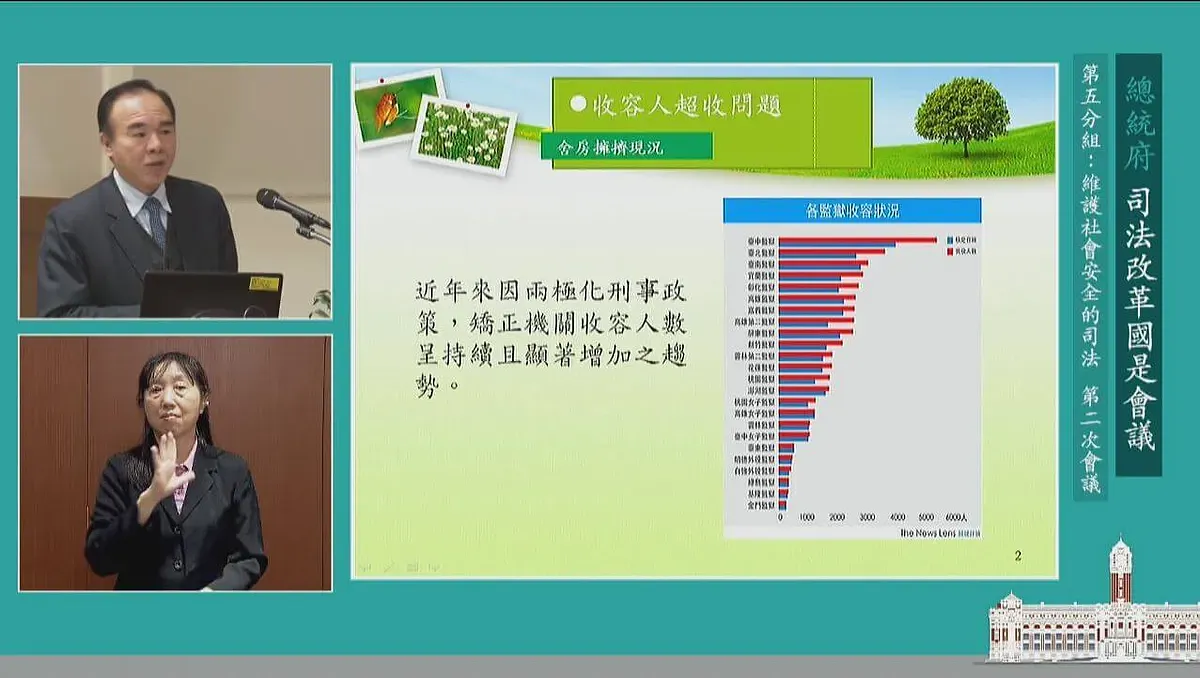
Review: The Second Meeting of the Fifth Division of the "Presidential Office's National Judicial Reform Conference"
Last edited: 2026-07-27
-
The chairperson first explained that on March 13, the Preparatory Committee agreed to add the issue of "Review of the Juvenile and Gender-Friendly Judicial System" (5-5). Because this may overlap with the issue addressed by the First Division (Protection of Victims and Vulnerable Groups), the Preparatory Committee agreed to the addition while requesting the two divisions to strengthen communication and hold joint meetings if necessary.
-
The pre-meeting resolution resolved to move the two sub-issues originally listed under 5-1—"Execution of Juvenile Criminal and Reformatory Cases and Attribution of Responsibilities" and "Evaluating the Comprehensive Transformation of Juvenile Reformatory Schools into Juvenile Correctional Schools"—to the newly added 5-5 "Review of the Juvenile and Gender-Friendly Judicial System."
-
This meeting lasted about four and a half hours, discussing five sub-issues concerning prison administration system reform (5-1). The next meeting is scheduled for March 30, with the topic of discussion being 5-3 "Effective Combating of Crime."
Discussion Sub-issues and Opinions
-
Overcrowding of Inmates
Represented by the Director-General of the Agency of Corrections, the Ministry of Justice stated that the statutory living space per inmate should currently reach 0.7 pings, but prisons currently only provide 0.5 pings. The solutions proposed by the Ministry of Justice include adjusting transfer operations and expanding or building new correctional facilities.
Member Lu Ying-chieh opined that prison expansion should not be adopted as a conclusion of the National Judicial Reform Conference, nor is it suitable as a primary solution. Member Lin Wen-wei argued that the focus of improvement should lie in reviewing front-end criminal policies to reduce the inmate population, rather than back-end "one bed per person." Member Hsu Chu-feng also suggested that the correctional and moral-reform functions of prisons should be strengthened to prevent inmates from reoffending and repeatedly re-entering prison after release, which is the only way to resolve the dilemma of overcrowded prisons.
-
Enhancement and Expansion of Prison Administration Manpower and Facilities
The Director-General of the Agency of Corrections stated that the high staff-to-inmate ratio is currently caused by prison overcrowding, a high turnover rate of guards, and a shortage of professional personnel. In terms of facilities, overcrowding and aging prison facilities have also led to poor living quality. Specific solutions include expanding manpower, improving housing space, and using smart monitoring systems to alleviate the burden on prison staff.
Member Lin Wen-wei argued that the shortage of prison administration manpower is a false issue, as its root cause is overcrowding. In addition, the duty system for prison guards should be revised. Member Lin Wen-wei stated that to date, an Enforcement Act for Prison Guards has not yet been established, making it easy for prisons to act independently and resulting in divergent management methods for inmates; furthermore, there are no explicit regulations on working hours for guards, leading to irregular and excessively long working hours. Member Lin Wen-wei suggested establishing an Enforcement Act for Prison Guards modeled after the Occupational Safety and Health Act for civil servants to protect the labor rights of prison guards.
Regarding prison administration manpower, both Member Liu Pei-yuan and Member Lu Ying-chieh emphasized that the recruitment of professional moral-reform personnel should be heavily supplemented, and the recruitment of professional moral-reform personnel should be segregated from that of custody personnel. Member Wang I-fan also stated that the recruitment of prison personnel requires strengthening examination subjects such as psychological counseling and guidance, and she can offer the examination subjects for juvenile investigators as a reference.
Regarding the enhancement of prison facilities, Member Lin Wen-wei mentioned that facilities should be substantially improved to meet humanitarian standards, such as reviewing water rationing, power rationing, and the location of meal-delivery hatches. Member Liu Pei-yuan also pointed out that using water and power rationing as disciplinary measures in disciplinary cells urgently needs review. Member Chou Su-chien further emphasized that basic prison infrastructure such as sanitation and lighting should be prioritized. She also pointed out that ensuring the health of inmates can better save National Health Insurance costs.
-
Current Status of Prison Medical Care and Improvement Suggestions
A representative from the Ministry of Health and Welfare stated that since inmates were included in the National Health Insurance scheme in 2013, their medical conditions have improved significantly, and current prison medical treatment spaces have been inspected and found to meet standards.
Member Lin Wen-wei questioned the current situation where guards are responsible for dispensing medication and the conditions for medical escorts outside the prison. Regarding medical escorts outside the prison, he pointed out that due to the lack of professional medical personnel on duty at night and on holidays, non-professional personnel are left to determine whether an inmate should be sent out for medical care. In addition, the application of restraints during medical escorts outside the prison is not evaluated by medical professionals, which may cause optimal medical treatment time to be missed due to the use of restraints. Furthermore, when inmates require hospitalization, enhanced monitoring and custody in the hospital room itself should replace more inhumane restraints such as handcuffs and leg irons.
Member Liu Pei-yuan also explained from the perspective of inmates that although joining National Health Insurance has improved inmates' medical conditions, inmates must write reports and wait for approval to see a doctor, thus requiring a long wait that is often too slow to meet urgent needs. Member Chou Su-chien emphasized that prison medical care should be viewed from a human rights perspective rather than a prison management perspective. The current correctional system possesses only the Peite Medical Prison, which is clearly insufficient, and the Ministry of Health and Welfare should be requested to support the establishment of additional medical prisons.
-
Inmate Treatment and Transparency of Parole
The Director-General of the Agency of Corrections explained that Taiwan uses three criteria—the circumstances of the crime, post-crime behavior, and recidivism risk—as evaluation standards for parole. Reform directions include establishing localized recidivism prediction models by referencing domestic and foreign research, providing victims with the opportunity to make statements, establishing objection procedures for inmates, and introducing external experts to participate, thereby making the parole procedure more transparent.
Approaching from the perspective of the accuracy of parole procedures, Member Ch'en Hung-ta suggested that experts and scholars should be invited to participate in the recidivism risk assessment of individual cases in parole procedures. Member Wang I-fan does not recommend conducting risk assessments only at the time of parole application; she suggested referencing practices from juvenile cases to investigate and understand inmates' recidivism risks and needs as early as possible, and propose treatment plans. Inmate daily life should then be arranged according to the treatment plan during imprisonment, and whether parole should be granted can be judged based on the implementation status of the treatment plan when applying for parole.
Member Huang Hsu-t'ien believed that the antagonistic relationship between inmates and victims should be addressed, and prisons should provide assistance. While improving inmate treatment, public perception should also be transformed.
Member Lu Ying-chieh proposed that the progressive treatment system should be abolished, or if there are difficulties, it should at least be decoupled from parole.
Member Lin Chih-chieh added that Article 78 of the Criminal Code concerning the revocation of parole does not account for the severity of the new offense, a situation that needs to be changed. Currently, once a parolee intentionally commits another crime during parole, the parole is invariably revoked, which tends to cause heavy sentences on parole to be revoked for minor offenses, posing a risk of imbalance between severity and punishment.
A common example is a person released on parole for a life sentence whose parole is revoked due to drunk driving, requiring them to re-enter prison to serve the remaining sentence. Because such cases suffer from a severe disproportionality in disposition, some judges will sentence them to exemption from punishment to prevent their parole from being revoked. -
Review of Judicial Relief Channels for Criminal Execution Procedures
A representative from the Ministry of Justice explained future legislative amendment directions, which include allowing lawsuits and statements of objection to be filed for matters other than parole, allowing statements of objection to be filed against the Ministry of Justice's review decisions regarding parole matters, and hoping that the Judicial Yuan will establish a specialized parole division to adjudicate parole cases. A representative from the Judicial Yuan stated that the establishment of specialized courts should take case volume into consideration, and the current case volume is not large.
Member Lu Ying-chieh also raised the possibility of establishing a hearing-model parole review procedure, alongside the establishment of a grievance system and external relief procedures. She pointed out that the low case volume is due to the fact that previous administrative litigation results were mostly dismissed, which lowered inmates' willingness to file lawsuits; if a specialized division is established in the future, the focus should be on changing mindsets, and the statements of objection the Ministry of Justice intends to adopt do not meet the requirements of due process of law. Member Liu Pei-yuan shared his experience: because inmates can submit parole applications once every four months, administrative litigation is usually unresolved by then, and the litigation period has long dragged past four months, allowing them to reapply for parole. Moreover, when administrative litigation takes place, moral-reform officers must submit defenses, so to avoid mutual trouble, inmates mostly choose to wait rather than pursue administrative litigation. Therefore, inmates mostly file administrative litigation only when they feel desperate about the results of their next application.
Meeting Resolutions
-
Review criminal policies to reduce the inmate population.
-
Establish an external prison visiting committee to periodically inspect prisons and submit reports on correctional facility-related matters, such as medical care, treatment, and improvement of basic living conditions.
-
Requirements for the professionalization of prison personnel, such as reforms in examinations and appointments, and strengthening on-the-job training. Increase the placement of professional personnel such as clinical psychologists and social workers; the Ministry of Justice should formulate operational and management guidelines for prison personnel. Prisons should be categorized into light, moderate, and heavy management modes, equipped with reasonable manpower.
- Establish a correctional environment meeting basic living requirements:
- In terms of management and punishment, the deprivation of inmates' basic living requirements shall not be used as a means, such as water and power rationing, and restrictions on communication and visitation systems shall be reviewed to swiftly achieve the basic requirement of one bed per person.
- Establish application standards for disciplinary cells, solitary confinement cells, and calm rooms (including entry criteria, time limits, and counseling measures).
- Perfect humanitarian treatment, such as budgeting for and improving ventilation and lighting equipment in housing units based on the inmate population.
-
All prison measures shall not deprive inmates of their human dignity, such as the location of meal-delivery hatches and toilet facilities.
-
The provision of medical services in all prisons should be balanced, and prisons should formulate an "evaluation procedure for medical escorts outside the prison and medical parole." In addition, relevant competent authorities are requested to provide a written evaluation report (including costs, funding, benefits, stakeholder perceptions, etc.) within one month regarding "establishing correctional institution-affiliated medical institutions by region" and "the Ministry of Justice and the Ministry of Health and Welfare setting up medical special zones in medical institutions near correctional institutions."
Review Comments
This meeting has entered substantive discussions and reached resolutions of great significance, hoping to improve the plight of inmates. However, the author also observed in this meeting that the reform directions of government agencies are insufficiently proactive; the author harbors deep concerns regarding whether such an attitude can truly achieve reform.
-
Regarding the issue of inmate overcrowding, the report submitted by the Ministry of Justice did not show any review of the policy favoring heavy sentences; it merely adopted remedial measures of expanding and building new prisons to create more space to accommodate more inmates. This article strongly agrees with the ideas proposed by the members, because the current dilemma of prison overcrowding is actually caused by the failure of the "polarized criminal policy"—that is, leniency is insufficient while severity is extreme, resulting in overcrowded prisons.
-
Continuing the aforesaid opinions on criminal policy review, there were also discussions during the meeting on the decriminalization of certain crimes. This article believes that crimes with unclear legal interests protected or those protecting merely moral ethics should be decriminalized, meaning offenses such as adultery and copyright cases should be resolved through civil procedures. This would not only alleviate prison overcrowding but also substantially decrease the number of criminal cases, allowing judicial resources to be more appropriately allocated.
-
In terms of the expansion of prison administration manpower and facilities, the manpower proposal put forward by the Director-General of the Agency of Corrections clearly cares only about "custody" while neglecting "moral reform." Perhaps due to limited government budgets, the government prefers to spend money where it can show "tangible achievements"—namely, ensuring inmates do not escape—while the effectiveness of moral reform does not matter. If this is truly the mindset of the competent authorities, the failure to reduce the risk of inmate recidivism may cause a greater waste of social costs.
-
Regarding inmate treatment and parole transparency, the Director-General of the Agency of Corrections consistently maintained that current practices are sufficiently transparent and open. However, the current parole system is held hostage by the progressive treatment system, meaning inmates must obtain a certain number of points before applying for parole, yet the awarding and revocation of points are entirely determined by prison supervisors without fixed standards, easily leading to arbitrariness. Moreover, when parole reviews fail, the reasons given to inmates are insufficiently specific, and inmates have no substantive participation or opportunity to express their opinions. How can this be called "transparent"? Furthermore, the reform proposal he put forward, which includes "giving victims the opportunity to make statements," must be approached with caution. Perhaps because the release of an offender on parole may cause fear in victims, the competent authorities believe victims' opinions should be heard. However, the significance of the parole system is to allow inmates who have truly repented to leave prison before the completion of their sentences; first, victims do not spend time living with the offender in prison and thus cannot know whether they have repented; second, theoretically, victims and inmates hold opposing stances, and how their statements should be evaluated is questionable. Therefore, this article believes that to eliminate the rejection mentality of victims or society towards inmates released on parole, efforts should start from making recidivism risk assessments precise and parole transparent, enabling the general public to understand the assessments and physical and mental conditions upon which upcoming released inmates are granted parole. If the government truly values victims, it should strengthen one-stop services, psychological counseling, and other resources when victims encounter problems. Furthermore, victims and inmates who are willing to attempt relationship restoration should be allowed to communicate sincerely with each other in a safe environment, understanding the harm originally caused and the possibilities for future change.
After watching the recording of this meeting, the author believes that prison administration reform cannot be separated from "education"; only with successful education can reform be smoothly implemented. First of all, the competent authorities are ultimately constrained by budgets, and budgets are controlled in the hands of elected representatives. Under the current social atmosphere, the prevalent view is that "inmates have no human rights because they did wrong," and improving prison facilities is often criticized as "living too comfortably," placing immense pressure on correctional institutions. Therefore, changing the public perception is an urgent priority. Furthermore, high recidivism rates among inmates are often related to social labeling and stigmatization; many individuals are forced to return to their old ways and re-enter prison simply because they cannot successfully reintegrate into society. Therefore, a judiciary that safeguards social safety is actually closely intertwined with education. When people no longer hold negative perceptions of the prison system, and when rehabilitated individuals are no longer subject to discrimination at every turn, prison administration reform can truly be considered a success.
Trivia: What is "Progressive Treatment"?
Progressive treatment is a measure for managing inmates in prisons. Progressive treatment divides inmate treatment into four stages, advancing progressively based on the inmate's performance during their execution period in the institution. The higher the stage, the more favorable the treatment. It is hoped that through this, inmates' sense of responsibility can be stimulated, helping them repent and improve, and reintegrate into social life.
The treatment of inmates with sentences exceeding six months is divided into four grades, starting from the fourth grade. According to Article 19 of the Prison Prisoners Treatment Act, their sentence length, applicable regulations, criminal frequency (habitual or repeat offenders), and offense category (adult offenders or juvenile offenders) all affect their responsibility points. The achievement scores earned by inmates each month can offset their responsibility points; once fully offset, they can gradually advance to the third, second, and first grades.
For example, according to Article 54 of the Enforcement Rules of the Prison Prisoners Treatment Act, "Inmates of the fourth grade may be permitted to meet with relatives and send and receive correspondence"; Article 55 stipulates that "Inmates of the third grade and above may, to the extent that it does not hinder moral reform, be permitted to meet with non-relatives and send and receive correspondence"; Article 56 stipulates that "Inmates of the fourth grade may be permitted to have visits or send and receive correspondence once a week, third-grade inmates once or twice a week, second-grade inmates once every three days, and first-grade inmates without restriction." By extension, as an inmate's treatment gradually progresses from the fourth grade to the first grade, the controls placed upon them are progressively relaxed. In other words, fourth-grade inmates receive the strictest treatment and constraints, whereas first-grade inmates have more independent space in preparation for reintegration into social life.
| Treatment | Fourth Grade | Third Grade | Second Grade | First Grade |
| Visitations and Correspondence |
|
|
|
|
Inmates must reach the second grade of progressive treatment before they can apply for parole, while the first grade mandates prompt reporting for parole. The current linkage between progressive treatment and parole is as follows:
-
Inmates must reach the second grade of progressive treatment before they can apply for parole, while the first grade mandates prompt reporting for parole.
-
Inmates within different sentence length brackets have different responsibility points, and the accumulated scores required to apply for parole vary significantly. For example, for a sentence of 3 to 6 years, the responsibility points for the second grade are 108, whereas for a sentence of 6 to 9 years, the second-grade responsibility points are 144. Inmates' monthly score promotions are calculated in units of 0.1 points. Whether a judge sentences someone to 5 years and 11 months or 6 years and 1 month makes a huge difference in the amount of accumulated scores required for an inmate to apply for parole.
-
Applying for parole requires an inmate's scores in moral reform, labor, conduct, and other categories to be 3 points or higher within the last three months. Once an inmate violates regulations and fails to meet this score condition, they cannot apply for parole for at least three months.
The linkage between progressive treatment and parole serves as a very convenient management tool for prison guards. Because inmates care deeply about their scores, it is easier to manage order. However, this system still produces quite a few side effects. One side effect is that inmates with long sentences find it difficult to gain score promotions, whereas inmates with short sentences find it easy. Consequently, short-term inmates care little about scores themselves, whereas long-term inmates care deeply. As a result, a phenomenon arises within prisons where short-term inmates bully long-term inmates. Furthermore, using progressive treatment to control prison order easily leads prisons to overlook inmates' reintegration issues. After all, progressive treatment scores merely make inmates obedient in prison; they cannot truly assist inmates in reintegrating.
Regarding whether the progressive treatment system should be abolished, reference can be made to the written materials submitted by Member Chou Su-chien. Member Chou Su-chien pointed out that Taiwan's current progressive treatment system is combined with parole and unilaterally decided by officials, carrying the implication of state grace, which violates the concept in current legal philosophy that the "right to social reintegration is an inherent right of inmates." In addition, to enforce the progressive treatment system and differentiate hierarchical treatment, prison authorities may end up depriving inmates of basic human rights and living treatment so that the management hierarchy can control more bargaining chips, which also runs the risk of unconstitutionality. Therefore, relevant authorities should re-examine the progressive treatment system, its relationship with the parole system, and even rethink what role prisons should play in the process of inmate reintegration.
This article is an AI-generated translation of the original Chinese text. In the event of any discrepancy, the Chinese version shall prevail.