
A Small Step for Police Name Tags, a Crucial Step for Sustaining Democracy
Last edited: 2026-07-27
※ Photo source: Tsz-tai Weihsin; thanks to “Udndata - Naruhodo” for granting permission to republish the full text
In the blink of an eye, the Sunflower Student Movement is about to reach its third anniversary. Recently, civil society groups returned to the site of the demonstration to protest the fact that the legislation for the oversight bill remains uncompleted.
However, the lingering questions left behind by the movement three years ago are not limited to the oversight bill. Late on the night of March 23, crowds occupied the Executive Yuan, and subsequently over a hundred citizens were prosecuted, with first-instance verdicts yet to be handed down. On the other hand, during the forced evictions that night, the manner in which force was deployed by the police, and the specific legal basis for each action, remain without accountability or investigative procedures to this day. Regarding that night, the police and the public each hold their own versions of events; believers remain steadfast in their beliefs, leaving the matter unresolved.
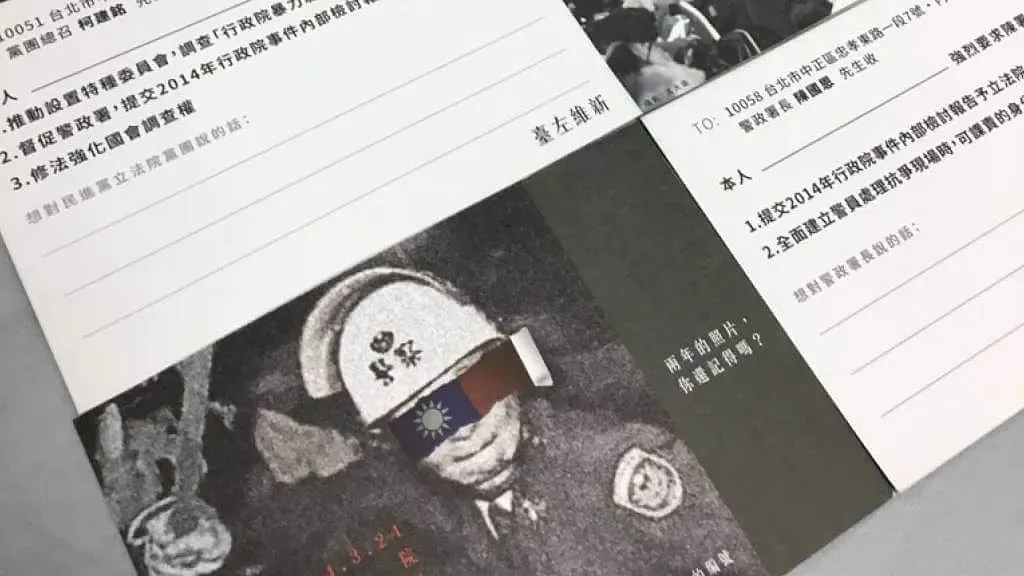
One of the key reasons is that, no matter how many images were captured at the scene, without officers wearing name tags, it was fundamentally impossible to identify the individual officers involved, making it naturally impossible for any investigation to begin.
The Elusive Police Name Tags That Never Seem to Appear
This is not the first time that clarification has been rendered impossible after protest conflicts due to "being unable to find the person." For instance, during the protests on April 10, 2004, where the People First Party and the Kuomintang claimed the presidential election was unfair, then-PFP Legislator Ch'in Hui-chu and Shen Chih-hui accused police of beating them during the eviction and demanded an investigation. However, because the Taipei City Police Department stated it was unable to identify the officers at the scene, the matter was ultimately dropped.
rWhen civil servants perform their duties while wearing name tags, on the one hand, it ensures that in the event of a dispute, specific individuals can be identified to initiate investigations, clarify the full picture, and establish responsibility. On the other hand, it is believed to enhance the officers' awareness of performing official duties in accordance with the law, as well as the public's sense of trust. Past judicial reform demands included propositions that judges should display name tags when presiding in court. After judges began wearing name tags in 1999, the quality of court proceedings did indeed improve; according to Judicial Yuan questionnaire results, the public largely expressed support for this measure.
In 2006, the Legislative Yuan passed a supplementary resolution to the general budget bill, demanding legal amendments to strengthen the identification of police officers and the wearing of name tags. Yet the National Police Agency beat around the bush, initially changing name tags to police emblems, then repeatedly convening meetings to revise them under the pretext of being too expensive and heavy, and finally "suspending discussion" in 2009 on the grounds of "global economic deterioration." Although the Control Yuan pointed out that the National Police Agency's actions constituted negligence, its investigation report failed to change the status quo.
Foreign Controversies Regarding Police Name Tags
How to effectively hold police accountable for law enforcement is not a challenge unique to Taiwan. To resolve investigative difficulties arising from anonymity and to enhance officers' awareness of the law and public trust, many jurisdictions—including the United States, Canada, and the United Kingdom—now require police officers on duty to wear standard-issue name tags printed with their full names in designated positions (such as outermost garments, the chest area, etc.).
However, demanding that police wear name tags is not without controversy, and the policy has sparked considerable boycotts and backlash in various places after its rollout.
For example, in 2011 in Oakland, USA, an on-duty police officer at a protest site covered their name tag with black electrical tape. Protesters questioned the commander (who was wearing a name tag) about the reason, and upon the commander's instruction, the officer reluctantly tore the tape off. A video of the process was uploaded online.
This was not an isolated incident. In London in 2009 and Toronto in 2010, during large-scale protest duties, incidents occurred where police officers collectively removed or concealed their name tags. At the time, Toronto police disciplined approximately 90 officers who had removed their name tags, leading to a legal challenge brought before the Ontario Labour Relations Board, which argued that the requirement to wear name tags was inherently unreasonable.
rOpponents of the name tag policy argued that wearing name tags might increase the risk of police officers facing attacks, or expose them to doxxing that could endanger the safety of their friends and family, while also violating officers' privacy rights.
In response, the Labour Relations Board rejected these arguments, ruling that the requirement to wear name tags was reasonable. Comparing data on assaults on police officers before and after the 2006 rollout of the name tag policy, there was no evidence showing that wearing name tags increased the risk of officers being attacked, nor had there been any retaliatory crimes targeting specific officers' families. Furthermore, it is not easy for ordinary members of the public to obtain other personal information about an officer or their family merely by relying on an officer's name tag.
At the same time, some commentators have pointed out that, compared to name tags, officers' personal social media accounts or official press releases actually reveal far more personal information. Indeed, a quick flip through Taiwan's news reports or the Facebook pages of various police units makes it easy to find information on outstanding police officers commended for cracking major cases or enthusiastically serving the public; police departments also frequently have active-duty officers shoot promotional photos or videos while introducing their names, ages, units, and other information.
Leaving Blind Spots or Standing Tall?
rHow to harness the positive effects of name tags on accountability and discipline while simultaneously alleviating the concerns of frontline officers is an ongoing challenge for the future. For example, whether to allow exceptions to remove name tags in specific assault or pursuit scenarios, or to maintain identification numbers while allowing the general public to query officer information associated with those numbers, are all discussions currently in progress.
Professor Hung Wen-ling (洪文玲) of the Central Police University has pointed out that police colleagues need to actively remind and monitor each other regarding potential abuses of power. However, based on practical experience thus far, accountability mechanisms among police peers seem to become less effective the larger the controversy, such as in large-scale forced evictions.
This is not due to individual police officers possessing particularly low legal knowledge or moral standards. No one likes to be supervised, and police are no exception. When antagonism escalates and external pressure mounts, empathy among colleagues leading to a shared defensive stance is human nature. Coupled with a lack of whistleblower protection mechanisms, it is difficult to expect any officer to stop or report a colleague.
Moreover, driven by the needs of leadership and command—and fearing the destruction of subordinates' trust as well as their own career prospects—superiors are prone to tending toward making big issues small and small issues nothing. Therefore, external accountability mechanisms remain necessary.
In a democratic society, all exercises of public authority cannot escape accountability. Administrative officials are no exception, nor are elected representatives, judges, or police officers. Yet, no matter how upright and impartial the investigative and supervisory systems may be, as long as the involved officer cannot be found, the truth behind law enforcement disputes cannot be clarified. If this is the case, no matter how rigorous the regulations governing police law enforcement are written, under a failing accountability mechanism, they remain mere empty words.
To be sure, Taiwan's police enjoy a high degree of trust from Taiwanese society, and whenever law enforcement disputes arise, public opinion overwhelmingly backs the police. However, enjoying trust is not a reason to be exempt from accountability. Should the police squander this trust by maintaining an anonymous blind spot that allows them to cut off accountability through "no such person" when necessary, thereby preserving the unchallenging nature of police power? Or should they overcome aversion and anxiety, stand tall with their heads held high, present clear legal bases for law enforcement, demonstrate the professional confidence of law enforcement personnel, and win broader trust? The answer goes without saying. (Postscript: Finding the Shoulder-Tapping Cop: Lessons for Taiwan from the Verdict in the Hong Kong Umbrella Movement 'Seven Police Assault Case')
The day after the Executive Yuan incident, Professor Jeffrey Martin of the University of Illinois, who has long studied Taiwan's police, wrote:
Taking allegations of police violence seriously is extremely important and should not devolve into mere verbal sparring. ... If a country's police cannot fulfill their professional duty to maintain order using the minimum necessary force, democracy will struggle to survive.
The choice of whether or not to wear them, much like the judges' name tags in judicial reforms twenty years ago, is a small first step in accountability, but its symbolic significance is by no means small.
This article is an AI-generated translation of the original Chinese text. In the event of any discrepancy, the Chinese version shall prevail.