
Review and Notes: The Third Meeting of the Second Division of the Presidential Office's National Judicial Reform Conference
Last edited: 2026-07-27
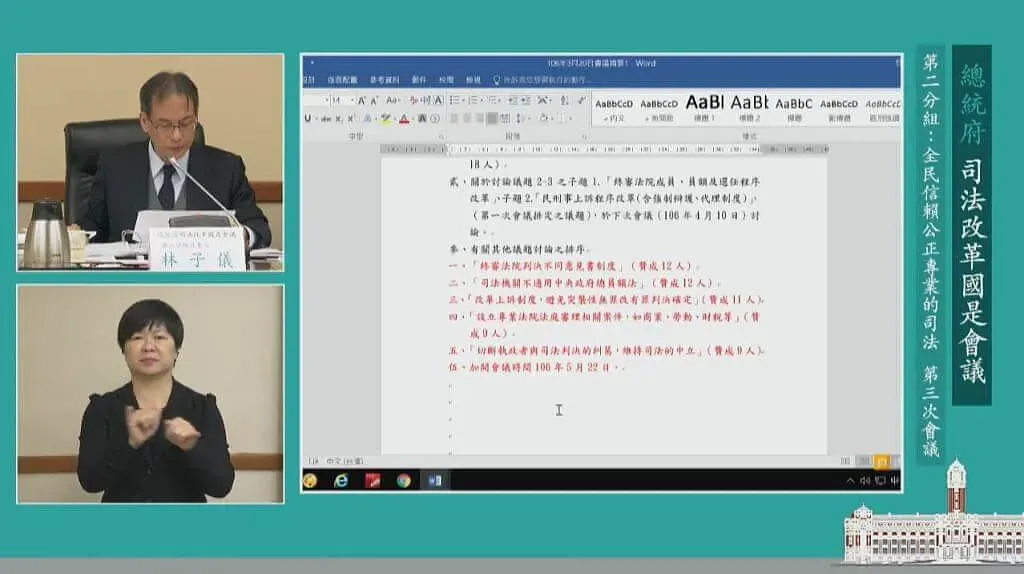
The third meeting of Division 2 of the National Judicial Reform Conference was held on March 20 to primarily discuss complementary measures for the constitutional review of judicial decisions. Notably, the scope of discussion was not entirely limited to the constitutional review of judicial decisions itself; some complementary measures will also apply to the currently operating unconstitutionality review mechanism. Therefore, this meeting will have a profound impact on our country's future constitutional interpretation practice.
General Discussion—Complementary Measures Related to the Constitutional Review of Judicial Decisions
The Judicial Yuan reported that after the introduction of the constitutional review of judicial decisions, current constitutional interpretation practices will need to undergo certain modifications. The reasons for these changes, aside from an increase in case volume requiring more resources to handle, largely involve adjustments made to address the current ineffectiveness of constitutional interpretation. Therefore, the following discussion allows us to examine the unconstitutionality review system from a more comprehensive perspective, rather than assuming these adjustments apply solely to the constitutional review of judicial decisions.
-
Who has the standing to petition for the constitutional review of judicial decisions?
The proposal was passed by vote, establishing that, in principle, individuals whose rights have been infringed may petition, while the Prosecutor-General may exceptionally petition in the public interest when individuals have suffered rights infringements.
The issue in contention here is who may petition for the constitutional review of judicial decisions. There was no dispute in the meeting that individuals have the right to petition; the controversy lay in whether prosecutors may do so. Prosecutor Wu Hsün-lung cited the Supreme Court's 2004 Tai-Shang-Tzu No. 2949 Judgment concerning the right to privacy, noting that erroneous legal interpretations by the Supreme Court affect prosecutors' practical operations. He argued that in such circumstances, the Prosecutor-General should also be permitted to petition for the constitutional review of judicial decisions, otherwise current dilemmas cannot be resolved.
Opponents argued from the perspective of German law that Germany also limits petitions to individuals who have suffered infringement, and other situations do not need to be handled through the constitutional review of judicial decisions. For instance, such matters might constitute extraordinary appeals and should thus be addressed via extraordinary appeals, or they might fall under other provisions of Article 5 of the Act Governing the Adjudication of Cases by Grand Justices of the Judicial Yuan. Therefore, it is not the case that all types of matters must be funneled into constitutional review for resolution.
-
Case-Selection Criteria
The proposal was passed by vote, holding that the Grand Justices' case selection must be explicitly prescribed by law, requiring "constitutional and principled importance" as well as "contributing to the realization of fundamental rights, or that the petitioner will suffer particularly grave damage due to the dismissal of the petition."
The issue in contention here is whether the Grand Justices' case-selection criteria need to be explicitly codified in law. The Judicial Yuan took the view that standards can gradually accumulate through the Grand Justices' practical operations. However, those advocating for legal codification argued that this is required by the principle of transparency, enabling the public to clearly understand what criteria their petitions must meet.
Behind the Judicial Yuan's concerns lies the question of whether written reasons must be provided when dismissing constitutional interpretation petitions. If explicitly prescribed by law, decisions of dismissal might encumber the efficiency of constitutional interpretations. Looking at comparative law, in the United States, the Supreme Court independently determines its acceptance criteria, whereas Japan accepts nearly all cases, resulting in noticeable differences in the quality of constitutional interpretation outcomes.
-
Decision-Making Method
The proposal was passed by vote to lower the required voting threshold from the current two-thirds to a simple majority of all Grand Justices, namely eight members. In other words, decisions on whether a case is unconstitutional will henceforth be reduced to a simple majority vote.
This issue is related to the normalization of court hearings. Grand Justices have been somewhat reluctant to convene Constitutional Courts because current laws stipulate that once convened, a constitutional interpretation outcome must be rendered within two months. In other words, under a two-thirds majority requirement, Grand Justices faced immense schedule pressure; lowering the voting threshold will also help normalize court hearings.
-
Should the Court Render Judgment Itself?
The motion was passed by vote, permitting Grand Justices to render their own judgments.
There was some controversy during the discussion of this issue, which must be explained from the role of the Grand Justices. Since Grand Justices constitute a court of law rather than fact, strictly speaking, they do not handle issues of fact-finding—even under the system of constitutional review of judicial decisions. In constitutional reviews, Grand Justices merely discuss whether the process of applying laws and regulations in the case raises unconstitutional issues, rather than whether the fact-finding was erroneous. Therefore, whether Grand Justices can render judgments themselves regarding facts may require further deliberation. Furthermore, if the Grand Justices ultimately render their own judgment and that judgment requires execution, the question of who will execute it arises—a problem currently experienced by administrative courts, for example.
Arguments favoring the rendering of judgments by the Grand Justices themselves proceeded from the perspective of reducing legal remedies procedures for individuals. If individuals are required to apply for retrials based on Grand Justice interpretations, it seemingly imposes greater litigation costs. Therefore, Grand Justices should be allowed to make direct decisions to spare individuals from the burdens of litigation.
Ultimately, a consensus was reached that when only questions of law are involved, Grand Justices may render judgments themselves without having to invariably revoke the original judgment and remand it; in other words, Grand Justices can independently decide whether or not to issue a judgment.
-
Dismissal of Petitions Without Statement of Reasons
Passed by vote.
-
Passed Unanimously: Mandatory Legal Representation for Individuals Petitioning for Constitutional Interpretation
Passed by vote.
-
Passed Unanimously: Non-Retroactivity
Passed by vote.
-
Open and Transparent Case Management
Under current procedures, three Grand Justices (a three-member panel) first decide whether to accept a case before submitting it to the full body of fifteen Grand Justices for a resolution. Currently, the progress of cases is publicly announced online after review by the three-member panel.
-
Can Constitutional Interpretation Petitions Be Made Public?
The Judicial Yuan considered further discussion necessary because cases may involve unrelated third parties, and the final resolution urged the Judicial Yuan to formulate a system for publicizing petition documents.
-
Attribution of Authorship for Grand Justice Interpretations
Passed by vote; future Grand Justice interpretations must indicate which Grand Justice authored the opinion.
Currently, the text of Grand Justice interpretations represents the joint opinion of fifteen individuals, resulting in low efficiency and a tendency to endlessly debate individual words and phrases. Allowing the outside world to know which Grand Justice authored the opinion will help promote judicial democracy.
-
Attribution of Voting Records
Passed by vote, allowing the outside world to know the voting results on the constitutionality of Grand Justice interpretations.
This sub-topic is an extension of authorship attribution. Attribution should not merely let the outside world know who wrote the opinion, but also let the public know the voting process. Attributing votes helps outsiders understand how the judgment's structure was formed, such as which judges considered the provision constitutional and which considered it unconstitutional. Currently, one can only guess based on the presence of dissenting or concurring opinions, which is insufficient.
-
Normalization of Oral Argument Proceedings
Passed by vote; oral argument proceedings will be required in principle.
Comments
Although this meeting was merely an extension of the second meeting and did not delve into the originally scheduled topics of "reforming appeal procedures," "pyramiding litigation," and "reforming the staffing of courts of final instance," it holds immense significance for judicial reform. This is because the resolutions adopted at this meeting will drastically alter constitutional interpretation practices. As we often say, Grand Justices are the guardians of human rights, and enhancing the efficiency of constitutional interpretation is inextricably linked to the protection of human rights.
Whether the current institutional design of constitutional interpretation can fulfill the constitutional spirit often relies heavily on the composition of the Grand Justices. Comparing the composition of Grand Justices across different eras reveals that, without significant institutional changes, the number of interpretations rendered has decreased year by year. However, following the inauguration of new Grand Justices last year, the efficiency of constitutional interpretation has notably improved, demonstrating that who serves as a Grand Justice is closely related to interpretation efficiency. If we wish to avoid human-factor issues, we need changes in institutional design.
There is a major impact regarding the enhancement of efficiency. First is the lowering of the voting threshold. Historically, the voting threshold was set excessively high due to historical reasons: early on, Grand Justices rendered Interpretation No. 76 determining who constituted the parliament, which displeased the Legislative Yuan, prompting them to directly amend the law to set the voting threshold at three-fourths, significantly raising the bar for Grand Justices to reach conclusions on constitutionality. Subsequent legal amendments only lowered the threshold to two-thirds. In comparative law, such a design is unreasonable; nearly all countries adopt a simple majority rule.
Beyond increasing efficiency, public consensus has also formed around the democratic accountability of the judiciary. Although the judiciary must premise itself on judicial independence, amidst the trend of deepening democracy in recent years, it can no longer hide in the shadows and remain unwilling to be scrutinized by the public. Alongside advocating for authorship attribution for lead opinions, this meeting also introduced the further step of voting attribution—allowing the legal reasoning of individual Grand Justices to be brought out into the sunlight and examined by the public. Such a decision greatly aids democratic accountability.
A sound institutional design can compensate for individual discrepancies. Whether the conclusions of this meeting can be genuinely implemented certainly requires further oversight, but with a consensus reached among both non-legal and legal participants, the reform of constitutional interpretation is right before our eyes. We look forward to the Grand Justices living up to expectations and playing their roles as competent guardians of the Constitution.
Meeting Documents
- Integration of the Commission on the Disciplinary Sanctions of Functionaries and the Supreme Administrative Court_Written Opinions of Judges Kuo Jen and Hung Cheng-hsiung_Document No. 2-3-Disc.3
- Reform of Civil and Criminal Appeal Procedures_Meeting Materials Provided by the Judicial Yuan_Document No. 2-3-Disc.2
- Reform of Staffing for Courts of Final Instance_Meeting Materials Provided by the Judicial Yuan_Document No. 2-3-Disc.2
- Explanation of Formulating Complementary Measures for the Constitutional Review of Judicial Decisions_Meeting Materials Provided by the Judicial Yuan_Document No. 2-3-Disc.1
- Explanation of Criminal Appeal Procedure Reform_Opinions Provided by the Ministry of Justice_Document No. 2-3-Disc.2
- Reform of Supreme Court Judge Staffing_Written Opinion of Committee Member Lin Chih-chung_Document No. 2-3-Disc.2
- Petitioners for the Constitutional Review of Judicial Decisions_Written Opinion of Committee Member Wu Hsün-lung_Document No. 2-3-Disc.1
- Sexual Assault Controversies and Judicial Credibility_Presentation by Committee Member Chang Sheng-hsing_Document No. 2-3-Disc.2
- The Pathologies of Trial Efficiency and Conflicting Judgments_Presentation by Committee Member Chang Sheng-hsing_Document No. 2-3-Disc.2
- Introduction to Laws Related to Offenses Against the Administration of Justice in the United States_Written Opinion of Committee Member Wu Hsün-lung_Document No. 2-3-Disc.3
- Opinions on the Prioritization of Subsequent Issues_Written Opinion of Committee Member Shih Tz'u-liang_Document No. 2-3-Disc.3
- Supplementary Opinions on Establishing the Constitutional Review of Judicial Decisions_Written Opinion of Committee Member Cheng Yü-shan_Document No. 2-3-Disc.1
- Reform of Civil and Criminal Appeal Procedures_Written Opinion of Committee Member Cheng Yü-shan_Document No. 2-3-Disc.2
- Opinions on Reforming the Membership, Staffing, and Selection Procedures of Courts of Final Instance_Written Opinion of Committee Member Cheng Yü-shan_Document No. 2-3-Disc.2
- Journal of Democracy and Governance 2017: Why Taiwanese Citizens Do Not Trust the Judiciary_Materials Provided by Committee Member Wang Chin-shou_Document No. 2-3-Disc.3
This article is an AI-generated translation of the original Chinese text. In the event of any discrepancy, the Chinese version shall prevail.
