
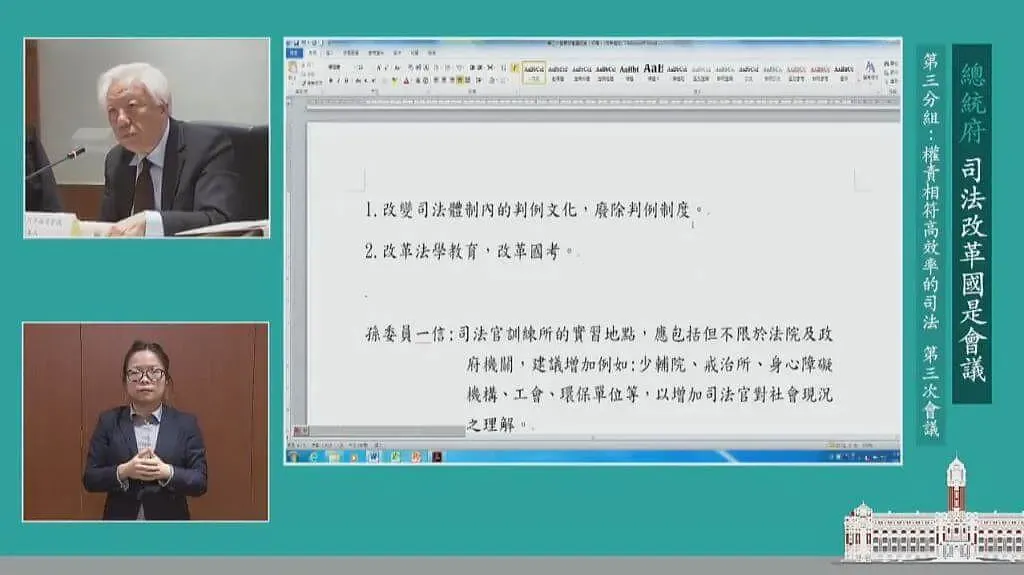
Brief Notes: Third Meeting of Group 3 of the Presidential Office's Judicial Reform National Consultation Conference
Last edited: 2026-07-27
Topic Diversified Recruitment of Judges and Prosecutors
Problem to Address Alleviating the shortage of judges, introducing professionals, and making judgments more impartial
Current Status Article 5 of the current Judges Act already provides for the diversified recruitment of scholars and attorneys, but results have been poor, with only attorneys transferring positions. Therefore, this meeting aimed to review whether related regulations should be relaxed.
Meeting Proposals
-
Relaxing Appointment Methods for Judges and Attorneys
(1) Relaxing university teacher certificates for full-time professors, associate professors, and assistant professors as the basis for qualification to hold judicial offices as judges.
Proposer's Explanation It is hoped that by relaxing the qualifications for scholars to serve as judges, more scholars will enter the adjudication system to contribute their expertise.
Committee Members' Opinions
- Some members suggested that not only should the qualifications for appointing judges and prosecutors be relaxed, but the training process should also be streamlined, and scholars should not be required to start as probationary judges, thereby increasing their willingness to serve as judges and judicial officials. In response, the Judicial Yuan stated that relevant supporting measures have already been stipulated in the selection regulations planned by the Judicial Yuan, ensuring scholars will not have to go through such a lengthy procedure before serving as judges.
- Under the current system, scholars are reluctant to transfer to judgeships because of heavy workloads and the inability to fully utilize their expertise, as well as trial culture restrictions such as the system of precedents that limits their scope for free play in individual cases. Therefore, this reform would have limited practical benefit.
Voting Result The proposal was passed by a vote.
(2) Establishing a system of part-time judges and fixed-term judges filled by legal professionals.
Proposer's Explanation This proposal was submitted by the Judicial Yuan. Its explanation stated that part-time judges have the same duties as regular judges, while fixed-term judges acting as associate judges are not required to write judgments but can provide opinions. It is hoped that this will help supplement the judicial workforce and allow professionals to participate in adjudication in specialized cases (e.g., financial cases).
Committee Members' Opinions Members' opinions were mainly divided into two parts: first, whether positions should be held by legal professionals; and second, the appropriateness of establishing systems for part-time and fixed-term judges.
- Some members asked who would serve as part-time judges, and whether the lack of life tenure protection for these judges might raise constitutional concerns. The Judicial Yuan responded that anyone who undergoes selection may serve as a part-time judge, and because these judges are selected through a vetting process, there are no unconstitutionality concerns.
- Some members believed that under this system, if professionals sit on the adjudication bench, defendants might not be able to cross-examine them due to their status as judges, which could infringe upon the defendant's right to confrontation.
- Some members noted that Taiwan differs from Germany's "three-in-one" system, where German law graduates acquire qualifications as attorneys, judges, and prosecutors immediately upon graduation; Taiwan lacks such a system, and Taiwanese professors may not have passed the national examinations or received relevant training—would the public feel at ease with this?
- The majority of speaking members at the meeting believed that positions as part-time and fixed-term judges should be restricted to individuals with legal training to prevent them from failing to play fair and objective roles in court.
- The majority of members at the meeting also believed that the wording of the proposal should be made more abstract to allow the Judicial Yuan more room for deliberation.
Voting Result After multiple revisions to the proposal, the members passed it by a vote.
-
Improving the Working Environment and Culture for Judges and Attorneys
(1) Maintaining the current diversified recruitment channels while improving the judicial official training system, judicial environment, workload, occupational dignity, economic conditions, and retirement security to increase incentives for senior attorneys and scholars to transfer to judgeships.
There was originally a proposal from the Ministry of Justice aiming to abolish the judicial official examination and training system within a set timeframe, but it failed to pass the vote. Subsequently, a similar proposal submitted by another committee member was discussed.
Proposer's Explanation Merely relaxing the appointment qualifications for judges and prosecutors is insufficient to achieve the goal of diversified recruitment for judges; reforms must begin from the fundamental level by improving working systems and cultural dimensions.
Committee Members' Opinions Members did not raise many opinions regarding this case.
Voting Result The proposal was passed by a vote.
(2) Changing the precedent culture within the judicial system, and reviewing the systems of precedents and resolutions of the Supreme Court's civil and criminal division meetings.
Proposer's Explanation: Precedents themselves hinder the advancement of legal science and affect how judges ascertain facts and apply law. Furthermore, there are too many subjects on the national examinations, causing candidates to answer based solely on keywords rather than training suitable judicial officials.
Committee Members' Opinions Speaking members almost universally criticized the precedent system, arguing that it affects judges' independent adjudication and strips away the background facts of cases. If diversified recruitment continues to apply the precedent system, diversified recruitment will become an empty promise, and thus it must be reviewed.
Voting Result The proposal was passed by a vote.
(3) Internship locations for the Judges Academy should include, but not be limited to, courts and government agencies; it is recommended to add grassroots social welfare organizations and social reform groups—for example: juvenile correction schools, drug戒治 institutes (rehabilitation centers), disability institutions, labor unions, and environmental protection units—to increase judicial officials' understanding of current social conditions.
Proposer's Explanation The current judicial official internship system fails to give judges a deep understanding of current social conditions. It is recommended to add internship locations so that the goal of diversified recruitment can be better achieved.
Committee Members' Opinions Members did not raise many opinions on this, only suggesting that other locations could be added after the word "examples" in the proposal so that judges can intern in different places.
Voting Result The proposal was passed by a vote.
(4) Increasing supporting personnel and necessary hardware equipment for judges and prosecutors to reduce their workloads. Simplifying written rulings. Reviewing the allocation of personnel in the Taiwan High Prosecutors Office and Taiwan High Court, and designing mechanisms that allow personnel from the High Prosecutors Office and High Court to flow back to district prosecutors offices and district courts.
Proposer's Explanation The quota of judicial assistants should be increased to assist judges, reduce their workloads, and raise the quality of judgments. In addition, current written judgments waste judges' lives; only by addressing this can the proportion of transfers to judgeships be increased.
Committee Members' Opinions
- This proposal originally did not mention prosecutors. A member proposed that the workloads of prosecutors and judges are actually linked, and therefore "prosecutors" should be added to the proposal.
- Some members suggested that focus should be placed on how to reduce workload, as state resources are limited, making increases in personnel quotas and equipment less practical.
- Some members suggested reviewing the decriminalization of minor offenses to reduce case volumes, but the chairperson explained that this matter falls under the scope of discussion for Group 5 and thus would not be discussed here.
Voting Result The proposal was passed by a vote.
This article is an AI-generated translation of the original Chinese text. In the event of any discrepancy, the Chinese version shall prevail.
