
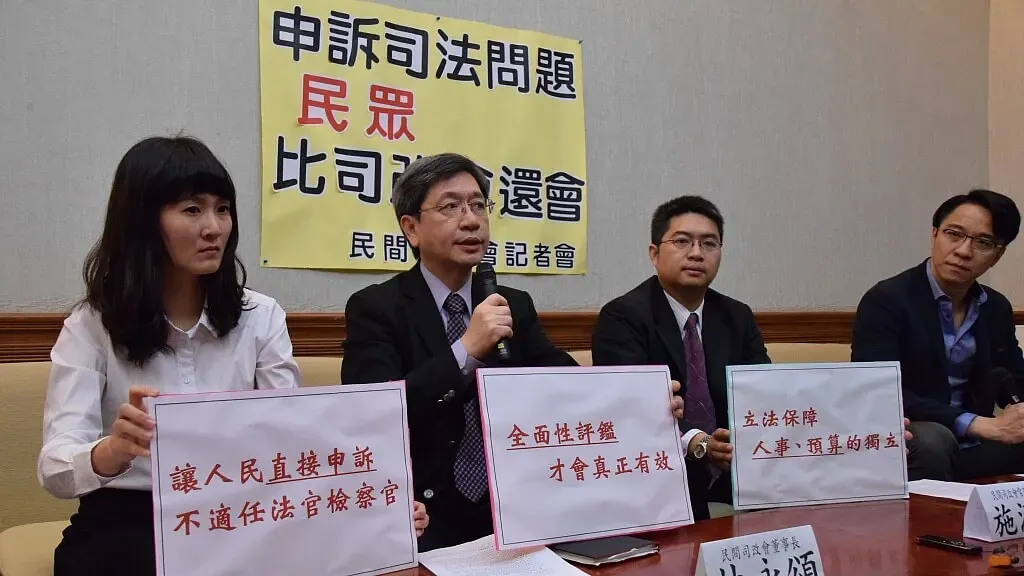
Appealing Judicial Issues: The Public is Better at It Than the JRF!
Last edited: 2026-08-24
More than five years have passed since the individual evaluation system for judges and prosecutors took effect in January 2012, yet it has repeatedly been criticized by the public as ineffective — making it an important issue that the public believes the National Conference on Judicial Reform must address. As one of the parties entitled to request evaluations, the Judicial Reform Foundation (JRF) believes the design of the current evaluation system has considerable room for improvement. At a press conference held today (the 31st) in Room 102 of the Legislative Yuan's Zhongxing Building, JRF called on the National Conference on Judicial Reform to "prescribe the right remedy for the disease" and put forward the following three specific reform proposals.
Allowing the Public to File Complaints Directly Against Unfit Judges and Prosecutors
Under the current Judges Act, members of the public cannot file complaints against judges or prosecutors directly; complaints must instead be submitted indirectly through specific agencies or organizations (such as JRF or bar associations). This design shows that the official Judges Evaluation Committee and Prosecutor Evaluation Committee are not only evading their responsibility to communicate directly with the public, but are also "shifting" onto private organizations a frontline responsibility for receiving public complaints that the authorities themselves should bear — reinforcing the public's sense that the judiciary remains remote and inaccessible. What, then, is left of any claim to a "people-friendly judiciary"?
Moreover, consider what would happen if a private organization, for lack of resources or other reasons, stopped accepting public complaints: the Judges Evaluation Committee and Prosecutor Evaluation Committee could effectively grind to a halt, since "if the private organization does not operate, the Committees cannot operate either." Is such a system design reasonable? In fact, over the past five-plus years, had JRF not continued to process public complaints, the track record of the two Committees would look even worse.
In reality, the people who care most about judicial and prosecutorial performance — and who have the most courage to file complaints — are often those who personally experienced the case. Even lawyers sometimes hesitate to file complaints for fear of offending a judge or prosecutor. From the outset, the government assumed the public would misunderstand the evaluation system and file "frivolous complaints," and accordingly designed strict barriers to "block" public complaints, shutting the public out of the right to request evaluations. A system that resists communication and dialogue with the public in this way does nothing to advance further interaction between the people and the judiciary.
We therefore believe that future reform of the evaluation system must allow the public to file complaints directly. Only by accumulating public complaint cases and handling experience — and by understanding where the public's concerns actually lie — can the underlying problems truly be resolved. Evaluation of judges and prosecutors should not have discipline as its sole objective, and the evaluation standard should not be set too strictly; otherwise every case will be deemed insufficiently serious and closed without any positive or constructive result. Lowering the evaluation threshold does not necessarily mean harsher punishment or removal in every case — for minor matters, judges and prosecutors could instead be required to improve through education and similar measures. This is the kind of forward-looking system design that is needed. Many cases that do not rise to the level of formal discipline are in fact excellent examples that can help advance the judiciary.
Legislating to Guarantee Independence in Personnel and Budget
The Judges Evaluation Committee and Prosecutor Evaluation Committee are established under the Judicial Yuan and the Ministry of Justice respectively, and depend entirely on those two bodies for budget and staff support. As a result, even though a majority of Committee members are external commissioners, their resolutions remain subject to suspicion of officials "shielding one another."
To ensure the independence and impartiality of deliberations by the two Committees, and to secure their operational momentum, we propose that legislation guarantee them an independent budget — one they may formulate according to their own operational needs — along with independent authority to hire full-time staff. At the same time, given the potentially large volume of cases that could result from allowing direct public complaints, and in order to maximize independence in both personnel and budget, establishing an "Evaluation Foundation" should be considered as an option.
Only a "General Evaluation" Can Be Truly Effective
Although the current evaluation system does include a general performance-review mechanism for judges and prosecutors, the results are not disclosed to the public and are used only for internal administrative reference. Because outside parties have no way of learning the results, the mechanism has proven ineffective and exists in name only.
We believe that, in addition to handling individual evaluations, the evaluation bodies must also conduct "general evaluations" of judges and prosecutors — periodically evaluating the entire body of judges and prosecutors. For example, in evaluating prosecutors, questionnaires should be distributed to case parties, retained defense counsel, the presiding judge, and superior prosecutors; the results should then be used to rank outstanding judges and prosecutors and compile a watch list, made public for citizen oversight — thereby strengthening self-discipline among judges and prosecutors. If the general evaluation process reveals that a judge or prosecutor has engaged in improper conduct, or is otherwise unfit, an individual evaluation could then be initiated on that basis.
Beyond the three core proposals above, other design considerations for the evaluation system include the following: evaluation committee members should include a certain proportion of non-legal professionals in addition to legal professionals, to prevent members of the legal profession from shielding one another; the evaluation bodies must have the power to investigate on their own initiative — for example, where a judge or prosecutor has been the subject of a complaint alleging poor conduct in a particular case, the body should be able to investigate whether the same judge or prosecutor has displayed similarly poor conduct in other cases; and if the evaluation bodies' authority is expanded to include the power to investigate on their own initiative, their nature would shift to resemble that of a prosecuting party — raising the question of whether their power should be limited to referral, and should not extend to direct disciplinary sanction. All of these are matters that should be carefully weighed as part of any accompanying package of reforms.
Attendees
- Lin Yung-sung, Attorney / Chairman, Judicial Reform Foundation
- Shih Hung-cheng, Attorney / Standing Executive Committee Member, Judicial Reform Foundation
- Huang Ying-chia, Attorney / Staff Attorney, Judicial Reform Foundation
- Kao Jung-chih, Attorney / executive director, Judicial Reform Foundation
Press Contact
Judicial Reform Foundation, CEO Kao Jung-chih — (02) 2523-1178
This article is an AI-generated translation of the original Chinese text. In the event of any discrepancy, the Chinese version shall prevail.