
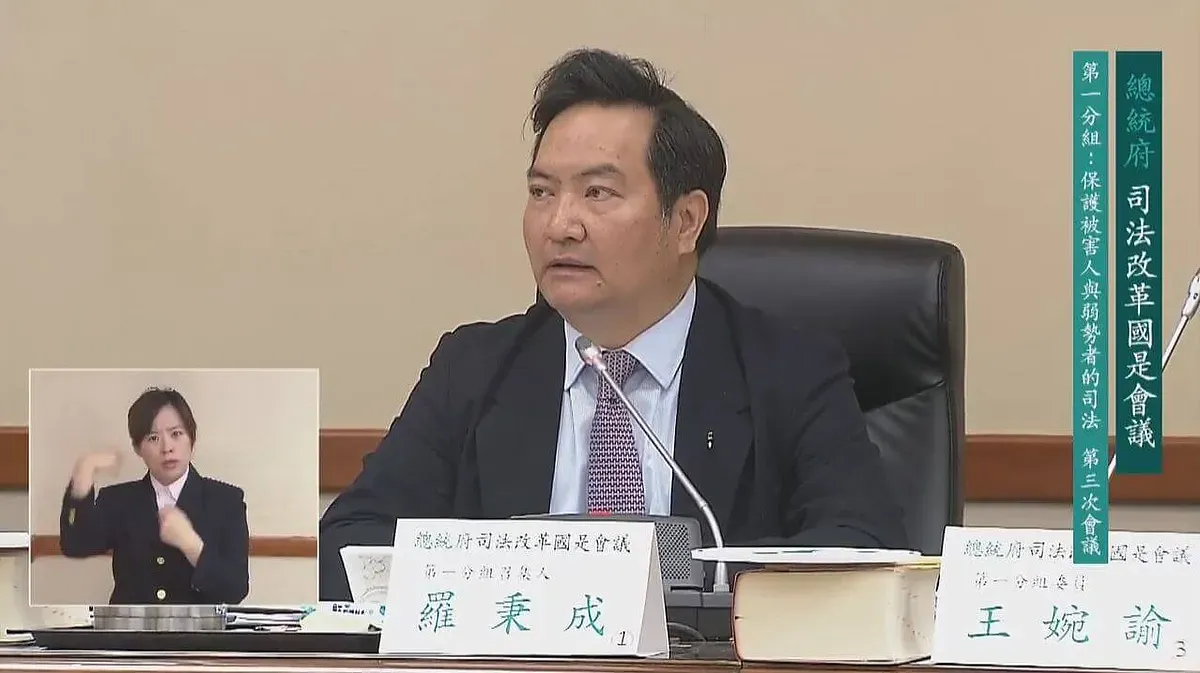
Brief Note: The Presidential Office's National Consultative Conference on Judicial Reform, Division 1, Meeting No. 3
Last edited: 2026-08-24
Committee Members Chang Wen-chen, Lin Chao-chen, Yao Chung-lueh (unverified romanization), and Wang Wan-yu Jointly Proposed Two Items for Discussion
This meeting lasted 3.5 hours, during which Proposal (1), submitted by Committee Members Chang Wen-chen (張文貞), Lin Chao-chen (林照真), Yao Chung-lueh (姚崇略), and Wang Wan-yu (王婉諭), was discussed. The four committee members jointly proposed two items, as follows:
Proposal (1): A reporting and discussion item regarding the implementation of the principle under Article 245 of the Code of Criminal Procedure that a prosecutorial investigation shall not be made public, as well as the "Directions for the Implementation of Non-Publicity of Investigations" (an administrative regulation without an official English title, as translated here) issued jointly by the Judicial Yuan and the Executive Yuan on December 5, 2012, and amended on August 1, 2013.
Proposal (2): A reporting and discussion item on preventing news media from making improper or illegal reports that affect the investigation and trial of judicial cases, and on implementing mechanisms such as competent authorities exercising lawful supervision and strengthening media self-regulation.
Controversial Points regarding Proposal (1) raised by the four committee members:
Why is the principle that prosecutorial investigations shall not be made public still failing to be effectively implemented? Do relevant competent authorities truly exercise strict accountability for law enforcement personnel who unlawfully leak details of cases under investigation? When major public security or criminal cases that attract social attention occur, might relevant law enforcement personnel intentionally leak case details to the media to claim credit or deflect blame, thereby producing specific effects? Are the relevant provisions of the "Directions for the Implementation of Non-Publicity of Investigations," enacted jointly by the Judicial Yuan and the Executive Yuan, still too abstract, general, and broad for frontline law enforcement personnel (especially judicial police) to understand and follow? Should uniform standard operating procedures (SOPs) be formulated for specific case types so that frontline law enforcement personnel can clearly understand which information about cases under investigation can be made public and which must be kept strictly confidential?
Plans:
For violations of the principle that investigations shall not be made public entailing administrative, disciplinary, or criminal liability according to law, the competent authorities [the Judicial Yuan, the Executive Yuan (Ministry of Justice, National Police Agency under the Ministry of the Interior), and the Control Yuan] shall investigate and handle them in accordance with statutory procedures and strictly hold them accountable. Relevant competent units (the Ministry of Justice and the National Police Agency under the Ministry of the Interior) should not base the promotion of law enforcement personnel solely on their case-solving rate or media exposure, but should carefully consider their effectiveness in safeguarding human rights in criminal justice practice. The Judicial Yuan, in conjunction with the Executive Yuan, should deeply review the implementation effectiveness of the May 2012 amendment to Article 245 of the Code of Criminal Procedure and the "Directions for the Implementation of Non-Publicity of Investigations," propose more specific and clear amendments to the overly abstract, general, and broad provisions in the aforementioned Directions, and formulate uniform standard operating procedures (SOPs) for specific case types so that frontline law enforcement personnel can clearly and definitely follow them.
Regarding the plans proposed by the four members, the meeting reached the following resolutions:
To implement strict accountability for those who violate the principle that investigations shall not be made public and who should bear administrative, disciplinary, or criminal responsibility according to law, competent authorities shall investigate and handle them in accordance with statutory procedures and strictly hold them accountable. At the same time, review reports and information regarding relevant investigations and disposition cases should be published periodically.
Prosecutorial and judicial police agencies (the Ministry of Justice, the National Police Agency under the Ministry of the Interior, and other related investigative agencies) should avoid using media exposure or the charges referred as factors when considering the promotion of law enforcement personnel, and should instead consider their effectiveness in criminal justice practice, such as compliance with the principle that investigations shall not be made public and the presumption of innocence.
The Judicial Yuan, in conjunction with the Executive Yuan, shall review the implementation effectiveness of the "Directions for the Implementation of Non-Publicity of Investigations," propose more specific and clear amendments targeting the overly abstract, general, and broad provisions in the aforementioned Directions, and formulate specific guiding principles regarding matters that may be made public. Prosecutorial and judicial police agencies (the Ministry of Justice, the National Police Agency under the Ministry of the Interior, and other related investigative agencies) shall also amend relevant regulations accordingly and establish uniform standard operating procedures to enable frontline law enforcement personnel to follow them clearly. Each investigative unit should implement a spokesperson system and designate restricted interview zones, and law enforcement units such as prosecutorial and judicial police agencies should control the free entry and exit of office areas by media and other personnel unrelated to the case.
Preparatory Committee Member Hsu Yu-hsiu (許玉秀) reminded that the principle that investigations shall not be made public derives from the principle of presumption of innocence, and the two are closely linked issues aimed at protecting the accused. The accused must be allowed to inspect files during the investigation, and granted sufficient rights of defense.
The chair responded that the issue of file inspection during investigation might be discussed in an additional meeting.
The next meeting is scheduled for Saturday, April 8, which will be the first additional meeting to continue discussions on the issues of "forensic science, appraisal mechanisms, and expert witnesses."
Matters not completed during this meeting will continue to be discussed at the second additional meeting on Saturday, April 15.
This article is an AI-generated translation of the original Chinese text. In the event of any discrepancy, the Chinese version shall prevail.