
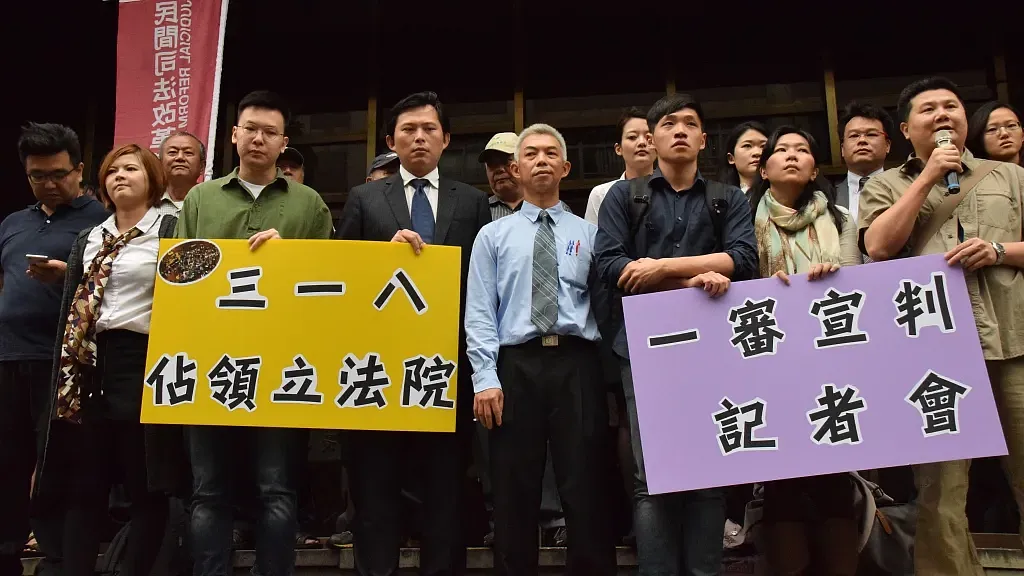
Press Conference on the First-Instance Verdict of the March 18 Legislative Yuan Occupation – Pro-Bono Lawyers Platform Against the Black-Box CSSTA
Last edited: 2026-08-24
Today, the Taipei District Court delivered its first-instance verdict regarding the 22 movement participants indicted for "inciting another to commit an offense," "obstructing public officers," "insulting a public office," and "acting as instigator of an unlawful assembly that failed to disperse" during the "March 18 Legislative Yuan Occupation." The court acquitted all 22 individuals, a decision met with high praise from the pro-bono legal team.
On March 17, 2014, then-Legislator Chang Ching-chung (張慶忠) ignored the countless letters, sit-ins, and public hearings held by civic groups over the previous year to express their opposition. Disregarding the public's fierce questioning regarding the sellout of Taiwan, and under conditions where party dictates superseded the public will, he rushed the Cross-Strait Service Trade Agreement (CSSTA) through in less than 30 seconds, forcibly sending the trade agreement out of committee.
Chang Ching-chung's actions not only demonstrated the arbitrary and authoritarian nature of those in power, but also failed to meet the spirit of democratic deliberation required of the Legislative Yuan under the constitutional framework, signaling the imminent resurgence of the party-state system. To rescue Taiwan's democratic constitutional order, which was then teetering on the brink of imminent peril, many citizens voluntarily entered the legislative chamber on March 18 and continued their occupation of the Legislative Yuan for 24 days. These rising civic actions were not only protected by the freedoms of speech and assembly guaranteed by the Constitution, but also constituted the exercise of the right to resistance — rooted in the principle of popular sovereignty — in an attempt to rescue Taiwan's democracy from the verge of collapse and restore the trampled constitutional order.
Faced with the destruction of the Constitution and the legal order by those in power, as well as executive arbitrariness and legislative dysfunction, the Taipei District Court fearlessly demonstrated the demeanor of a judicial organ serving as the guardian of the people's rights. By recognizing the exercise of the right of resistance and joining awakened citizens in defending and safeguarding democratic values, the court not only established judicial authority and dignity and rescued a gravely endangered constitutional order, but also further highlighted the invaluable nature of the civic will.
We look to the new government to heed the lessons of the people's courageous resistance against injustice, to cease the arbitrary expansion of executive authoritarianism, to implement the basic order of the separation of powers, to respect the collective will of the people, and to refrain from presumptuously using the judiciary to muzzle public expression. We urge the government to respect basic human rights such as freedom of speech and freedom of assembly, and to cherish the democracy and the rule of law that our revolutionary martyrs and predecessors fought for with their blood and freedom.
Attendance List
Pro-Bono Legal Team
- Attorney Yu Po-hsiang
- Attorney Liu Chi-wei
- Attorney Tsai Wan-ting
- Attorney Lo Wan-ting
- Attorney Lin I-wen
- Attorney Lin Chun-hung
- Attorney Tseng Wei-kai
Defendants
- Lin Fei-fan
- Chen Wei-ting
- Tseng Po-yu
- Chou Fu-i
- Tsay Ting-kuei (commonly styled "Tsai" in some non-press sources — please confirm preferred spelling)
- Li Hui-jen
- Huang Kuo-yang
- Wang Wen-pin
- Hsu Shun-chih (please verify this defendant belongs to the 318 case, not the separate 323 Executive Yuan case)
- Wang Hsi-ho (please provide the Chinese characters to confirm romanization)
- Huang Kuo-chang
Judicial Reform Foundation
Chen Yu-fan, Deputy Executive Director
Press Contact
Judicial Reform Foundation, Researcher Ting Yu-cheng — 02-2523-1178 #20
This article is an AI-generated translation of the original Chinese text. In the event of any discrepancy, the Chinese version shall prevail.