
Hsu Tzu-chiang's Practice Exercise for Taiwan's Judiciary
Last edited: 2026-08-24
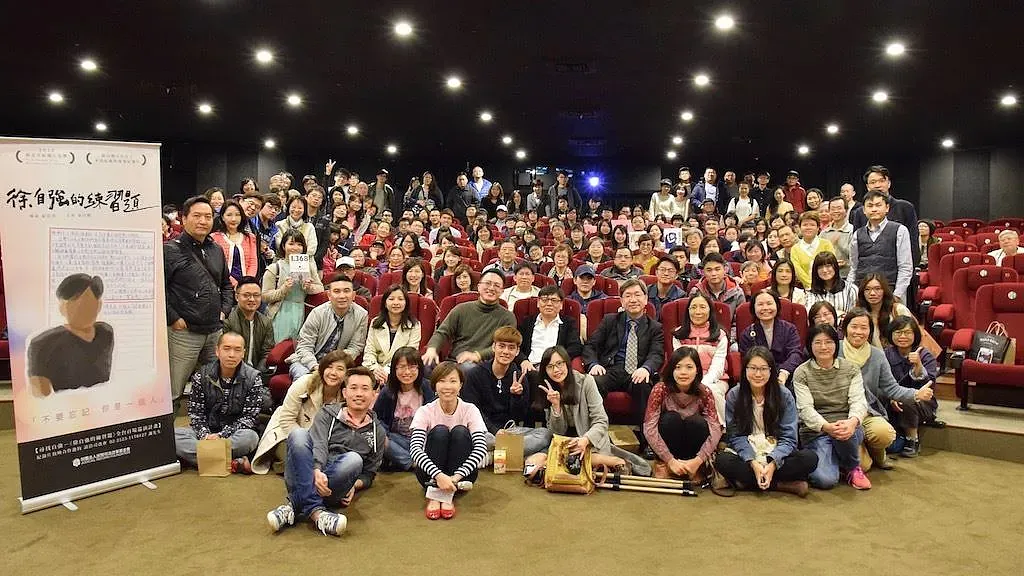
Photo / Group photo of the audience after the premiere of Condemned Practice Mode (《徐自強的練習題》)
The Hsu Tzu-chiang (徐自強) case took place in 1995, a dark era for the judiciary characterized by political interference, corruption, and sloppy case handling. That year, the Judicial Reform Foundation (JRF) was established. Although Hsu and the JRF did not know each other at the time, their fates intersected because of the justice system.
Four years later, in 1999, the Judicial Yuan convened a two-day National Judicial Reform Conference, where one hundred legal elites discussed twelve major issues, including citizen participation in trials, criminal procedure reform, personnel reform for judges and prosecutors, and the evaluation, supervision, and removal of judges and prosecutors. The grand judicial reform conference failed to save Hsu Tzu-chiang. That same year, the Taiwan High Court handed down a death sentence in the fifth retrial, which was finalized the following year, making Hsu a death row inmate awaiting execution.
For better or for worse, the JRF came to know Hsu Tzu-chiang after his death sentence was finalized, and launched efforts to rescue him.
With a death sentence finalized, how was he to be saved? To preserve his life in the first place, it was necessary to attract media attention and academic concern, compelling authorities to stay their hands and spare him from the firing squad. Press conferences were held one after another; petitions were filed requesting the Control Yuan members to investigate, the Prosecutor-General to file an extraordinary appeal, and scholars to conduct judgment evaluations; domestic and international civic groups and human rights organizations were mobilized in solidarity, and a rescue volunteer team was organized.
While rescuing the individual case, the work of changing the system never stopped. Injustices gradually pooled civic strength, slowly driving the gears of judicial reform. In 2004, J.Y. Interpretation No. 582 allowed Hsu's case to reopen the following year, temporarily sparing him from execution and allowing him to continue his frail struggle against the judiciary. That year marked the tenth anniversary of the JRF's founding, and the conclusion of the Judicial Reform Journal read, "The revolution has not yet succeeded; comrades must still strive."
In 2010, a collective corruption scandal involving High Court judges broke out, prompting the passage of the Judges Act, which civil society had advocated for more than a decade. The people of Taiwan finally had a channel to apply for the evaluation of judges and prosecutors; however, the "culture" of the presumption of guilt remained difficult to eradicate. The following year, Hsu Tzu-chiang unexpectedly walked out of prison due to the enforcement of the Criminal Speedy Trial Act. Director Chi began recording him with a camera, and Hsu, temporarily tasting freedom, gave speeches across Taiwan to reclaim the innocence he rightfully deserved from the judiciary.
In August 2014, the JRF and the Taipei Bar Association were invited to visit the Taiwan High Court Tainan Branch to observe "Court Digital Technology." Little did anyone expect that this would become one of the turning points for the exoneration in Hsu's case. Digital technology finally entered the "ancient castle," and the pro bono legal team requested the High Court to hear Hsu's case using a computerized courtroom. The paper transcripts that had been bound within the case files for over a decade were transformed into living evidence presented in court under a 200-inch screen. Students observing the trial remarked, "The co-defendants' contradictions are absurdly obvious; how could the judges not understand?" We felt a momentary sense of relief.
In August 2015, civic groups paid a visit to the presidential candidates, advocating that Taiwan needed thorough judicial reform and that the authorities should establish a standing judicial reform committee. In less than a month, on September 1, 2015, the ninth retrial of Hsu's case resulted in an acquittal. Supporters gathered inside and outside the courtroom hugged and wept that day. However, the Taiwan High Prosecutors Office immediately filed an appeal by "knee-jerk reflex." The High Prosecutors Office's culture of insisting on guilt stimulated the fighting spirit of the rescuers, drawing more attention to the miscarriage of justice, and finally securing funding to publish Hsu Tzu-chiang's story and begin filming a documentary.
In 2016, political rotation occurred, and the gears of judicial reform turned to a critical moment. In her 520 inauguration speech, President Tsai Ing-wen announced the convening of the National Conference on Judicial Reform, and in October, the Supreme Court ruled to uphold Hsu Tzu-chiang's acquittal, finalizing the case.
In 2017, the book on Hsu's case was successfully published. On March 18, during the special screening of Condemned Practice Mode, Ah-chiang said, "Today, I feel like everything is truly over."
Twenty years — a defendant in a wrongful death penalty case went from having no prosecutor in the courtroom to seeing a prosecutor, from standing to being allowed to sit, and from wearing foot shackles twenty-four hours a day to finally having them removed. The judiciary seemed to have progressed. Grassroots judges and prosecutors, dissatisfied with outside criticism, shouted that corruption and sloppy handling were things of the past, as if the future of the judiciary held infinite hope. Yet when Hsu Tzu-chiang said, "It is truly painful, because every judge asked me to prove that I didn't do it. How am I supposed to prove something I never did?" when the target of legal battles remained the unshakable "culture" of the presumption of guilt, had the era when Mother Hsu cried out at the courthouse gates that "the judiciary is unfair" truly passed?
The 2017 National Conference on Judicial Reform continued to discuss the unfinished issues from 20 years ago. The documentary allows us to remember Hsu Tzu-chiang and the twenty-year history of judicial reform we have traversed. The state, the people, and the judges and prosecutors must also never forget.
This article is an AI-generated translation of the original Chinese text. In the event of any discrepancy, the Chinese version shall prevail.