
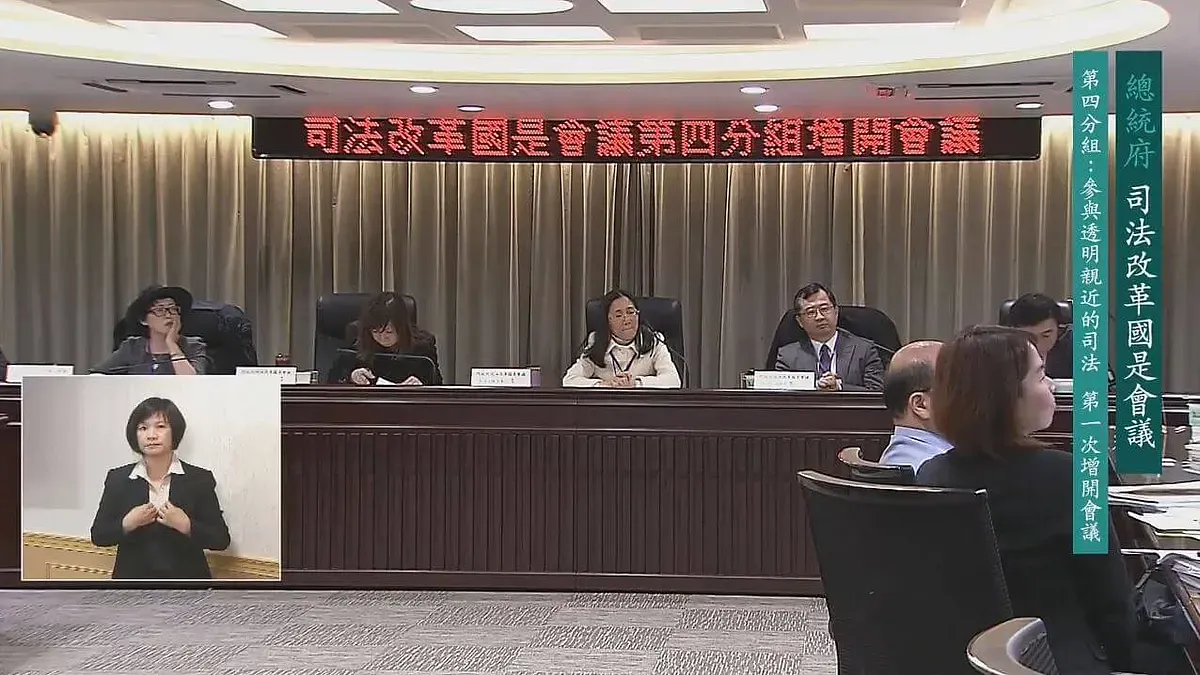
Brief Note: First Ad-hoc Meeting of the Fourth Division of the Presidential Office's National Judicial Reform Conference
Last edited: 2026-08-24
Reports by Agencies, Experts, and Scholars
(1) Kao Jung-chih, Executive Director of the Judicial Reform Foundation
Preferred system: Trial implementation followed by a final policy decision.
Core appeal: Discussions on the jury system thus far seem like pursuing an elusive "dream lover." While this lover has fantastic qualities, many people point out the issues this "dream lover" has had in other countries, such as juries being abolished in France. Why doesn't the JRF instead let go for now and try living with this "dream lover" for a bit without making marriage the prerequisite?
Advantages of the jury system: A jury trial is an elaborate trial. Through a jury, court proceedings become lively, public participation increases, and citizens feel valued by the courts because prosecutors and defense counsel know they must use language that ordinary people can understand to persuade them.
Disadvantages of the lay assessor system: The lay assessor system may allow judges to intervene in decisions made by citizens, ultimately leaving citizens afraid to form their own opinions and swayed by judges. The Judicial Yuan has also argued that the jury system restricts defendants' rights to appeal and deprives them of their right of access to court. However, based on the legal principle of "double jeopardy" and the fact that a jury trial is an elaborate trial, the jury system is inherently unsuited to having its verdicts overturned on appeal. The Judicial Yuan claims the lay assessor system is superior, yet lacks empirical evidence to substantiate this, and the lay assessor system cannot bring about profound judicial reform.
Necessary institutional supplementary measures: Regarding the implementation of the jury system, the JRF believes it should include the single-pleading-document principle, rigorous preparation proceedings, thorough cross-examination, and non-time-consuming centralized trials for the jury system to be successfully implemented. The implementation of the jury system can begin with "fact-finding"; because the "sentencing procedure" is more specialized, it can be temporarily excluded from juries. We hope that in 5 or 6 years, we will no longer just be discussing the pros and cons of this "dream lover," but instead discussing the actual effectiveness of a public participatory trial system after its implementation.
(2) Attorney Li Yi-kuang, Taiwan Bar Association
Preferred system: The lay assessor system, such as Japan's Saibanin system.
Core appeal: We have considerable experience with public participation in trial systems. The purpose of introducing public participation in trials is to assist judges in accurately finding facts and rendering appropriate sentences.
Disadvantages of the jury system: We must prevent trial by media, turning "public participation in trials" into "populist trials." Due to cost considerations, public participation in trials is unsuited for excessively complex cases and should be limited to serious crimes and cases with simple facts. Because Taiwan belongs to the civil law legal family and thus relies more heavily on professional judges, it is unsuited for a jury system. I recommend referencing Japan's Saibanin system and adopting a lay assessor system. I believe the number of lay assessors should exceed that of professional judges so that the opinions of citizens are not overly influenced, and citizens should also have the right to question defendants and witnesses.
Necessary complementary measures: We should also adopt the single-pleading-document principle; otherwise, upon indictment, judges will review the prosecution's dossier and invariably conclude that the defendant is guilty, rendering any fairness to the defendant nonexistent. Furthermore, appeals at the second instance should be changed to a strict appeal review so that lay assessors' opinions at the first instance are not easily overturned. To avoid the frequent wrongful convictions seemingly found under the U.S. jury system, the lay assessor system we recommend includes the participation of judges, making wrongful convictions less likely. We strongly recommend that the public be given the option to choose whether to have lay assessors.
(3) Prosecutor Li Hao-sung, Ministry of Justice
Preferred system: The lay assessor system.
Core appeal: According to a 2014 judicial trust survey by the Organisation for Economic Co-operation and Development (OECD), adopting a jury system or an Advisory Jury System (觀審制) does not inherently demonstrate that one system will definitely increase public trust in the judiciary. When considering "public participation in trials," greater consideration should be given to how to keep the court efficient, fair, transparent, and professional. Germany adopted a jury system from 1848 to 1924 and later switched to a lay assessor system because juries were deemed unprofessional, procedures time-consuming, and requiring massive funding. France originally also adopted a jury system, but switched to a lay assessor system in 1941 due to difficulties in applying the law and finding facts. Japan adopted a jury system from 1928 to 1943, but ultimately abolished it because jurors were deemed unprofessional.
Disadvantages of the jury system: (1) The latter half of Article 8, Paragraph 1 of the Constitution stipulates: "No person shall be tried or punished save by a court of law in accordance with the prescribed procedure." As understood from J.Y. Interpretation No. 392, the "court" referred to in the latter half of Article 8, Paragraph 1 of the Constitution does not include courts composed of juries. (2) The jury system must be paired with complex juror selection procedures, sequestered lodging, and restrictions on media reporting to prevent jurors from being influenced by the media. However, can jurors in densely populated Taiwan be completely insulated from media influence? (3) Civil law codes contain many abstract legal concepts; can jurors fully comprehend them? (4) Jury verdicts do not come with reasons; can the public accept this?
Necessary complementary measures: Regarding the controversy over the single-pleading-document principle, I believe that the more evidence presented by the defendant post-indictment, the less biased a judge's fact-finding will be, since the judge's mindset will not be prejudiced by the prosecution providing relevant evidence against the defendant ahead of time. I disagree with restricting prosecutors' right to appeal in first-instance cases resulting in acquittals, because restricting prosecutors' right to appeal is tantamount to denying crime victims the ability to further contest the defendant's guilt or innocence, which is unfair to victims. Regarding the defendant's procedural right of election, a 2012 ruling by the Supreme Court of Japan stated: "If fair courts are institutionally guaranteed to render appropriate judgments based on law and evidence, even if defendants are not granted the power to choose the application of the Saibanin system, it is difficult to deem it a violation of the constitutional guarantee of a defendant's right to trial by a fair court." While defendants have the right to request lay assessors, if the court refuses, it does not necessarily affect the defendant's rights.
(4) Judge Chen Szu-fan, Judicial Yuan
Preferred system: The lay assessor system.
Core appeal: Public participation in trials helps achieve five objectives: (1) making court trials open and transparent; (2) reflecting public sentiment in judgments; (3) making judicial trial terminology more plain and easy to understand; (4) enhancing public trust in the judiciary; and (5) fostering the public's rule-of-law spirit. Germany, France, and Japan have all adopted lay assessor systems. Norway abolished juries for second-instance felony cases in 2016 and switched to a lay assessor system. Denmark has also switched to a lay assessor system in recent years due to severe criticism over jury verdicts lacking reasons. Historically, several former British colonial countries in the common law legal family—such as India, Singapore, Malaysia, and South Africa—each had complex racial or ethnic compositions; although they originally adopted jury systems, they have all switched to lay assessor systems. Japan has discussed whether to reinstate the jury system, but ultimately voted it down because jury verdicts do not provide reasons for findings of guilt or innocence, and restricting parties from appealing on the grounds of "fact-finding" would likely be difficult for the general public to accept.
Advantages of the lay assessor system: The lay assessor system helps facilitate mutual communication between citizens and judges, prevents unreasonable judgment outcomes in individual cases, and prevents citizens from feeling anxious due to a lack of professionalism during fact-finding. Furthermore, judges can issue reasoned judgments, which helps appellate courts review whether the trial process was reasonable. Although there are concerns that under a lay assessor system, citizens' opinions might be influenced by judges, taking Japan's Saibanin system as an example, Japanese law explicitly mandates that judges strive during deliberations to ensure that Saibanins can fully express their opinions, and deliberation rules also stipulate that citizens must be allowed to state their opinions first. In practical operation, judges are also very careful not to let their own views influence Saibanins' mental impressions (shinshō), thereby avoiding the so-called phenomenon of judges influencing citizens' mental impressions. Regarding whether citizens can decline the lay assessor system, the Judicial Yuan considers it initially inappropriate for citizens to refuse, as based on the South Korean experience, allowing defendants to refuse lay participation would be tantamount to allowing defendants to manipulate court proceedings.
Necessary complementary measures: We support the single-pleading-document principle and believe that appellate reviews under the lay assessor system should be restricted appellate reviews.
(5) Participating Expert: Attorney Yu Po-hsiang
Preferred system: The jury system.
Core appeal: Public participation in trials is a political institution. How to prevent judicial independence was a problem of the past; what we must address now is how to prevent judicial independence from turning into judicial dictatorship. Different life experiences bring more nuanced perspectives to fact-finding. Professional judges in the civil law legal family lack high democratic legitimacy, necessitating public participation in trials to enhance the democratic legitimacy of the judiciary and make the judiciary "the people's judiciary."
Advantages of the jury system: Although jury verdicts do not come with reasons, they can still be reviewed by appellate courts and are not entirely unchallengeable. Regarding the jury system, another comparative law example worth referencing is South Korea. South Korea also has a long history of military dictatorial rule, where the judiciary long served as an instrument of victimization, lacking independence, fairness, and integrity. Prior to introducing the jury system, its level of public trust in the judiciary was comparable to ours. In this realistic environment, South Koreans chose the jury system, and professional judges must in principle respect the jury's verdict of guilt or innocence. Empirical research on the U.S. jury system shows that the conviction threshold for jurors is higher than that for professional judges. The agreement rate between professional judges and jury verdicts is close to 80%; in the remaining nearly 20% of divergent cases, the proportion of acquittals delivered by juries is much higher than that delivered by professional judges.
Disadvantages of the lay assessor system: Regarding the German-style lay assessor system, numerous studies point out that German professional judges form a closed professional community, viewing lay assessors as disturbances to their work and treating them as "outsiders." Through professional authority and informational asymmetry (professional judges read the dossier in advance, while lay assessors are prohibited from accessing dossier evidence), professional judges can easily make lay assessors feel that dissenting views are unwelcome. Consequently, in the vast majority of German cases, lay assessors remain silent and serve merely as window dressing.
Necessary complementary measures: To realize the ideal of a fair court through adversarial proceedings, the Legislative Yuan previously issued a subsidiary resolution requiring the Judicial Yuan to study and introduce the single-pleading-document principle within 6 years. However, the 6-year deadline has long passed, yet the Judicial Yuan has taken no action. The introduction of public participation in trials—whether through a jury system or a large-scale lay assessor system similar to Japan's Saibanin—makes amending the Code of Criminal Procedure to adopt the single-pleading-document principle (as well as related rules of evidence and investigation structures) an urgent necessity. Regarding the appeal system, although Japan and South Korea did not alter their original Code of Criminal Procedure frameworks, years of practical operational results show that judgments rendered by Saibanins or juries should in principle be respected, and appellate courts do not lightly alter or overturn them. The reason France and Germany switched from jury systems to lay assessor systems lies in their high insistence on adjudication by professional judges.
(6) Participating Expert: Professor Lin Yu-shun
Preferred system: The lay assessor system.
Core appeal: The lay assessor system encourages citizens to abandon their consciousness as subjects of rule, bid farewell to the traditional mindset of over-reliance on the state, shape self-public consciousness, and actively participate in public affairs. Judicial trials are also part of the sovereign democratic ruling structure; we expect citizens to base themselves on self-discipline and responsibility and widely participate in the operation of criminal procedures in various forms. If ordinary citizens can participate in the operation of the judiciary alongside professional legal practitioners, the contact points between the judiciary and the public will gradually expand and amplify, which will not only enhance public understanding of the judiciary, but also make the judiciary and the trial process closer to the public, simple, and clear.
Advantages of the lay assessor system: It helps citizens become the protagonists of the courtroom, livens up court proceedings, makes judicial terminology citizen-friendly, and prevents trial delays through centralization.
Complementary measures: Under the lay assessor system, the joint submission of dossiers and evidence should be abolished in favor of the single-pleading-document principle, and appellate reviews should also adopt restricted appellate reviews.
Questions from Fourth Division Members
(1) Member Kao Ju-ping's Question: Do lay assessors or jurors have the right to refuse to attend court?
Kao Jung-chih, Executive Director of the JRF: For lay assessors or jurors, attending court is both a right and an obligation. The higher a country's rule-of-law culture, the more willing lay assessors or jurors will be to attend court.
Taiwan Bar Association: Public lay participation is not a panacea; it can also result in incorrect fact-finding. A defendant's request for public lay participation should merely be a right. For lay assessors, however, it is an obligation.
Prosecutor Li Hao-sung, Ministry of Justice: For lay assessors or jurors, attending court is both a right and an obligation.
(2) Member Li Nien-tsu's Question: Is there a constitutional basis for the obligation of lay assessors or jurors to attend court?
Attorney Yu Po-hsiang: The U.S. Constitution does not derive jury service as an obligation. Member Li's question is a matter of the legislative level.
Professor Lin Yu-shun: This is a matter of policy choice. But if there are lay assessors or jurors who do not want to attend court, would we dare hand over the power of adjudication to reluctant lay assessors or jurors?
Taiwan Bar Association: Under the current Constitution, there is no constitutional basis to require lay assessors to attend court. If the entire populace identifies with public participation in trials, we can amend the Constitution to add a constitutional basis.
Prosecutor Li Hao-sung, Ministry of Justice: The obligation of lay assessors or jurors to attend court may be based on due process of law under Article 8 of the Constitution or the protection of a defendant's right to trial under Article 16 of the Constitution.
Judge Wu Chiu-hung, Judicial Yuan: It cannot be discerned from the Constitution that attendance by lay assessors or jurors is a constitutional obligation. Whether lay assessors or jurors should attend court is a political decision. Whether to require the attendance of lay assessors or jurors may perhaps be prescribed by law pursuant to Article 23 of the Constitution.
Kao Jung-chih, Executive Director of the JRF: The obligation of lay assessors or jurors to attend court lacks explicit constitutional provisions like those in the United States. Perhaps this constitutional obligation can be derived from the principle of popular sovereignty under Article 2 of the Constitution.
(3) Member Chen Yao-hua's Question: Are judges' mental impressions (shinshō) more easily tainted, or are citizens' mental impressions more easily tainted?
Prosecutor Li Hao-sung, Ministry of Justice: It is hard to give a definitive answer. Individuals who have received legal training should be more rigorous and thus better able to make correct judgments.
Judge Chi Kai-feng and Judge Chang Yung-hung, Judicial Yuan: Regarding whether judges' or citizens' mental impressions are more easily tainted, the U.S. jury system was established on the basis of preventing juries from turning into "Red Guard-style" people's show trials; Taiwan seemingly lacks this foundation.
Attorney Yu Po-hsiang: There is no empirical basis showing that professional judges are less susceptible to media influence than citizens. I have seen judges directly bring Next Magazine and Apple Daily to question parties, clearly showing that professional judges may be even more susceptible to media reports than citizens. Taking the famous O. J. Simpson case in the United States, it can be seen that the jury in that case was not influenced by the media.
Kao Jung-chih, Executive Director of the JRF: Empirical evidence is still needed to answer this question. In Taiwan, cases such as the Mommy Mouth case and the model murder case featured extensive media coverage that affected trial fairness. If the authorities lack the will to implement good methods to prevent the media from influencing juries, the jury system will be difficult to implement. I must emphasize that I have a dream for the jury system: if we can adopt the jury system, it will help resolve more than half of Taiwan's problems, including the clarification of statutory content, oral proceedings, centralized trials, and the joint submission of dossiers and evidence.
Taiwan Bar Association: It feels like the media is a manufacturing and heavy-industry sector. When judges review cases, they are less easily swayed by the media and have a clearer understanding than citizens.
(4) Chang Ching: I have a question only for the Judicial Yuan. Judicial Yuan President Hsu Tzong-li said that Taiwan belongs to the civil law legal family and is unsuited for a jury system. Do you accept this? Also, who wrote this report?
Judge Chen Szu-fan, Judicial Yuan: If we are talking about the American-style jury system, Taiwan is unsuited to directly transplanting it. This report is an institutional report and was submitted to and approved by the four senior executives of the Judicial Yuan.
(5) Member Chen Chin-hsien's Question: Can those who support the lay assessor system think of an advantage for the jury system? Can those who support the jury system think of an advantage for the lay assessor system? Furthermore, how long do supporters of the lay assessor and jury systems feel such a system should be pilot-tested before official launch?
Judge Chang Yung-hung and Judge Chen Szu-fan, Judicial Yuan: The advantage of the jury system lies in its ability to completely isolate judges from citizens. However, our theoretical foundation is not rooted in a distrust of judges. No country pilot-tests a public participation in trials system before revising it. Allow me to remind everyone: human rights cannot be pilot-tested, and defendants' interests cannot be pilot-tested.
Kao Jung-chih, Executive Director of the JRF: Regarding trial runs, we hope that northern, central, southern, and eastern regions can be selected to pilot-test both jury and lay assessor systems. In the past, the Judicial Yuan advocated for the Advisory Jury System (觀審制). Yet we saw that advocacy for that system could transform overnight into advocacy for the lay assessor system, demonstrating that policymakers' determination is not necessarily fixated on any single system. The advantage of the lay assessor system is that institutional changes are minor, but the JRF precisely hopes for major changes. We hope jury system cases can be controlled within formal serious crimes, minor criminal cases, or applied in administrative litigation. Some also believe that having citizen juries in administrative litigation would help the public understand the judiciary.
Taiwan Bar Association: To be honest, I cannot see the advantages of the jury system because jurors are laypersons, and layperson trials are not superior to professional judges. Regarding pilot testing, the Japan Federation of Bar Associations once spent a significant amount of time helping lawyers adapt to public participation in trials.
Attorney Yu Po-hsiang: The advantage of the lay assessor system is that the financial burden is smaller and the Code of Criminal Procedure does not require overly extensive amendments.
Professor Lin Yu-shun: Japan's lay assessor system cost 7.8 billion yen during its initial 3-year pilot period. I am not very in favor of pilot testing. As for the advantages of the jury system, we have been taught them since childhood, which is a benefit. Adopting a jury system or a lay assessor system is deeply connected to history and culture.
Prosecutor Li Hao-sung, Ministry of Justice: I do not quite agree with pilot testing. The advantage of the jury system is that it truly implements public participation, but the lay assessor system can achieve this as well. A responsible policymaker must consider how much money the country has.
Questions from Other Division Members
(1) Member Huang Chih-hao's Question: How can proponents of the lay assessor system prevent citizens from being influenced by judges? How should proponents of the jury system prevent sensationalized trials and skyrocketing costs?
Kao Jung-chih, Executive Director of the JRF: We can pilot-test cases for 7 to 10 years to determine the budget. Sensationalized trials must be prevented through judges.
Taiwan Bar Association: Adopting a system where dossiers and evidence are not jointly submitted, and requiring professional judges not to excessively intervene in citizens, can prevent sensationalized trials.
Prosecutor Li Hao-sung, Ministry of Justice: The public has high caliber and presumably will not submit to authority.
Judge Chang Yung-hung, Judicial Yuan: In Japan, which uses a lay assessor system, the Japanese public feels they are unaffected by authority effects.
Attorney Yu Po-hsiang: Regarding the problem of skyrocketing costs, the caseload may not necessarily be too high. In the United States, in fact, the vast majority of jury cases do not suffer from sensationalized trial problems; we have been misled by American courtroom movies. U.S. judges bear a major responsibility in directing litigation and preventing sensationalized trials.
Professor Lin Yu-shun: Both jury and lay assessor systems will encounter the authority effect problem. We should trust the public more. Cost assessments involve the courage of policymakers.
(2) Member Chang Sheng-hsing's Question: Can jurors be interviewed? If a juror's interview content shows bias, can it constitute grounds for a retrial? What sanctions should jurors face for violating confidentiality obligations?
Taiwan Bar Association: Under the jury system, the public disclosure of mental impressions should be prohibited. Under the lay assessor system, mental impressions must be explained.
Prosecutor Li Hao-sung, Ministry of Justice: Even though lay assessors have freedom of speech, there are still confidentiality obligations to heed.
Judge Chen Szu-fan, Judicial Yuan: Japanese lay assessors are not permitted to publicize deliberation proceedings.
Kao Jung-chih, Executive Director of the JRF: Deliberation proceedings should be audio- and video-recorded throughout for subsequent review.
Attorney Yu Po-hsiang: It is very difficult for collegiate panels to provide reasons; criticizing the jury system on the grounds that it does not provide reasons is off target.
Professor Lin Yu-shun: Whether lay assessors will leak trial information involves a country's rule-of-law standards.
(3) Member Chang Wei-chih's Question: Since our focus is on dialogue between legal and non-legal professionals, all participating agencies and experts have used a great deal of professional terminology. Have all participating agencies and experts considered how to explain things to non-legal professionals? If the court knows that the single-pleading-document principle is a potential remedy to break down the judge's mental impressions—which are as impregnable as a copper wall and iron bastion once formed—why has it continuously failed to act? Must it wait for a resolution from the judicial reform? Must it wait until a jury or lay assessor system is decided before acting? This should be a topic for the 3rd Division to discuss; why was it dumped onto the 4th Division?
Prosecutor Li Hao-sung, Ministry of Justice: We will review our terminology being insufficiently citizen-friendly and incapable of dialoguing with non-legal professionals.
Kao Jung-chih, Executive Director of the JRF: Member Chang's words are like the story of the child exposing the emperor's new clothes. The participation system was devised by the Judicial Yuan over the past 5 years without considering the public. The jury system is not without flaws, but there are underlying difficulties. Publishing written decisions, drafting plain-language judgments, communicating with the media, and engaging in effective dialogue between legal and non-legal professionals are all objectives we aim to achieve by promoting the jury system. The judiciary should proactively dialogue with the public now.
Taiwan Bar Association: When clients ask legal questions, they often realize that parties are frequently left standing aside in the courtroom. The courtroom should be lively and look after the people.
Attorney Yu Po-hsiang: I feel apologetic regarding Member Chang Wei-chih's challenge. However, this occurred because the structure of our meeting is unfriendly to non-legal professionals, a structural influence affecting the outcome. The JRF has also presented statistics revealing that across division meetings of the National Conference on Judicial Reform, the proportion of statements made by non-legal professionals was relatively low.
Professor Lin Yu-shun: When writing my report on the lay assessor and jury systems, I also considered whether to address it to non-legal or legal professionals. As it turns out, my report still feels too difficult for non-legal professionals, and I apologize for this. This problem also demonstrates that when citizens participate in trials in the courtroom, they are easily overlooked.
(4) Member Tsai Yuan-shih's Question: How much additional cost and attorney fees will the public incur for jury criminal cases?
Kao Jung-chih, Executive Director of the JRF: The costs of jury trial cases are manageable by the state because we can decide which cases apply, and it is even fine to try applying them in administrative litigation, which resonates more with the public.
Attorney Yu Po-hsiang: Costs and attorney fees will increase under both jury and lay assessor systems. In adopting the jury system, we must also pay attention to strengthening legal aid.
(5) Member Chang Chuan-fen's Question: Regarding advocates of the jury system, how do you confront the issue of human rights protection? For example, do unreasoned verdicts and unappealability potentially restrict human rights protections?
Kao Jung-chih, Executive Director of the JRF: Regarding the appeal system, the JRF has simulated an appeal trial under a jury system. Trial transcripts, judge instructions, and video recordings of deliberation proceedings are all items that appellate reviews can examine.
Conclusions by Agencies and Organizations
Judge Su Su-eh, Judicial Yuan: The U.S. jury system is very expensive; it has even evolved into how selecting jurors affects winning lawsuits, giving the impression that wealthy individuals are more likely to win and creating class inequality problems. U.S. Supreme Court Justices have even stated that when winning or losing a trial depends on money, fairness is completely out of the question. Reform is never achieved overnight; we must proceed step by step. Reform should not be a grandiose fireworks show, and the courtroom should not be a laboratory. Once reform becomes a reality, perfecting complementary measures is an obligation.
Prosecutor Li Hao-sung, Ministry of Justice: Only when we listen more and accommodate more can this public participation system have a possibility of success.
Taiwan Bar Association: For judges, the heaviest workload is writing judgments. Under a jury system, judges do not need to write judgments; under a lay assessor system, judgments must be written. Regardless of the system adopted, consideration should be given to whether incumbent judges will support it, as well as whether it can protect the rights of the people.
Kao Jung-chih, Executive Director of the JRF: The JRF's main focus is that we need to conduct more empirical research, and we are not forcefully pushing the jury system. What we emphasize is that if the Judicial Yuan's resources are limited, it should start with the jury system and then make adjustments as it goes, thereby finding the best system. Taiwan is also heavily influenced by the United States, and we should respond to a certain degree to the public's perception of the American jury system.
Chair's Declaration
Our Fourth Division is scheduled to discuss the "public participation in trial system" at our final division meeting. If agencies and organizations wish to supplement written opinions, please submit them no later than April 28.
This article is an AI-generated translation of the original Chinese text. In the event of any discrepancy, the Chinese version shall prevail.