
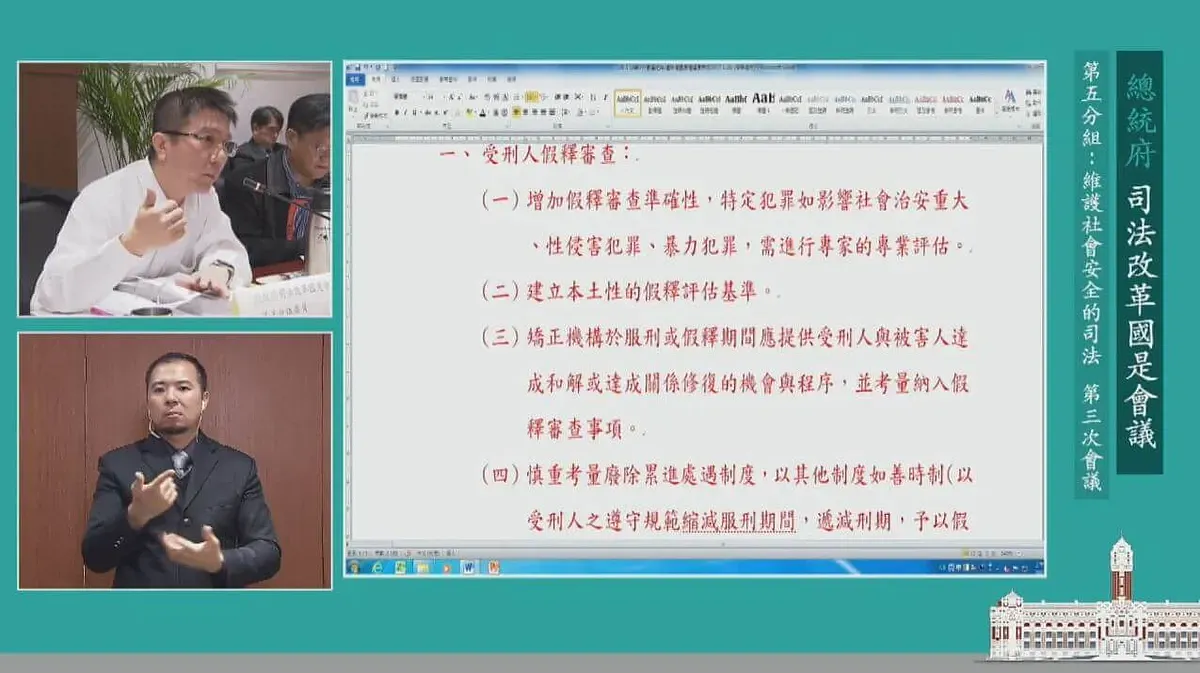
Notes and Commentary: The 3rd Meeting of Division 5, Office of the President's National Consultative Conference on Judicial Reform
Last edited: 2026-08-24
Meeting Summary
This meeting lasted approximately four and a half hours, adopting numerous resolutions on topics including "Review of Anti-Corruption Laws and Regulations," "Strengthening Asset Recovery Mechanisms," and the decriminalization of petty offenses (Copyright Act, defamation). Additionally, several supplementary resolutions regarding the "Prison System Reform" from the second meeting were passed.
The next meeting is scheduled for Thursday, April 20, discussing Sub-issue 5-2: "Review of Criminal Policies on Substance Abuse and Psychiatric Crimes." Topics include the review of anti-drug policies and the policy of imposing heavier penalties for drug offenses, the improvement of diversified treatment programs for drug users and drunk drivers, the prevention of crimes committed by individuals with mental illness, and more.
The 5th meeting on Thursday, May 4, will continue discussing the unfinished sub-issues under "Effective Combat against Crime," which include corporate crime, strengthening flight prevention, offenses against the administration of justice, and sentencing. Furthermore, discussions on investigation management will also continue.
An extraordinary meeting will be held on Thursday, May 11, to discuss Sub-issue 5-4, "Crime Prevention and Management."
The Chairperson mentioned that regarding the issue of "Review of Child-, Youth-, and Gender-Friendly Judicial Systems" (5-5), which was added with the consent of the Preparatory Committee, a joint meeting may be held if necessary. However, this meeting has not yet decided when a joint meeting will be convened.
Discussion Sub-issues and Opinions
Regarding the discussion on the crime of corruption, no intense debate was observed between legal professionals and non-legal professionals. After Committee Members Lu Ying-chieh, Lin Chih-chieh, Tsai Hsiu-juan, and Yu Li-chen each expressed their professional opinions, many resolutions concerning the crime of corruption were swiftly adopted. Among the discussions, consensus was reached on only one proposal—whether to establish an agency more effective than the Agency Against Corruption of the Ministry of Justice—and thus no resolution regarding a specialized agency was made. Notably, Committee Member Lin Wen-wei reminded legal professionals to use terms familiar to non-legal professionals as much as possible so that laypersons could understand; however, his opinion was not given much weight.
Regarding asset recovery, since Committee Member Chiu Chin-ting emphasized that the requirements for provisional attachment remain unclear in the Supreme Court, this division resolved to request the Judicial Yuan to inform the Supreme Court to unify its legal interpretation as soon as possible. Furthermore, because Committee Member Chiu Chin-ting emphasized that the asset recovery methods under the Code of Civil Procedure do not allow securities investors to promptly obtain compensation, the resolutions called for amendments to the Code of Civil Procedure. Because Committee Member Yu Li-chen emphasized that the confiscation system still lacks a dedicated agency with specialized personnel, the meeting also adopted the resolution to "request the government to prioritize supplementing the staffing of prosecutors' offices and establishing relevant mechanisms with specialized personnel and dedicated responsibilities."
Regarding the decriminalization of certain petty offenses, the Chairperson noted that, serving as the president of Business Today, he has long experienced the chilling effect that the crime of defamation exerts on journalists—meaning it makes journalists afraid to pick up their pens to write news. Committee Member Huang Hsu-tien mentioned the issue of frivolous litigation, suggesting that the filing of criminal frivolous lawsuits should be deterred by increasing the criminal litigation filing fees for certain petty offenses. Committee Member Chen Hung-ta pointed out that many public reports of the crime of fraud are filed merely over civil disputes rather than genuine criminal matters, and the issue of frivolous litigation regarding fraud should also be reviewed. However, this division currently decided only to adopt a resolution on defamation: "It is recommended that the crime of defamation be decriminalized, and that damages potentially caused by defamatory acts be handled through civil litigation."
Regarding the issue of investigation management, the Criminal Investigation Bureau advocated that judicial documents deposited at police stations, the long-distance transport of wanted fugitives, and the increase of bailiff manpower in prosecutors' offices and courts—rather than borrowing police officers—should be addressed, and that the <Regulations Governing the Direction and Supervision of Judicial Police> enacted during the Period of National Mobilization for Suppression of Communist Rebellion should be abolished; restrictions on obtaining communication-connection records should be deleted; and the police's authority in emergency searches should be expanded. Nevertheless, the Chairperson considered that these issues all involve major legislative amendments and have a significant impact on human rights, leading to the adoption of the resolution: "Since multiple aspects involve amendments to the Code of Civil Procedure and related laws and regulations, with a profound impact on human rights, it is recommended to reconfirm with the Ministry of the Interior before reporting back."
Meeting Resolutions
I. Confirmation of the Meeting Minutes on the "Prison System Reform" Issue of March 16:
All motions were unanimously voted for and passed by all 18 attending committee members. Committee Member Chi Hui-jung took a leave of absence, and the Chairperson did not participate in the vote.
(I) Recommendations regarding "overcrowding of inmates," "enhancement and expansion of prison administration manpower (such as custodial, reformative, and technical training personnel) and equipment," and "current status and improvement of prison medical care":
Review the penalty system to reduce the inmate population.
Establish an external prison visitation committee to regularly inspect prisons and submit reports on matters related to correctional institutions, such as medical care, treatment, and the improvement of basic living conditions.
Professionalization requirements for prison personnel: (1) Examinations, appointments, and promotions of prison personnel should be reformed, in-service professional training should be increased, and counseling capabilities, legal knowledge, and human rights concepts should be strengthened; (2) The Ministry of Justice should formulate operational and management guidelines for prison personnel in accordance with the Civil Servants Safety and Health Protection Measures; (3) Conduct detailed investigations and classifications of inmates, divide prisons into low-, medium-, and high-security management models, and allocate reasonable manpower; (4) Amend the law to uniformly change the job title of "prison administrative personnel" to "prison officer" to afford them occupational dignity.
Establish a correctional environment meeting basic living needs: (1) The annual operational budget of correctional institutions should be budgeted according to the actual inmate population, and basic living needs such as water and electricity must not be paid out of operational funds; (2) In terms of management and punishment, depriving inmates of basic living needs, such as water and electricity rationing, shall not be used as a means of punishment, and the system restricting correspondence and visits as management and disciplinary measures should be reviewed; (3) Promptly achieve the basic requirement of one bed per person; (4) Establish application standards for disciplinary cells, solitary confinement cells, and calm-down rooms (including entry criteria, time limits, and counseling measures); (5) Improve humanitarian treatment, such as upgrading ventilation and lighting equipment in cells.
All prison measures must not impair the human dignity of inmates, such as the location of food delivery slots, toilet facilities, and the supply of water and electricity.
Improvement of the medical environment: (1) The provision of medical services in all prisons should be balanced, and prisons should formulate an "assessment process for medical treatment outside prison and medical parole, alongside humanitarian measures during medical transfers outside prison"; (2) Furthermore, the Ministry of Health and Welfare is requested to provide a written assessment report (including costs, funding, benefits, stakeholder perspectives, and humanitarian treatment during medical escorts) regarding the "establishment of medical institutions affiliated with correctional institutions on a regional basis" and the "setup of specialized medical zones in medical institutions near correctional institutions" for policy reference.
(II) Inmate Treatment and Parole Transparency
Inmate parole review:
Increase the accuracy of parole reviews, and implement professional assessments by experts for specific crimes such as those severely impacting social order, sexual offenses, and violent crimes.
Establish localized parole assessment benchmarks.
Correctional institutions should provide inmates and victims with opportunities and procedures to reach reconciliation or restorative relationships during imprisonment or parole periods, and consider incorporating this into parole review items.
Carefully consider abolishing the progressive treatment system, utilizing other systems such as the merit-based credit system to adjust the sentence served by inmates, linking it to the parole review threshold in the Criminal Code. Alternatively, decouple the progressive treatment system from parole submissions. (The wording will be separately revised by the Chairperson.)
Although parole reviews in current prisons go through a committee, the committee members do not have contact with the inmates; thus, it is inappropriate to make decisions based solely on the opinions of the moral instruction officers (educators). For the sake of thoroughness, it is recommended that the parole procedure adopt a hearing-like model, incorporating inmate participation and assistance from professionals such as lawyers, while also attaching importance to the opinions of victims or their families and ensuring they are informed of whether they can participate in the parole review procedure.
Revoking parole upon committing a minor offense during the parole period violates the principle of proportionality. It is recommended to amend Article 78 of the Criminal Code to allow discretionary space in parole revocation.
Establish individualized treatment plans for inmates to achieve reformative potential and assist in reviewing the completion of such plans upon parole. Treatment content for specific crimes, such as sex offenses and domestic violence, must incorporate a gender-conscious perspective.
Regarding the handling of juvenile branches, since they are minors protected by law, prosecutors are requested to directly assign them to the Yangming Campus (National Taichung School) for execution upon issuing execution orders, rather than temporarily placing them in adult prisons; it is hoped that the Ministry of Justice will have the courage to take responsibility and implement this immediately. If they are under the age of 23 upon entering the prison, they should be permitted to complete their education without being subject to the upper age limit of 23, and an amendment to Paragraph 3, Article 3 of the Prison Act is recommended. Additionally, in parole practice for juveniles, it is common that parole cannot be filed upon serving one-third of the executed sentence; it is respectfully requested that judicial practice effectively implement the provisions of the Juvenile Justice Act. This shall be recorded and listed as a discussion item for the Issue 5-5 meeting.
(III) Review of Judicial Remedy Channels in Criminal Execution Procedures
Regarding the legislative amendments mentioned in the Agency of Corrections' report (Draft Amendments to the Prison Act, Draft Amendments to the Detention Act), please accelerate the legislative amendment process. Regarding parole rejections and prison matters involving the rights and interests of inmates (such as disciplinary actions), opportunities for complaints and judicial remedies should be provided. The institutional design should comply with the requirements of due process and the right to a hearing, granting prison inmates the right to express their opinions and be represented by professional agents. As for whether judicial remedies should establish specialized courts to handle litigation regarding parole rejections and prison disciplinary dispositions, flexibility is reserved for judicial discretion.
The statements and materials of this issue involving children and juveniles, gender issues, and the Draft Regulations on the Detention and Treatment in Juvenile Correctional Institutions shall be incorporated into "(V) Review of Child-, Youth-, and Gender-Friendly Judicial Systems (5-5)" to be jointly referenced and discussed during the deliberation of that issue.
II. Meeting Records Regarding the Discussion Topic of this Meeting, "Effective Combat against Crime"
The meeting records for this part have not been officially voted on and are still pending revision and confirmation by the committee members.
Review of Anti-Corruption Laws and Regulations
Principle: Utilize the United Nations Convention against Corruption and its enforcement act to grasp global trends, promote benefits while eliminating corruption, and maintain forward-looking dynamism.
Public Sector
Consolidate the Anti-Corruption Act and malfeasance offenses under the Criminal Code regarding constituent elements and penalties.
Coordinating with the adjustment of penalties, grant prosecutors discretionary powers such as suspension of prosecution.
Regarding transparency, sunshine laws, and real-name systems in representative bodies (lobbying, conflict of interest avoidance, asset disclosure), the Agency Against Corruption is requested to provide a brief explanation at the next meeting.
Promptly promote the legislation of the Whistleblower Protection Act.
Private Sector
To achieve anti-corruption and integrity in enterprises and non-profit organizations, criminal penalties for private-sector anti-corruption and commercial bribery should be added.
To strengthen the governance and supervision of foundations (e.g., government-endowed foundations, medical foundations, religious foundations, etc.), the Foundation Act should be enacted as soon as possible and related laws and regulations should be revised.
Promptly promote the legislation of the Public Interest Whistleblower Protection Act.
Strengthening Asset Recovery Mechanisms
The provisional attachment system needs to balance the realization of creditors' interests with the protection of debtors' constitutional property rights. Currently, judicial opinions of the Supreme Court regarding provisional attachment vary, and the evidentiary threshold for prima facie evidence is unclear. The Judicial Yuan should be requested to inform the Supreme Court to unify its legal interpretation as soon as possible.
The establishment of creditor-debtor relationships in class-action lawsuits should take into consideration the prevention of debtors from maliciously transferring assets. Therefore, the Judicial Yuan should promptly amend the Code of Civil Procedure, reviewing regulations concerning provisional attachment and class-action creditor-debtor relationships to ensure that class actions involving securities crimes, food safety crimes, and public safety crimes proceed smoothly.
To implement the special chapter on confiscation and realize judicial justice, the government is requested to prioritize supplementing the staffing of prosecutors' offices and establishing relevant mechanisms with specialized personnel and dedicated responsibilities to strengthen the tracking and confiscation of illicit proceeds from crimes.
Review of Decriminalization of Petty Offenses (Copyright Act, Defamation)
Defamation—Based on the protection of freedom of speech and freedom of the press, and to prevent the use of criminal charges to coerce civil settlements and the abuse of state litigation resources: according to empirical statistics on defamation, out of 28,073 completed investigations of defamation cases from 2014 to 2016, only 5,745 cases were prosecuted, and an observation of all defamation judgments over a three-year period shows that virtually no one received custodial sentences. This clearly indicates that the existence of this offense may interfere with freedom of the press and expression while risking the waste of judicial resources. It is recommended that defamation be decriminalized, and that damages potentially caused by defamatory acts be handled through civil litigation.
Criminal litigation concerning special property crimes (such as quasi-property crimes) should conditionally adopt a fee-based system to prevent prosecutors' offices from becoming accomplices to debt-collection agencies due to frivolous litigation. (The Chairperson instructed that this opinion be forwarded to Division 2 for reference.)
Regarding copyright criminal penalties, as indicated by the report from the Intellectual Property Office, this issue involves matters that must be observed under our nation's economic and trade negotiations and external trade agreements, making direct decriminalization inappropriate. It is recommended to consult experts on how to adjust the legal system, balancing the protection of intellectual property rights and our nation's external economic and trade needs, before reporting back for further processing.
Investigation Management—Investigative Practices and Dilemmas
Coordinate the issue of dual investigative bodies with Division 3 to confirm which division will handle it.
Since multiple aspects involve amendments to the Code of Civil Procedure and related laws and regulations, with a profound impact on human rights, it is recommended that the Ministry of the Interior reconfirm before reporting back. This division will then invite relevant units such as the Ministry of Justice, the Judicial Yuan, and the bar association to respond to the investigative dilemmas and suggestions raised by the National Police Agency.
Commentary
This meeting adopted a great number of resolutions; however, the quality of discussion did not appear very good. Due to the multitude of items pending resolution, discussions for almost every resolution involved only two to three committee members speaking, lacking thorough debate. In fact, as can be seen from the meeting minutes of the 4th Preparatory Committee on February 13, President Tsai Ing-wen hoped that the focus of this National Conference on Judicial Reform would be to help non-legal professionals understand where the dilemmas of the judiciary lie, which aspects of the judiciary deserve criticism, and which aspects should not be criticized based on the inherent nature of the judiciary. However, as can be observed from this meeting, the National Conference on Judicial Reform turned into a "rubber-stamping conference." When a certain committee member raised highly professional opinions within their specialized field, claiming it to be a judicial problem, other committee members seemingly felt compelled to "endorse" it and pass resolutions without having time to truly understand whether that professional opinion could actually solve the judicial problem or not. Non-legal professionals' distrust of the judiciary is the core issue that the National Conference on Judicial Reform was convened to address. Yet, when this conference degenerates into a "rubber-stamping convention" that coerces non-legal participants into endorsing professional opinions they cannot understand, can it truly resolve the problem of "non-legal professionals' distrust in the judiciary"?
This article is an AI-generated translation of the original Chinese text. In the event of any discrepancy, the Chinese version shall prevail.