
Op-Ed: Enacting a Public Prosecutors Office Act to Safeguard Prosecutorial Independence
Last edited: 2026-08-24
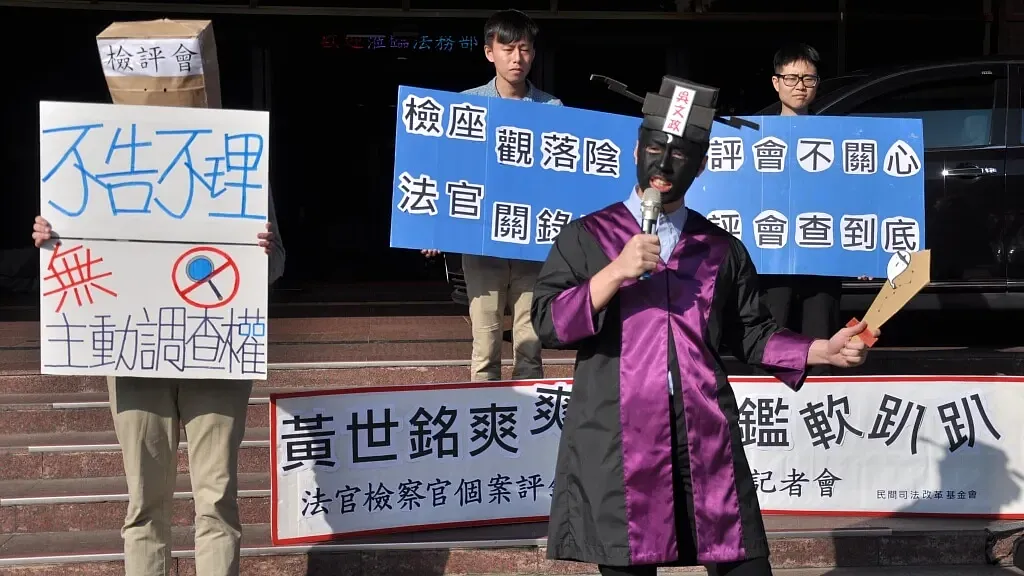
Photo / Jan. 5, 2015, Press Conference on the 3rd Anniversary of the Evaluation System for Judges and Prosecutors: "Huang Shih-ming Gets a Carefree Retirement, Evaluation is Toothless!"
Since the inception of the National Conference on Judicial Reform, the debate over whether prosecutors are administrative or judicial officials has remained a central and contentious issue. This topic touches upon the core of prosecutorial powers, including whether prosecutors should possess compulsory disposition powers, whether decisions not to prosecute should carry the same substantive finality as a finalized judgment, and whether current interrogation practices are appropriate. Consequently, both sides have engaged in fierce debates as they review and scrutinize prosecutorial powers from the ground up.
Because summons, apprehension, detention, search, wanted warrants, and interrogation severely infringe upon human rights, if an administrative apparatus wielding massive human and material resources could exercise these powers autonomously, it would pose a grave threat to democracy and freedom. Therefore, both common law and civil law jurisdictions vest these powers in courts, which operate under the passive principle of nemo judex sine actore (there is no judge without a plaintiff) and exercise their powers neutrally and passively. If prosecutors are not judges, they naturally should not wield the aforementioned powers, nor should their decisions not to prosecute carry the same substantive finality as judgments.
The English word for prosecutor is "prosecutor," and the German word is "Staatsanwalt" (literally meaning the state's lawyer); the English word for judge is "Judge," and the German word is "Richter." In both English and German, prosecutors and judges are strictly distinct; the former prosecutes while the latter adjudicates, and their roles must not be confused. Whether in civil law or common law jurisdictions, based on the framework of the separation of powers, prosecutors are fundamentally distinct from judges. Prosecutors do not possess powers such as issuing summonses, apprehension, detention, searches, wanted warrants, and interrogation—these are basic principles of the rule of law.
Looking at the primary legal systems our country has received—the United States, Japan, and Germany—it is well known to our citizens that American prosecutors belong to the executive branch, and Japan also straightforwardly categorizes prosecutors as administrative officials without powers such as summons, apprehension, detention, search, wanted warrants, and interrogation. In Germany, a civil law jurisdiction, Chapter 9 ("The Judiciary") of its Basic Law begins with Article 92, which explicitly states that "judicial power is vested in judges." Therefore, German prosecutors are neither judges nor part of the judicial power. Even though German legal doctrine describes prosecutors as an independent system situated between judicial power and executive power, prosecutors are ultimately not judges, do not possess compulsory disposition powers, and cannot interrogate criminal suspects or witnesses in the form of a hearing like judges do (according to observations by Ministry of Justice personnel dispatched to Germany, there are simply no interrogation rooms inside German prosecutors' offices). Although German prosecutors may summon witnesses, for witnesses who refuse to appear, they can only impose fines under the supervision of the court; they cannot apprehend or detain witnesses, let alone order witnesses to take an oath (apprehension, detention, and administering oaths are all powers reserved for judges). Whether in Germany, Japan, or the United States, decisions not to prosecute rendered by prosecutors do not have the effect equivalent to a court ruling.
Our country's prosecutors offices are subordinate to the Ministry of Justice, and the Ministry of Justice falls under the Executive Yuan. Our country's prosecutors are situated within the executive power; no matter how one puts it, they are not judges. Professor Lin Yu-hsiung, a scholar of criminal procedure law, also pointed out in his textbook, "Prosecutors are investigative organs and their roles are not as neutral as judges. Therefore, based on the principle of judicial reservation, powers regarding major compulsory dispositions should not be conferred upon prosecutors."
However, the powers that prosecutors in the US, Japan, and Germany do not have are all possessed by prosecutors in our country. Our prosecutors possess compulsory disposition powers, conduct interrogations of criminal suspects and witnesses in investigative hearings, and can even order witnesses to make statements under oath. Furthermore, although their decisions not to prosecute are named dispositions, they carry the same finality as court rulings. Prosecutors in the US, Japan, and Germany would likely feel unfamiliar with their Taiwanese counterparts due to the immense powers the latter wield.
Those who defend our current status quo—which completely deviates from the principle of the separation of powers—usually resort to the excuse that prosecutors and judges both pass the judicial officers special examination and complete judicial officer training, so what judges of the judicial power can do, prosecutors can do as well. Furthermore, categorizing prosecutors as judicial officers can ensure the independence of the exercise of their duties; conversely, if they are categorized as administrative officials, prosecutors will be reduced to tools of political struggle.
Let us first discuss the reason that prosecutors and judges are both judicial officers. As mentioned previously, whether in the US, Japan, or Germany, a judge is a judge and a prosecutor is a prosecutor, but there is simply no such concept as a "judicial officer." We have clearly made a mistake somewhere. This error originated when we introduced Western legal systems in the late Qing dynasty, mistakenly attaching the prosecutorial agency within the adjudication institution, sitting together on the bench, and collectively referring to the judges (推事) of the trial court and the prosecutors of the prosecutor's office as "judicial officers" (司法官). They were examined and trained together, and provisions regarding the organization and personnel of courts and prosecutors' offices were placed in the same law (from the Organic Act of Courts of the late Qing and Beijing Republican government eras to the Organic Act of Courts of the Nanjing Nationalist government). This mistake has been carried forward all the way to the present. Because they are judicial officers just like judges, prosecutors can exercise compulsory disposition powers and decisions not to prosecute share the same effect as finalized judgments, just like judges.
In the historical process of judicial reform, the separation of the judiciary and prosecution was indeed accomplished on July 1, 1980, physically dividing courts and prosecutors' offices into separate organizations subordinate to the Judicial Yuan and the Ministry of Justice, respectively. Afterward, considerable effort was spent to remove prosecutors from the trial bench, and subsequently the power to approve detentions, searches, and wiretaps was successively returned to the courts. However, courts and prosecutors' offices still jointly apply the Organic Act of Courts. When the Judges Act was enacted, the Ministry of Justice also insisted that provisions be applied mutatis mutandis to prosecutors, threatening to block its passage otherwise. As for powers like summons, apprehension, wanted warrants, and interrogation—which were "unjustly enriched" due to the mistaken reception in the late Qing—they are meat already in the mouth and will never be spit out. Therefore, although the judiciary and prosecution have been separated, the constitutional anomaly of violating the principle of the separation of powers persists because prosecutors possess powers that should belong to judges. To trace the problem to its source and clear up the root cause, the claim that prosecutors are also judicial officers is entirely a misunderstanding.
Let us turn to the claim that the attribute of being a judicial officer can protect prosecutors from administrative interference when prosecuting crimes. The fatal flaw of this claim is that it is completely detached from reality. Due to the aforementioned historical errors, Taiwanese prosecutors still refer to themselves as "judicial officers" to this day (otherwise, how could the Judges Act apply to them mutatis mutandis?). Yet, whether in the past or present, even draped in the guise of judicial officers, prosecutors are still not immune to administrative interference.
To name one prominent example, let us look at the Wu-Su case, which led then-Minister of Justice Chiu Tai-san to resign from his position as a prosecutor. At the time, the Chief Prosecutor of the Hsinchu District Prosecutors Office intended to forcibly take over the case from Prosecutor Kao Hsin-wu based on the principle of prosecutorial unity. However, due to a public uproar, they had to instead assign two other prosecutors to jointly investigate the case with Kao Hsin-wu. After Wu Tien-hui was indicted and acquitted, it triggered the resignation of eight judicial and investigative personnel, including then-Prosecutor Chiu Tai-san. Has the attribute of being a judicial officer ever protected prosecutors from administrative interference?
Let us look at the most recent case involving former Prosecutor-General Huang Shih-ming's leaking of secrets. The Prosecutor-General directs and supervises prosecutors nationwide and serves as the head of all prosecutors in the country. Although nominated by the President and appointed with the consent of the Legislative Yuan, because the prosecutor's discretionary power of indictment practically guards the gates of the court, the Prosecutor-General cannot be a subordinate of the President; otherwise, the President could interfere in the judiciary through the Prosecutor-General. The President has no authority to summon the Prosecutor-General (the Prosecutor-General is not among the attendees listed in Article 4 of the Organic Act of the National Security Council), and the Prosecutor-General should not seek an audience with the President regarding individual cases under investigation. However, Huang Shih-ming, in his capacity as Prosecutor-General, sought an audience with President Ma Ying-jeou to report on an ongoing case being investigated by the Special Investigation Division, and presented wiretap transcripts to be used as material for political struggle. Did the attribute of being a judicial officer prevent prosecutors from voluntarily becoming tools of political struggle?
As can be seen from the aforementioned two cases, the attribute of being a judicial officer fundamentally fails to protect prosecutors from improper administrative interference or from being reduced to tools of political struggle. The key lies in the fact that the operation of the principle of prosecutorial unity must follow due process of law, and prosecutorial organizations must be correspondingly reformed so that due process of law can be observed. Therefore, rather than stubbornly insisting that prosecutors are judicial officers, why not emulate Japan by enacting a Public Prosecutors Office Act and explicitly stipulating matters such as the appointment, dismissal, status protection, remuneration, and retirement of prosecutors to ensure the independence of prosecutorial duties, thereby enabling the principle of prosecutorial unity to operate in accordance with due process of law? This is the right path to take.
This article is an AI-generated translation of the original Chinese text. In the event of any discrepancy, the Chinese version shall prevail.