
Judicial Oversight Mechanisms in the United Kingdom
Last edited: 2026-07-27
Introduction
In the UK, there are five mechanisms related to judicial oversight:
- Judicial Conduct Investigation Office ("JCIO")
- Nominated judge
- Investigating judge
- Disciplinary panel ("DP")
- Judicial Appointment and Conduct Ombudsman ("JACO")
They are all responsible for assisting the LC/LCJ in investigating judicial misconduct and making recommendations, with the final decision resting with the Lord Chancellor / Lord Chief Justice ("LC/LCJ") (the heads of the judiciary).
The JCIO, nominated judge, and investigating judge operate in a somewhat hierarchical manner. First, anyone wishing to file a complaint regarding judicial misconduct must apply to the JCIO within three months of the incident. If the JCIO finds no misconduct after investigation, the case will be dismissed. Before dismissal, the JCIO will give the complainant an opportunity to supplement their materials; if the final decision remains a dismissal, the reasons will be provided to the complainant. On the other hand, if the JCIO determines that misconduct has indeed occurred, it has two options: handle the complaint via a summary process, or transfer the case to a nominated judge for further investigation.
Under the summary process, the JCIO submits a report containing its findings, disciplinary recommendations (e.g., removal, suspension, or other penalties), and reasons to the LC/LCJ for a final ruling.
If transferred to a nominated judge, the nominated judge will continue the investigation. Based on the findings, the nominated judge may (1) dismiss the case, (2) issue an informal warning to the subject, (3) submit disciplinary recommendations to the LC/LCJ, or (4) refer the case to an investigating judge for deeper investigation if the case is deemed serious or complex.
If the nominated judge recommends removal or suspension, the subject has the right to request the intervention of a disciplinary panel. The DP reviews the investigative documents and recommendations, and interviews witnesses when necessary. Ultimately, the DP provides its opinion on whether the recommendation for removal or suspension is appropriate. If the nominated judge considers the case too serious and complex, they may also refer it to an investigating judge for further inquiry.
Regardless of which mechanism (JCIO, nominated judge, or investigating judge) is conducting the investigation, the subject has the right to make a statement explaining why they should not be disciplined or expressing their views on the investigation results. Additionally, complainants may provide evidence and materials to assist the investigating bodies.
The investigative reports from the aforementioned bodies are all submitted to the LC/LCJ for a final ruling. Even if a disciplinary recommendation has already been made, the LC/LCJ may request another investigative body to intervene. For example, if the JCIO submits recommendations to the LC/LCJ, the LC/LCJ may request other investigative bodies—such as a nominated judge, investigating judge, or even a DP—to intervene (giving the LC/LCJ a second or third opinion). The decision of the LC/LCJ constitutes the final result (i.e., there is no further avenue of appeal).
In addition to the investigative bodies mentioned above, there is also the JACO. The JACO functions more like an oversight unit. Its role is not to investigate whether a subject has engaged in misconduct, but rather to oversee whether the investigative bodies have conducted investigations in accordance with the law and whether they have abused their powers (simply put, an administrative role). Therefore, both complainants and subjects unsatisfied with the investigation results may request the JACO to intervene.
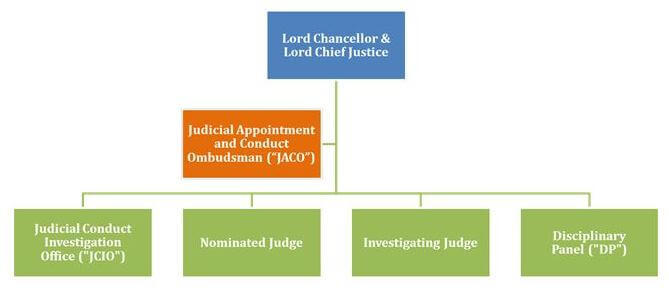
Overview of Institutions
-
The Lord Chancellor (LC) & The Lord Chief Justice (LCJ):
The heads of the judiciary, responsible for making the final disciplinary decision with no further avenue for review.
-
The Judicial Conduct Investigation Office (JCIO):
The front-line office responsible for receiving complaints against judges and assessing their merits.
- Meritorious: Transfers the case to a nominated judge.
- Unmeritorious: Dismissal.
Simultaneously provides comprehensive investigation information to both the complainant and the subject judge, and informs both parties that if they disagree with the review result, they may further submit the case to the JACO.
-
Nominated Judge:
Members are nominated by the LCJ with the agreement of the LC, and hold a rank at least equal to that of the subject judge. Their role is to make recommendations to the LC and LCJ regarding whether a complaint constitutes misconduct and, if so, what disciplinary measure is appropriate.
- If the investigation finds no misconduct, the complaint will be dismissed.
- May issue informal advice.
- May refer the complaint to an investigating judge for further inquiry.
- If a member of the public does not file a formal complaint but learns of alleged judicial misconduct, the information may be forwarded to the JCIO for investigation.
-
Investigating Judge:
Conducts investigations upon the request of the following two:
- LC, LCJ: Members are nominated by the LCJ with the agreement of the LC, and must hold a rank higher than that of the subject judge.
- Nominated judge: Upon completing an investigation, they are responsible for preparing reports and recommendations for the LC and LCJ regarding whether the allegations constitute misconduct and the appropriate disciplinary measures that may be required.
-
The Disciplinary Panel ("DP")
Convened by either of the following:
- LC, LCJ
- The office holder concerned
Convened when a nominated judge identifies judicial misconduct and recommends removal or suspension. Composed of four members → two judicial professionals and two lay members.
- Current or former office holders holding a rank higher than the office holder concerned.
- Current or former office holders holding a rank equal to the office holder concerned.
- The other two members must not have served as (1) an office holder or (2) a practicing or employed attorney/barrister-solicitor.
Responsible for re-examining evidence, reports, the nominated judge's recommendations, and the appropriateness of oral evidence adopted by the office holder concerned. Prepares reports and recommendations for the LC and LCJ concerning whether the allegations constitute misconduct and the appropriate sanctions.
-
The Judicial Appointment and Conduct Ombudsman ("JACO")
Complainants or the office holder concerned may apply to the JACO to review whether handling of misconduct or disciplinary measures failed to comply with prescribed procedures or involved other maladministration. Complaints to the JACO must be made within 28 days of receiving the outcome of a complaint. The JACO cannot comment on any decision itself, but if it considers the outcome to be fair, it may make recommendations to the LC and LCJ. If the JACO considers a decision unreliable due to maladministration, it can set aside the decision and prompt the JCIO to reinvestigate.
This article is an AI-generated translation of the original Chinese text. In the event of any discrepancy, the Chinese version shall prevail.