
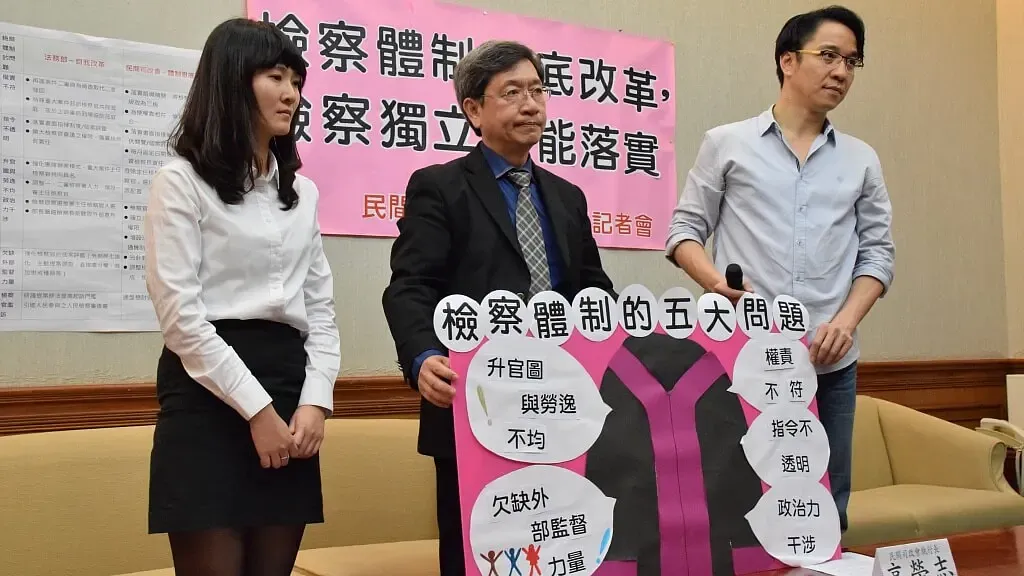
Press Release | Thorough Reform of the Prosecutorial System is Essential to Realize Prosecutorial Independence!
Last edited: 2026-08-24
As the key that unlocks criminal justice and self-bound by the principle of "prosecutorial unity," the prosecutorial system will face severe doubts regarding the impartiality of criminal justice if it fails to maintain external independence. Recently, owing to the National Conference on Judicial Reform, the Ministry of Justice has successively proposed various reform plans, such as strengthening team-based case handling models, having prosecutors who indicted major cases jointly appear in court, adding chief prosecutors at the first-instance level, having chief prosecutors elected and recommended by grassroots prosecutors, increasing external democratic mechanisms in the selection of chief prosecutors, and making the chain of command and supervision transparent. However, can these reforms truly provide a remedy for the existing problems within the prosecutorial system?
Since 1998, the Judicial Reform Foundation (JRF) has continuously promoted legislative advocacy for the Prosecutors Act and completed the Draft Organic Act of the Prosecutors Offices in 2016. In response to the five major problems currently plaguing the prosecutorial system—mismatch between power and responsibility, non-transparent directives, the career advancement ladder and uneven workloads, political interference, and a lack of external oversight—the JRF has put forward reform recommendations, hoping to complete the operation of the prosecutorial system through the enactment of dedicated legislation. Below is an explanation of the legislative directions proposed by the JRF:
1. Realize organizational streamlining by reducing the prosecutors offices from three tiers to two tiers, and merging investigation and public prosecution to achieve a match between power and responsibility
The current prosecutorial system suffers from issues such as a mismatch between power and responsibility and uneven workloads. Fundamentally, this is closely related to the allocation of prosecutorial manpower and jurisdictions. According to statistics from the Ministry of Justice in 2015, there were a total of 1,389 prosecutors, with 1,182 prosecutors in regional prosecutors offices. After deducting chief prosecutors and deputy chief prosecutors, grassroots prosecutors numbered only 1,014, of whom fewer than 700 were responsible for investigating crimes. Given the massive volume of cases, this manpower allocation is highly problematic. Furthermore, investigative prosecutors are not required to appear in court for public prosecution, which not only forces public prosecution prosecutors to repeatedly review case files but also makes it impossible to clearly delineate accountability.
To resolve the uneven manpower allocation and achieve the goal of matching power and responsibility, prosecutors offices should be reduced from the current three tiers to two tiers. This will allow prosecutorial manpower to return to regional prosecutors offices, adopt a system combining investigation and public prosecution, and pair it with a team-based case handling model so that prosecutors in the same group can mutually support investigation and public prosecution matters.
-
Ministry of Justice 2015 Prosecutor Statistics Table
Total
Supreme Prosecutors Office
High Prosecutors Offices
Regional Prosecutors Offices
Prosecutor General
Chief
Prosecutor
Chief Prosecutor
Chief
Prosecutor
Chief Prosecutor
Chief
Prosecutor
1,389
1
1
18
6
21
160
21
174
1,014
- Prosecutorial affairs are divided into investigation, indictment, and execution. Prosecutors responsible for frontline investigation account for approximately 2/3 of the total number in prosecutors offices.
- High prosecutors offices are only responsible for investigating internal and external rebellion, and their workload largely stems from frequent requests for re-investigation (tsai-i).
-
Adjust the composition of the Prosecutor Review Committee by adding external members to soundly establish the prosecutor personnel mechanism
The lack of external oversight has always been a criticized aspect of the prosecutorial system. Furthermore, the members of the Prosecutor Review Committee (PRC)—which is currently responsible for matters such as the appointment, dismissal, rewards, and disciplinary actions of prosecutors—are entirely composed of prosecutors. Operating under an insular prosecutorial mindset, abuses of prosecution power and violations of procedural justice are frequently heard of yet go unpunished, causing serious infringement upon human rights and severely hindering the sound development of the prosecutorial system.
To ensure the selection of the capable and elimination of the unfit within the prosecutorial system, as well as a personnel operation mechanism where individuals are suited to their positions, the members of the Prosecutor Review Committee should have diverse representation. This will help change the past insular, seniority-based personnel decision-making culture of the prosecutorial system, strengthen accountability functions, and prevent the recurrence of abuses of prosecution power.
-
Establish the personnel and administrative supervision powers of the Minister of Justice, introduce a communication mechanism between the Minister of Justice and the Prosecutor General, and establish clear boundaries between legal policy and investigative command to prevent political interference and implement responsible government
Avoiding political interference is a prerequisite for realizing prosecutorial independence. Therefore, although the Minister of Justice serves as the highest administrative supervisory official of the prosecutorial system, they must not issue specific directives regarding individual case investigations.
As the head of policy planning, the Minister of Justice should naturally bear political responsibility for promoting policies; thus, they should enjoy certain powers regarding the appointment and dismissal of chief prosecutors. Meanwhile, as the commander-in-chief directing prosecutors nationwide in handling cases and overseeing the operation of prosecutorial practice, the Prosecutor General should also have room to express opinions on the candidates for chief prosecutors. However, the current mechanism grants the Minister absolute power to appoint and dismiss chief prosecutors, which not only lacks internal democracy within the prosecutorial system but also threatens prosecutorial independence. To balance the political responsibility of the Minister of Justice and implement internal democracy within the prosecutorial system, the appointment and dismissal of chief prosecutors should first be voted on by grassroots prosecutors, then selected by the Prosecutor General, subsequently submitted to the Minister of Justice for final selection, and finally submitted to the Prosecutor Review Committee for approval.
In addition, if the policies issued by a politically appointed Minister of Justice are refused execution by the prosecutorial system, it will inevitably lead to a constitutional order crisis. Therefore, a communication mechanism between the Minister of Justice and the Prosecutor General must be established to resolve disputes and confirm the attribution of responsibility.
-
Abolish chief prosecutors and replace them with "senior prosecutors" elected as group leaders, thereby rectifying human resource allocation
Uneven workloads in prosecutorial affairs have shaped the career advancement ladder of the prosecutorial system, and chief prosecutors represent the very first hurdle on this ladder. Current chief prosecutors are appointed through selection by the Minister of Justice, which invisibly increases the risk of political interference. Moreover, once appointed, if transferred to serve in a different prosecutors office, chief prosecutors face the awkward dilemma of being out of place in the new office, rendering them unable to effectively lead investigation teams.
Once the prosecutorial organization is reorganized into two tiers, it should effectively reduce the problem of uneven workloads. To implement internal democracy within the prosecutorial system, the system of chief prosecutors selected by the Minister should also be abolished and replaced by "group leaders" elected by grassroots prosecutors. Candidates for group leaders must meet the standards of "senior prosecutors."
Group leaders independently elected by grassroots prosecutors can not only implement internal democracy within the prosecutorial system but also rectify the allocation of human resources, which will be of great benefit to the operation of the prosecutorial system.
-
Implement a written command system and bring transparency to job supervision
The problem of non-transparent directive powers was not improved even after the enactment of the Judges Act, and the amendments proposed by the Ministry of Justice this time also list transparent command and supervision as a reform policy. Looking at the opinions proposed by the Ministry of Justice, they are quite similar to the contents formulated in the JRF's 2016 Draft Organic Act of the Prosecutors Office, both demanding that individual case commands be made in writing and empowering prosecutors to initiate individual case evaluations against violators.
However, the JRF's version of the Draft Organic Act of the Prosecutors Office also stipulates the complementary measure that "written instructions, approvals, decisions, orders, or opinions shall all be attached to the relevant case files; upon conclusion of the case investigation, interested parties may request to review them," so as to facilitate the pursuit of accountability. Reform should not be half-hearted; we hope to put the people first and add the innovation of attaching written documents to the files.
-
Implement prosecutors meetings to promote the democratization and transparency of internal decision-making within the prosecutorial system
The prosecutors meeting represents the collective will of prosecutors. In addition to being held on a regular basis, its authority should also include: the allocation of prosecutorial affairs (such as the assignment of various divisions), the election, dismissal, and order of succession for group-handling group leaders, the composition of group members, as well as methods for case allocation, the unification of legal application and prosecution standards, the initiation of the right to request disciplinary action against prosecutors, and other matters related to prosecutorial affairs.
As the head of the prosecutors office and based on the principle of "one prosecutor's office," the chief prosecutor shall still have the authority to make the final decision on resolutions of the prosecutors meeting in order to externally unify prosecutorial affairs. Therefore, if the chief prosecutor disagrees with a resolution of the prosecutors meeting, they still enjoy the authority to directly alter the resolution. However, to clarify accountability, the chief prosecutor must state their reasons in writing and attach them to the minutes of the prosecutors meeting for future inspection and investigation. The reform policy proposed by the Ministry of Justice is identical regarding the requirement that the chief prosecutor attach reasons in writing.
The functions of the prosecutorial organization differ significantly from those of the courts, yet current laws govern both jointly under the Court Organization Act, which hinders the independent development of the prosecutorial organization. Amidst the National Congress on Judicial Reform, we must carefully consider the comprehensive blueprint for prosecutorial reform, aiming to realize the independence of prosecutorial powers through the enactment of the Organic Act of the Prosecutors Office and the Prosecutors Act. Only through comprehensive prosecutorial system reform can prosecutorial independence be truly realized!
| Problems of the Prosecutorial System | Ministry of Justice: Self-Reform | JRF: Thorough Systemic Reform |
| Mismatch between Power and Responsibility |
|
|
| Non-Transparent Directives |
|
|
| Career Advancement Ladder and Uneven Workloads |
|
Abolish chief prosecutors and replace them with "senior prosecutors" elected as group leaders, rectifying human resource allocation |
| Political Interference |
|
|
| Lack of External Oversight Power | Strengthen individual case evaluations for prosecutors (strengthening external democracy, proactive proposal of investigations, direct disposition power, increasing types of disciplinary actions, etc.) |
|
| Abusive Prosecution by Prosecutors | Deliberate on proposing amendments to raise the threshold for indictment; introduce citizen participation via Citizen Prosecutorial Review Committees | Comprehensively review accountability mechanisms |
Attachments
- 20160415 Draft Organic Act of the Prosecutors Office
- Ministry of Justice: Welcoming the National Congress on Judicial Reform - Self-Reform of the Prosecutorial System ~ Reduction of Remands for Re-investigation Cases and Democratization of Prosecutorial Personnel
- Ministry of Justice: Welcoming the National Congress on Judicial Reform - Self-Reform of the Prosecutorial System ~ Citizen Participation in Prosecution and Exquisite Investigation
Attending Representatives
Lin Yung-sung, Attorney at Law / Chairman, Judicial Reform Foundation
Huang Ying-chia, Attorney at Law / Staff Attorney, Judicial Reform Foundation
Kao Jung-chih, Attorney at Law / Executive Director, Judicial Reform Foundation
Press Contact
Judicial Reform Foundation / Executive Director Kao Jung-chih (02)2523-1178
This article is an AI-generated translation of the original Chinese text. In the event of any discrepancy, the Chinese version shall prevail.