
MythBusters: Are the Individual Evaluation Systems for Judges and Prosecutors Different From What You Think?
Last edited: 2026-08-24
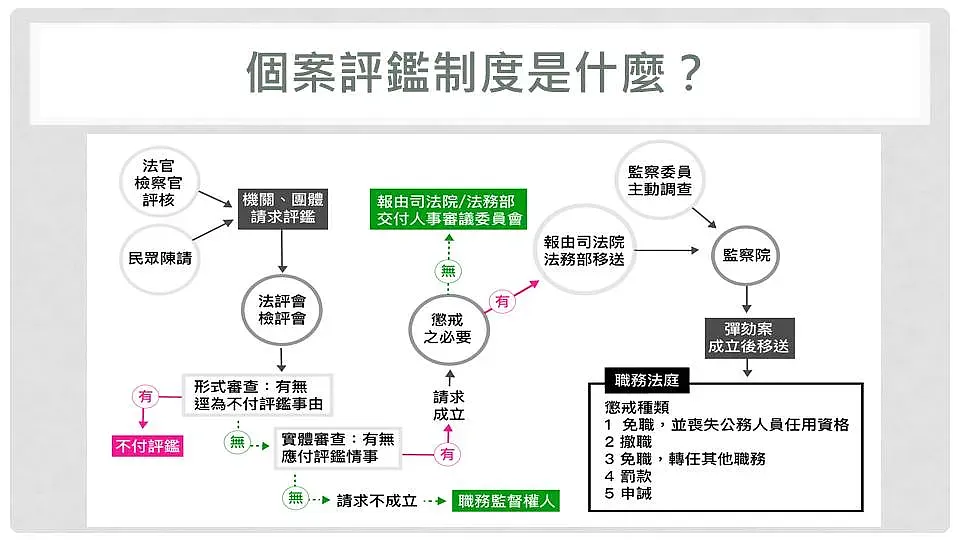
Image / Flowchart of the Individual Evaluation System under the Judges Act
The fourth meeting of the third subgroup on April 12 took over three hours to discuss item by item the specific reform proposals put forward by various members on the issue of "reviewing the functions of the Judges Evaluation Committee and Prosecutor Evaluation Committee or the feasibility of establishing a legal professionals' evaluation foundation." There was very intense engagement on two sub-topics: "whether attorneys may serve as evaluation commissioners" and "whether the public should be allowed to directly request evaluations."
How the individual evaluation system is designed is not only a matter of concern for the public, but also closely watched by judges and prosecutors as "potential victims." However, amidst the abundance of discussions, misconceptions about the current situation persist, which is detrimental to the exchange of opinions and communication. Therefore, we hope that the following explanation will debunk myths and help everyone concerned about this issue to gain a clearer grasp of the current situation.
Myth 1
Whenever someone requests an evaluation from the Judges Evaluation Committee (JEC) / Prosecutor Evaluation Committee (PEC), must the evaluated judge/prosecutor submit a defense?
Current provisions of the Judges Act stipulate that if members of the public wish to file a grievance against a judge or prosecutor for illegal or derelict conduct, they cannot directly request an evaluation from the JEC or PEC; instead, they must do so indirectly through specific agencies (courts, prosecutors offices), organizations (bar associations, foundations or associations meeting certain criteria).
Before the enactment of the Judges Act, judges stated bluntly at consultation meetings on the draft Judges Act that if case parties were permitted to be requesters, judges would be exhausted from dealing with avalanches of evaluation requests on top of their heavy judicial workloads, drastically increasing the burden on judges[1]. After the Judges Act was passed, whenever the JRF requested an evaluation that was subsequently resolved by the JEC as unfounded, judges would also strongly criticize the JRF through op-eds for "abusing litigation" and failing to fulfill its gatekeeping responsibilities, forcing a group of dedicated judges to waste time and life writing defense briefs for themselves.
The aforementioned remarks show that in the imagination of judges, whenever an evaluation is requested (regardless of whether the requester is an ordinary case party or an organization such as the Judicial Reform Foundation), the evaluated judge must submit a defense.
How is the Current Evaluation System Designed?
According to the Implementation Measures for Evaluation by the Judges Evaluation Committee, the JEC does not require judges to submit a defense and express their opinions for every single individual evaluation request. Synthesizing the provisions and evaluation practices, there are two scenarios in which the JEC will mail duplicate copies:
- Cases where the JEC determines the evaluation request to be well-founded (Article 8 of the Measures)
- Cases where the JEC determines the evaluation request to be potentially well-founded (summarized from evaluation resolution documents)
Relevant Provisions
After accepting an individual evaluation case, this Committee shall immediately distribute it by rotation to commissioners for handling.
The handling commissioner and a review panel composed of two other commissioners shall review whether there are circumstances for which an evaluation should not be initiated in accordance with Article 37 of this Act, and shall not conduct investigations or notify the evaluated judge to state opinions on their own initiative.
The review panel's review under the preceding paragraph shall be conducted in writing; when necessary, it may request the agency to which the evaluated judge belongs or the agency where the evaluation facts occurred to submit written explanations or provide relevant materials.
After the review panel completes the review under paragraph 2, except where three members of the review panel unanimously agree that no evaluation should be initiated, the handling commissioner shall immediately draft disposition opinions and submit them to this Committee for deliberation.
The composition of the review panel under paragraph 2 shall be determined by this Committee.
The review panel shall, in principle, be composed of commissioners possessing qualifications under different subparagraphs of Article 34, paragraph 1 of this Act.
— Article 4 of the Implementation Measures for Evaluation by the Judges Evaluation Committee
Before this Committee makes a resolution under Article 39, paragraph 1 of this Act, it shall serve duplicate copies of the evaluation request to the evaluated judge, and notify them in writing that they may submit an opinion brief within twenty days.
The written notice under the preceding paragraph shall record the following matters:
- The name of the evaluated judge and the name of the agency to which they belong.
- The facts and legal basis asserted by the requester.
- The evidence methods that have been or will be investigated and the facts to be proven thereby.
- The intent that an opinion brief may be submitted to make factual and legal statements.
- If, without justifiable reason, an opinion brief is not submitted or opinions are not stated orally to this Committee in accordance with the provisions of paragraph 3, this Committee may proceed to make a resolution without waiting for their statement.
The evaluated judge may, within the time limit prescribed in paragraph 1, request in writing to make oral statements of opinion to this Committee during deliberation in lieu of submitting an opinion brief.
Where opinions are stated orally, this Committee shall make a record thereof.
— Article 8 of the Implementation Measures for Evaluation by the Judges Evaluation Committee
The provisions of the Implementation Measures for Evaluation by the Prosecutor Evaluation Committee are comparatively simpler, but they also show that a duplicate copy is mailed to notify the evaluated prosecutor only after initial screening confirms entry into substantive deliberation.
After accepting an evaluation case, the Prosecutor Evaluation Committee shall, except for cases where a resolution not to initiate an evaluation is made, serve a duplicate copy of the individual prosecutor evaluation request to the person being evaluated.
The evaluated person shall submit an opinion brief within twenty days after receiving the duplicate copy of the individual prosecutor evaluation request. Failure to comply without justifiable reason within the time limit shall not affect the conduct of the evaluation proceedings.
The opinion brief submitted by the evaluated person shall be attached to the evaluation case file.
When the Prosecutor Evaluation Committee deems it necessary, it may notify the evaluated person to appear and state opinions at the meeting of the Prosecutor Evaluation Committee. If the evaluated person fails to appear at the meeting on the designated date, a resolution may be made directly based on the results of the investigation without waiting for their statement.
Following the statement of opinions by the evaluated person attending under the preceding paragraph, evaluation commissioners may pose questions. The gist of the contents of the statements and questions shall be recorded in the meeting minutes.
Where the evaluated person and other relevant personnel appear on the designated date to state opinions, they shall withdraw prior to the statements and shall not participate in the commissioners' expression of opinions and resolution.
— Article 7 of the Implementation Measures for Evaluation by the Prosecutor Evaluation Committee
That is to say, when a judge or prosecutor receives a notice and is required to submit a defense, the JEC or PEC has already determined that the case is not an "abusive lawsuit," and it is definitely not a situation of being harassed "without cause."
Myth 2: Evaluation Request = Removal?
In November 2015, the JRF held a press conference to release its 2015 Court Observation Report and, based on court observation records and judgments, requested evaluations for four of the observed judges, triggering a strong backlash from the legal practice community. Both the statement by the Judges Association[2] and op-eds by individual judges[3] heavily criticized the JRF's method of initiating the evaluation system this time as "decontextualized" and "generalizing from a single instance," and called upon the Judges Evaluation Committee to seek out the context before and after questions and answers during its deliberation in order to arrive at a "fair" evaluation result. The executive secretary who hosted the court observation project immediately wrote an op-ed to reiterate the JRF's assertion that the legal community should break the myth of "emphasizing substance over procedure" regarding judges with poor courtroom demeanor, allowing judges whose speech and conduct are improper to receive customer complaints and even be removed[4].
In May 2016, the JRF launched the "National Judicial Reform Movement," inviting the public to vote and select judicial problems currently in urgent need of resolution. The voting results showed that "lack of clear and objective review standards to eliminate truly incompetent judicial officials" unexpectedly made the list. Netizens further commented, believing that Article 30, Paragraph 2 of the Judges Act is riddled with indeterminate legal concepts, and what kind of speech and conduct by a judge will result in evaluation is tied to the unstable discretionary power of JEC members. Minor speech or behavioral flaws of a judge, although not reaching the level of "incompetence," are evaluated because the current Code of Judicial Ethics is too vague and set too high a standard, and are subsequently forced to leave, causing reverse selection and leaving judges vulnerable to fault and at a loss as to what to do[5]. This echoes back to November 2015, when judges, upon learning that the JRF had requested individual evaluations for four judges all at once, expressed hope through statements and op-eds at the first instance to persuade the JEC to incorporate the "context before and after Q&A in the courtroom" into the review criteria when deliberating individual evaluation requests.
Judging from the aforementioned op-eds by judges and comments by netizens, the concern and question of judges regarding "what kind of speech and conduct by a judge will be evaluated?" is built upon a tacit presupposition: evaluation equals removal.
However, if "evaluation" is placed back within the regulatory framework of the Judges Act, one will find that the JEC's determination that an "individual evaluation should be undertaken" is merely the starting point. The JEC must further decide whether the evaluated judge has a "need for disciplinary action," and subsequently transfer the evaluated judge into disciplinary or administrative sanction proceedings respectively (Article 39 of the Judges Act). The removal that judges constantly dwell upon is merely one of the types of disciplinary actions an evaluated judge may receive after disciplinary proceedings are initiated. Furthermore, in cases where a judge is determined by the JEC not to require evaluation, the Judges Act specifically provides that the JEC may, depending on the circumstances, transfer the case to the holder of the power of official supervision for sanction (Article 38 of the Judges Act).
In this regard, the Judges Act distinguishes the severity of judges' speech and behavioral flaws by "presence or absence of grounds for evaluation" and "presence or absence of need for disciplinary action," structuring three levels of handling measures: (1) JEC determines grounds for evaluation exist and disciplinary need exists: transferred to the Control Yuan (Article 39, Subparagraph 1 of the Judges Act); (2) JEC determines grounds for evaluation exist but no disciplinary need exists: submitted to the Judicial Personnel Review Committee (Article 39, Subparagraph 2 of the Judges Act); (3) JEC determines no grounds for disciplinary action exist but internal official supervision needs exist: transferred to the holder of the power of official supervision for disposition. For prosecutor evaluations, similar handling measures exist through the mutatis mutandis application of provisions governing judge evaluations.
That is to say, the task entrusted to the individual evaluation system is to make two judgments:
Should an evaluation be undertaken?
Whether the behavior complained of by a judge constitutes a reasonable exercise or abuse of the power to direct litigation? Whether it constitutes a divergence of legal views or an abuse of the power of legal interpretation? The JEC must deliberate case by case to draw the line of judicial independence.
Whether the behavior complained of by a prosecutor constitutes a reasonable exercise or abuse of prosecutorial discretion or compulsory disposition power? The PEC must deliberate case by case to draw the line between independent handling of cases by prosecutors and the principle of prosecutorial unity.
How to hold accountable?
Once the JEC confirms that the evaluated judge cannot take refuge under the umbrella of judicial independence, or the PEC confirms that the evaluated prosecutor cannot attribute misconduct to superior orders or criminal policy requirements, it must then confirm the degree of incompetence and initiate the diversion to internal self-regulation mechanisms (Judicial Personnel Review Committee) or external oversight mechanisms (Control Yuan).
In short, under the framework of the current Judges Act, the core task of the JEC/PEC is "classification" and "screening," and does not involve substantive disciplinary action/sanctions.
Footnotes
[1] Compilation of Drafts of the Judges Act (17), Judicial Yuan, pp. 16, 28, 32, 37.
[2] Statement by the Judges Association of the Republic of China, November 11, 2015 Statement Link (Last visited: December 14, 2016)
[3] Chou Yu-hsiu, Did Judges Really Make a Slip of the Tongue?, Apple Daily, November 17, 2015 (Last visited: December 14, 2016). Sun Chien-chih, Wishing for a Professional Court Observation Report, PNN PTS News Issues Center, November 19, 2015 (Last visited: December 14, 2016)
[4] Huang Wei-ting, Judge, I'd Believe You If Pigs Could Fly, Apple Daily, November 12, 2015 (Last visited: December 15, 2016)
[5] For the complete comments by netizens, please refer to the National Judicial Reform Movement Website (Last visited: December 14, 2016)
This article is an AI-generated translation of the original Chinese text. In the event of any discrepancy, the Chinese version shall prevail.
