
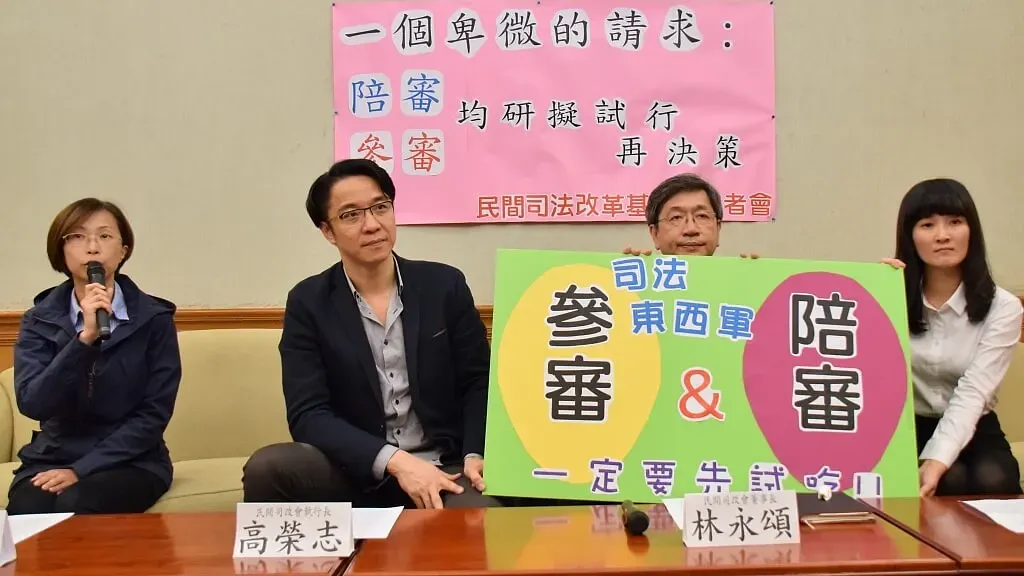
Press Release | A Humble Request: Research and Pilot Both Lay Participation Systems Before Making a Final Decision
Last edited: 2026-08-24
Photo / 2011 Press Conference of the Judges and Prosecutors Evaluation Act Promotion Alliance
In recent years, public confidence in the judiciary has faced widespread skepticism, falling short of public expectations. To enhance judicial trust and promote judicial transparency and democratization, both the authorities and the public have proposed allowing citizens to participate in judicial trials.
How the public should participate in trials has been under lengthy discussion for five to six years. Both lay assessor and jury systems have their respective pros and cons, but without domestic practical experience, these systems remain purely in the realm of imagination. Today (the 13th) at Room 101, Zhongxing Building of the Legislative Yuan, we held a press conference to explain the current situation and make a humble request to the authorities: regardless of whether a lay assessor system or a jury system is adopted in the future, authorities should first research and pilot both before making a final decision.
Comparison of Citizen Participation Systems Has Lasted for Five to Six Years
The advantage of citizen participation in trials lies in involving ordinary citizens in the trial proceedings, incorporating public opinions and diverse perspectives into the trial process, and thereby ensuring that the trial as a whole is trusted by the public. Furthermore, because the process is open, transparent, and approachable, it indirectly achieves the effects of simplifying legal terminology and promoting overall civic legal education.
The Judicial Yuan began vigorously promoting the "Advisory Jury System" in 2011. Because lay observers (advisory jurors) could only express opinions but not vote, the system itself suffered from major flaws and consistently failed to win the favor of the ruling and opposition parties, the legal community, and the public. This prompted civil society to initiate research and discussions on the jury system and the lay assessor system. Over the past five to six years, a considerable body of discourse has accumulated regarding the pros and cons of Taiwan adopting either a jury system or a lay assessor system.
"Lay Assessor" and "Jury" Systems Each Have Pros and Cons
Under a lay assessor system, the trial of a case—from fact-finding and the application of law to sentencing—is conducted jointly by a collegiate panel composed of lay assessors and professional judges. Through the "joint trial and adjudication" by citizens and judges, diverse public opinions interact with judges, exerting a positive influence on the judges.
The disadvantage is that, due to the inherent gap in legal professional knowledge between lay assessors and professional judges, trial proceedings remain dominated by professional judges. Coupled with the psychological phenomenon known as the "authority effect," judges' legal opinions easily influence citizens' judgments, potentially undermining the essential spirit of "substantive public participation" inherent in citizen participation in trials.
In a jury system, judges and citizens participate through "divided trial functions." Judges are responsible for directing the trial proceedings, while jurors are responsible for fact-finding to determine whether the defendant is guilty or not guilty. Subsequently, if guilty, sentencing is handled by the judge. To enable jurors who do not understand the law to participate in the trial, prosecutors and defense attorneys must dedicate all their energy to persuading the jurors, which effectively revitalizes court proceedings. Meanwhile, because judges recede to a secondary role in fact-finding, they appear more impartial and fair both formally and substantively, which also helps achieve the goal of a fair court.
Of course, the jury system also has disadvantages. For example, public opinion may prevent jurors from exercising judgment impartially, or jurors may fail to strictly adhere to the requirements of relevant legal principles. Moreover, leaving the entire process of deliberating guilt or innocence to the public makes legal professionals very uneasy.
Both Systems Should Be Piloted First to Accumulate Domestic Experience
Since 2011, the Judicial Yuan has spearheaded the promotion of the Advisory Jury System, making policy decisions arbitrarily and obstinately while completely shutting out suggestions and opinions from other scholars and experts. The Judicial Yuan following the political transition seems to have already predetermined the future adoption of the "lay assessor system," with no apparent policy discussion or decision-making process. We worry that without sufficient communication and discussion with the outside world, we will repeat past mistakes.
Therefore, we suggest that while controversies persist among various sectors regarding whether to adopt a jury system or a lay assessor system in the future, simulation comparisons of the pros and cons of various systems should be conducted first, alongside small-scale pilot programs. Only on the basis of empirical research can major decisions regarding ultimate policy be made.
The "citizen participation in trial system" has evidently become a consensus across all sectors. Since we know that "lay assessor" and "jury" systems each have pros and cons, and the comparison and discussion of systems from various countries have lasted for five to six years, we should begin pilot programs at this stage. By inviting the public into courtrooms to operate the systems of various countries, we can accumulate domestic experience, followed by careful analysis and evaluation, thereby enabling a responsible final policy decision.
Attending Representatives
Lin Yung-sung, Attorney at Law/Chairman, Judicial Reform Foundation
Chen Yu-fan, Attorney at Law/Deputy Executive Director, Judicial Reform Foundation
Huang Ying-chia, Attorney at Law/Staff Attorney, Judicial Reform Foundation
Kao Jung-chih, Attorney at Law/Executive Director, Judicial Reform Foundation
Press Contact
Judicial Reform Foundation/Kao Jung-chih, Executive Director — (02) 2523-1178
This article is an AI-generated translation of the original Chinese text. In the event of any discrepancy, the Chinese version shall prevail.
