
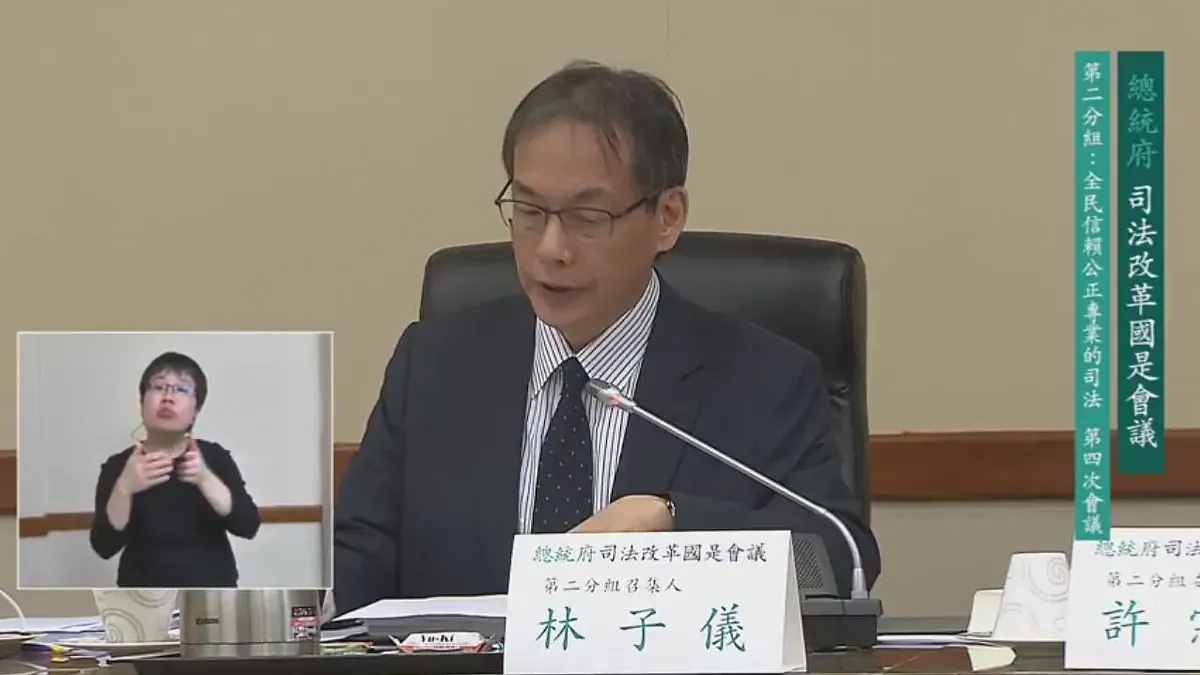
Brief Note: The 4th Meeting of the 2nd Division of the Office of the President's National Judicial Reform Conference
Last edited: 2026-08-24
Committee Resolutions
Passed the resolution advocating for a robust first instance, a second instance based on post-hoc review as a general rule (strict retrial system), and a third instance as a strict review of law. The Judicial Yuan was also requested to propose complementary measures regarding mandatory attorney representation, legal aid, and court-appointed defense for discussion and finalization by committee members at the next meeting.
Summary of Committee Member Statements
Lu Tai-lang, Secretary-General of the Judicial Yuan:
Basically continuing the direction of the judicial reform conference resolutions from 1989 (the 88th year of the Republic) to promote the future litigation procedure such that the first instance is relatively solid and detailed, the second instance is relatively restricted, and the third instance is quite strict—commonly referred to by the legal community as a pyramid shape. Why reform this way? All judicial procedures have two major focuses: fact-finding and the application of law. Fact-finding relies on evidence, and evidence will perish or become ambiguous due to changes in time and space, such as witnesses' memories, traces at the scene, or physical evidence. Fact-finding must accomplish the most complete determination of relevant facts in the shortest possible time, which requires the highest possible judicial capacity. Both the number of judges and their experience must be extremely adequate. With experienced judges, the key points of a case can be identified right at the first instance. Therefore, the litigation procedure should have the following limitations: after a thorough investigation in the first instance, the facts must already be nearly complete, and the second instance may make some supplements only under extremely exceptional circumstances. The third instance is suggested to focus on the application of law, especially its most important function of unifying judicial rulings. No single event happens repetitiously; fact-finding varies from case to case. It is hoped that in subsequent reforms, the function of the Supreme Court will lie in the unification of rulings. As for the present, district court judges are relatively lacking in both manpower and experience, while the Supreme Court has a relatively large number of personnel. Therefore, fact-finding in the first instance often encounters difficulties, and after appeals, judgments are frequently revoked on the grounds of unclear facts. According to statistics, 60% of revocations of original judgments by the Supreme Court are due to unclear facts. Such a situation forces the parties to run around tirelessly. To build stronger fact-finding capabilities, as well as manpower and related complementary measures for district court judges—such as expanding attorney representation so that parties can better present factual evidence, including mandatory defense—it is hoped that through a more rigorous trial planning procedure, relevant disputed issues can be thoroughly discussed in the first instance, corrected in the second instance, and unified in legal application views and rulings in the third instance.
Lin Li-ying, Director of Department of Prosecutorial Affairs, Ministry of Justice:
Since the reforms in 1989, only minor changes have been made to the first instance; reforms to appellate trials must be accelerated. Repeated trials of facts are the root of public grievances. The Ministry of Justice is cooperating with the Judicial Yuan to propose complementary measures:
Complementary Measures for the Prosecution
Many reform plans have already been formulated in March, incorporating external and internal democratic mechanisms to change the constitutional fabric of the judiciary, allowing second-instance prosecutors to also share investigative duties. In addition, the chief prosecutor's power of direct command enables heads to assume greater responsibility under case-handling conditions. As can be seen on the screen projection, there is a gap between the prosecution's appeal rate and the overall appeal rate. At the High Court, the prosecution's appeal rate is even lower relative to the overall rate. The prosecution has already made considerable efforts to prudently appeal based on strict requirements, essentially showing the prototype of a pyramid. The question to be asked, however, is that current criticisms from practitioners, including the legal community, regarding the litigation system—specifically that the rejection rate is too high and appeals are becoming a mere formality—are gradually giving rise to a backlash. We should consider whether, after such a long period of first-instance reform without completing reforms in the appellate trials, everyone can truly accept tighter thresholds for appeals.
Prosecution's Proposed Complementary Legislative Amendments
Grand Justices interpreting the Constitution face a situation where the court of final appeal proposed by the Judicial Yuan—equivalent to the supreme courts of the US and Japan while also possessing the function of constitutional interpretation—treats the existence of a constitutional dispute in the original judgment as grounds for appeal to the third instance. This creates a suspected overlap in jurisdiction and organization. When doubts arise, after appealing to the Supreme Court, relief may still be sought from the Grand Justices based on constitutional doubts. This is equivalent to having two constitutional interpretation agencies. Subsequent reforms should therefore aim toward a multi-tier pyramid rather than a single pyramid.
Member Cheng Yu-shan:
Reform of Appellate Procedures
The Judicial Yuan's data is already very clear regarding the current preservation rate. Why are there still so many cases in the Supreme Court? The Secretary-General presented a report indicating that the large number of personnel in the Supreme Court seems to have become an original sin, but that is actually not the case—it is because there are simply too many appealed cases.
Is the Supreme Court Truly a Strict Review of Law?
Supreme Court judges often state that they worry about whether the facts of a case are truly as presented, because they have intervened too deeply in the facts, and by the time they try the case, it is already too far removed from when the facts occurred.
Member Wu Hsun-lung:
The court of final appeal adopts a discretionary appeal system (permission to appeal), the purpose of which is to unify legal interpretations rather than review whether the application of law is correct. Therefore, adopting a discretionary appeal system—taking the United States as an example—permits appeals only when there are inconsistent legal interpretations in fact-reviewing courts. If the purpose is to review whether the application of law is correct, it should adopt an appeal as of right, which is our country's current system, where judgments violating laws and regulations can be appealed. If our country were to switch to a discretionary appeal system, and a second-instance judgment violated the law but was favorable to the appellant, the judgment would become final. If the lower court's view is identical to the appellate court's, clear cases would be handled swiftly. However, if it is a "hairpin-turn" (abruptly reversing) judgment, requiring Supreme Court permission to appeal would raise concerns.
Member Chang Sheng-hsing:
Proposed three directions for Supreme Court reform: downsizing the organization of the Supreme Court, restructuring its members, and diversifying selections.
Member Li Nien-tsu:
According to J.Y. Interpretation No. 371, courts may not declare laws unconstitutional, so ultimately, the two organs capable of interpreting the Constitution will naturally be distinct and not identical. In addition, the Supreme Court has a problem where the number of its self-rendered judgments is too few, leading to repeated remands for retrial. Under the circumstance of repeated remands, would fact-finding after 10 years really be truer than the initial fact-finding? District courts and high courts should be merged, fact-finding should be reduced to a single instance with the High Court acting as the fact-finder, and the Supreme Court should act as the legal review court, provided there is exquisite adjudication and adequate attorney representation.
Member Wang Chin-shou:
Asked two questions: First, do repeated remands affect judges in handling other cases? Second, once fact-finding is resolved, the Supreme Court still has many divisions; if the legal views among these many divisions are inconsistent, what impact will that have on judgments?
Member Chang Sheng-hsing:
A judge of a legal review court constantly worrying about fact-finding paradoxically allows fact-finding judges to shirk their responsibilities, ultimately making the Supreme Court the target of accountability. A clear distinction must be made: the Supreme Court should simply do a good job of legal review. The Supreme Court still has many divisions. It is not intentionally inconsistent, but a large number of people does indeed lead to differences, making it difficult to reach a single conclusion because no single judgment will satisfy everyone.
Member Li Nien-tsu:
If fact-finding is limited to a single instance, it is still possible that the Supreme Court needs this many people, perhaps because the Supreme Court may discover new facts and therefore needs the necessity of remanding for factual determination. However, the true thing the Supreme Court needs to do is legal debate. Convening oral argument sessions for divergences in views among divisions would help unify the views across divisions. There is already precedent before the Supreme Court: if a division has previously adjudicated a matter, oral arguments must be raised, followed either by adherence or modification with stated reasons accounted for in the judgment. Over time, this will lead toward a direction of unified judicial views.
Member Chang Chuan-fen:
The implementation of the pyramid theory leads to court downsizing, but this requires many preconditions to be established first. Whether it is the views proposed by the Judicial Yuan or Member Li, complementary measures must come first; otherwise, blindly discussing matters backward at this stage raises doubts in my view. Furthermore, while discussing the system, we should not only look at downsizing, but also discuss other areas like out-of-court dispute resolution—such as arbitration and mediation—to give the people more choices.
Member Cheng Li-chen:
Regarding the reform of the pyramid system, should we also reach a conclusion? If we decide to strengthen the first-tier fact-finding court, the first-tier court should be equipped with the best judges, rather than putting them at the final tier. On the professional aspects of fact-finding trials, cases often fail to be established due to insufficient facts. Should professional personnel and the professional nature of evidence investigation also be considered together? Finally, regarding mandatory representation: under current phenomena, I might be economically disadvantaged, unable to afford a better lawyer, and thus unable to obtain better protection. Shouldn't there also be some systems to assist economically disadvantaged people?
Convener:
Confirming the importance of fact-finding trials, a good fact-finding trial requires good complementary measures. Whether it should be a strict legal review is a matter of current regulations and needs to be refocused for discussion. Mandatory attorney representation is important, and complementary measures are also important. We must avoid abstract theories and come up with substantive guidelines.
Member Chen Chun-hung:
Strengthening fact-finding and pyramidization are not necessarily the same issue. Strengthening fact-finding should mean increasing quality, but there is currently a lack of a mechanism to control quality, which should be handled alongside other issues. Miscarriages of justice often stem from fact-finding issues. If methodology is not one of the avenues for relief, I harbor doubts about pyramidization.
Member Wang Wen-ling:
Regarding the inability to process backlogs of cases, I believe there are several possibilities: the amendment of procedural law has been stuck for so many years on whether facts have been clearly determined. How on earth should the timing of legal amendments be judged? The Judicial Yuan and the private sector should reach a consensus on legal amendments, confirming that the first instance is ready. Secondly, what kind of talent can enter the Supreme Court? If talent selection cannot be resolved, completing the legal amendments may still fail to alter the current litigation pattern. The third issue is the image of justice—what kind of perception are we giving the public? Right now, it should be an exquisite and solid image, but there is no complete discourse, and the public cannot understand it.
Member Tsai Pi-yu:
Regarding the order of reform, personnel reforms should not be implemented only within five years of implementing the new litigation system; I hold reservations about this. Currently, one-third of first-instance judges are junior judges. Experienced judges should be transferred to the first instance before the new litigation system is implemented. Moreover, appeal conditions should be explicitly codified as soon as possible to avoid outside criticism.
Member Cheng Yu-shan:
Procedural law must absolutely take precedence. Without precedence, cases will simply accumulate in the Supreme Court. Speaking of the issue of personnel numbers, the courts of final appeal in other countries have very adequate staffing. I absolutely support pyramidization; as long as there is no problem with fact-finding trials, a pyramid will naturally form. Legal issues are also easy to resolve because legal issues are currently very rare in the Supreme Court, as every appealed case relates to facts. Therefore, amendments to procedural law must take absolute precedence. We can find judges with legal-review awareness to go to the Supreme Court right now, but the Judicial Yuan is not doing it.
Member Ho Fei-peng:
The law explicitly stipulates that the Supreme Court is a legal review court, yet when it involves factual determination, the Supreme Court tries to manage it anyway—this is wrong. The Supreme Court cannot use unclear facts as grounds for remanding for retrial. Junior status does not necessarily correlate with being solid; it is mainly a matter of attitude. The Supreme Court should also hold arguments when holding trials.
Member Chang Sheng-hsing:
Such assertions are not grassroots judges fighting against the Supreme Court; this is a division of functions, and fact-finding courts must also be held accountable hereafter. The Supreme Court needs not only downsizing, but also restructuring.
Member Hsu Tzong-li:
The critical issue of the pyramid system is what Member Wang mentioned: exactly when can we know that fact-finding trials are sufficiently robust? Current data (acquiescence rate and preservation rate) already show that progress in fact-finding trials is obvious to all.
Member Fan Li-ta:
What is the ultimate goal? Does it help human rights protection?
Member Hsu Tzong-li:
Heavy effort should be placed on the first instance, which is more helpful to the judiciary.
Member Wang Chin-shou:
Litigation pyramidization has already been resolved at the first National Judicial Reform Conference; it is just that the reform did not succeed. I have visited the Tainan District Court and High Court, and in fact, junior judges are also very serious, and their procedural protections are quite solid. Furthermore, judges all look at Supreme Court judgments; pyramidization is necessary.
Member Wu Hsun-lung:
Hairpin-turn judgments should not adopt a discretionary appeal system because discretionary appeals are extreme exceptions. I am deeply concerned about this situation and believe a full appeal system should be adopted. As for how to streamline the Supreme Court's caseload, we can refer to the French system, where in principle appeals are limited to twice, and the second time the Supreme Court must render a judgment itself. Alternatively, we can refer to the American system: if evidence that ought to be investigated was not investigated, but it does not affect the judgment, the US adopts a harmless error review. If it did not affect the outcome, although evidence was not investigated, the appeal should be dismissed.
Member Tsai Pi-yu:
The label of "pacifier judges" is constantly being attached to young judges, so I believe we should dilute the role of young judges in fact-finding trials. Experience needs to accumulate and takes time. Past efforts failed, and President Cheng believes that modifying the litigation system will automatically pyramidize it, but judging from civil litigation, that does not seem workable. Therefore, I believe personnel reforms and procedural law should go hand in hand.
Member Chen Chun-hung:
Can we allow other issues to be discussed together? Perhaps that is the only way to change the predicament of pyramidization.
Member Chang Sheng-hsing:
I agree that organizational streamlining does not necessarily lead to pyramidization—I agree. But while it may not be a sufficient condition, it is definitely a necessary condition.
Member Chang Chuan-fen:
Aside from a poor system, the deficiencies of the current status quo also involve execution-level problems, so we must still face execution issues. Regarding legal review under the current status quo, appeals are inherently permitted only upon violations of laws and regulations, and courts may render judgments themselves or remand cases. Aside from endless remands, there are even more procedural rejections, which easily provoke skepticism and distrust. I think the value of our meeting lies in bringing current problems to light and changing them directly if possible. If complete execution still poses problems, then we must amend the law. For systemic reform, how can we leap to conclusions if we do not discuss complementary measures alongside the system's conclusions?
Member Li Nien-tsu:
Regarding President Cheng's mention of remanded cases—80 to 90 percent of which are factual issues—how can this be changed? The previous failure could be attributed to Supreme Court judges not favoring it. I merely wish to bring up the continued existence of this problem. If, as President Cheng says, factual determinations are excluded, does the Supreme Court need to be downsized? Personally, I think downsizing is not mandatory; the first and second instances could be merged. If the Supreme Court can reduce its caseload by 20%, that would relieve a lot of pressure. I believe the Supreme Court should not adopt a discretionary appeal system; it should frequently render its own judgments, provide adjudicative views, and spend its energy on debates. The Supreme Court should be a judgment of legal views, and the Grand Justices can also respect their legal views. Conversely, what will the ultimate case volume be under a discretionary appeal system?
Member Cheng Yu-shan:
Under the current structure of the Supreme Court, half of the civil division members are seconded to administrative work and must return to fact-finding trials after three years, returning before they have even grown familiar with the role. The concept of legal review cannot be achieved overnight; in reality, the Supreme Court indeed suffers from a generational fault line. I agree with Member Li's opinion: how many judges are needed is a judicial policy matter, and what matters most is how to support judges. How legal review should break away from facts is an issue because the primary reason for appeals is often that factual determinations lack supporting reasons, causing the Supreme Court to expend all its energy there.
Member Hsu Yu-hsiu:
When President Cheng mentioned that insufficient reasons turn cases into fact-finding trials, isn't that a problem created by the Supreme Court itself? A system can implement due legal practice. I disagree with not downsizing; if judicial assistants are sufficiently numerous, naturally there won't need to be so many judges.
Member Hsu Tzong-li:
The key issue of the pyramid—aside from efficiency—is actually a matter of human rights. Making fact-finding robust further prevents miscarriages of justice, and paired with complementary measures, these situations can be improved. Regarding personnel versus procedure, I believe procedure should take priority. My personal ideal is for the Supreme Court to have only a dozen or so judges. If implemented immediately, what about old cases? A transitional period may be needed to allow the new litigation system to be implemented, taking at most five years to digest the backlog of cases under the old system, after which personnel can be downsized. Under the new system of litigation procedure, the demand for personnel will decrease progressively—this is a logical inevitability. As for Member Li Nien-tsu's innovative proposal to merge the first and second instances, I believe that might cause massive problems.
Member Cheng Yu-shan:
Currently, the Supreme Court has only a little over forty substantive judges.
Lu Tai-lang, Secretary-General of the Judicial Yuan:
Under the Judicial Yuan's current planning, each judge is assigned one assistant, with the current average being 0.8 assistants. For in-service training, judges are permitted to voluntarily pursue further studies for one year every seven years, taking forty hours of training annually; in addition, professional cases come with longer professional seminars. Member Chang Chuan-fen mentioned the need for complementary measures, which are currently all in place. Out-of-court dispute resolution is addressed in Division 4. Mandatory attorney representation will be expanded. Through a multi-pronged approach, we are increasing court-appointed defense counsel for individual cases—pro bono defense—for which the Judicial Yuan will allocate a budget. Regarding the transfer of judges, Article 46 of the Judges Act currently permits reassignment to lower courts for organizational changes.
This article is an AI-generated translation of the original Chinese text. In the event of any discrepancy, the Chinese version shall prevail.
