
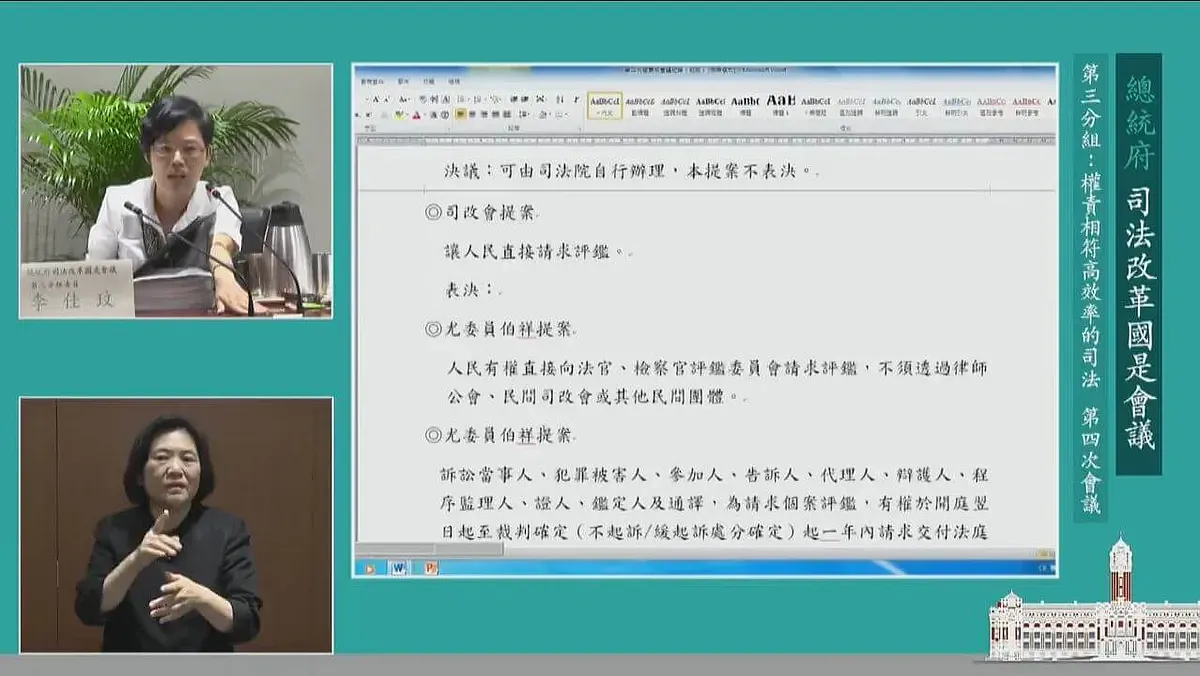
Brief Notes: The 4th Meeting of Division 3 of the Presidential Office's National Consultative Conference on Judicial Reform
Last edited: 2026-08-24
- Lasting four hours, this meeting concluded the discussion on "reviewing the functions of the Judges Evaluation Committee and Prosecutor Evaluation Committee or the feasibility of establishing a Legal Professionals Evaluation Foundation." Several reform proposals were passed, aiming to drive changes in the evaluation process, as well as the organization and powers of the evaluation committees.
- The items passed in this meeting can be categorized into four aspects: the accessibility of the evaluation system, the operational capacity of the evaluation committees, ensuring the objectivity and impartiality of evaluation resolutions, and due evaluation procedures.
- Accessibility of the Evaluation System
- Citizens may directly request an evaluation.
- Appropriately extend the time limit for requesting evaluations.
- Operational Capacity of the Evaluation Committees
- The evaluation committees shall have an independent budget and dedicated staff: serving as a complementary measure for citizens to directly request evaluations, assisting in conducting preliminary screening procedures.
- Ensuring the Objectivity and Impartiality of Evaluation Resolutions
- Increase the sources and proportion of external members: introduce diverse perspectives to eliminate concerns of officials shielding one another.
- Attorney members shall not participate in the evaluation of judges and prosecutors whose cases they have previously handled: this simultaneously eases the pressure on judges and prosecutors handling cases and helps ensure the impartiality of investigation and trial.
- Evaluation requesters may obtain necessary information during the evaluation procedure and appear to state their opinions; conversely, the evaluated judges and prosecutors shall be granted certain procedural guarantees.
- Changes in the Organization and Powers of the Evaluation Committees
- Empowered with the power to initiate cases ex officio.
- Empowered with the power to investigate ex officio: for cases already accepted for deliberation, investigations may be conducted into misconduct not mentioned in the evaluation request.
- Regarding cases involving severe misconduct and the necessity for disciplinary action, they may be directly referred to the Disciplinary Chamber of the Judiciary for adjudication without passing through an impeachment by the Control Yuan.
- Accessibility of the Evaluation System
- Episode of the Meeting
At the beginning of the meeting, committee member Chen Rui-jen proposed to alter the agenda by bringing forward the discussion on "the positioning of prosecutors and the organizational restructuring of the prosecutorial system," which was seconded by committee member Chen Chung-yen. The chairperson became furious, stating that the agenda order had already been scheduled in accordance with the Ministry of Justice's opinions, and Chen Rui-jen's sudden proposal would inevitably waste time for a vote, even briefly expressing an intention to resign as chairperson. Ultimately, Chen Rui-jen withdrew the proposal.
This article is an AI-generated translation of the original Chinese text. In the event of any discrepancy, the Chinese version shall prevail.