
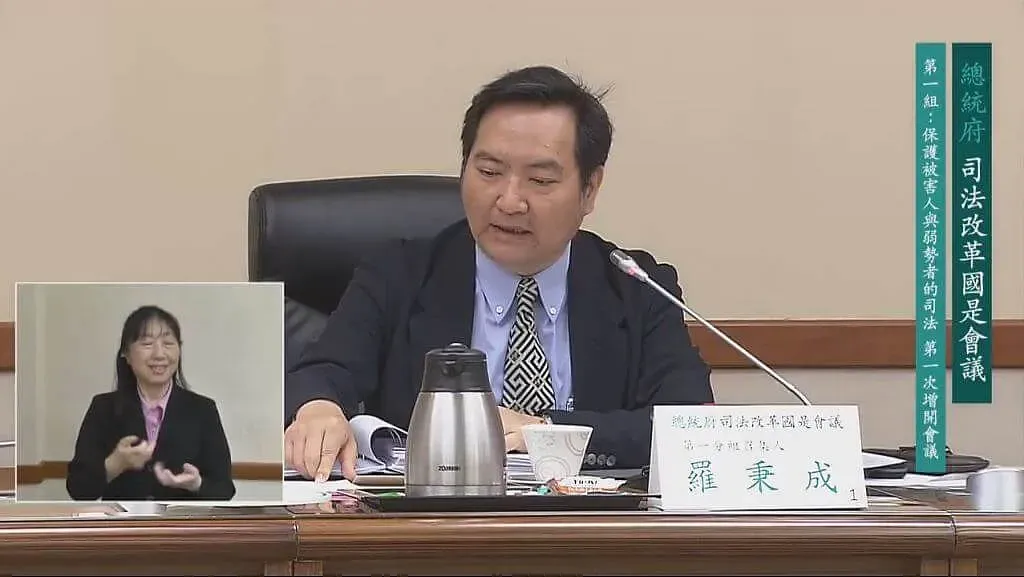
Brief Notes: First Additional Meeting of the First Division of the Presidential Office's National Consultative Conference on Judicial Reform
Last edited: 2026-08-24
Lasting four hours, this meeting discussed whether to establish a national-level forensic science committee, a unified evidence code, expert witnesses, polygraph results as evidence for conviction, and evidence custody. The meeting ultimately passed five resolutions.
There were two proposals in this meeting, both jointly proposed by member Chen Lung-chi along with members Huang Chih-hao, Chao I-shan, and Li Chun-i. Although members Lin Chao-chen and Chang Wen-chen had previously proposed amendments at the March 16 meeting, both members withdrew their proposals in this meeting to facilitate discussion.
The four members jointly proposed two motions, which are:
2-1 Discussion on establishing an independent national-level forensic science committee at the ministry level or above outside the Executive Yuan, dedicated to the following matters of policy, education, and accreditation to strengthen the judiciary's ability to discover the truth and reduce miscarriages of justice: (1) formulating and promoting forensic science policies to enhance the overall quality of scientific evidence; (2) integrating and promoting forensic science education at all levels; and (3) formulating and implementing accreditation norms and licensing systems for related laboratories and experts.
2-2 Discussion on studying and formulating a unified evidence code and perfecting rules of evidence based on the design of a fair tribunal and adversarial litigation: (1) strictly excluding improperly obtained confessions and misleading scientific evidence from trials, narrowing the court's scope for "balancing" improper evidence to promote a fair tribunal and correctly ascertain facts, thereby avoiding miscarriages of justice; (2) implementing adversarial proceedings, replacing the expert evaluation system and its systemic flaws with an expert witness system; and (3) prohibiting in principle the use of conclusions from polygraphs or similar techniques as evidence in trials to enhance the court's fact-finding ability and prevent influence from misleading or immature science.
Key Points of Discussion
Regarding "Whether to Establish a National-Level Forensic Science Committee":
Regarding the organizational structure, member Huang Chih-hao, one of the proposers, hoped to place it in an agency outside the Executive Yuan to maintain the organizational independence of the national-level forensic science committee. However, member Tsai Chiung-tun disagreed with explicitly mentioning "outside the Executive Yuan" in the proposal, because if the national-level forensic science committee is not established under the Executive Yuan, it is almost tantamount to requiring it to be established under the Judicial Yuan. However, following the future "transition of the Judicial Yuan into a judicial tribunal," the Judicial Yuan will no longer shoulder administrative tasks, making it even less suitable to lead the national-level forensic science committee.
Members Lin Yu-shun and Chang Wen-chen also pointed out that the national-level forensic science committee in the United States is an organization established under the executive branch, and therefore argued that the national-level forensic science committee does not necessarily have to be excluded from being under the Executive Yuan.
Regarding the Formulation of a "Unified Evidence Code":
2-1 Proposer Huang Chih-hao argued that our country's Code of Civil Procedure does not have many provisions concerning rules of evidence. Furthermore, neither the Code of Civil Procedure nor the Administrative Litigation Act contains provisions regarding the use of improperly obtained evidence, frequently causing controversies in the adoption of evidence. In addition, provisions in the Code of Criminal Procedure concerning the adoption of illegally obtained evidence are also ambiguous. For example, Article 158-4 of the Code of Criminal Procedure stipulates: "Unless otherwise provided by law, in determining the admissibility of evidence obtained by public officials implementing criminal proceedings through a violation of statutory procedures, consideration shall be given to the balanced protection of human rights and public interests." This frequently causes judges to allow illegally obtained evidence to be used in court if they internally believe the defendant is guilty, or to render illegally obtained evidence inadmissible if they internally believe the defendant is not guilty, making it difficult for judges to maintain a neutral role in adjudicating matters. Therefore, our country should have clear evidence law provisions to handle issues of evidence utilization. There should also be unified evidence law provisions across criminal, civil, and administrative litigation to prevent ambiguities in evidence adoption between the Code of Civil Procedure and the Administrative Litigation Act.
2-2 Members Yao Chung-lu and Lin Chih-feng both argued: Both the U.S. civil and criminal procedure laws adopt the adversarial system, which is why a unified evidence code exists there. However, Taiwan's Code of Civil Procedure adopts the adversarial system, whereas the Code of Criminal Procedure adopts a modified adversarial system rather than a pure adversarial system, allowing judges to investigate ex officio under certain conditions. Compared with the United States, the litigation models are inconsistent; thus, they questioned whether our country can formulate a unified evidence code for criminal, civil, and administrative litigation.
2-3 Member Lin Yu-shun reminded: Simply enacting an evidence code without concurrently reforming key characteristics of the adversarial system—such as cross-examination and the principle of a single indictment—would likely be insufficient.
2-3 Member Chang Wen-chen stated: Public distrust of judges' free evaluation of evidence in Taiwan may stem from a misunderstanding, or it may genuinely be because judges possess excessively broad discretionary space in evaluating evidence. However, the lack of public trust in judicial fact-finding is indeed a problem.
The United States formulated a unified evidence code due to similar circumstances. While the U.S. adopted this approach, I harbor some hesitation as to whether it is suitable for Taiwan. When the U.S. originally formulated a unified evidence code, it sparked constitutional controversies because enacting legislation to restrict rules of evidence at the core of adjudication involves the separation of powers and checks and balances. Nevertheless, the U.S. Supreme Court ultimately ruled the unified evidence code constitutional, largely because the judiciary exerted stronger influence during the code-making process, and because the U.S. employs juries in criminal and civil systems where fact-finding is performed by a jury, necessitating rules for fact-finding. Since the situation in Taiwan differs from the U.S.—Taiwan belongs to the civil law tradition and traditionally accords a high degree of respect to judges' application and determination of evidence rules in individual cases—the U.S. approach is not necessarily applicable to Taiwan.
Nevertheless, I believe that public distrust of judges' free evaluation of evidence in Taiwan is indeed a problem. A resolution should be passed demanding at least that competent authorities confront this issue. Could we ask the competent authority, namely the Judicial Yuan, to study how to unify the application of evidence evaluation rules in judgments, grounded in the design of a fair tribunal?
2-4 Preparatory Committee Member Hsu Yu-hsiu noted: Since our country intends to adopt a "system of people's participation in trials," we should pay even more urgent attention to the reform of rules of evidence.
Regarding "Expert Witnesses" and the Abolition or Retention of the Expert Evaluation System:
3-1 Member Huang Chih-hao: The expert witness system is rooted in the spirit of the adversarial system, allowing both parties to move for expert witnesses to testify in court, where expert witnesses must appear and be subject to cross-examination. Under the expert evaluation system, expert evaluation is viewed as assisting the court in making determinations, and the defendant has no right to demand whether or to whom an evaluation should be sent. Furthermore, current evaluation practices include "institutional evaluation," where only the institution's name is affixed, leaving it unknown who conducted the evaluation or whom to summon for cross-examination, and the submitted evaluation report can be used without undergoing cross-examination. In addition, the current evaluation system allows prosecutors to submit matters for evaluation while denying defendants the same right, forcing defendants to request prosecutors or judges to initiate an evaluation, which is inherently unfair.
3-2 Member Tsai Chiung-tun noted: Expert evaluation is a neutral approach. Under the expert witness system, where both prosecutors and defendants may independently hire their own expert witnesses, the expert witnesses are certainly not neutral. Moreover, if defendants are permitted to independently hire expert witnesses, defendants of differing financial means would be able to hire expert witnesses of varying professional competence, clearly placing financially disadvantaged defendants at a disadvantage due to their inability to hire competent expert witnesses. Among scholars, Professors Lin Chih-chieh and Yang Yun-hua also oppose the expert witness system.
3-3 Member Mao Sung-ting: I agree with the problems of the expert witness system raised by member Tsai Chiung-tun. Regarding the problems of the current evaluation system, based on my eight years of judicial experience, there is no such thing as an unsummonable evaluator. If everyone is most dissatisfied with the institutional evaluation portion of the current system, it should be addressed in a less burdensome manner, such as deleting the provision prohibiting the apprehension of evaluators or abolishing institutional evaluation so that evaluations may only be specifically commissioned to natural persons. Furthermore, I believe that moving toward an adversarial system makes it reasonable for parties to independently select experts to present opinions. Therefore, I believe the expert witness system should be introduced while simultaneously reforming the current evaluation system, rather than abolishing it outright.
3-3 Preparatory Committee Member Hsu Yu-hsiu: As I understand it, evaluators are essentially expert witnesses. Rather than saying we should discard the evaluation system or replace it with an expert witness system, the problem is how to prevent courts from being lethargic. In fact, there are currently some cases where defendants or prosecutors move for expert witnesses to testify in court rather than relying on court-commissioned evaluations. Moreover, the argument that introducing the expert witness system will create financial inequality is not entirely fair, because the status quo is already the same. Wealthier individuals can afford better experts to assist them, while those without means must rely on the court. In other words, this is not a problem inherent in the evaluation system itself, but a problem of practical operation. There should be flexibility allowing both parties to move to summon their respective expert witnesses, and when defendants lack financial means, the court must provide certain assistance or legal aid resources.
3-4 Regarding the problems of the current evaluation system, everyone reached a consensus, and similar practices akin to expert witnesses have already emerged within the current system, though the system remains incomplete—on this point there is also consensus. However, no consensus was reached during the meeting as to whether the evaluation system should be completely replaced by expert witnesses, particularly considering that expert witnesses called by the two parties may lack neutrality, and whether judges should retain the power to order evaluations ex officio.
Regarding the "Polygraph System":
4-1 Chairperson Lo Ping-cheng: The administration of polygraphs can be handled through the aforementioned resolution to "establish a national-level forensic science committee"; the admissibility of polygraph evidence can be handled through the aforementioned resolution on a "unified evidence code." Furthermore, divergences have emerged within the Supreme Court regarding the admissibility of polygraph evidence, making it truly necessary to address this issue.
Regarding "Evidence Custody":
5-1 Member Li Chun-i: Explicit provisions are currently lacking regarding the minimization of evidence, the post-trial preservation of evidence, and the adoption of identical types of evidence by different evaluation units.
5-2 Chairperson Lo Ping-cheng: There are no clear provisions regarding the legal consequences of the loss of physical evidence.
5-3 Member Chen Lung-chi: Evidence custody is an extremely important regulation; do not dismiss it as too troublesome!
5-4 Member Lin Chih-feng: Regarding urine testing by current prosecutors, once a judgment becomes final, the urine sample bottles are destroyed. Evidence custody involves cost considerations; if the state has money, I have no objection to preserving physical evidence for 100 years.
5-5 Regarding the custodial unit for physical evidence, no consensus was reached during the meeting; thus, it is recommended that the Executive Yuan and the Judicial Yuan jointly deliberate on the matter.
Based on the proposals submitted by the four members, the meeting ultimately adopted the following resolutions:
Our country should establish an independently functioning national-level forensic science committee, whose members should include experts from related fields such as human rights, psychology, law, medicine, brain science, and criminal forensics, dedicated to policy, education, and accreditation matters to strengthen the judiciary's ability to discover the truth and reduce miscarriages of justice: (1) formulate and promote forensic science policies to enhance the overall quality of scientific evidence; (2) integrate and promote forensic science education at all levels; and (3) formulate and implement accreditation norms and licensing systems for related laboratories and experts.
It is recommended that the Judicial Yuan study and formulate a specialized evidence law applicable to criminal, civil, and administrative litigation, perfecting rules of evidence to promote the court's correct determination of facts and strengthen evidence-centric trial functions.
It is recommended that the Judicial Yuan study, formulate, and perfect an expert witness system while simultaneously reviewing the functional deficiencies and the question of abolition or retention of the current evaluation system.
Regarding the standard operating procedures for administering polygraph evidence and its admissibility, these issues should be reviewed concurrently within the aforementioned forensic science committee and specialized evidence law resolutions. Prior to the establishment of the forensic science committee and the enactment of the specialized evidence law, the administration of polygraphs and the qualification of their evidence should be considered with caution.
It is recommended that the Executive Yuan and the Judicial Yuan jointly deliberate on establishing an evidence custody and post-final-judgment physical evidence preservation system, regulating methods of evidence custody and retention periods, and clearly prescribing the legal consequences of violations.
The next meeting is scheduled for Saturday, April 15, which will be the second additional meeting to continue discussions on the issue that investigations shall not be made public.
This article is an AI-generated translation of the original Chinese text. In the event of any discrepancy, the Chinese version shall prevail.