
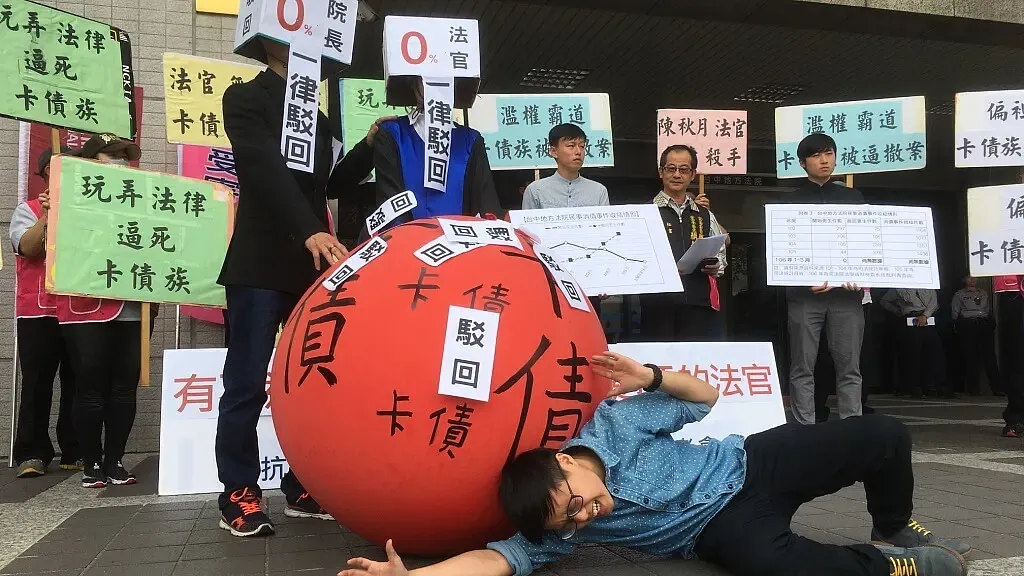
An Unfit President Breeds Unfit Judges: Joint Press Conference on the Breakdown of the Debt Clearance Mechanism at the Taichung District Court
Last edited: 2026-08-24
Judge Chen Chiu-yueh of the Taichung District Court began handling cases under the Consumer Debt Clearance Statute in September 2015. Due to her deplorable conduct during court sessions, frequently coercing withdrawals and dismissing petitions for debt rehabilitation and exemption from liability for those who refused, public grievances mounted. On May 24, 2016, the Self-Help Association of Debtors Victimized by Credit Card Debt petitioned the Judicial Yuan (see Appendix 1). At that time, the Taichung District Court issued a press release emphasizing that Judge Chen Chiu-yueh had never committed any illegal acts or abuses of power (see Appendix 2). Backed by her superiors, Judge Chen Chiu-yueh not only failed to improve but became even more egregious. Pursuant to Article 46 of the Consumer Debt Clearance Statute, a judge may not dismiss a petition for rehabilitation unless one of the three grounds listed in Paragraph 1 is present. Consequently, the average approval rate for rehabilitation across district courts nationwide exceeds 70% (see Table 2), and Judge Lin Shih-min, another judge in the Taichung District Court's Debt Clearance Division, achieved an 80% rehabilitation approval rate. Yet, solely in the case of Judge Chen Chiu-yueh, from September 2015 to February 2017, she did not issue a single ruling to commence rehabilitation, resulting in a rehabilitation approval rate of 0%, constituting an extremely severe case of illegality (see Table 3).
Originally, the debt clearance mechanism at the Taichung District Court operated smoothly. Taking 2013 as an example, the number of initiated rehabilitation cases was 206, while the number of withdrawn cases was 105 (see figure below). After President Chiang Hsi-lin took office in August 2015, the number of initiated rehabilitation cases plunged to 44 in 2015, while the number of withdrawn cases soared to 378. At the end of last year, Judge Lin Shih-min was transferred out of the Debt Clearance Division, and from January to March of this year, the number of initiated rehabilitation cases at the Taichung District Court was unexpectedly 0, causing the debt clearance mechanism to completely break down (see Table 4). This is not merely an issue of an individual judge, but rather demonstrates that the entire system of judicial official supervision is a dead letter, highlighting that an unfit president breeds unfit judges.
Figure: Case Intake and Disposition of Civil Debt Clearance Cases in the Taichung District Court
Note: Sources are the Judicial Statistics Annual Report for 2011–2014, the Judicial Statistics Monthly Report for 2015, and the Judicial Yuan's Jurisprudential Data Retrieval System Judgment Search for 2017.
Pursuant to Article 19 of the Judges Act: "A judge shall be subject to official supervision to the extent that their independent adjudication is not affected. Official supervision includes halting a judge's unlawful exercise of official powers, correcting a judge's inappropriate remarks and conduct, and urging a judge to promptly execute their duties in accordance with the law." Article 20 provides: "Official supervision of judges shall be governed by the following provisions: 1. The President of the Judicial Yuan supervises judges of all courts and members of the Public Functionary Disciplinary Sanction Commission. 10. The president of a district court supervises the judges of that court and its branch courts." President Chiang Hsi-lin holds the authority of official supervision over Judge Chen Chiu-yueh and the judges of that court. Should the official supervision mechanism of the Taichung District Court fail, supervision should be exercised by the President of the Judicial Yuan. Last year, the cries for help from credit card debt victims still echoed in our ears, yet the Taichung District Court continued to allow the debt clearance mechanism to break down, and President Chiang Hsi-lin cannot shirk his responsibility.
The breakdown of the debt clearance mechanism at the Taichung District Court has caused vulnerable debtors in the Greater Taichung area to face bank debt collection and worsening economic conditions without being able to resolve their issues through the Consumer Debt Clearance Statute. This impacts not only the individual debtors but also their even more vulnerable children and parents standing behind them. Because official supervision has become a dead letter, the Judicial Reform Foundation already requested an individual case evaluation for Judge Chen Chiu-yueh on April 13, which is currently being reviewed by the Judges Evaluation Committee (see Appendix 3). However, judge evaluation is too slow to meet urgent needs and cannot resolve the breakdown of the debt clearance mechanism. Today, we are holding a press conference at the main entrance of the Taichung District Court to put forth four demands, requiring the judicial authorities to immediately respond and take action:
Publicly solicit information regarding Judge Chen Chiu-yueh's improper adjudication of debt clearance cases, which this Foundation will compile and submit to the Judges Evaluation Committee. Complaint Hotline: Judicial Reform Foundation 04-23292371, see appendix for the solicitation announcement.
Judge Chen Chiu-yueh is unfit to adjudicate debt clearance cases and official supervision should be immediately exercised over her.
President Chiang Hsi-lin has allowed the debt clearance mechanism to break down and official supervision should be immediately exercised over him.
Hearings for debt clearance cases must be audio and video recorded throughout to supervise whether judges maintain appropriate conduct during debt clearance proceedings.
Appendices
Press Release of the May 24, 2016 Press Conference by the Self-Help Association of Debtors Victimized by Credit Card Debt
Taichung District Court Clarification Press Release Regarding the Self-Help Association of Debtors Victimized by Credit Card Debt (May 24, 2016)
Request for Individual Case Evaluation of Judge Chen Chiu-yueh
Public Solicitation Announcement for Information on Judge Chen Chiu-yueh's Improper Adjudication of Debt Clearance Cases
Attending Representatives
Lin Yung-sung / Chairman, Judicial Reform Foundation
Huang Wei-ting / Director, Taichung Office, Judicial Reform Foundation
Representative, Self-Help Association of Debtors Victimized by Credit Card Debt
Tseng Wen-hsueh / Legislative Bill Researcher, Office of Legislator Hsu Yung-ming
Li Chao-ming / Secretary, Office of Councilor Yen Li-min
Press Contact
Huang Wei-ting, Director, Taichung Office, Judicial Reform Foundation
| Illegal Act | Statute for Consumer Debt Clearance |
| The judge violated the provision of the Debt Clearance Statute that the repayment period may not exceed six years, coercing debtors into accepting the bank's terms of 180 installments over 15 years with a deplorable attitude. | Article 53 of the Debt Clearance Statute: The final repayment period shall not exceed six years from the day following the date when the ruling approving the rehabilitation plan becomes final and conclusive. |
| For information that debtors were unable to obtain, the judge failed to investigate in accordance with the law and instead determined that the debtors violated the reporting obligation under Article 46, Paragraph 3 of the Debt Clearance Statute, dismissing the rehabilitation petition. | Article 9 of the Debt Clearance Statute: The court shall investigate necessary facts and evidence ex officio, and may make inquiries to tax or other authorities and organizations. |
| Even when the balance of a debtor's disposable income after deducting necessary living expenses for themselves and their dependents by law is lower than the amount to be repaid under the rehabilitation plan for three consecutive months—meeting the statutory non-attributable cause under Article 75 of the Debt Clearance Statute—the judge nevertheless determined that the debtor had an attributable cause under Article 46, Paragraph 2. | Article 75 of the Debt Clearance Statute: After a rehabilitation plan has been ruled approved and become final and conclusive by the court, if a debtor has difficulty in performance due to causes not attributable to themselves, they may petition the court for a ruling to extend their performance period. However, the extended period shall not exceed two years. Where the balance of a debtor's disposable income after deducting necessary living expenses for themselves and their dependents by law is lower than the amount to be repaid under the rehabilitation plan for three consecutive months, it shall be presumed that the cause in the preceding paragraph exists. |
| Where debtors met the provisions of Article 132 of the Debt Clearance Statute, the judge still required debtors to make additional repayments to banks ranging from 30,000 to 1,000,000 NTD before granting exemption from liability, arbitrarily adding restrictions not provided by law. | Article 132 of the Debt Clearance Statute: After a ruling to terminate or conclude liquidation proceedings becomes final and conclusive, the court shall, unless otherwise provided, rule to exempt the debtor from their debts. |
| Year | Number of Concluded Rehabilitation Cases | Number of Commenced Rehabilitation and Liquidation Cases | Commencement Ratio |
| 2012 | 1803 | 1368 | 76% |
| 2013 | 2619 | 2060 | 79% |
| 2014 | 2857 | 2202 | 77% |
| 2015 | 3486 | 2562 | 73% |
| 2016 | 3612 | 2521 | 70% |
| Judge Chen Chiu-yueh | Judge Lin Shih-min | ||
| Ruling Result | Case Count | Ruling Result | Case Count |
| Commencement of Rehabilitation Petition | 0 | Commencement of Rehabilitation Petition | 28 |
| Dismissal of Rehabilitation Petition | 11 | Dismissal of Rehabilitation Petition | 7 |
| Prohibition of Compulsory Enforcement Prior to Rehabilitation Ruling | 1 | Prohibition of Compulsory Enforcement Prior to Rehabilitation Ruling | 16 |
| Supplementary Payment of Adjudication Fees | 2 | Supplementary Payment of Adjudication Fees | 0 |
| Transfer of Jurisdiction | 1 | Transfer of Jurisdiction | 0 |
| Total | 15 | Total | 51 |
| Year | Initiated Rehabilitation Cases | Withdrawn Cases | Concluded Debt Clearance Cases |
| 2012 | 232 | 41 | 841 |
| 2013 | 297 | 75 | 1164 |
| 2014 | 206 | 105 | 1077 |
| 2015 | 185 | 258 | 1257 |
| 2016 | 44 | 378 | 1436 |
| Jan-Mar 2017 | 0 | No data yet | No data yet |
This article is an AI-generated translation of the original Chinese text. In the event of any discrepancy, the Chinese version shall prevail.