
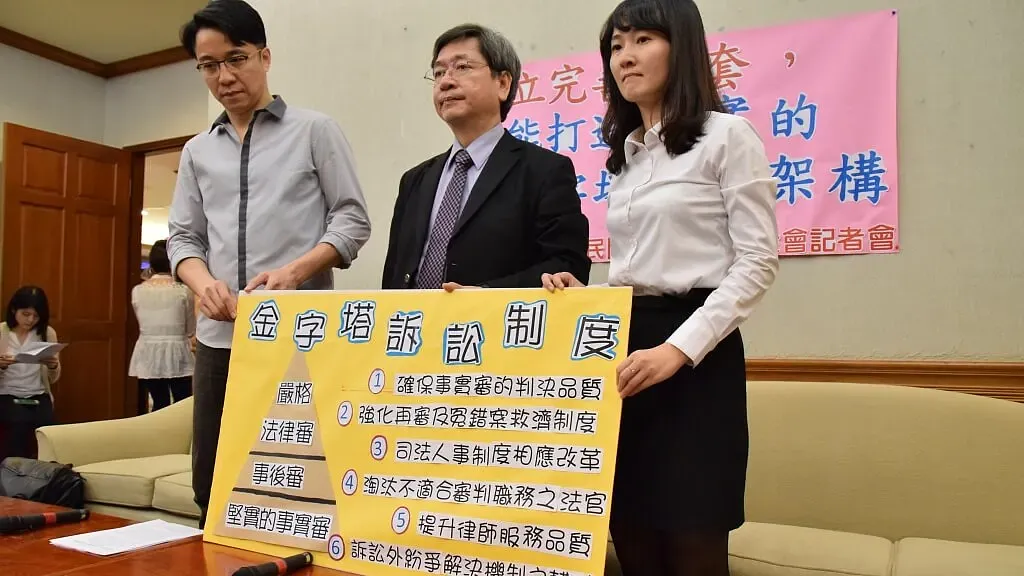
Press Conference|Establishing Comprehensive Supporting Measures is Essential to Build a Solid Pyramidal Litigation Structure
Last edited: 2026-08-24
The National Judicial Reform Conference held in 1999 resolved to transform the current cylindrical litigation system into a "pyramidal" litigation structure. However, because the corresponding supporting measures were never implemented, the reform has been delayed to this day. During the 2017 National Conference on Judicial Reform, panel sessions once again passed the proposal submitted by the Judicial Yuan, titled "Reform Direction of the Pyramidal Litigation Procedure: Establishing a solid first instance; adopting subsequent review as the principle for the second instance while concurrently adopting a continuous trial system; and structuring the third instance as a strict legal review."
It remains questionable whether Taiwan's judicial environment has developed mature conditions capable of withstanding the shock of comprehensively adopting a pyramidal litigation system. Today (the 25th), a press conference is held at Room 101 of the Zhongxing Building, calling upon the National Conference on Judicial Reform and authorities to formulate relevant supporting measures and propose six recommendations prior to the implementation of the pyramidal litigation system.
The "Pyramidal Litigation System": Should We Pay Attention to "Disadvantages Outweighing Advantages"?
The pyramidal litigation system refers to a structure where the first instance serves exclusively as a fact-finding trial, while the second instance adopts a subsequent review, using the facts investigated in the first instance as the entire foundation as a rule (meaning the higher instance cannot alter the fact-finding). The third instance is changed to a strict legal review, examining only the application of law and the uniform interpretation of law. The advantages are that it allows the first-instance court, which is closest in time to the incident, to effectively clarify the case facts, preventing the first- and second-instance courts from repeatedly investigating facts—which wastes judicial resources to no avail—and prevents the third-instance court from intervening in fact-finding and frequently remanding cases for retrial, which makes cases difficult to finalize and generates public grievance. It also aims to alleviate problems such as the excessive number of judges in the third-instance court, which leads to divergent legal interpretations.
However, the disadvantage of adopting a pyramidal litigation system is that if the first-instance fact-finding deviates from the truth, although the public may still formally request an appellate remedy, the higher-instance court will not reinvestigate evidence because it adopts a subsequent review and relies on the facts found by the first instance as the basis for its judgment. At the same time, due to strict review of appeals or potentially to reduce the caseload of appeals, appeal requests could be easily dismissed, thereby causing wrongful convictions to be upheld. Without adequate supporting measures, the public may suffer harm rather than reap benefits, and consequently lose the opportunity to remedy flaws in the original trial through appellate review.
Recommended Supporting Measures for the Pyramidal Litigation System
As a rule, we support the reform direction of the pyramidal litigation system. If sound supporting measures are properly operated, it will bring positive significance to the protection of public rights and interests, ensuring high judicial quality and efficiency. Nevertheless, we call upon the authorities to adopt progressive reforms and provide comprehensive supporting measures to prevent the public from suffering harm before gaining any benefits. Below are six recommendations regarding the supporting measures that need to be formulated prior to the implementation of the pyramidal litigation system:
Ensuring the Judgment Quality of Fact-Finding Trials
The success of the pyramidal litigation system reform is premised on a solid fact-finding trial. As the focus of case fact-finding shifts to the first-instance court, the burden on first-instance judges will increase substantially. It is recommended to encourage judges from the second instance to transfer to first-instance courts to handle cases. In addition to increasing the number of first-instance judges and solving the human-resource burden, this will also allow the trial experience of former second-instance judges to be passed down.
During the transitional period when the pyramidal system is newly implemented, consideration should be given to allowing the public the right to choose whether to apply the new system or the old system. For example, if the new system is chosen, the first-instance trial must adopt a three-judge panel throughout the entire process, with three or more judges participating in the evidence investigation and trial procedures from beginning to end, adopting continuous and concentrated trials to achieve judicial efficiency.
Corresponding Reforms to the Judicial Personnel System
In addition to adjusting judicial manpower in the first and second instances, the caseload of the Supreme Court will decrease substantially after the implementation of the pyramidal litigation system, and the number of Supreme Court judges should be reduced correspondingly to prevent the current phenomenon of inconsistent legal interpretations among various divisions.
Following this restructuring, the Supreme Court will exercise the functions of unifying legal interpretations and judicial law-making, thus playing a heavier role. It is all the more necessary to avoid the current selection methods characterized by inbreeding and seniority. How to diversify the sources of future Supreme Court judges so as to broadly incorporate various opinions and make the public trust Supreme Court judgments is also a key to the success of the pyramidal system.
Strengthening Retrial and Wrongful Conviction Relief Systems
Under circumstances where opportunities for appellate relief are relatively restricted, the threshold for extraordinary remedies should be relaxed to prevent wrongful convictions. Furthermore, to increase the opportunities for reopening trials in wrongful conviction cases, the design of the Criminal Cases Review Commission (CCRC) in England—establishing an independent criminal review mechanism outside the judiciary—should have reference value. Within prosecutors' offices, a specialized unit established by the prosecution system along the lines of the American "Conviction Integrity Unit" can also be referenced to independently review controversial cases and rescue the innocent.
Phasing Out Judges Unsuited for Judicial Duties
If judges with poor adjudication quality (e.g., plagiarizing judgments) or poor courtroom attitudes (e.g., berating parties) are found to be manifestly unsuited for judicial duties, consideration should be given to reassigning their duties immediately, transferring them at least to non-judicial positions (e.g., research judges), in order to build solid litigation proceedings.
At the same time, the system of probationary and provisional judges must be enforced. If evaluations show that a judge is manifestly unsuited for judicial duties, they shall not be transitioned to tenured judges upon completion of their term.
Enhancing the Service Quality of Attorneys
To build a solid fact-finding trial, the role of attorneys is equally crucial. A conscientious attorney must submit complete requests for evidence investigation during the fact-finding trial and present corresponding litigation claims for the client, so as to prevent the client's rights and interests from being prejudiced during the appellate review due to limitations on the scope of presenting factual defenses.
Under the premise of attorney self-governance and self-discipline, how to enhance the service quality of attorneys will depend in part on how bar associations strengthen their disciplinary functions to weed out derelict attorneys, or promote self-improvement of attorneys' abilities through in-service education.
Therefore, we call upon bar associations to provide specific explanations on how to enhance disciplinary functions. Possible methods include collecting opinions on attorney service quality from the public, judges, or prosecutors, and actively reminding the public that they may report attorneys to the association. If bar associations remain unable to fulfill their duties, appropriate government intervention may be a necessary measure in the initial stage to ensure people's litigation rights.
To reduce the sources of cases entering the courts and appellate reviews, the pyramidal system may need to be paired with mandatory attorney representation and mandatory defense systems, and the scope of legal aid must also be expanded correspondingly. Therefore, attorney information should also be made transparent and public, allowing the public to choose attorneys with corresponding specialties based on the nature of the case.
Auxiliary Role of Alternative Dispute Resolution (ADR) Mechanisms
To prevent a massive influx of cases into the courts, which would excessively burden judicial resources, and to ensure that limited judicial resources can be used for cases truly in need, strengthening alternative dispute resolution mechanisms and reducing court caseloads are definitely indispensable supporting measures.
In summary, just like the construction of the Egyptian pyramids, aside from having a solid foundation, it requires a long construction process of a decade or two to stand firm for millennia. The reform of the litigation system is no different; only by constructing a solid foundation for fact-finding, coupled with stable and thorough supporting measures, and implemented with steady progress, can the public truly benefit from it.
Attendees
Lin Yung-sung, Attorney at Law / Chairman, Judicial Reform Foundation
Huang Ying-chia, Attorney at Law / Staff Attorney, Judicial Reform Foundation
Kao Jung-chih, Attorney at Law / Executive Director, Judicial Reform Foundation
Press Contact
Kao Jung-chih, Executive Director, Judicial Reform Foundation — (02) 2523-1178
This article is an AI-generated translation of the original Chinese text. In the event of any discrepancy, the Chinese version shall prevail.