
Brief Review: The 5th Meeting of Group 2 of the Presidential Office's National Consultative Conference on Judicial Reform
Last edited: 2026-08-24
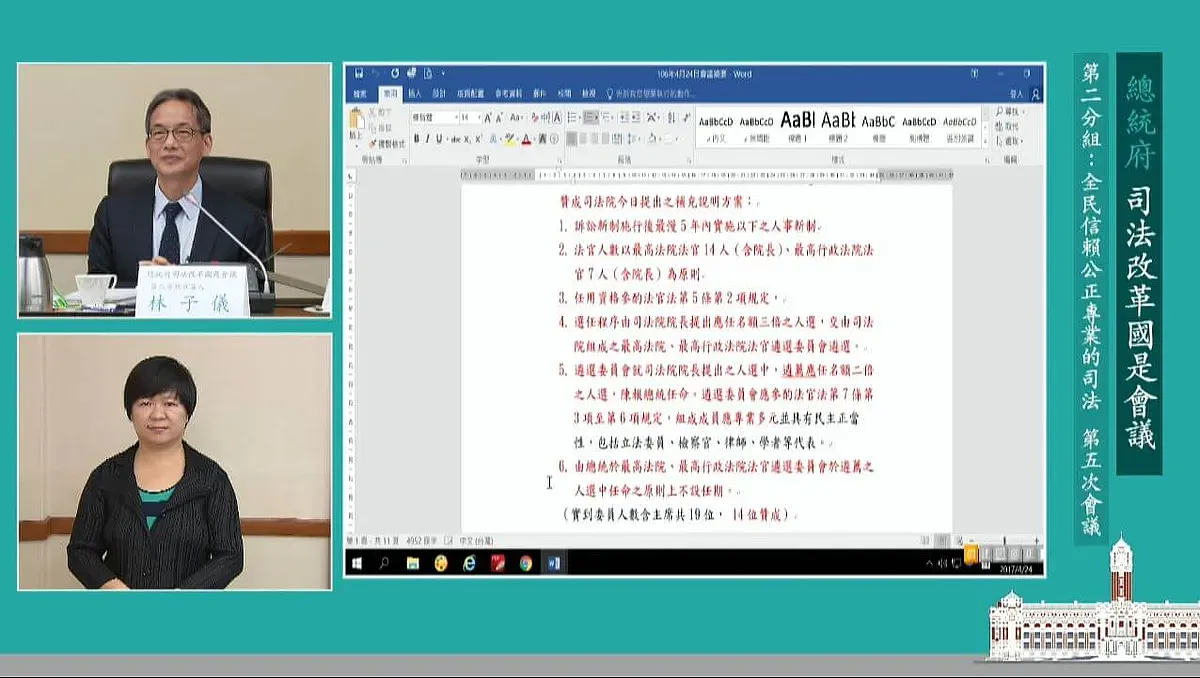
The focal point of discussion in this meeting was the number of Supreme Court judges, qualification requirements, selection procedures, and term lengths. Members had fewer objections regarding the President's final power of appointment.
Regarding the total number of Supreme Court judges, in coordination with the implementation of the pyramidal litigation system and the subsequent decrease in caseloads at the Supreme Court, the number of positions should be reduced accordingly. Reducing the headcount helps prevent conflicting rulings among different divisions. As for the exact number of judges, members held differing views, but it was ultimately decided to set the number at 14 (including the President of the Supreme Court). In the future, the Supreme Court will have only one civil division and one criminal division, with 7 judges per division. The number should not be too large to prevent excessive divergence of views within each division, which would make integration difficult.
The controversy surrounding appointment qualifications lies in why candidates must possess qualifications for the intended position: because they hold lifetime tenure, they must meet judicial officer appointment qualifications to comply with the Constitution's requirements for lifetime tenure protection.
The selection procedure for Supreme Court judges was the focus of discussion and involves major reforms. It was resolved to design a process with democratic legitimacy; through diversified selection, it should ameliorate the current problem where all Supreme Court judges are selected from High Court judges, causing Supreme Court opinions to tend toward conservatism. First, the President of the Judicial Yuan nominates three times the number of vacant positions, based on the rationale that, as the supervisor of courts nationwide, they must bear responsibility for the ultimate outcomes of the judiciary. Second, the Judges Selection Committee then selects twice the number of candidates, with a committee composition that is diverse and professional. Finally, the names are submitted to the President for appointment, and the President cannot select anyone outside of the list.
Political appointments of judges of courts of last resort are commonly adopted worldwide. Countries internationally that have both constitutional courts and supreme courts all utilize political appointments, and comparative legal experience should be sufficient for reference. As for how the selection procedure should be designed, it remains open for discussion, but special attention should be paid to the checks and balances and dispersion of power.
This article is an AI-generated translation of the original Chinese text. In the event of any discrepancy, the Chinese version shall prevail.