
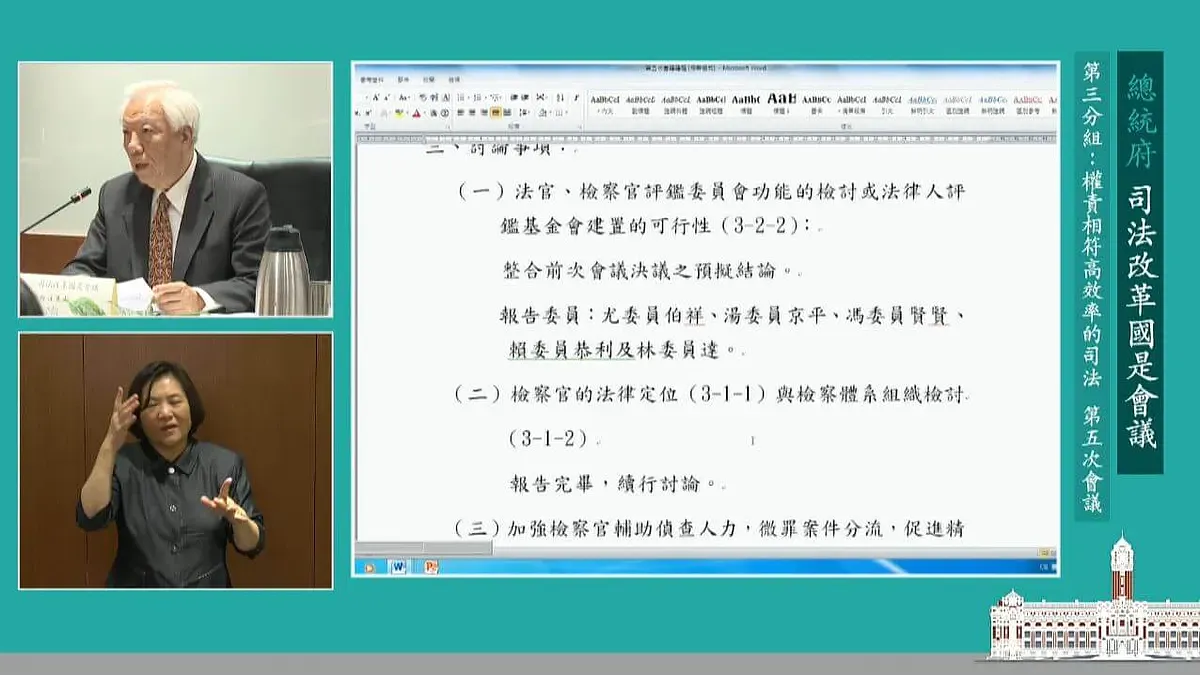
Brief Notes: The 5th Meeting of Group 3 of the Presidential Office's National Consultative Conference on Judicial Reform
Last edited: 2026-08-25
- Following the previous meeting, Committee Member Lin Yu-hsiung stated in an interview that he would withdraw in protest. Committee Member Lin did not attend this meeting, but according to Committee Member Chen Rui-jen relaying a text message, Committee Member Lin has not yet formally withdrawn. At the outset, the Chairperson also briefly responded to the three questions raised by Committee Member Lin regarding the National Conference on Judicial Reform during his interview.
- This meeting discussed the items of "Legal Status of Prosecutors," "Legislation and Institutional Names," "Whether Prosecutorial Power Should Be Included in the Constitution," and "Personnel Reform and Case-Handling Methods"
- In fact, this meeting shelved the discussion on the issue of the "Legal Status of Prosecutors," with the most critical factor being the conveners' concern that formally reaching a resolution would have too severe an impact on the prosecutorial system.
- However, when discussing whether to amend the names of prosecutors' offices and whether to enact a special law specifically for prosecutors, multiple committee members argued that it must be tied to the status of prosecutors, bringing forth the discussion of "whether the status of prosecutors and reform plans can be decoupled." Committee members arguing against decoupling had quite intense clashes with committee members friendly to the prosecutorial system, and non-legal committee members also had a 50-50 split in opinions, ultimately failing to form a consensus among the members.
- From the reform proposals ultimately passed by vote in this meeting, it can indeed be observed that when the proposing party approaches from other directions to downplay the connection with the status of prosecutors, it is easier to garner support, for example:
- Institutional names of prosecutors' offices at all levels (such as the Taiwan Taipei District "Court" Prosecutors Office) no longer bear the name of the court - to avoid public confusion.
- Revitalize tier-one and tier-two prosecutorial personnel, establishing a rotational system among judicial tiers based on practical experience - to resolve the current problem of uneven workloads between district prosecutors' offices and high prosecutors' offices.
- The selection of tier-one chief prosecutors should be based on the principle of recommendation through voting by prosecutors - to prevent improper external interference in case handling.
- The reason such a discussion unfolded, inferred as a possible cause, is that when committee members debated the "status of prosecutors," they failed to clarify the following issues, making it very difficult for non-legal committee members unfamiliar with this discussion to participate, and even leading them to believe it merely lapsed into academic debate. The Chairperson also suggested that the Ministry of Justice should hold a seminar to invite everyone for discussion.
- What is the definition of a judicial officer / administrative officer? Does it equal the exercise of judicial power / the exercise of administrative power?
- If the answer is affirmative, what framework of the separation of powers helps to distinguish the judicial power / administrative power here?
- What does it mean to "possess" judicial officer attributes?
- As this meeting drew to a close, there was another small interlude. Committee Member Yang Yun-hua suddenly spoke up, accusing the Chairperson of attacking Committee Member Lin Yu-hsiung at the most recent preparatory committee meeting. The Chairperson was clearly very dissatisfied, responding that it had been agreed that the meeting was internal and its contents should not be made public, and slammed the table to loudly announce the adjournment.
This article is an AI-generated translation of the original Chinese text. In the event of any discrepancy, the Chinese version shall prevail.