
The Most Terrifying Thing is a Judiciary Unwilling to Face Its Mistakes: Response Statement on the Malfunctioning of the Debt Clearance Mechanism at the Taichung District Court
Last edited: 2026-08-25
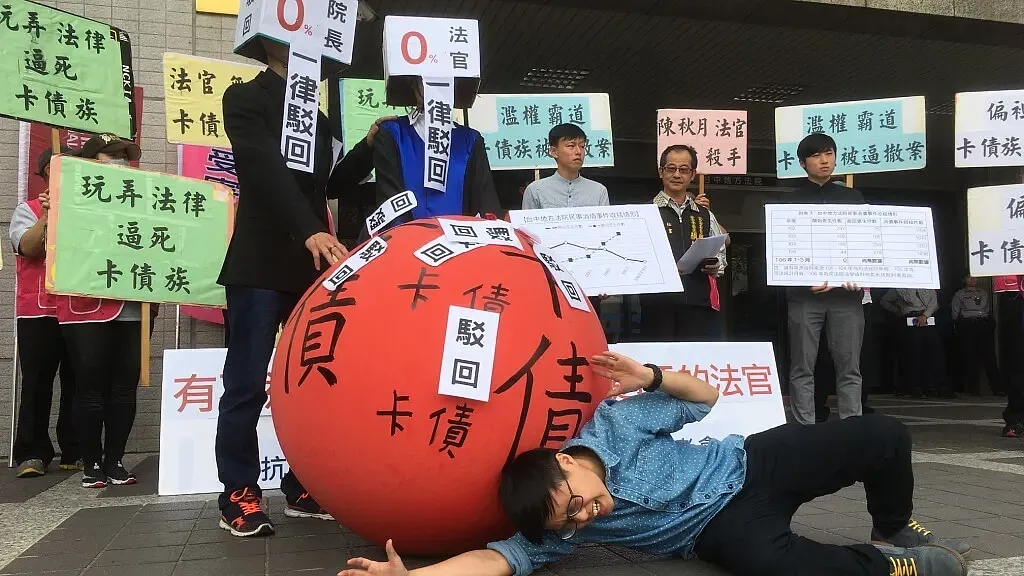
Following the press conference held by the Judicial Reform Foundation and the Self-Help Association of Debtors Victimized by Credit Card Debt on April 24, 2017, to protest the malfunction of the debt clearance mechanism at the Taichung District Court, the Taichung District Court issued a press release on April 25 titled "Regarding Allegations by Some External Groups That the Court's Handling of the Consumer Debt Clearance Mechanism Has Malfunctioned." On April 26, Judge Lin Yi-hung of the Nantou District Court published an op-ed titled "District Court Judges: Incorrect Information is the Culprit Behind the Bankruptcy of Judicial Credibility." The Judicial Reform Foundation hereby responds with the following statement:
The Judicial Yuan Should Urge / The Taichung District Court Should Proactively Provide Statistical Data on Debt Clearance Cases to Maintain Public Credibility:
The press release issued by the Self-Help Association of Debtors Victimized by Credit Card Debt and the Judicial Reform Foundation on April 24, 2017, protesting the malfunction of the debt clearance mechanism at the Taichung District Court, was based on search results from the "Judicial Yuan Legal Data Retrieval System." It pointed out that Judge Chen Chiu-yueh initiated zero rehabilitation cases between September 2015 and March 2017, and the Taichung District Court also initiated zero rehabilitation cases between January and March 2017.
Subsequently, Judge Lin Yi-hung of the Nantou District Court published an op-ed in the media pointing out that according to the "Judicial Yuan Debt Clearance Event Announcement" system, there were other rulings on rehabilitation cases. Upon review and comparison by this Foundation, we found that the announcement statuses between the two systems are inconsistent. The announcement records of Judges Chen Chiu-yueh and Lin Shih-min during the aforementioned period have been compiled in Attachment 1 for comparison and reference purposes.
As Judge Lin Yi-hung stated, between September 2015 and March 2017, while not appearing in the "Judicial Yuan Legal Data Retrieval System," Judge Chen Chiu-yueh indeed issued 3 rehabilitation rulings according to the "Judicial Yuan Debt Clearance Event Announcement" system (105-Ssu-Chieh-Keng-Tzu No. 70 on April 29, 2016; 106-Ssu-Chieh-Keng-Tzu No. 25 on February 9, 2017; and 106-Ssu-Chieh-Keng-Tzu No. 52 on March 27, 2017). Also as Judge Lin stated, the Taichung District Court initiated 4 rehabilitation cases between January and March 2017, 2 of which were rendered by Judge Chen Chiu-yueh (the aforementioned 106-Ssu-Chieh-Keng-Tzu No. 25 on February 9, 2017, and 106-Ssu-Chieh-Keng-Tzu No. 52 on March 27, 2017) and 2 by Judge Chang Kuo-hua (105-Ssu-Chieh-Keng-Tzu No. 142 on March 29, 2017, and 105-Ssu-Chieh-Keng-Tzu No. 85 on March 30, 2017). We thank Judge Lin Yi-hung for his guidance and hereby add the data for Table 3 and Table 4 of the original (April 24) press release as follows. We will also correct the content of the evaluation request against Judge Chen Chiu-yueh.
However, external investigative capacity is limited. When compiling Attachment 1, this Foundation found that judges at the Taichung District Court adopt different external announcement operational procedures, lacking any consistency. This raises doubts about the chaotic internal administrative management of the Taichung District Court, leaving the public unable to understand the actual handling of debt clearance cases by the court. We call upon the Taichung District Court to immediately formulate improvement measures, and we will subsequently request the Judges Evaluation Committee to further investigate the actual handling practices.
In any case, what matters most to the public is whether the debt clearance mechanism of the Taichung District Court has malfunctioned. Although the court emphasized in its press release on April 25, 2017, that "the court's debt clearance mechanism has not malfunctioned," even with the addition of the aforementioned data—excluding the 5 cases entirely dismissed in 2015—looking solely at the entire year of 2015 (see Attachment 1), Judge Chen Chiu-yueh ruled to initiate rehabilitation in only 1 case while dismissing 6, yielding a dismissal-to-initiation ratio of 14% (1/7). This is far lower than the 90% (29/32) of Judge Lin Shih-min at the same court, and far below the national district court average of over 70% (see Table 2 of the original press release).
Nevertheless, these remain findings derived solely from external data comparison. Therefore, we call upon the Judicial Yuan to urge the Taichung District Court (and for the Taichung District Court to proactively) provide the following data to maintain public credibility:
The total number of rehabilitation cases handled by Judge Chen Chiu-yueh from September 2015 to March 2017, the number of cases where rehabilitation was ruled to be initiated, the number of rehabilitation cases dismissed by ruling, and the number of cases withdrawn by the parties.
The total number of rehabilitation cases handled by the Taichung District Court from September 2015 to March 2017, the number of cases where rehabilitation was ruled to be initiated, the number of rehabilitation cases dismissed by ruling, and the number of cases withdrawn by the parties.
The Judicial Yuan Should Urge / The Taichung District Court Should Proactively Explain the Surge in Withdrawn Cases:
Originally, the debt clearance mechanism of the Taichung District Court operated smoothly. Taking 2012 as an example, the number of initiated rehabilitation cases was 232, and the number of withdrawn cases was 41. After President Chiang Hsi-lin took office in August 2015, the number of initiated rehabilitation cases plummeted to 44 in 2015, while the number of withdrawn cases skyrocketed to 378 (see Table 4).
Comparing the figures for 2015, there were 33,202 total cases nationwide, with a national total of 1,090 withdrawn cases. The Taipei District Court accepted 11,907 debt clearance cases, ranking first nationwide (36%, 11,907/33,202), but had only 64 withdrawn cases (6%, 64/1,090). In 2015, the Taichung District Court accepted 1,593 debt clearance cases, ranking only sixth nationwide (5%, 1,593/33,202), yet its withdrawn cases soared to 378 (35%, 378/1,090). A comparison between the two reveals the extreme severity of the situation regarding withdrawn cases at the Taichung District Court (see Attachment 2).
Regarding this, the Taichung District Court's press release on April 25, 2017, remained completely silent, vaguely stating: "Those who are dissatisfied with rulings dismissing rehabilitation or liquidation applications may file an interlocutory appeal to seek relief through the judicial tier system. Allegations by some external groups that certain actions of this court's judges have infringed upon debtors' rights must be a misunderstanding." This is an evasive answer that sidesteps the substantive questions. Furthermore, while this Foundation held a press conference at 3:30 PM on the 24th, the Taichung District Court rapidly issued a press release responding by the next morning, raising suspicions as to whether any basic investigation was conducted at all. Was its level of concern truly lower than that of Judge Lin far away in the Nantou District Court?
We ask President Chiang Hsi-lin: how can members of the public seek relief through the judicial tier system in cases where judges exhibit terrible courtroom attitudes and coerce citizens into withdrawing their cases? Has the Taichung District Court investigated the reasons behind the surge in withdrawn cases since you took office? Is it due to the problems concerning Judge Chen Chiu-yueh as reported by the public, or are there other reasons? If Judge Chen Chiu-yueh is as outstanding and conscientious as you claim, then should not the Taichung District Court all the more publicly explain the reasons for the surge in withdrawn cases to prevent such an outstanding judge from suffering misunderstandings? Moreover, as the supervisory authority over President Chiang Hsi-lin, the Judicial Yuan should all the more urge the Taichung District Court to provide explanations promptly to prevent the public from continuing to "misunderstand"!
A Judiciary That Cannot Face Its Mistakes Is the Most Terrifying Thing
The statistical figures cited in this Foundation's press release on April 24 were intended to demonstrate the systemic problems behind the malfunction of the Taichung District Court's debt clearance mechanism, thereby demanding that the court disclose the actual situation and supervise judicial quality. Critics argue that individual cases handled by judges should be specifically examined to avoid bias, a view that aligns with this Foundation's stance and is highly commendable.
Behind every single number is a living debtor, and behind every debtor are their children and parents. When handling debt clearance cases, judges must conduct prudent investigations, fully comprehend the legislative intent of the Consumer Debt Clearance Statute, and render judgments in accordance with the law.
The issue of the malfunctioning debt clearance mechanism at the Taichung District Court was already raised by the Self-Help Association of Debtors Victimized by Credit Card Debt on May 24 of last year, yet it was ignored. Earlier this year, when this Foundation visited the Judicial Yuan, we also assisted the Self-Help Association of Debtors Victimized by Credit Card Debt in raising the issue once more, but the Taichung District Court remained completely unchanged. When the Judicial Reform Foundation and the Self-Help Association of Debtors Victimized by Credit Card Debt held a press conference on April 24 of this year, the Taichung District Court still believed that everyone else was in the wrong. This attitude of being unable to face its own mistakes is the most terrifying thing of all, and the sluggish public satisfaction rating is perhaps merely a fitting consequence.
Attachments
- Announcement Status of Restructuring Case Rulings by Judge Ch'en Ch'iu-yueh of Taichung (September 2015 – March 2017)
- Statistics Table on Received and Concluded Consumer Debt Clearance Cases Across Courts in 2016
| Judge Chen Chiu-yueh | Judge Lin Shih-min | |||
| Ruling Result | Number of Cases | Ruling Result | Number of Cases | |
| Restructuring Application Initiated | 3 | Restructuring Application Initiated | 36 | |
| Restructuring Application Dismissed | 11 | Restructuring Application Dismissed | 7 | |
| No Compulsory Execution Prior to Restructuring Ruling | 1 | No Compulsory Execution Prior to Restructuring Ruling | 17 | |
| Order to Supplement Court Fees | 1 | Order to Supplement Court Fees | 0 | |
| Transfer of Jurisdiction | 1 | Transfer of Jurisdiction | 0 | |
| Total | 17 | Total | 60 | |
| Note 1: Data sources include the "Judicial Yuan Legal Data Retrieval System Judgment Search" and the "Judicial Yuan Debt Clearance Event Announcement." Note 2: Cases uploaded to the "Judicial Yuan Legal Data Retrieval System" and the "Judicial Yuan Debt Clearance Event Announcement" are inconsistent. |
||||
| Year | Number of Initiated Restructuring Cases | Number of Withdrawn Cases | Number of Concluded Debt Clearance Cases |
| 2012 | 232 | 41 | 841 |
| 2013 | 297 | 75 | 1164 |
| 2014 | 206 | 105 | 1077 |
| 2015 | 185 | 258 | 1257 |
| 2016 | 44 | 378 | 1436 |
| Jan–Mar 2017 | 4 | Data Not Yet Available | Data Not Yet Available |
| Note: Data sources are the Annual Judicial Statistics Reports for 2012–2015, the Monthly Judicial Statistics Report for 2016, and the Judicial Yuan Legal Data Retrieval System Judgment Search and Debt Clearance Event Announcement for 2017. | |||
This article is an AI-generated translation of the original Chinese text. In the event of any discrepancy, the Chinese version shall prevail.