
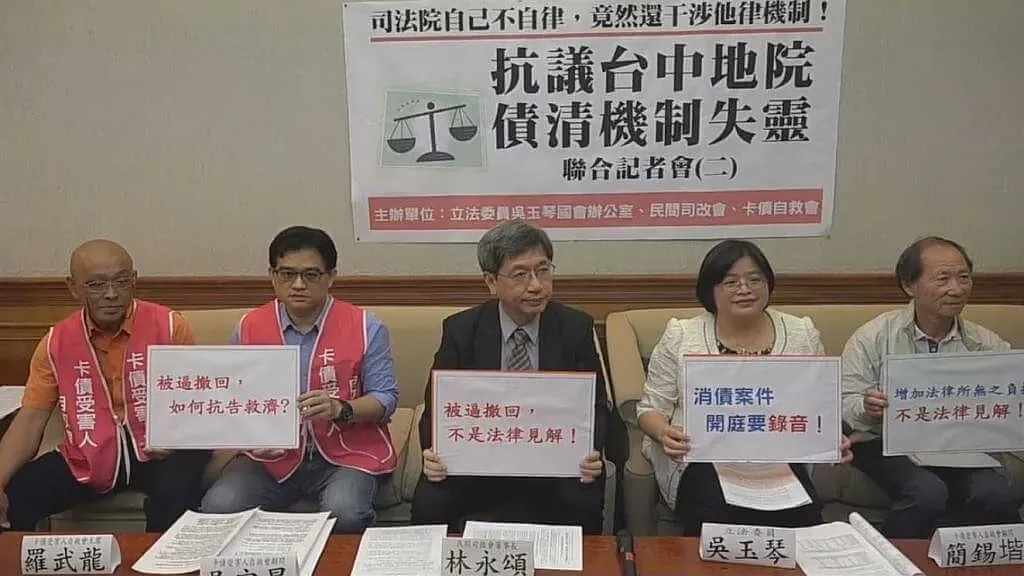
The Judicial Yuan Fails to Self-Regulate and Even Interferes with External Accountability! Joint Press Conference on Protesting the Malfunction of the Debt Clearance Mechanism at the Taichung District Court (Part II)
Last edited: 2026-08-25
- JEC Case Number
- Grounds for Evaluation
-
Evaluation Result
2012 Ping-Tzu No. 1
Coaxing and misleading parties into withdrawing appeals
Two demerits
2014 Ping-Tzu No. 4
Coaxing and misleading parties into withdrawing appeals
Submitted to the Personnel Review Committee for deliberation
2014 Ping-Tzu No. 11
Rushing to guide the withdrawal of lawsuits
Submitted to the Personnel Review Committee for deliberation
2014 Ping-Tzu No. 12
Directly admonishing the withdrawal of actions
Submitted to the Personnel Review Committee for deliberation
2015 Ping-Tzu No. 13
Coaxing and hinting at the withdrawal of appeals
Official reprimand urging attention through supervisory duties
The Judicial Reform Foundation and the Self-Help Association of Debtors Victimized by Credit Card Debt held a press conference on April 24 to "Protest the Malfunctioning of the Debt Clearance Mechanism at the Taichung District Court," pointing out systemic issues within the debt clearance mechanism. However, in a press release issued on Monday (May 1), the Judicial Yuan not only failed to address the issues, but instead accused the JRF of violating judicial independence and asserted that individual judge evaluation requests should not be filed against Judge Chen Chiu-yueh.
No matter how much the Judicial Yuan wishes to uphold judicial independence, it is unbelievable that it would do so in a manner that violates judicial independence! The Judicial Yuan's attitude of shielding and covering up dereliction of its supervisory duties is appalling. Refusing to self-regulate is one thing, but it even directly concluded that this case involved "judges holding different legal interpretations" and therefore could not be subject to evaluation. This action severely undermines the independence of the Judges Evaluation Committee (JEC). Since the individual judge evaluation system under the Judges Act came into effect, there has never been a situation where the Judicial Yuan directly dictated to the JEC!
A skyrocketing number of withdrawn cases—are we not even allowed to question this? Is the Judicial Yuan unwilling to conduct even an investigation?
In the past, the debt clearance mechanism at the Taichung District Court operated smoothly. According to the Judicial Statistics Annual Report, taking 2012 as an example, the number of initiated debt repayment rehabilitation cases was 232, and the number of withdrawn cases was 41. However, after Chief Judge Chiang Hsi-lin took office in August 2015, the number of initiated rehabilitation cases plummeted to 44 in 2016, while withdrawn cases skyrocketed to 378 (see Table 1).
Comparing this on a national scale, the total number of cases nationwide in 2016 was 33,202, with a total of 1,090 withdrawn cases nationwide. The Taipei District Court accepted 11,907 consumer debt cases, ranking first nationwide (36%, 11,907/33,202), yet its withdrawn cases numbered only 64 (6%, 64/1,090). In 2016, the Taichung District Court accepted 1,593 consumer debt cases, ranking only sixth nationwide (5%, 1,593/33,202), yet its withdrawn cases reached a staggering 378 (35%, 378/1,090). Comparing the two, it is evident that the situation regarding withdrawn cases in the Taichung District Court is extremely severe (see Table 2).
We must ask the Judicial Yuan: regarding the public's reaction to the surge in withdrawn cases at the Taichung District Court this time, did the Judicial Yuan attempt to understand the reasons before issuing its press release in response? Was it truly an issue with Judge Chen Chiu-yueh, as reported by the public, or were there other structural factors? If the Judicial Yuan failed to conduct even the most basic investigation yet rushed to issue a press release taking a stance in an attempt to protect the dignity of judges, isn't that a fruitless endeavor? As a judicial administrative body, the Judicial Yuan should maintain objectivity and neutrality. When faced with judicial dilemmas raised by the public, it should provide explanations or make improvements following careful investigation. Can a biased attitude of one-sided protection truly restore public satisfaction with the judiciary?
Furthermore, since the individual judge evaluation system under the Judges Act was launched in 2012, decisions by the Judges Evaluation Committee to initiate proceedings and exercise supervisory duties show that judges coercing or inducing the withdrawal of lawsuits is a recurring issue (see the table below). Without requesting an investigation, how can one ascertain whether the withdrawal situation in the Taichung District Court was indeed improper or unlawful? On what basis does the Judicial Yuan claim that our Foundation cannot request an evaluation in this regard? The Judicial Yuan hastily appeals to all sectors to respect judicial independence, little realizing that by unilaterally issuing a statement at the outset of the JEC's investigation to determine that this case constitutes "legal interpretations and is exempt from evaluation," it is precisely interfering with the JEC's independent exercise of its powers! Destroying judicial independence in the name of judicial independence is both unbelievable and deeply ironic.
The Judicial Yuan Interferes with the Judges Evaluation Committee
The Self-Help Association of Debtors Victimized by Credit Card Debt filed a petition with our Foundation stating that since Judge Chen Chiu-yueh began handling consumer debt cases in September 2015, she has adjudicated cases through methods such as coercing debtors into withdrawing cases, unlawfully dismissing applications for rehabilitation, and making arbitrary rulings on liquidation exemptions from liability. Following review, our Foundation deemed that Judge Chen Chiu-yueh's violations of the Judges Act were of a serious nature, and accordingly filed for individual judge evaluation on April 13.
As mentioned above, since this case is already pending before the Judges Evaluation Committee, it should logically be adjudicated by the JEC to determine whether disciplinary or corrective action should be imposed. Yet, the Judicial Yuan unexpectedly published a press release stating: "Pursuant to the law, when debtors apply to the court for rehabilitation rulings, judges review the cases in accordance with relevant provisions of the Consumer Debt Clearance Statute and rule on whether to permit rehabilitation accordingly. This falls within the core scope of judicial trial work, which is institutionally protected by judicial independence and free from any interference. If parties are dissatisfied with the rulings, they may seek remedies through interlocutory appeal procedures, and such matters do not constitute grounds for requesting individual judge evaluation." This overtly dictates to the Judges Evaluation Committee, using judicial administration to interfere with the JEC's independent investigative powers.
We cannot help but pose four questions to the Judicial Yuan:
When debtors are forced to withdraw their cases and the cases no longer exist, how can they still seek "remedies" through appeal?
When debtors are forced to withdraw their cases, what kind of "legal interpretation" is that considered to be?
When a judge imposes extra burdens not prescribed by law during liquidation proceedings, is that also a form of "legal interpretation"?
When a judge simply makes an error in fact-finding that leads to incorrect legal subsumption, while the law itself is not in dispute, does that also count as a "legal interpretation"?
The definition and scope of "legal interpretation" are not up for debate, but discussion must follow "investigation" and be conducted based on the specific circumstances of individual cases. We hope the Judicial Yuan will earnestly reflect on the above four questions before discussing the definition and scope of "legal interpretation." Otherwise, to indiscriminately and directly conclude that this case is a matter of "legal interpretation"—could this be an attempt to influence the JEC and interfere with the independence of the JEC in exercising its functions?
Our Foundation's stance on safeguarding judicial independence is no different from that of the Judicial Yuan, but judicial independence should not merely be an empty slogan, nor should it become an excuse to evade problems. Faced with potential judicial problems, the Judicial Yuan fails to actively self-regulate and instead interferes with the exercise of powers by the Judges Evaluation Committee. This leaves us deeply concerned that the current insufficient guarantee of independence for the Judges Evaluation Committee urgently needs to be resolved.
Failure to Record Court Hearings in Debt Clearance Cases, with the Judicial Yuan Shielding and Refusing to Supervise
According to Article 90, Paragraph 2 of the Court Organization Act: "Court hearings shall be audio-recorded, except where otherwise provided by law. When necessary, they may also be video-recorded." However, most district courts fail to audio- or video-record hearings when adjudicating debt clearance cases. Once a situation arises where a judge exhibits poor courtroom demeanor or improperly compels the withdrawal of a lawsuit, it is practically impossible for the public to investigate and gather evidence to protect their rights.
In our Foundation's previously held press conference, we made the concrete recommendation that hearings in consumer debt cases should be audio- and video-recorded throughout the entire proceedings, demanding an immediate response and handling by the Judicial Yuan. However, the Judicial Yuan has turned a deaf ear and completely failed to respond to this day, constituting a dereliction of duty.
The Judicial Reform Foundation and the Self-Help Association of Debtors Victimized by Credit Card Debt solemnly urge the Judicial Yuan to self-regulate and clean up its act by immediately investigating the malfunction of the debt clearance mechanism at the Taichung District Court, as well as mandating full audio and video recording of hearings in consumer debt cases. Simultaneously, it must respect external accountability mechanisms and refrain from interfering with the investigation and review powers of the Judges Evaluation Committee, so as to prevent the JEC's independent evaluation authority from being improperly affected. Finally, we wish to re-emphasize that actively confronting problems with a problem-solving attitude is the only foolproof way to enhance public trust in the judiciary.
Attending Representatives
Wu Yu-chin / Legislator
Chien Hsi-chieh / Advisor, Debt Debtor Self-Help Association
Wu Tsung-sheng / Associate Professor and Advisor, Debt Debtor Self-Help Association
Lo Wu-lung / Debt Debtor Self-Help Association
Charley Y.S. Lin / Chairperson, Judicial Reform Foundation
Kao Jung-chih / Executive Director, Judicial Reform Foundation
Press Contacts
Charley Y.S. Lin / Chairperson, Judicial Reform Foundation
Kao Jung-chih / Executive Director, Judicial Reform Foundation
| Year | Number of Restructuring Cases Initiated | Number of Withdrawn Cases | Total Concluded Consumer Debt Cases |
| 2012 | 232 | 41 | 841 |
| 2013 | 297 | 75 | 1164 |
| 2014 | 206 | 105 | 1077 |
| 2015 | 185 | 258 | 1257 |
| 2016 | 44 | 378 | 1436 |
| Jan.–Mar. 2017 | 4 | No data yet | No data yet |
| Note: Data sources are the Judicial Statistics Annual Reports for 2012–2015, the Judicial Statistics Monthly Report for 2016, and the Judicial Yuan's Legal Data Retrieval System Judgment Inquiries and Consumer Debt Event Announcements for 2017. | |||
| Cases Received | Restructuring / Liquidation Procedures Initiated | Total Withdrawn Cases | Total Concluded Cases | |
| Total across District Courts | 33202 | 3186 | 1090 | 28140 |
| Taipei District Court | 11907 (36%) | 336 | 64 (6%) | 11042 |
| Shihlin District Court | 4571 (14%) | 223 | 63 (6%) | 4100 |
| Panqiao District Court | 3080 (9%) | 442 | 103 (10%) | 2393 |
| Taoyuan District Court | 1844 (6%) | 310 | 69 (6%) | 1349 |
| Taichung District Court | 1593 (5%) | 44 | 378 (35%) | 1436 |
| Kaohsiung District Court | 6441 (19%) | 694 | 104 (10%) | 2550 |
| Note: Data source is the 2016 Judicial Statistics Monthly Report | ||||
This article is an AI-generated translation of the original Chinese text. In the event of any discrepancy, the Chinese version shall prevail.