
Brief Note: The 5th Meeting of the 1st Division of the Presidential Office's National Congress on Judicial Reform
Last edited: 2026-08-25
This meeting lasted approximately five hours and passed two proposals: "Urging the State to Formulate a Comprehensive and Sound Policy for Victim Protection and Establish Corresponding Policy Implementation Mechanisms" and "Reshaping and Strengthening the Implementation of Crime Victim Protection Measures."
Regarding Proposal 1: "Urging the State to Formulate a Comprehensive and Sound Policy for Victim Protection and Establish Corresponding Policy Implementation Mechanisms," participating committee members discussed issues such as the state's resource allocation for crime victim protection operations, mechanisms for implementing victim protection policies, the positioning and duties of a national dedicated victim protection organization, and the legislative model of a special act on victim protection and its harmonization with the current legal system.
Meeting Resolution: "Urging the State to Formulate a Comprehensive and Sound Policy for Victim Protection and Establish Corresponding Policy Implementation Mechanisms"
To safeguard the basic human rights of crime victims, protect their human dignity, and facilitate their reintegration into normal social life, thereby fulfilling the intent of the Constitution and international human rights conventions to protect victims, the state should establish basic policies and legal systems concerning crime victim protection as soon as possible with a comprehensive and integrated new mindset:
The Executive Yuan should promptly formulate a basic policy on crime victim protection
The protection of crime victims is not limited to providing financial compensation to crime victims, or providing legal assistance during litigation proceedings, nor is it limited to the scope of crime victims and their protection measures defined in current laws. Instead, it must construct an integrated institutional, psychological, and material support network, requiring inter-ministerial cooperation including, but not limited to, police administration, social welfare, labor administration, health administration, education, justice, and other departments to provide necessary assistance to crime victims, involving a wide range of aspects. Therefore, referring to Japan's example where the central government bears the responsibility for planning and implementing comprehensive policies to protect crime victims, there is an urgent need in our country for the Executive Yuan to formulate a comprehensive basic policy with guiding principles, serving as a policy programmatic framework for dividing the division of labor among various ministries regarding crime victim protection and promoting crime victim protection measures related to their respective jurisdictions.
The Executive Yuan should establish a standing Crime Victim Protection Commission
Considering that the current executive agency for victim protection is a third-level unit under the Executive Yuan, whose hierarchy is insufficient to integrate various departments for the effective protection of victims, in order to elevate the rank of crime victim protection affairs, plan and deliberate specific matters of crime victim protection, effectively achieve inter-ministerial communication and coordination, implement the national crime victim protection policy, and urge various agencies to implement integrated and planned crime victim protection measures, referring to the example of the Cabinet Office of Japan in establishing a policy promotion meeting for crime victims, the Executive Yuan should establish a Crime Victim Protection Commission, with the Vice Premier of the Executive Yuan serving as the convener. Among its external members, a certain quota should be specifically guaranteed to be filled by representatives of crime victim families and prominent social figures with distinguished experience in crime victim protection work.
The State should enact a Basic Act on Crime Victim Protection
Building upon the above, the protection of crime victims possesses basic policy characteristics and cross-ministerial comprehensiveness. Considering that policies inevitably change with changes in government or other circumstances, in order to manifest the state's emphasis on the protection of crime victims and ensure that crime victim protection matters possess sustainability and stability, the long-term goal should still be the enactment of a basic law on crime victim protection. Through the hierarchy and effectiveness of a basic law, the state's fulfillment of its responsibility to protect crime victims can be ensured.
The State should ensure in an appropriate manner that the budget for crime victim protection services is no less than a certain proportion of the total annual budget of the central government
Building upon the above, given that the resources previously invested by the state in the field of crime victim protection have been relatively limited, the government, in order to demonstrate its determination to value the human rights of crime victims and implement protection work, must first ensure that the state will inject sufficient resources to maintain the sustainable implementation of protection work in all aspects. Therefore, referring to the practice of the Act Governing the Allocation and Management of Educational Budgets in specifying an educational budget floor while balancing the flexible needs of state administration, the state should explicitly declare—in an appropriate manner (not limited to legislation, though the legislative route is indeed the most effective way to demonstrate the government's determination)—the intent that the budget for crime victim protection services shall not be less than a certain proportion of the total annual budget of the central government.
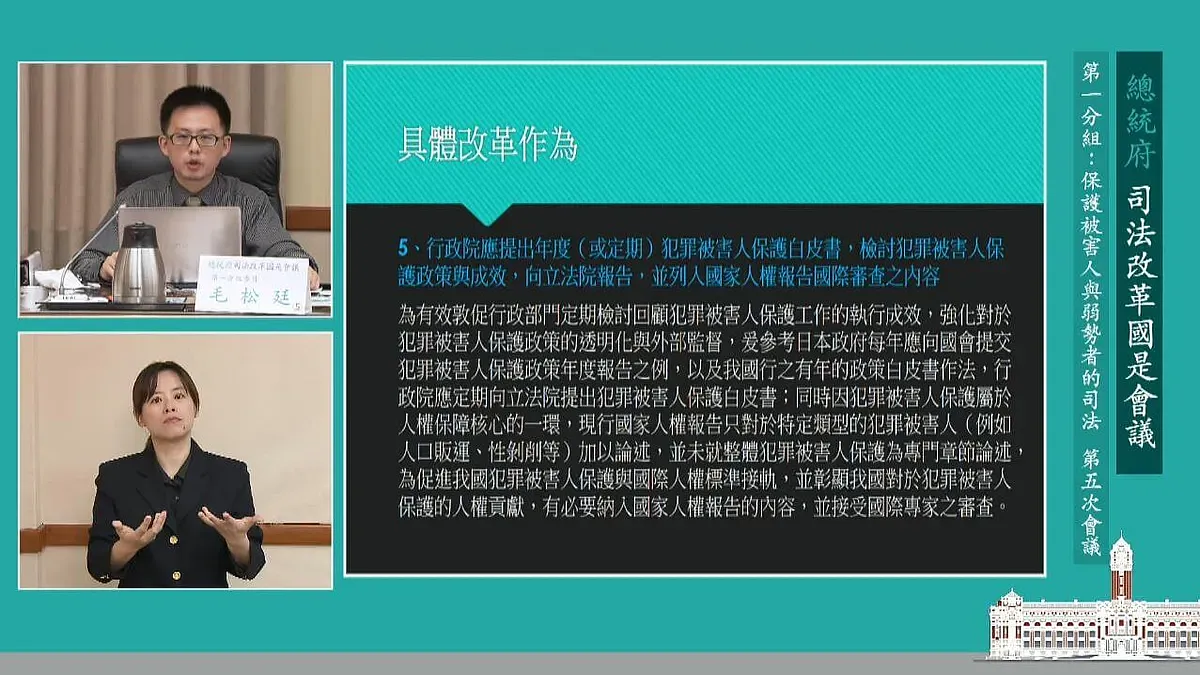
The Executive Yuan should regularly submit a White Paper on Crime Victim Protection, review the policies and effectiveness of crime victim protection, report to the Legislative Yuan, and include it in the international review contents of the national human rights reports for the Two Covenants
To effectively urge the executive branch to regularly review and reflect upon the implementation effectiveness of crime victim protection work, and to strengthen the transparency and external supervision of crime victim protection policies, referring to the example of the Japanese government submitting an annual report on crime victim protection policies to the parliament every year, as well as our country's long-standing practice of policy white papers, the Executive Yuan should regularly submit a White Paper on Crime Victim Protection to the Legislative Yuan. Meanwhile, because crime victim protection is an integral core part of human rights protection, and current national human rights reports only address specific types of crime victims (such as human trafficking, sexual exploitation, etc.) without featuring a dedicated chapter on overall crime victim protection, in order to promote the alignment of our country's crime victim protection with international human rights standards and to manifest our country's human rights contributions to crime victim protection, it is necessary to incorporate it into the contents of the national human rights report and subject it to review by international experts.
Regarding Proposal 2: "Reshaping and Strengthening the Implementation of Crime Victim Protection Measures," participating committee members discussed issues such as the establishment of dedicated victim protection personnel in police agencies, the division of powers and responsibilities between the Crime Victim Protection Association and local governments, and how to enhance the service capacity of the Crime Victim Protection Association.
Meeting Resolution: "Reshaping and Strengthening the Implementation of Crime Victim Protection Measures"
The organization and processes for crime victim protection should take "warm connections" as their core philosophy and establish a "single-window contact mechanism and full-process service system":
The central government should establish a nationwide intelligent platform for crime victim protection, integrating various units (including collaborative platforms among prosecutors' offices, police departments, precinct offices, other social welfare agencies and local governments, the Crime Victim Protection Association, and the Legal Aid Foundation, Taiwan, etc.) to provide services required by crime victims.
Crime victim protection services should be separated from probation and offender rehabilitation services, and the administrative hierarchy of crime victim protection duties should be elevated, providing adequate organizational establishment, staffing, and budget.
The Crime Victim Protection Association should be restructured into a crime victim protection organization with the status of a public legal person or administrative juridical person, and professional dedicated personnel should be established to cooperate with various private protection organizations nationwide, forming a victim protection network characterized by close cooperation between the public sector and the third sector.
Establish a professionally capable police system dedicated to crime victim protection and dedicated personnel of the Crime Victim Protection Association:
Police portion (Crime Victim Protection Officers)
Each police bureau (including precinct offices) shall permanently station crime victim protection officers with police status to serve as a window.
Cultivation stage: The Civil Service Special Examination for Police Personnel should evaluate whether to add a "social work police category" to recruit talents with social work educational backgrounds and social worker qualifications.
In-service stage: Dedicated police officers should exclusively handle crime victim protection business to safeguard professionalism and ensure the rights and interests of the parties involved.
A regular in-service continuing education and training exchange program should be established for dedicated police officers, along with an appropriate professional competency appraisal mechanism.
Specialized police for women and children and crime victim protection officers should be integrated to form a social work police system that assists vulnerable victims.
Crime Victim Protection Dedicated Personnel
Cultivation stage: It is suggested that senior students from social work, psychology, counseling-related departments, law, and crime prevention departments be allowed to intern at the Crime Victim Protection Association. After graduation, they may apply for interviews at the Crime Victim Protection Association. Upon passing written reviews and individual short-term work evaluations, they shall undergo unified pre-service training modeled after the Academy for the Judiciary by the Crime Victim Protection Association, and subsequently be dispatched to local branches.
In-service stage: Regular in-service continuing education and training exchange programs should be established, along with an appropriate professional competency appraisal mechanism.
Case management: For crimes involving severe legal interest violations such as life and physical integrity, as a matter of principle, every victim should be assisted and served by a dedicated personnel.
The application process, review methods, amounts, and disbursement methods of crime victim compensation should be amended, with specific reform methods as follows:
Re-evaluate the crime victim compensation system, including issues such as excessively low compensation amounts, review standards and procedures, and the scope of application regarding "subrogated payment for civil damages liability."
Dedicated personnel of the Crime Victim Protection Association (single window) should assist crime victims in completing relevant procedures for applying for crime victim compensation. Relevant agencies should review the current application, review, and approval process for crime victim compensation—for example, adopting written review as a principle—and review the appropriateness of the exclusion clause in Article 10 of the Crime Victim Protection Act.
Because victim protection involves the allocation of various resources, the chairperson conveyed the President's opinion during the meeting, stating that if necessary, the government will readjust the allocation of resources.
Proposal 3: "Constructing a Criminal Justice System that Upholds Victim Dignity," due to the expiration of meeting time, will be scheduled for discussion at another time.
The division resolved to add Tuesday, May 23, as the 4th supplementary meeting. The next meeting will be the 3rd supplementary meeting on Saturday, May 13.
This article is an AI-generated translation of the original Chinese text. In the event of any discrepancy, the Chinese version shall prevail.