
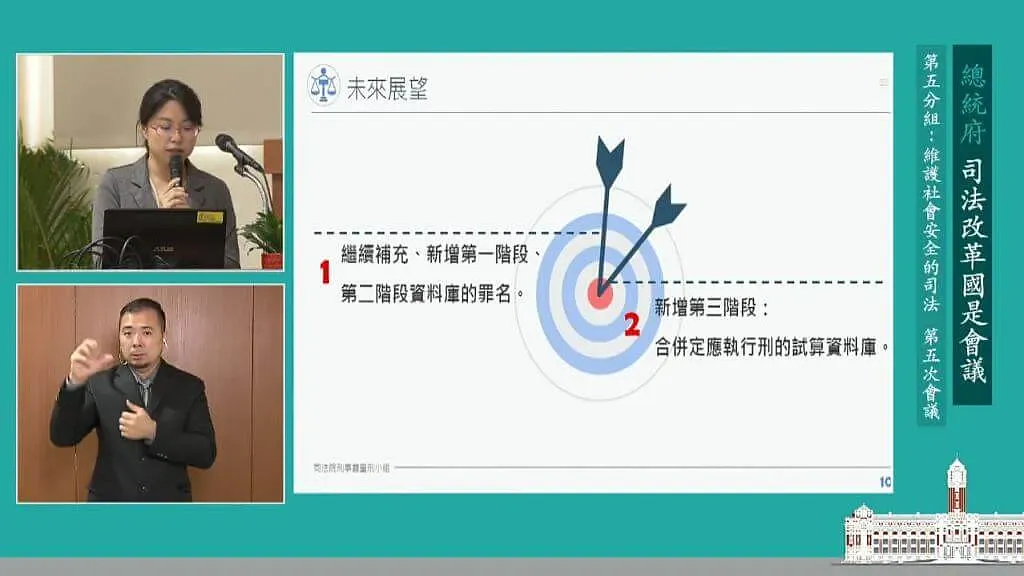
Commentary: The Fifth Meeting of the Fifth Division of the Presidential Office's National Consultative Conference on Judicial Reform
Last edited: 2026-08-25
This meeting lasted approximately four and a half hours and reached numerous resolutions on several agenda items: 5-3-1 Review of Anti-Corruption Legislation - Transparency, Sunshine Laws, and Real-Name Systems for Legislative Bodies (lobbying, conflict of interest avoidance, declaration); the flight-prevention aspect of 5-3-3 "Strengthening Flight-Prevention and Asset-Recovery Systems"; 5-3-5 "Offenses Against the Administration of Justice"; and 5-3-4 "Establishment of Sentencing Guidelines."
Chairperson Liang Yung-huang clarified that the preparatory committee's closed-door meeting on April 13 was labeled a "secret meeting" by the media. However, the preparatory committee had previously agreed that "the content of the meeting would not be disclosed to the public." It was intended as a conversational meeting primarily to allow preparatory committee members to freely share their experiences. The April 13 conversational meeting did mention the hope that all division meetings would conclude by early June 2017.
This meeting invited the Agency Against Corruption to report on the implementation of the Lobbying Act, Prosecutor Li Hao-sung of the Ministry of Justice to report on the detention and flight-prevention mechanism, the Ministry of Justice to report on the study of "Offenses Against the Administration of Justice," and the Judicial Yuan to report on the current two-stage sentencing system.
Regarding the flight-prevention aspect of 5-3-3 "Strengthening Flight-Prevention and Asset-Recovery Systems," the proposal to grant prosecutors the power to request detention during trial for felony cases and to study diverse alternatives to detention was added. However, the proposal that the court shall conduct a detention review upon a guilty verdict and adopt a principle of detention was put on hold.
Regarding 5-3-5 "Offenses Against the Administration of Justice," the provision on "punishment for false statements by defendants" was put on hold, and the remaining parts underwent minor wording adjustments by committee member Yu Li-chen.
Committee members Chi Hui-jung, Chiu Chin-ting, and Liu Pei-yuan took leave from this meeting.
The next meeting is scheduled for Thursday, May 11, to discuss "Decriminalization of Minor Copyright Infringement Offenses," "Corporate Crime," "Investigation Management," and crime prevention-related issues (including "Reintegration of Ex-offenders into Society and Associated Measures," "Establishing Research Mechanisms, Utilizing Judicial Statistical Data, and Enhancing the Quality of Judicial Practice Operations," "Strengthening Research and Education on Crime Prevention," "Police Crime Prevention Strategies," "Review of the Adult Probation System," and "Review of Community Treatment and Security Measures"). Committee member Chang Chung-hsin will also be invited to report on issues concerning the "Decriminalization of Minor Copyright Infringement Offenses."
The remaining meeting dates are Thursday, May 18, and Thursday, June 8.
Discussion Subtopics and Opinions
Regarding transparency, sunshine laws, and real-name systems for legislative bodies (lobbying, conflict of interest avoidance, declaration), discussion lasted only about 40 minutes. The Agency Against Corruption's report revealed that those registering under the Lobbying Act are almost exclusively NGO groups, failing to effectively require politicians in legislative bodies to register and thus unable to prevent political lobbying. The Agency Against Corruption also conceded that current regulations on public functionaries' conflicts of interest are enforced by the Control Yuan, while the Political Donations Act is enforced by the Ministry of the Interior. Without integration, it remains practically difficult to prevent political lobbying regarding legislative transparency and real-name systems. Members' opinions primarily focused on the idea that transparency, sunshine laws, and real-name systems should also entail varying degrees of management for public servants at different levels. Committee member Lin Chih-chieh emphasized the importance of complying with the United Nations Convention against Corruption. Therefore, the preliminary resolution of this meeting responded primarily to tiered management, unified jurisdiction, and international conventions.
Regarding the flight-prevention aspect of "Strengthening Flight-Prevention and Asset-Recovery Systems," discussion lasted about 150 minutes. Members failed to reach a consensus on whether mandating detention in principle upon a first-instance conviction violates the presumption of innocence. Consequently, the proposal that "consideration should be given to amending Article 312 of the Code of Criminal Procedure so that upon the pronouncement of a judgment, the court shall re-evaluate whether it is necessary to detain the defendant or apply other alternative measures to prevent the defendant from fleeing" was put on hold. Regarding whether prosecutors should have the power to request detention during trial, committee member Hsu Shih-feng expressed that granting prosecutors such power would vest them with excessive authority, noting that Japanese prosecutors do not possess this power either. Committee member Yu Li-chen countered that German prosecutors do have the power to request detention during trial, and committee member Li Ming-hung likewise opined that prosecutors should be granted the power to request detention during trial. However, other members did not express their views on whether prosecutors should have the power to request detention during trial. Ultimately, most members concluded that current alternatives to detention are insufficient, and since it remains to be studied which defendants of specific offenses are most likely to abscond prior to sentencing or before enforcement of imprisonment, they requested the Judicial Yuan to analyze cases of defendants absconding during trial and individuals failing to report for sentence execution between 2012 and 2015, categorized by offense, for the committee's reference.
Regarding "Offenses Against the Administration of Justice," discussion lasted only about 15 minutes. On whether to criminalize false statements by defendants, committee member Lu Ying-chieh opined that it might jeopardize a defendant's right against self-incrimination. Committee member Huang Hsu-tien stated that defendants interrogated by judicial police are often induced into specific imprecise facts, and if defendants were to be criminalized for false statements, would the judicial police constitute instigators? From this perspective, Huang Hsu-tien also expressed reservations. Therefore, this sub-point was put on hold. Members raised no further opinions regarding the addition or amendment of other offenses.
Regarding the "Establishment of Sentencing Guidelines," concerning the first paragraph of the resolution, the majority of members agreed that oral argument should be conducted in sentencing proceedings. Judge Hsu Shih-feng noted that the current practice where judges merely let victims make empty statements requesting the judge to impose a heavier sentence is truly insufficient to advance sentencing discussions. Committee member Lai Fang-yu emphasized that victims should be granted the right to participate during sentencing. Lai Fang-yu also cited sexual assault cases where expert witnesses can provide opinions on sentencing, noting that Hong Kong even has a Coroner's Court which, in cases involving death, allows jurors to investigate why the social safety net was broken and to provide recommendations to the government. Committee member Hsu Yu-hsiu mentioned that the United States has an amicus curiae system for sentencing procedures, leading to the proposal to "introduce expert witness and amicus curiae systems." Regarding the second paragraph of the resolution concerning the establishment of the Judicial Yuan's sentencing trend advisory system, committee member Lin Chih-chieh pointed out that sentencing systems for five major crime types that attract significant public attention—corruption crimes, financial crimes, food safety crimes, gender-based violence (including sexual violence), and domestic violence and child abuse crimes—should be prioritized for establishment. Committee member Lai Fang-yu suggested that sentencing for combined concurrent sentences should also be valued by the Judicial Yuan. Members present discussed how the death penalty should be sentenced: what constitutes "no possibility of reform" warranting the death penalty? Committee members Chen Hung-ta and Li Ming-hung considered the term "no possibility of reform" to be imprecise and lacking objective standards. Judge Hsu Shih-feng mentioned that when judges exercise discretion on the death penalty, they consider more than just "no possibility of reform"; they seek expert evaluation, consider the defendant's educational background and personality development process, and make meticulous determinations, though she also conceded that a judge can never fully guarantee that a defendant has the possibility of reform yet will never commit crimes again. Therefore, regarding death penalty sentencing, members proposed that "severe punishments (including life imprisonment and death)" should also be incorporated into the sentencing system, though no preliminary resolution was reached on the substance of "no possibility of reform." Committee member Huang Hsu-tien proposed that "focus groups should broadly incorporate opinions from civic groups, social welfare groups, and social reintegration groups," rather than exclusively seeking out civic groups that voice opinions for victims while lacking social reintegration groups representing the defendant's perspective, as is current practice.
Meeting Resolutions
Preliminary Resolution on 5-2-1 "Review of Anti-Drug Policy and the Policy of Applying Severe Punishments for Drug Offenses, Including the Review of Applying One Crime, One Punishment to Drug Use Offenses"
Amend the Narcotics Hazard Prevention Act to expand the confiscation system, thoroughly depriving serious crimes such as the manufacturing, selling, and transporting of drugs of their criminal proceeds. (Chairperson's ruling: Please have the Ministry of Justice provide foreign legislative examples at the next meeting.)
Amend the Narcotics Hazard Prevention Act to change the threshold for possessing Category 1 and Category 2 narcotics from "pure net weight" to "net weight," and study lowering the possession threshold of "20 grams" for possessing Category 3 and Category 4 narcotics. (Committee member Lu Ying-chieh stated that the Ministry of Justice submitted materials too late during the last meeting, and this topic should be re-examined.)
Resolution on 5-2-2 "Improvement of Diverse Treatment Models for Drug Users Undergoing Addiction Rehabilitation, Integrating Judicial, Medical, and Social Work Resources, and Returning Compulsory Rehabilitation Centers to the Medical System of the Ministry of Health and Welfare"
It is recommended to establish a drug prevention fund and set up a dedicated mechanism directly under the Executive Yuan to supervise and horizontally integrate and coordinate drug prevention resources across ministries.
For drug users, in addition to criminal penalties, it is recommended that the government invest more resources to implement diverse treatment programs, assisting drug users in overcoming addiction and reintegrating into society.
It is recommended that competent authorities (Ministry of Health and Welfare, Ministry of Justice, etc.) encourage the private sector to establish diverse treatment institutions for addicts and allocate generous budget subsidies to these institutions to encourage private participation, while establishing subsidy and counseling mechanisms. (Passed with 16 votes)
Preliminary Meeting Resolutions
5-3-1 Review of Anti-Corruption Legislation
Regarding the status of public functionaries and the exercise of public authority, uniform standards should not be uniformly applied; they should be categorized to exercise varying densities of supervision. Furthermore, for integrity supervision over various types of public functionaries (legislators at all levels, political appointees, career civil servants, judicial personnel, etc.), it is recommended that jurisdiction be unified.
Regarding sunshine laws, conflicts of interest, and information disclosure for legislative bodies and political appointees, it is requested to analyze the implementation performance and problems of current laws, reviewing whether regulatory and practical conditions comply with international treaties, benchmark national standards, and global anti-corruption trends while reflecting the expectations of Taiwanese society.
5-3-2 Strengthening Flight-Prevention Systems
Current provisions of Article 116-2 of the Code of Criminal Procedure regarding alternatives to detention are insufficient; legislative examples from various countries should be referenced to design feasible measures that balance the connotations of international conventions, defendants' rights, and flight-prevention effects, and to study alternative measures to detention.
Considering Taiwan's international situation and the difficulties in diplomacy, extradition, and mutual legal assistance, it is recommended to study amending the Code of Criminal Procedure to allow prosecutors to request detention during trial against defendants facing potential heavy sentences and who are at risk of fleeing, so as to prevent defendants from absconding.
Competent authorities should analyze cases of defendants absconding during trial and individuals failing to report for sentence execution between 2012 and 2015, categorized by offense, for the committee's reference.
5-3-5 Offenses Against the Administration of Justice
To ensure the proper exercise of state judicial power and discover the truth, relevant offenses against the administration of justice should be studied, reviewing the offenses of destroying criminal evidence and perjury, adding offenses of violating lawfully issued orders preserving rights and jumping bail, adding offenses of interfering with witnesses and retaliating against whistleblowers and witnesses, and adding offenses of obstructing criminal investigation and execution, so as to curb law-enforcement obstructing behaviors such as abuse of power and lobbying.
5-3-4 Establishment of Sentencing Guidelines
The Judicial Yuan should study a two-stage trial procedure for conviction and sentencing, wherein sentencing proceedings should conduct oral argument, enhance victim participation, and introduce expert witness and amicus curiae systems.
The Judicial Yuan's sentencing trend advisory system should establish sentencing factors and propose guidelines for case types of public concern—such as corruption crimes, financial crimes, food safety crimes, gender-based violence (including sexual violence), domestic violence and child abuse crimes, and severe punishments (including life imprisonment and death)—and review standards for determining combined sentences. The establishment of sentencing factors should have focus groups broadly incorporate opinions from civic groups, social welfare groups, and social reintegration groups.
Commentary
Regarding the flight-prevention system, prosecutors should still possess the power to request detention during trial. Otherwise, leaving it solely to judges to decide on their own whether a defendant needs to be detained during the trial process is tantamount to requiring judges to determine during trial whether a defendant is guilty and whether to detain them. During the review of detention in the investigative stage, judges strive to avoid violating their neutral role when they order detention ex officio even when prosecutors do not request it. Yet, during the review of detention in the trial stage, we choose not to consider granting prosecutors the power to request detention during trial while expecting judges to violate their neutral role and detain defendants ex officio; this appears unreasonable.
Discussions regarding the "Offenses Against the Administration of Justice" appear overly superficial. Regarding the "jumping bail" offense, several committee members stated that current laws do not criminalize fleeing, resulting in no cost to flight and making flight an obvious choice. This assertion is problematic. In fact, based on the JRF's case-handling experience at the complaint center, some individuals who believe they are wrongfully convicted choose to flee, and for them, fleeing is an agonizing decision that severely impacts their lives as well as their physical and mental well-being. For this perspective, reference can be made to the experience of committee member Chen Lung-chi, who was wrongfully convicted and later exonerated. The National Conference on Judicial Reform may likewise hold that even those who believe they are wrongfully convicted should report to prison and be subjected to criminal liability for jumping bail, but this should not be rooted in a flawed understanding of flight. Furthermore, whether the offense of "destroying evidence" should be expanded to cover a defendant destroying their own evidence involves issues of expected compliance; whether this can truly deter defendants from destroying evidence unfavorable to them, or merely result in an additional conviction and longer imprisonment, should be grounded in empirical research.
Moreover, regarding the "perjury" offense, expanding this crime to statements made before all investigative personnel presents even more severe problems. The quality of questioning by investigative personnel in Taiwan lacks safeguards, systematic training, and review. Currently, when witnesses recant in court and change their previous testimonies unfavorable to the defendant, prosecutors often warn witnesses not to recant arbitrarily on the grounds that they had already sworn oaths during the investigation, threatening them with perjury charges to reinforce the testimony. Strictly speaking, however, determining which statement is genuine should be part of the investigation in the first place; utilizing the perjury charge to reinforce testimonies unfavorable to defendants is precisely where the problem lies. The fundamental solution does not lie in using criminal penalties to guarantee the credibility of statements obtained by police and prosecutors, but through reliable investigative interview procedures. If a defendant or witness recants in court, the police and prosecutors can present how the methods by which they originally obtained statements fully complied with procedures for acquiring high-quality testimonies, thereby demonstrating why the court should adopt the statements they originally obtained or reject the recantations made by defendants or witnesses in court.
Although some members questioned whether determining the "possibility of reform" for the death penalty is a precise legal concept, substantive discussion was ultimately bypassed due to an excessive number of agenda items in this meeting. This is somewhat regrettable. While members might have been concerned that determining the death penalty's "possibility of reform" could involve "adding or removing agenda items" requiring a decision by the preparatory committee, and that the death penalty issue is highly sensitive, the general public often feels angered when a murderer escapes the death penalty based on having a "possibility of reform." If this is merely left to the Judicial Yuan's sentencing trend advisory system to study independently, the Judicial Yuan may not necessarily clarify whether the "possibility of reform" regarding the death penalty is indeed a precise legal concept.
Regarding committee member Lai Fang-yu's mention that Hong Kong established a "Coroner's Court" for sentencing and permits amicus curiae participation in reviews, this meeting consequently reached a preliminary resolution to "introduce expert witness and amicus curiae systems." However, under sections 27 and 35 of Hong Kong's Coroners Ordinance, the "Coroner's Court" is a rigorous procedure similar to that of a medical examiner; it does not handle criminal proceedings and must even transfer suspected defendants to criminal proceedings. Therefore, the "Coroner's Court" should have no bearing on sentencing procedures. As for the recommendation mentioned in section 44 of the Coroners Ordinance regarding coroners and juries suggesting measures "to prevent the occurrence of deaths similar to the death being investigated," its efficacy remains unknown as the Coroners Ordinance does not explicitly provide details.
The resolution that "the Judicial Yuan should study a two-stage trial procedure for conviction and sentencing, wherein sentencing proceedings should conduct oral argument, enhance victim participation, and introduce expert witness and amicus curiae systems" may also be problematic. Adopting oral argument in sentencing proceedings and enhancing victim participation are not conducive to establishing a sentencing procedure centered around optimal treatment for the defendant. A better approach would be to introduce sentencing investigation officers to submit sentencing reports or adopt the "sentencing court" suggested by Professor Li Mao-sheng. Additionally, incorporating amicus curiae into sentencing procedures is also unreasonable; amicus curiae generally provide legal opinions, whereas sentencing primarily requires social investigations.
At this meeting, only lawyer-background members—including the Chairperson, Li Ming-hung, Hsu Shih-feng, Yu Li-chen, Chen Hung-ta, Huang Hsu-tien, Lai Fang-yu, Lin Chih-chieh, and Lu Ying-chieh—spoke. Although most non-lawyer members may have been fully briefed on the controversies surrounding legal issues during pre-meeting workshops, or perhaps due to time pressure, non-lawyer members were unwilling to prolong the procedures by speaking, this meeting's approach of prioritizing efficiency over discussions that seek to help non-lawyer members understand the pros and cons of current institutional reforms leaves one to wonder: will future plenary sessions of the National Conference on Judicial Reform also end up with only lawyer-background members speaking?
This article is an AI-generated translation of the original Chinese text. In the event of any discrepancy, the Chinese version shall prevail.