
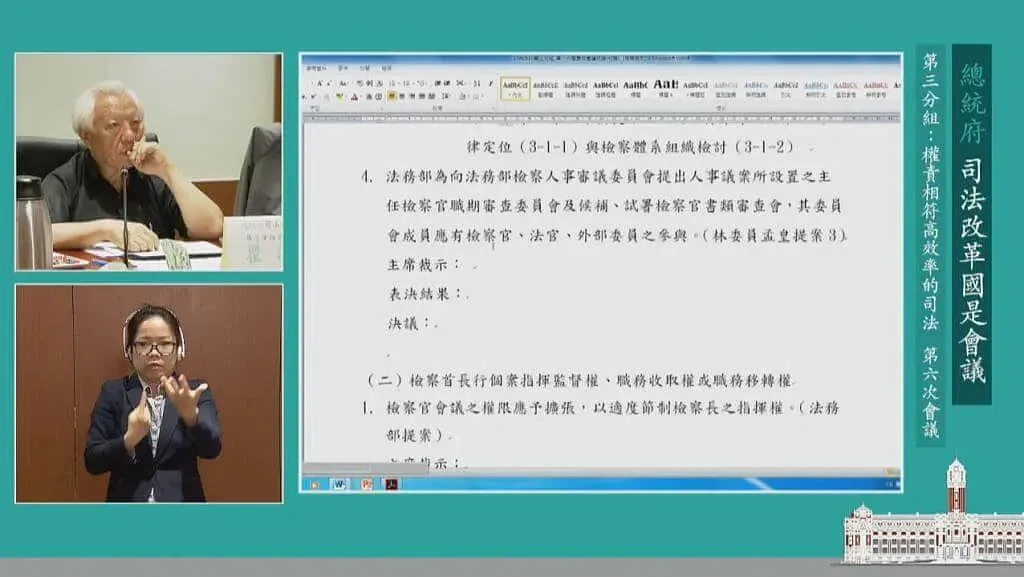
Brief Notes: The 6th Meeting of the 3rd Division of the Presidential Office's National White Paper on Judicial Reform
Last edited: 2026-08-28
Committee members Lin Yu-hsiung and Chen Chung-yen were absent from this meeting; according to news reports, both have publicly announced their withdrawal from the National Conference on Judicial Reform.
Continuing from the previous meeting, this meeting proceeded to discuss "The Legal Status of Prosecutors (3-1-1) and Review of the Prosecution System Organization (3-1-2)," categorized into the following sub-topics:
Democratization and External Participation in the Prosecutorial Personnel System, and the Assignment of Prosecutors' Duties
The issue to be addressed here is: by whom should prosecutorial administrative power (including the reappointment of chief prosecutors to divisions and the assignment of prosecutors' duties) be exercised? To what extent should it be delegated to the autonomy of the prosecution system, and how should the powers of chief prosecutors and the Minister of Justice be curtailed? Should external members be incorporated into joint decision-making? Reflected in the current institutional design, this involves the exercise of powers and the membership composition of the Prosecutorial Personnel Review Committee and the Chief Prosecutor Term Review Committee.
Members reached a consensus on the direction of enhancing internal autonomy and external participation within the prosecution system, but disagreed on whether to grant voting rights to external members. Supporting members argued that external opinions help enhance the appropriateness of resolutions and alleviate factional alliances or parochial issues stemming from internal autonomy; opposing members expressed skepticism toward this argument. However, neither the supporting nor opposing views addressed whether the Minister of Justice holds a decisive vote regarding external members, and whether the Minister of Justice might continue to retain control over prosecutorial administration through the selection of external members.
Chief Prosecutors' Exercise of the Power to Issue Individual Case Directives, the Power of Assumption, or the Power of Transfer
The issue to be addressed here is that in investigative practice, chief prosecutors have failed to implement the provisions in the Judges Act and the Court Organization Act regarding the written exercise of directive and supervisory powers. Can evaluation be utilized to ensure that chief prosecutors implement written directives, thereby preventing the abuse of the principle of the unity of the prosecution system?
Committee member Lin Ta challenged the argument that "chief prosecutors have failed to implement written directives," asking based on his own case-handling experience: "Must all directives from chief prosecutors concerning individual cases be in writing?"
Committee member Lai Kung-li pointed out, based on his experience as a member of the Judges Evaluation Committee, the practical difficulties that may arise in "referring chief prosecutors who fail to implement written directives for evaluation," including the difficulty of initiation (requiring joint signatures by three prosecutors to petition the evaluation committee for an evaluation) and the difficulty of investigation (consisting only of the prosecutor's unilateral allegations).
Prosecutors' Power of Compulsory Disposition During Investigation
This topic saw the most intense clashes in this meeting, on the grounds that adopting the reservation of judge principle would not only affect prosecutors' investigations but also directly impact the courts' caseload. Members with a prosecutor background further linked this to the new law prohibiting nighttime interrogation, arguing that a surge in court cases would prolong defendants' waiting times, which is not necessarily advantageous to defendants.
Members supporting the shift of the power of compulsory disposition to judicial reservation responded to the argument about a caseload surge by suggesting that once legal amendments increase the difficulty for prosecutors to execute compulsory dispositions, prosecutors will themselves evaluate whether to initiate compulsory dispositions, and the caseload should be lower than the current situation.
-
Because many issues in the 3rd Division remain undiscussed, it was resolved to hold an additional meeting on Wednesday, May 24.
This article is an AI-generated translation of the original Chinese text. In the event of any discrepancy, the Chinese version shall prevail.
