
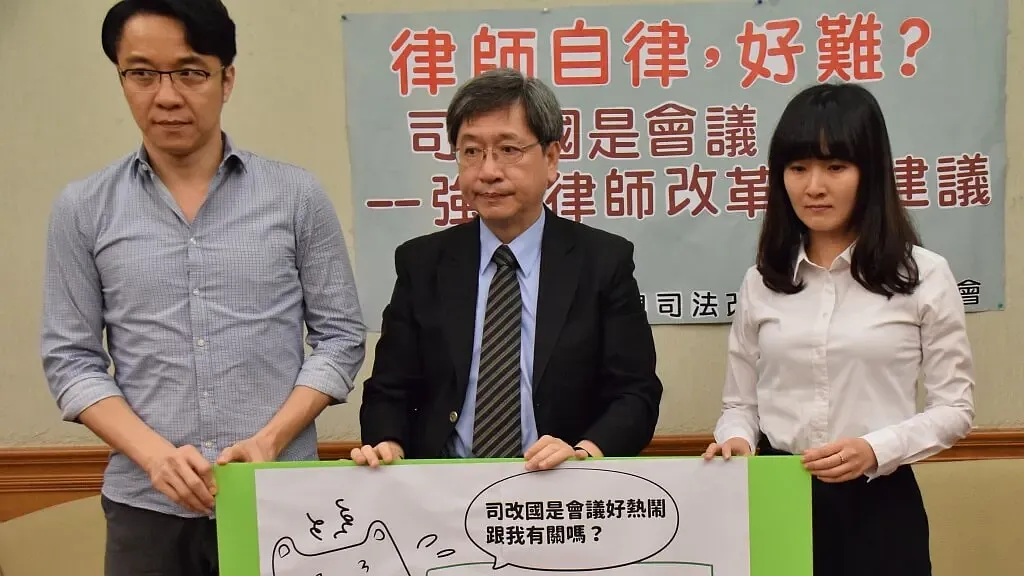
Press Conference | Self-Regulation for Attorneys Is Hard? National Youth/Citizens' Conference on Judicial Reform: 7 Recommendations for Strengthening Attorney Reform
Last edited: 2026-08-28
The National Conference on Judicial Reform recently passed the reform direction for a pyramid-shaped litigation system, accompanied by the expansion of mandatory attorney representation and mandatory defense. While this may improve overall judicial efficiency, how to enhance attorneys' professional competence and professional ethics is the key to the success or failure of institutional reform. Furthermore, discussions among various groups regarding how to weed out incompetent attorneys, prevent the public from encountering subpar legal services, and maintain overall standards remain insufficient.
Among these issues, the ineffective attorney disciplinary mechanism has long been criticized by the legal community. With the convening of the National Conference on Judicial Reform, the legal profession should not and has no reason to continue using "attorney autonomy" as a slogan to stand still; it must immediately initiate self-reform. Otherwise, a failure of self-regulation will ultimately lead to intensified external regulation. At today's (16th) press conference held in Room 101 of the Zhongxing Building, our Foundation proposes the following 7 concrete recommendations for the legal profession's self-reform mechanism, hoping to serve as a modest spur to induce broader contributions and initiate the opportunity for reform.
Judicial Personnel Convicted of Corruption Shall Not Transfer to Become Attorneys
Judges and prosecutors who exercise judicial or prosecutorial powers, if convicted of corruption offenses with final judgment, can no longer be expected by the public to fairly perform the duties of an attorney in the future. Currently, after these corrupt judicial personnel are released from prison, some local bar associations still permit them to join the association and practice law, while other bar associations refuse their admission on the grounds that they are manifestly unsuitable to engage in the legal profession.
We must ask: Why is there such inconsistency among bar associations regarding admission standards? And why must the public in certain regions tolerate such corrupt judicial personnel serving as attorneys? We call once again that the legal community should not be a judicial recycling bin, and corrupt judges and prosecutors who have been weeded out must not be allowed to escape into the legal profession. Bar associations should refuse corrupt judicial personnel from joining the ranks of attorneys, act as gatekeepers for the public, and safeguard public rights and interests.
The Attorney Disciplinary Committee Should Not Have Double Standards
Following the aforementioned issue of whether corrupt judicial personnel may transfer to become attorneys, the decisions made by the Attorney Disciplinary Committee have exhibited inconsistent standards, where similar facts have led to vastly different findings. While one attorney was disbarred for committing fraud by abusing power during their tenure as a judge (92nd Year Lu-Cheng-Tzu No. 12), another attorney who committed corruption while serving as a prosecutor was decided not to be subjected to disciplinary action on the grounds that the Disciplinary Committee determined the offense must be committed during the period of practicing as an attorney for disciplinary action to be necessary (99th Year Lu-Cheng-Tzu No. 9), allowing them to continue practicing as an attorney.
Regarding acts that severely undermine the credibility of the judiciary, whether they should be disciplined has seen double standards in the disciplinary committee. As the criteria for disbarment become lower and lower and findings more and more lenient, the Disciplinary Committee not only contradicts itself but also creates unfairness among individual cases, further fueling public disappointment and distrust toward the function of attorney discipline.
Currently, decisions concerning attorney discipline can only be queried through the Executive Yuan Gazette Online Information Network, yet not all disciplinary decisions are made public (for example, decisions not to discipline are not published). It is difficult for outsiders to glimpse the full picture of attorney discipline or to supervise the standards of the Attorney Disciplinary Committee based thereon. In comparison to judge and prosecutor evaluations or civil servant discipline, where results are made public regardless of the outcome, if the legal profession is truly determined to enhance its self-regulatory function, it has no excuse to maintain lower standards than others. We hereby call upon the Ministry of Justice to make all written decisions public to be subject to public scrutiny.
Bar Associations Should Effectively Handle Attorney Ethics and Conduct
The Foundation has received complaints from the public stating that some bar associations directly informed citizens that they would not handle complaints against attorneys, nor would they refer the attorney to the Attorney Disciplinary Committee, compelling citizens to turn to other bar associations to file complaints. The long-standing lack of effectiveness in the attorney disciplinary function stems from the vastly divergent values within the current legal community, the inability to forge a common consensus on ethical norms, and interpersonal ties among attorneys. Coupled with the fact that most attorneys lack the courage to report other attorneys, this results in the outcome of "the public suffering harm while professionals shield one another."
When members of the public harbor doubts that an attorney's conduct has infringed upon their rights, they often lack the legal professional knowledge and capability to bring charges against the attorney to fight for their rights. It is recommended that bar associations proactively establish appeal channels for improper attorney practices for public consultation and assistance in filing complaints with the bar association. In addition, allowing victimized parties to directly appeal against attorneys to the Disciplinary Committee without going through the bar association to prevent mutual shielding, and appropriately granting procedural participation rights, are also options worth considering.
Bar Associations Should Actively Improve the Quality of Legal Services
For attorneys who are negligent in the exercise of their duties but whose actions do not yet necessitate referral for disciplinary action, bar associations should establish a system to actively handle such matters. For instance, an "Ethics and Conduct Committee" could be established within bar associations, modeled after the judge/prosecutor evaluation committees, with a certain proportion of external members to introduce diverse perspectives. In addition to transferring severely serious cases of complained attorneys to attorney discipline, the committee can also issue reminders, admonitions, warnings, or require proactive reinforcement of professional education to enhance the quality of legal services. Furthermore, considering that some bar associations may lack sufficient personnel to handle all complaint cases, the Taiwan Bar Association should establish relevant mechanisms to assist in handling them.
Attorney Information Should Be Transparent and Publicly Accessible
Information in the current legal market is opaque. When searching for attorneys, the public often has to rely solely on word-of-mouth or fragmented information from the internet. To increase transparency in the legal market, attorney information should be made public so that the public can find attorneys who best suit their individual needs.
We recommend that the competent authority set up an "Attorney Information Query System" integrating attorney qualifications and related practice information for public web inquiries. The query system should allow searches using an attorney's name as a keyword, bringing up basic profile information such as their firm name, affiliated bar associations, disciplinary records, and records of violating attorney ethical codes. Furthermore, attorneys could independently apply to log their educational and professional background, continuing education records, areas of expertise, service items, and fee schedules for public reference.
Bar Associations Should Formulate Specific Measures for Participating in Social Public Interest Affairs
Attorneys possess a public interest nature and do not merely serve private interests as their primary purpose (referring to Article 1 of the Attorney Regulation Act). Compared to other freelance professionals, attorneys bear heavier public interest responsibilities. Attorneys should proactively and actively participate in social public interest affairs, such as providing legal aid and grassroots legal services. To prevent the requirement of attorney participation in public interest from becoming merely directory provisions, we call upon bar associations to formulate specific measures for participating in social public interest affairs. However, to balance varying circumstances among individual attorneys, the methods of participating in public interest can be flexible, and offset and exemption mechanisms may also be established.
Bar Associations Should Establish Minimum Compliance Items for Attorney Practice
The actual practice of attorneys in executing their duties currently relies on the accumulation of experience and groping through practice workflows. To prevent attorneys from making procedural omissions due to insufficient familiarity, thereby damaging the rights and interests of clients, it is recommended that bar associations take stock of matters attorneys should note when handling cases, and design the most basic compliance and attention workflow requirements spanning case acceptance, drafting legal briefs, court hearings, and case closing. This provides attorneys with a basis to follow when handling cases, thereby achieving a basic consistency in handling cases among attorneys, preventing omissions caused by disorder, allowing the public to understand attorney practice workflows, and enabling outsiders to supervise whether attorneys comply with the minimum requirements mandated for executing their duties.
Attendees
Lin Yung-sung, Attorney at Law / Chairman, Judicial Reform Foundation
Huang Ying-chia, Attorney at Law / Staff Attorney, Judicial Reform Foundation
Kao Jung-chih, Attorney at Law / Executive Director, Judicial Reform Foundation
Press Contact
Judicial Reform Foundation / Executive Director Kao Jung-chih
This article is an AI-generated translation of the original Chinese text. In the event of any discrepancy, the Chinese version shall prevail.