
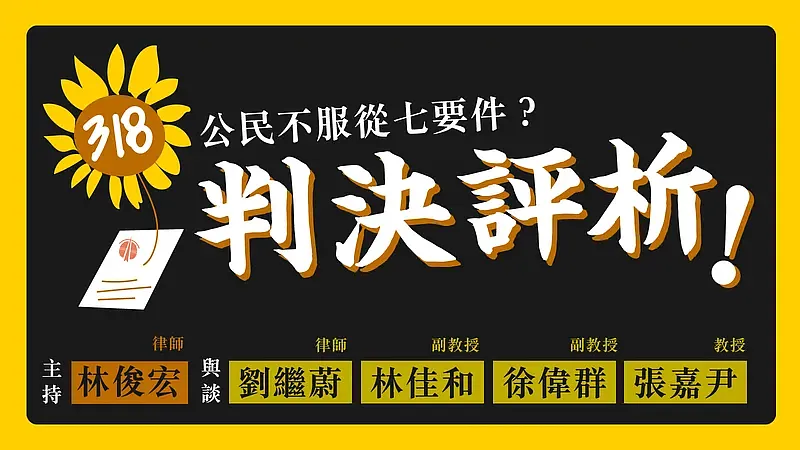
Seminar | Seven Elements of Civil Disobedience? — Symposium on the Judgment Analysis of the March 18 Movement
Last edited: 2026-08-28
On March 17, 2014, then-Legislator Chang Ching-chung announced the completion of the committee review of the Cross-Strait Service Trade Agreement (CSSTA) in less than 30 seconds, sparking dissatisfaction among numerous students and members of the public. On March 18, they entered the Legislative Yuan and staged a sit-in protest that lasted for 24 days. On February 10, 2015, the Taipei District Prosecutors Office indicted 22 activists who participated in the March 18 occupation of the Legislative Yuan on charges including "inciting crime," "obstruction of official duties," and "insulting a public office."
On March 31, 2017, the Taipei District Court acquitted the 22 defendants in the March 18 Legislative Yuan case. In its judgment, the court adopted "civil disobedience" for the first time as the rationale for acquittal, and—drawing upon domestic and foreign academic theories and practical insights—established the seven key elements of "civil disobedience":
- The object of protest involves major illegal or wrongful acts related to the government or public affairs.
- It must be undertaken for the purpose of concerning public interest or public affairs.
- There must be a discernible connection between the protest action and the object of the protest.
- It must be an open and non-violent action.
- Principle of suitability: The means of protest must contribute to the achievement of the advocacy goal.
- Principle of necessity: There are no other lawful and effective alternative means available.
- Narrow sense proportionality principle: The harm caused by the protest action must be less than the benefits brought by the advocacy goal.
This judgment should be considered a major breakthrough in Taiwan's judiciary. In response, the Taipei District Prosecutors Office filed an appeal on April 28, 2017, arguing that the status of the concept of "civil disobedience" adopted by the original trial judgment remains unclear within the criminal law crime-review framework, and that concrete argumentation and confirmation are necessary.
The outcomes of civil movements often lead to prosecution by prosecutors and subsequent judicial proceedings, making the judicial exploration of the concept of civil disobedience of utmost importance. The Judicial Reform Foundation, the Human Rights Committee and Judicial Reform Committee of the Taipei Bar Association, and Taiwan Law Journal co-hosted the Symposium on the Judgment Analysis of the March 18 Movement, aiming to deepen the concept of civil disobedience within Taiwan's democratic and rule-of-law spirit through discussions among scholars and participants.
Symposium on the Judgment Analysis of the March 18 Movement

Time June 3 (Sat.) 13:30-17:00
Venue Room 2201, Wan-Tsai Hall, National Taiwan University (No. 1, Sec. 4, Roosevelt Rd., Taipei City)
Moderator Lin Chun-hung / Executive Director, Taipei Bar Association
Presenter Liu Chi-wei / Pro Bono Defense Attorney for the 318 Case
Panelists Lin Chia-ho / Associate Professor, Department of Law, National Chengchi University
Hsu Wei-kuan / Associate Professor, Department of Law, Chung Yuan Christian University
Chang Chia-yin / Professor, Department of Law, Shih Hsin University
※ The contents of this symposium will be published in the Taiwan Law Journal on July 14.
This article is an AI-generated translation of the original Chinese text. In the event of any discrepancy, the Chinese version shall prevail.