
Brief Notes: 3rd Extraordinary Meeting of the 1st Division of the Presidential Office's National Judicial Reform Conference
Last edited: 2026-08-28
This meeting lasted approximately six hours, and discussed two topics: "Mechanisms for Effectively Protecting the Judicial Rights and Interests of Indigenous Peoples" and "Constructing a Criminal Justice System that Upholds Victims' Dignity."
Regarding the topic of "Mechanisms for Effectively Protecting the Judicial Rights and Interests of Indigenous Peoples," the compiled issues included:
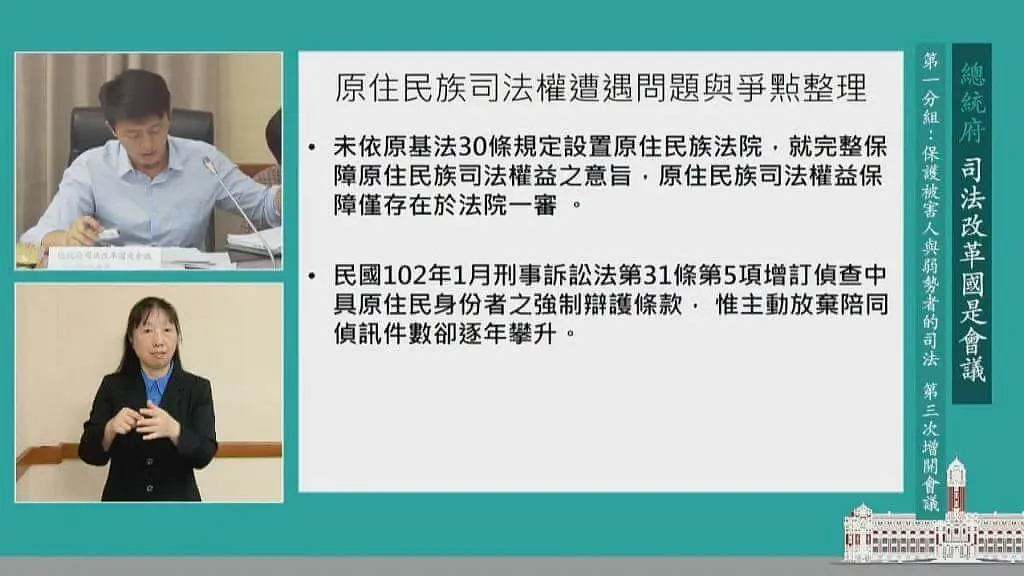
The establishment and performance of indigenous specialized courts (divisions) have been ineffective, and no independent indigenous court has been established, resulting in the protection of indigenous judicial rights and interests being limited to the first instance of the court system.
The scope of cases handled by specialized divisions should be reviewed and should not be segregated solely by legal status; for example, Han people raised in tribal communities cannot receive the protection of indigenous judicial rights and interests in cases involving cultural conflicts.
There are inconsistent legal interpretations among specialized divisions (courts), as well as differing views between judges and prosecutors.
Cases involving the voluntary waiver of the right to be accompanied during interrogations are increasing year by year. What are the reasons for this?
After representatives attending from the Council of Indigenous Peoples, the Judicial Yuan, the National Police Agency of the Ministry of the Interior, and Associate Professor Tsai Chih-wei (蔡志偉) of the Graduate Institute of Financial and Economic Law at National Dong Hwa University presented their opinions, participants discussed whether current judicial personnel possess sufficient professional literacy regarding indigenous traditional customs and culture, whether special arrangements should be made for indigenous peoples in judicial procedures, and whether it is necessary to establish an indigenous court. They subsequently passed the following resolutions:
Relevant branches and departments of the government should establish mechanisms to effectively protect the judicial rights and interests of indigenous peoples, and enhance the sensitivity of judicial professionals to cultural conflicts and their professional legal knowledge related to indigenous peoples, in order to implement the spirit of protecting indigenous judicial rights and interests as enshrined in Paragraph 12 of Article 10 of the Additional Articles of the Constitution, the United Nations Declaration on the Rights of Indigenous Peoples, and the Indigenous Peoples Basic Act:
Short-term measures—Fostering cultural conflict sensitivity among judicial personnel and effectively protecting the judicial rights and interests of indigenous peoples:
For judicial personnel handling indigenous cases (including judges, prosecutors, lawyers, and police officers), in addition to regular systemic courses such as in-service training organized by various agencies, they should be arranged to hold practical workshops in tribal communities to gain a firsthand, deep understanding of their culture and daily lives.
Regarding the future selection of judges for indigenous specialized divisions, the Judicial Yuan is requested to study a professional certification system for indigenous affairs judges, encourage judges to obtain certification, and prioritize certified judges when appointing judges to indigenous specialized divisions.
Policies should be adopted (such as studying the inclusion of "Indigenous Law" as one of the elective subjects in the bar examination) to encourage law schools and departments in universities to offer courses related to indigenous studies, in order to understand the criteria for judging cultural conflict cases, among other matters.
Medium-term measures—Reviewing the scope of cases tried in indigenous proceedings, studying the establishment of an Indigenous Judicial Advisory Committee, and incorporating cultural factors of indigenous cases into the lay participation in trials system:
The Judicial Yuan should review the scope of cases tried by indigenous specialized divisions, incorporating cases that do not involve individuals with indigenous status but still pertain to cultural conflicts into the jurisdiction of indigenous specialized divisions. It should also study and plan a circuit court system for indigenous cases.
The Council of Indigenous Peoples is requested to study the establishment of an Indigenous Judicial Advisory Committee. When there are doubts as to whether a case constitutes a cultural conflict case, the Indigenous Judicial Advisory Committee may be requested to issue advisory opinions or opinions on whether a cultural defense is established, serving as a reference for handling the case.
When drafting the lay participation in trials system, the Judicial Yuan should incorporate the cultural factors of indigenous cases into legislative considerations (such as referencing foreign legal examples and introducing the spirit of elders or tribal representatives participating in trials).
Long-term measures—Our country should reference the legislative examples of various countries to study the feasibility of recognizing indigenous customary law and establishing indigenous courts, so as to realize the spirit of indigenous judicial autonomy.
The Judicial Yuan should strengthen advocacy work, utilizing television, radio, and electronic media to promote the human rights of indigenous peoples, thereby increasing their willingness to utilize this mechanism. Furthermore, police units must conscientiously inform indigenous peoples of their rights and remind parties that they may conduct legal consultations regarding their cases via telephone.
Regarding the topic of "Constructing a Criminal Justice System that Upholds Victims' Dignity," compiled issues included:
Is institutional protection sufficient?
The restriction of "parties" in criminal procedure (prosecutors, judges). What is the role and positioning of the victim?
What is the purpose of victims participating in litigation?
Does victim participation in litigation violate the presumption of innocence?
Is victim participation in litigation used by the government, taking advantage of the situation (or populism), as a means of "revenge"?
Controversies surrounding death penalty sentencing.
Regarding the death penalty issue, some members raised objections, arguing that victims' participation in litigation is unrelated to death penalty sentencing and should not be discussed under this topic. The proposing members ultimately agreed to withdraw the discussion on death penalty sentencing.
After representatives attending from the Judicial Yuan and the Ministry of Justice presented their opinions, participants discussed whether current procedural protections for victims in litigation are inadequate, whether strengthening victims' litigation rights affects the fairness of the court, and the scope of victims under the victim litigation participation system, subsequently passing the following resolutions:
Crime victims are "parties to a case" who suffer physical and mental distress and whose rights have been infringed; however, under the provisions of criminal procedure, they are not "parties to litigation" (Article 3 of the Code of Criminal Procedure: Parties are limited to prosecutors, private prosecutors, and defendants). Among them, crime victims who have suffered major infringements upon their life, bodily integrity, and other interests are in particular need of special protection during judicial procedures, because such victims face the criminal justice system "isolated and helpless," able only to "weep in the dark." To enhance the Taiwanese people's trust in the judiciary, the government not only has the obligation to help victims emerge from their trauma, but criminal procedures should also prevent the possibility of "secondary" or "tertiary" victimization of victims, while simultaneously reflecting the viewpoints and opinions of victims.
Protecting privacy and "upholding dignity": When conducting public trial proceedings, courts should protect the privacy of victims or their families, and unless necessary, should not disclose personal information related to victims.
"Timely grasp" of litigation information: Crime victims are parties to the case and should have the right to understand the progress of litigation (such as being informed of the progress of the investigation during the investigative stage) and case records. Therefore, upon the conclusion of a case investigation (prosecution, non-prosecution, suspension of prosecution, etc.) and throughout the litigation process of the case, litigation mechanisms should be established to protect victims' rights to review files and receive notifications (such as notifications regarding the perpetrator's release on bail, parole, etc.), enabling victims to understand and grasp the progress and contents of the proceedings.
Reserving a "victim's seat" in the courtroom: To respect victims and protect their rights, a victim's seat should be set up within the trial area of the courtroom, and this seat should be adjacent to the prosecutor to facilitate full communication in conducting related litigation activities, enabling the court to fully listen to the opinions of the victims.
"One-stop" dispute resolution: To alleviate the mental pain and burden suffered by such victims and avoid contradictory or inconsistent civil and criminal judgments, civil and criminal disputes should in principle be resolved through the same trial procedure. The Judicial Yuan is requested to study implementing this through legislative amendments or judicial administrative measures (such as "confiscated items - victims applying for return"; special institutional incentives should be provided for criminal division judges to render judgments on incidental civil actions on their own, encouraging criminal division judges to implement the norms of Article 501 of the Code of Criminal Procedure).
"Accompanying all the way" through legal aid lawyers: For crime victims who are economically disadvantaged and apply for legal aid, the Legal Aid Foundation should assign legal aid lawyers familiar with victim protection laws and regulations to assist victims in implementing the aforementioned support mechanisms in criminal procedures.
The next meeting, the 6th meeting, will be held on Tuesday, May 16, and is scheduled to discuss Topic II: "Reducing the Occurrence of Wrongful Convictions and Strengthening Relief Mechanisms."
This article is an AI-generated translation of the original Chinese text. In the event of any discrepancy, the Chinese version shall prevail.