
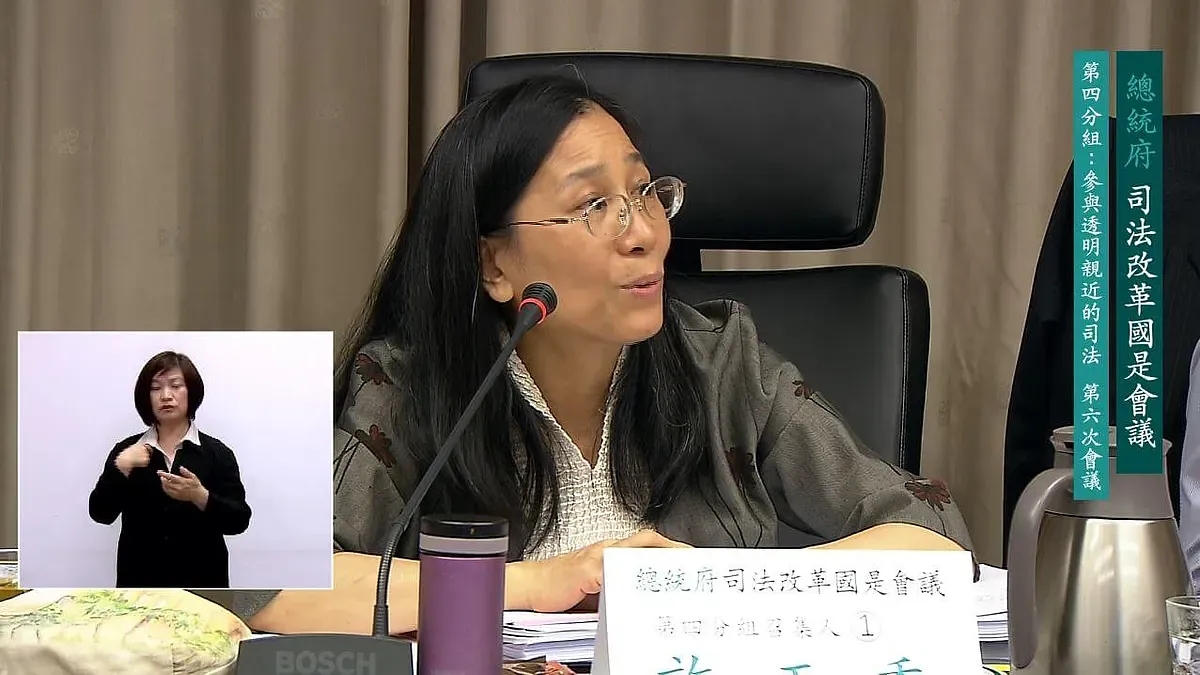
Brief Note: The 6th Meeting of Division 4 of the Presidential Office's National White Paper on Judicial Reform
Last edited: 2026-08-28
It is requested that the Judicial Yuan, within one year and after weighing the public's right to know, the right of litigants to a fair trial, the personality rights of defendants, witnesses, and interested parties, and the realization of open, transparent, and due process principles, study the scope and conditions for courtroom live-streaming for first- and second-instance cases in district courts, high courts, the High Administrative Court, and the Intellectual Property Court, including: (1) civil and criminal election cases, (2) criminal corruption cases, (3) cases detrimental to the public interest (such as major economic cases), (4) litigation and class actions involving vulnerable groups and marginalized cultures, (5) cases involving high constitutional controversy and major political attention, and (6) all cases in the High Administrative Court, especially food safety, environmental protection, and tax law cases. (Passed with 15 votes) (Amending the resolution of March 10)
It is recommended that the Taiwan Bar Association establish a public-demand-oriented attorney information disclosure system. (Passed with 12 votes) (Amending the resolution of March 10)
The Judicial Yuan should revise Article 389, Paragraph 1 of the Code of Criminal Procedure and Article 253, Paragraph 1 of the Administrative Litigation Act. Prior to such amendments, if a party applies to hold a verbal argument hearing, it is recommended that the Supreme Court and the Supreme Administrative Court handle the matter in accordance with the principle of due process under the Constitution; for civil litigation cases, it is recommended to strictly observe the provisions of Article 474, Paragraph 1 of the Code of Civil Procedure regarding the holding of verbal arguments. (Passed with 17 votes)
It is recommended that the Judicial Yuan study the feasibility of modernizing and popularizing judgment documents within one year, including the use of modern internet communication models. The Executive Yuan should propose and promote amendments to the Central Regulation Standard Act, requiring all agencies to use plain and easy-to-understand language that the public can readily comprehend when formulating laws and regulations, in order to achieve the objective of "popularizing the law." (Passed with 18 votes) (Supplementing the resolution of the 3rd meeting on March 24)
The Judicial Yuan should draft appropriate judgment formats to implement due process, including using information technology to assist judges in writing judgment documents to improve judgment accuracy, shorten the time required for judges to draft judgment documents, and help make judicial reasoning clearer, more explicit, and easier to read. (Passed with 16 votes)
It is recommended that the President, in accordance with the powers vested by the Constitution, design and provide a consultative platform to facilitate ongoing dialogue between society and relevant government departments, thereby urging the Judicial Yuan, the Ministry of Justice, the Executive Yuan, the Legislative Yuan, the Examination Yuan, and the Control Yuan to strive to implement the recommendations of the National Conference on Judicial Reform. (15 votes)
Legal Education
University legal education should increase legal practice and practical courses, strengthen interdisciplinary legal studies, as well as liberal arts education and multicultural courses, such as Taiwan legal history, sociology of law, judicial behavioral science, human rights, justice, democracy, gender, labor, and indigenous peoples' jurisprudence.
Post-bachelor legal education should pay attention to students' foundational knowledge in liberal arts and multiculturalism upon admission. Such education should also strengthen legal practice and practical courses as well as interdisciplinary legal studies.
For the acquisition of integrated professional qualifications, the examination and training content should appropriately include or continue the educational content specified in item (1). (17 votes) (Supplementing the resolution of the 4th meeting on April 14)
Before the reform of the judicial personnel recruitment system, trainees who have already passed the judiciary examination shall immediately undergo training in agencies affiliated with the Ministry of Justice or the Judicial Yuan based on conditions such as voluntariness, grades, and agency staffing quotas. (Passed with 11 votes) (Supplementing the resolution of the 4th meeting on April 14)
To enhance the professional capabilities of specialized courts and specialized prosecutor dockets, the Judicial Yuan and the Ministry of Justice should formulate concrete plans regarding the training, issuance of professional licenses, and supporting transfer measures for judges of specialized courts and specialized prosecutors. For example, to enhance the professional capabilities of personnel specialized in handling medical dispute litigation, the Judicial Yuan and the Ministry of Justice should urge judges and prosecutors in specialized medical dispute divisions (dockets) to participate in a mandatory number of hours of professional medical-related study and training each year. (Passed with 16 votes)
The Code of Criminal Procedure should adopt the single-charge-sheet principle (the principle of separate submission of indictment and dossiers) for ordinary litigation procedures. (14 votes)
Regarding whether public participation in trials should adopt the American-style jury system or the Japanese-style lay assessor system (mixed-court system), after thorough discussion, neither proposal reached the majority threshold required for adoption, leaving the issue unresolved.
Discussion Summary
4-3-1 Study on Courtroom Trial Live-Streaming
This issue was discussed for about 70 minutes. The 2nd meeting of this division had previously passed a resolution requesting the Judicial Yuan to submit a report by April 28, but this division postponed the discussion until the current meeting. Regarding the resolution of the 2nd meeting, this meeting added the requirement of "after weighing the public's right to know, the right of litigants to a fair trial, the personality rights of defendants, witnesses, and interested parties, and the realization of open, transparent, and due process principles." However, this division failed to reach a consensus on how to weigh whether trials of fact should be live-streamed.
Taiwan Bar Association
Attorney Lai Mi-ting
Yesterday in the mediation court, I personally asked parties involved in lease and loan cases whether they would agree to courtroom live-streaming, and the public all opposed it. Can courtroom live-streaming in criminal litigation protect personality rights and the right to reputation? The Taiwan Bar Association believes that courtroom live-streaming is currently inappropriate. Lawyers work in the courtroom, yet they would be scrutinized by the entire nation; it seems that lawyers' right to work is not being protected. The Tainan Bar Association also believes that courtroom live-streaming will reduce witnesses' willingness to testify. If the live-streaming of Constitutional Court and Supreme Court legal debate hearings has not been evaluated for whether it increases public trust, can it be extended to courtroom live-streaming in trials of fact?
Judicial Yuan
April 28 Written materials
Although the Court Organization Act contains provisions on open courtrooms, litigants still hold a reasonable expectation regarding the scope of dissemination when private information regarding their personal affairs is disclosed due to litigation within a certain space. Because internet broadcasting (and its subsequent redistribution and archiving) is boundless, if courtroom proceedings are broadcasted, case-related privacy and personal data will circulate limitlessly and unreservedly on the internet, and once copied, it cannot be requested to be deleted, which deviates from the modern trend of the development of the "right to be forgotten." Courtroom live-streaming would also reduce witnesses' willingness to testify because witnesses will realize that their testimony (which may contain personal information they do not wish to disclose to the public) will be spread across the world via the internet, and they will inevitably face the aforementioned concerns of litigants, thereby fearing to appear in court, or even if they appear, concealing facts (or taking the easy way out) or even lying about what they saw and heard, creating difficulties for discovering the truth in cases. In addition, litigation participants' litigation strategies in the courtroom may also shift from legal arguments to appealing to public opinion or the approval of social society due to the broadcasting of court proceedings, or using sensational and populist language to exert non-legal pressure on the court. Such pressure will be exerted on both witnesses and judges simultaneously, forming an obstacle to discovering the truth and maintaining judicial justice. Moreover, although some commentators mention that courtroom live-streaming can supervise judges' courtroom demeanor, regarding the courtroom demeanor of judges in trials of fact, under the current status quo of open courtrooms, except for cases closed to the public, anyone is already free to enter, observe, and judge. If judicial personnel indeed exhibit unprofessional behavior, one can attend the trial in person and conduct supervision. Therefore, the Judicial Yuan fundamentally does not support live-streaming trials of fact.
Secretary-General of the Judicial Yuan Lu Tai-lang (supplementary remarks)
My response to legislators in the Legislative Yuan was that, fundamentally, we do not support live-streaming trials of fact. However, this does not mean it cannot be discussed. If the National Conference on Judicial Reform resolves that "some trials of fact should be live-streamed," the Judicial Yuan will show even higher respect for it.
Judges Association
Courtroom live-streaming is not a prerequisite for a fair trial. Not every advanced rule-of-law country in the world adopts courtroom live-streaming. Courtroom live-streaming must take into consideration the willingness of witnesses and expert witnesses to participate and the protection of privacy rights. If courtroom live-streaming is to be opened, it should be limited to trials of law. Based on my personal experience, when asking a witness to testify in a drug case, a political figure was worried that she might face life-threatening risks after testifying. Especially in tax law cases, litigants' assets are easily exposed, and allowing courtroom live-streaming raises suspicions of violating privacy protection.
Committee Member Li Nien-tsu
The value of open trials conflicts with the value of privacy protection. In fact, when public interest is involved, privacy rights must recede. When considering courtroom live-streaming, open trials, and privacy protection, we must pay attention to this conflict of values.
Committee Member Lin Chang-ching
I support opening live-streaming because only with courtroom live-streaming will the public trust the judiciary. The reason why the judge allowed courtroom live-streaming in the South African Oscar Pistorius trial was that the judge believed the Pistorius case was a matter of high social controversy, making it necessary to gain public trust across the country in the court proceedings through live-streaming.
Committee Member Chen Yao-hua
To oppose courtroom live-streaming, reasons why other countries consider it inappropriate should be presented. Regarding the discussion on courtroom live-streaming, we have not yet seen the Judicial Yuan drive the discussion.
Committee Member Lin Chao-chun
There is a gap between courtroom live-streaming and audio/video recording. The UK Court of Appeal basically permits courtroom live-streaming, but with a 10-second delay compared to the live scene.
Committee Member Chen Chin-hsien
Regarding the concern that courtroom live-streaming might make courtroom participants hesitant to appear in court, serving as judicial personnel inherently involves risks to life, and judicial personnel should bravely shoulder this. Furthermore, the court should protect the personal safety of everyone who comes to court.
Committee Member Tsai Yuan-shih
Courtroom live-streaming can promote judicial openness and transparency. What we are asking for is for the Judicial Yuan to study the matter, rather than demanding that trials of fact must or must not be live-streamed.
Committee Member Chang Wei-chih
Although we have a million reasons not to live-stream, can someone give me one reason why live-streaming is necessary? This is the direction we should be discussing.
Chairperson Hsu Yu-hsiu
An open trial is not equivalent to courtroom live-streaming, but courtroom live-streaming can achieve the effect of an open trial.
4-3-4 Disclosure of Information in the Attorney Market to Enhance Attorney Service Quality
This issue was discussed for about 40 minutes, with the focus falling on how the Ministry of Justice should or should not manage the bar association. Because the bar association desires self-governance, yet before the Attorney Regulation Act is amended, the bar association is still regulated by the Ministry of Justice. This division previously passed a resolution on March 10 stating: "Regarding the issue of the public obtaining market information on attorneys, the Ministry of Justice is requested to formulate concrete and clear policy directions and regulatory recommendations, and submit them for discussion at the 5th meeting on April 28 (Passed with 13 votes)." As a result, the current meeting only passed the resolution: "It is recommended that the Taiwan Bar Association establish a public-demand-oriented attorney information disclosure system (Passed with 12 votes)." It seems this issue has never received a high degree of consensus among the committee members. Observing from the 2nd meeting and this meeting collectively, it is still unclear what consensus the committee members have formed regarding what information in the attorney market should be disclosed. No wonder Committee Member Chang Wei-chih angrily pounded the table, stating that this is simply an issue of information disclosure and not to use dignity and privacy rights as pretexts!
Taiwan Bar Association
Attorney Lai Mi-ting
Regarding lawyers' professional qualifications (cases handled, hours, seniority) and lawyer fee standards, we are already discussing them. Regarding lawyer fee standards and contract drafting methods, various bar associations all have templates and draft forms.
Committee Member Yen Chueh-an
Because it is difficult for the attorney market to be fair, it is necessary to require the disclosure of attorney information to make it fair.
Committee Member Kao Ju-ping
Going market rates for attorney fees should be a concept of open data. If handed over to the Ministry of Justice to handle, the bar association will push back; if handed over to the bar association, people will worry that the bar association will be conservative and unwilling to discuss going rates for attorney fees.
Committee Member Tsai Yuan-shih
What we should emphasize is that attorney services must be made public. This case indeed involves the dispute between the Ministry of Justice regulating the bar association and the bar association demanding self-governance and self-discipline.
Committee Member Wu Kuang-lu
Lawyers are not in the advertising business. Handling cases is a customized, handicraft-like endeavor and cannot be priced directly like selling beef noodles. All my clients come through referrals, and my law firm doesn't even have a sign. I would rather this proposal be withdrawn.
Committee Member Li Nien-tsu
Can the government forcefully provide pricing information? Lawyers do not like to be price-tagged because this involves the professional dignity of lawyers. The most important thing between a lawyer and a client is trust.
Committee Member Chang Wei-chih
This is simply an issue of information disclosure. Some lawyers mentioned that because lawyers have dignity, certain attorney information is not disclosed, but everyone under the sun has dignity!
4-2-2 Study and Adoption of Judicial Sunshine and Transparency
This issue was discussed for only 25 minutes.
Committee Member Li Nien-tsu
The holding of verbal arguments by the Supreme Court and the Supreme Administrative Court is a fundamental principle of "judicial sunshine and transparency." However, the Criminal Division of the Supreme Court and the Supreme Administrative Court both treat verbal arguments as exceptions, and the Civil Division of the Supreme Court also ignores the fact that Article 474, Paragraph 1 of the Code of Civil Procedure treats verbal arguments as the rule, operating it instead as an exception. Therefore, I am making a proposal to require the Supreme Court and the Supreme Administrative Court to faithfully implement the holding of verbal arguments.
Committee Member Wu Kuang-lu
Regarding the holding of verbal arguments by the Supreme Court and Supreme Administrative Court, the Taiwan Bar Association also attaches great importance to it. Article 474, Paragraph 1 of the Code of Civil Procedure stipulates that "The judgment of the third instance shall be rendered after verbal arguments. However, this shall not apply when the court deems it unnecessary." Yet the Civil Division of the Supreme Court always operates this as an exception. Furthermore, when opinions among high courts differ, the Supreme Court should hold verbal arguments to unify legal interpretations!
Chairperson Hsu Yu-hsiu
In fact, the failure of courts to thoroughly implement centralized trials, which causes lawsuits to often drag on for a long time, is also a major problem, and this is something the public is quite resentful about.
Committee Member Chiang Hui-min
I also feel that failing to thoroughly implement centralized trials is truly undesirable.
Committee Member Lin Chao-chun
Regarding centralized trials, it may be necessary to establish a new separate issue, because trials of law do not involve the issue of centralized trials.
4-4-1 Reform of Judicial Documents and Judicial Language
This issue was discussed for about 55 minutes. Regarding overall measures for simplifying judgments, this division had previously passed a resolution at the 3rd meeting on March 24: "It is recommended that the Judicial Yuan's 'Committee for the Promotion of Simplified and Popularized Judgments' submit a report to Division 4, including promotional goals, progress, and tracking mechanisms, before the 6th meeting of Division 4 (May 12, 2017), and refer to the following recommendations." Later, because the Judicial Yuan failed to put forward more proactive opinions, this division changed its approach to demanding that the Judicial Yuan study the matter within one year and put forward this division's goal as "using plain, easy-to-understand language that the public can readily comprehend, in order to achieve the purpose of popularizing the law," while pinning its hopes on the Executive Yuan to propose amendments to the Central Regulation Standard Act.
Regarding the resolution that "The Judicial Yuan should draft appropriate judgment formats to implement due process, including using information technology to assist judges in writing judgment documents to improve judgment accuracy, shorten the time required for judges to draft judgment documents, and help make judicial reasoning clearer, more explicit, and easier to read," Committee Member Chen Hsien-yu criticized this wording as vague and unclear, making it difficult to explain to judicial colleagues. Judges will definitely scramble for a good system, while naturally rejecting a poor one. Committee Member Chen Chin-hsien confidently stated that he definitely has a way to explain the so-called plain-language judgment culture to other judges, and this resolution is a proposal worth trying. Secretary-General Lu Tai-lang of the Judicial Yuan expressed the view that judgment formats and due process may not necessarily be related, but Chairperson Hsu Yu-hsiu noted that the issue of judgment formats affects whether judges conduct trials in accordance with due process, and how judges gain external trust stems from their judgments; when judgments are well-written, all judicial problems can be resolved. Ultimately, regarding "using information technology to assist judges in writing judgment documents," although only Committee Member Chang Wei-chih mentioned "standard information exchange formats (such as the Akoma Ntoso format)," considering that the general public might not necessarily know what a "standard information exchange format (such as the Akoma Ntoso format)" is—as Committee Members Chiang Yuan-ching, Kao Ju-ping, Ping Lu, and Chen Hsien-yu raised such doubts—it was decided not to mention this terminology.
4-2-4 Establishing Permanent Channels for Public Suggestions on the Judiciary and Judicial Reform Units
This issue had not been discussed previously by this division, but since it lacked special controversy, it was passed without much dispute. However, given that Division 2 also has the issue of "establishing a judicial policy research institution," the resolution of this division will likely overlap with the future resolution of Division 2 on the issue of "establishing a judicial policy research institution."
4-1-2 Reform of Legal Education
This issue was decided directly. This division had previously passed a resolution at the 4th meeting on April 14: "Regarding the issue of 'legal education reform,' it is recommended that the Executive Yuan (Ministry of Education, Ministry of Justice), the Judicial Yuan, and the Examination Yuan jointly convene a national conference on reforming legal education (Passed with 16 votes)." At this meeting, rather than waiting for the previously requested "national conference on reforming legal education," some reform goals were directly proposed, such as: "University legal education should increase legal practice and practical courses, strengthen interdisciplinary legal studies, as well as liberal arts education and multicultural courses, such as Taiwan legal history, sociology of law, judicial behavioral science, human rights, justice, democracy, gender, labor, and indigenous peoples' jurisprudence (Passed with 17 votes)." This seemed somewhat hasty.
4-1-1 Review of National Examinations or Other Selection Methods for Judges, Prosecutors, Attorneys, and Legal Officials
This issue was discussed for about 65 minutes. Regarding the training of judges and prosecutors, this division had previously passed resolutions at the 4th meeting on April 14: "The acquisition of professional legal qualifications should be integrated (a combined examination) (Passed with 16 votes)," and "After one year of training and passing, oral interviews for judges and prosecutors shall be conducted separately based on staffing quotas, grades, and preferences, and those admitted shall be assigned as candidate judges and candidate prosecutors (Passed with 16 votes)." These were resolutions for combined examinations and combined training for judges and prosecutors. However, this meeting discussed that before legislation for "combined examinations and combined training" is passed, "combined examinations and separate training" should be adopted. The inconsistency in training scenarios before and after legislation caused extreme pushback from Committee Member Tsai Yuan-shih. Committee Member Wu Kuang-lu also mentioned that combined training for prosecutors and judges allows them to understand each other's stances, while separate training prevents prosecutors and judges from interacting too closely in courtroom activities. However, requiring trainees to decide whether they want to be prosecutors or judges before they have even received training in prosecutorial and judicial matters is quite strange. This resolution ultimately received only 11 votes in support.
Regarding specialized courts, the discussion lasted about 20 minutes. The opinions of non-legal and legal committee members on this issue were clearly polarized: non-legal committee members cared about whether judges are specialized, while legal committee members cared about whether judges have promotion opportunities to provide work enthusiasm. In addition, although this issue finally resulted in a resolution requesting the Judicial Yuan to study specialized courts, it may overlap with Issue 2-4-1 not yet discussed by Division 2: "Establishing specialized courts/divisions to handle related cases, such as commercial, labor, tax, etc."
Committee Member Chiang Yuan-ching
Having specialized courts in the first instance but no specialized courts in the second instance may practically lead to situations where unspecialized second-instance judges overturn specialized first-instance judges.
Committee Member Lai Yueh-mi
For judges who are dedicated to specialized courts, consideration should be given to enabling them to remain motivated to continue serving in those specialized courts.
Committee Member Ho Cheng-cheng
Only if judges are more specialized (e.g., in medical expertise) can they reduce the torment inflicted on litigants.
Committee Member Li Nien-tsu
It is inappropriate to require every court to have various specialized courts, because in more remote places like Kinmen and Taitung, it is difficult to have sufficient specialized courts.
Committee Member Lin Chao-chun
Some specialized court judges may not wish to stay in their original trial courts and instead hope for opportunities to rotate and move to appellate courts. What we should expect are judges capable of handling various aspects of specialization.
Committee Member Tsai Yuan-shih
Sometimes long-term tenure in a specialty instead makes judges narrow-minded. I actually feel it is better for judges to keep an open mind and be willing to increase their specialized knowledge.
Judicial Yuan
Secretary-General Lu Tai-lang
The current situation is that specialized courts affect promotions, causing pushback from judges, such as in the Intellectual Property Court. Distinguishing too many specialized courts will result in too few judges in each specialized court, making it difficult to handle recusal issues. We must also consider that judges in certain specialized courts become overly exhausted due to excessive caseloads.
Chairperson Hsu Yu-hsiu
Although judges hope for promotions and therefore do not stay long in the same court, the public has also reflected that frequent changes of judges cause distress to the public.
4-2-1 Public Participation in the Judiciary
This issue was discussed for about 15 minutes. Regarding the "single-charge-sheet principle," because the current system of dossier submission is seen as affecting judges' prejudices against defendants, if the public can participate in trials in the future, "lay judges" (as opposed to professional judges) maintaining prejudices against defendants under the current dossier-submission system would similarly be problematic. Therefore, this division believes that switching to the "single-charge-sheet principle" is a prerequisite for public participation in trials, and decided to discuss it first. Committee Member Tsai Yuan-shih made a solemn appeal, noting that most discussions on the "single-charge-sheet principle" only address avoiding judicial pre-judgment. However, the reason the current system is "dossier submission" (as opposed to the single-charge-sheet principle) is precisely to allow judges to familiarize themselves with the case facts early on. Assuming that judges will form pre-judgments seems to reflect doubts distrusting professional judicial judgment. Only "dossier submission" can safeguard judges' duty to care for courtroom participants.
Regarding the issue of public participation in trials, it was discussed for about 180 minutes. Among them, Legislator Huang Kuo-chang was invited to report for about 60 minutes in his capacity as the "former Director of the Empirical Legal Research Center of the Academia Sinica's Institute of Legal Studies" regarding institutional research on public participation in trials. When responding to Committee Member Chang Ching's question—"Have empirical research findings changed or continued your thoughts?"—Legislator Huang stated: "My only opposition is to the lay participation system (Guan-Shen-Zhi). To promote the lay participation system, the Judicial Yuan even deliberately dissolved its own internal research committee, which might have opposed it. I later lean more towards the jury system, for two major reasons. First, I found that the public's factual determination ability is not inferior to that of legal professionals. Second, I feel that public participation can strengthen adherence to the presumption of innocence. Third, public participation helps incorporate social experience."
Later, the committee members failed to reach a consensus on questions such as: Do judges exert an authoritative effect in the Japanese lay assessor system? If the American jury system or Japanese lay assessor system is introduced to Taiwan, how many members should comprise the panel? Can the American jury system or Japanese lay assessor system allow citizens to refuse to serve as "lay judges"? Can the American jury system or Japanese lay assessor system allow defendants to refuse to be tried under such systems? Can the American jury system and Japanese lay assessor system be pilot-tested together? In the end, perhaps as Committee Member Chen Hsien-yu remarked: "How well do the 20 of us here understand lay participation or jury systems? Why not trust the lay participation system that the Judicial Yuan is willing to take responsibility for?" The non-legal members did not voice further aggressive opinions opposing the lay participation system, and quite unusually, this division failed to reach a consensus on the system of public participation in trials.
This division previously resolved whether to hold another vote on "pilot-testing the American jury system for five years" and "pilot-testing the Japanese lay assessor system for five years." However, because this proposal was similar to the previously rejected proposal of "pilot-testing the American jury system and the Japanese lay assessor system separately," and because the rules of procedure did not explicitly specify whether "pilot-testing the American jury system for five years" and "pilot-testing the Japanese lay assessor system for five years" could be voted on again, and there was no time to ask the preparatory committee for a resolution, this division abandoned efforts to forge a consensus.
Chairperson Hsu Yu-hsiu mentioned that the lack of consensus also reflects the fact that public participation in trials is indeed a complex issue requiring more prudent deliberation by the plenary session of the National Conference on Judicial Reform, the legislature, and the Judicial Yuan. Chief Executive Lin Feng-cheng of the National Conference on Judicial Reform noted that the plenary session might not have time to discuss it further.
Perhaps, as Committee Member Chen Chin-hsien remarked on the discussion of the public participation system in trials: "It seems the less people trust judges, the more they support juries." Ultimately, the system of public participation in trials is just like the problems the National Conference on Judicial Reform aims to solve: Are the people truly willing to trust judges?
Side Matters
Committee Member Chang Ching's four proposals—"Chief prosecutors of prosecutors' offices should be popularly elected," "A certain proportion of judges at all levels of courts should be popularly elected," "Prosecutors should be categorized as administrative officials," and "Article 13 of the State Compensation Act should be abolished"—were reserved for the preparatory committee to decide whether to submit them to the plenary session of the National Conference on Judicial Reform for discussion.
This article is an AI-generated translation of the original Chinese text. In the event of any discrepancy, the Chinese version shall prevail.