
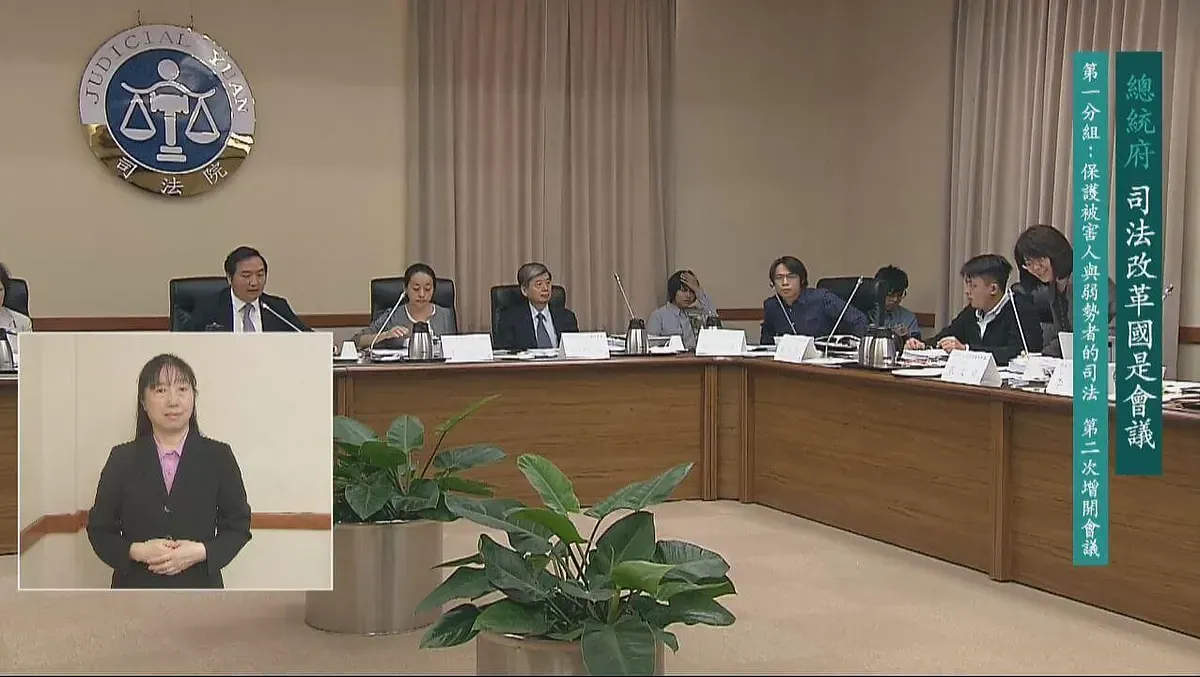
Brief Note: Second Additional Meeting of the First Division of the Office of the President's National Consultative Conference on Judicial Reform
Last edited: 2026-08-28
- This meeting lasted approximately five and a half hours, discussing the issues of "non-disclosure of investigations, media influence on trials, and privacy protection."
The core problem of this issue is how to strike a balance and truly protect freedom of the press and freedom of speech alongside the personal rights and reputations of criminal suspects and related victims during the exercise of judicial power.
Current media formats include three major categories: print media (newspapers, magazines), electronic media (terrestrial radio and television, cable radio and television, satellite radio and television), and online media. However, the scope that the law can regulate is quite limited.
Regarding "in order to prevent improper or unlawful reporting by news media from affecting the investigation and trial of judicial cases, the competent authorities should implement supervision in accordance with the law and strengthen mechanisms such as media self-regulation," following oral explanations by the proposing committee members and the presentation of opinions by attending experts from the National Communications Commission, the Association of Taiwan Journalists, and the Satellite Television Association of the Republic of China, the following resolution was adopted by majority vote:
The National Communications Commission and relevant competent authorities of the Executive Yuan (such as the Ministry of Justice and the National Police Agency under the Ministry of the Interior) should comprehensively review relevant regulations as soon as possible and propose concrete measures to effectively prevent problems where improper or unlawful reporting of judicial cases by the media affects investigations and trials. These include:
Based on the constitutional principles and spirit of the presumption of innocence, non-disclosure of investigations, protection of the privacy of persons related to a case, respect for cultural diversity, and the maintenance of judicial justice, studying relevant laws and drafts including the Satellite Broadcasting Act (such as the Digital Communications Act), and formulating penal regulations regarding the boundaries of reporting on cases still under investigation or trial (such as restricting or prohibiting the media from filming or broadcasting images of criminal suspects or persons related to a case, crime scene images, and the referencing of such images), the use of headlines, as well as the judicial human rights of parties and interested persons involved in relevant cases and their right to correction of erroneous reports.
Studying the explicit inclusion of specific instances of media infringement upon judicial human rights through broadcasting, television, internet, and other media as punishable offenses, and using this as an important basis for competent authorities to review the issuance or denial of relevant licenses or permits. Secondly, requesting the National Communications Commission to convene representatives of various relevant media outlets to provide relevant resources, assisting in the review of current relevant self-regulation mechanisms and regulations, so that front-line media practitioners can clearly understand the standards and boundaries for reporting and commenting on judicial cases, thereby enhancing the quality of media handling of judicial news.
Requesting that studies be conducted so that if media reports on cases under investigation involve personal data such as the names and ages of defendants or suspects, such data should in principle be appropriately masked or redacted; however, matters related to major public interest such as major national security incidents, suspected terrorist attacks, continuous or mobile crimes, etc., shall not be subject to this restriction. Furthermore, the principle of the presumption of innocence should be implemented in reports, along with the appropriate inclusion or explanation of relevant warnings, such as "Anyone shall be presumed innocent until proven guilty by a final judgment in accordance with the law," to fulfill the intent of non-disclosure of investigations and the presumption of innocence in protecting defendants.
Regarding the reform proposal submitted by Committee Member Huang Chih-hao: "If news reports or statements of criminal events during an investigation are proven to be inconsistent with the facts, resulting in damage to the personal rights of the reported person such as privacy and reputation, in addition to the reported person's right to claim joint and several liability for damages from the reporter and their affiliated media enterprise, it is recommended that legislation stipulate that in cases of serious circumstances, the reported person may additionally claim a certain amount of punitive damages jointly and severally. However, this shall not apply if the reporter or media enterprise can prove that their erroneous report was the result of good-faith and reasonable verification." Because it failed to pass, no conclusion could be reached.
Due to time constraints of the meeting, the chairperson announced that the "Obstruction of Justice" proposals submitted by Committee Member Huang Chih-hao and Committee Member Shih Ping-hui would be reserved for discussion in a future meeting.
This article is an AI-generated translation of the original Chinese text. In the event of any discrepancy, the Chinese version shall prevail.