
Brief Notes: The 4th Meeting of the 4th Working Group of the Presidential Office's National White Paper on Judicial Reform
Last edited: 2026-08-28
A Mediation Act should be enacted to regulate the following matters: standardized definitions of mediation, competent authorities for mediation, the legal effect of mediation, qualifications of mediators (professional mediator licensing system), mediator education and training, mediation fees, ethical obligations of mediators, recusal of mediators, and the scope of compulsory mediation. (Passed with 17 votes)
The Code of Civil Procedure should be amended to expand the scope of compulsory mediation, including disputes among residents of apartment buildings, consumer disputes (including travel contract disputes), and medical disputes. Compulsory mediation should not be limited to judicial mediation; it may also be conducted through administrative mediation and private mediation. Administrative mediation should be led by administrative agencies and conducted by qualified mediators using methods consistent with mediation principles. For private mediation mechanisms, the law should stipulate that cases subject to statutory compulsory mediation cannot enter litigation without undergoing mediation. (Passed with 15 votes)
Government agencies should widely adopt alternative dispute resolution (ADR) clauses, such as mediation and arbitration, in standard contract templates issued by them (e.g., travel contracts, consumer contracts, apartment building bylaws) to encourage and facilitate public utilization. (Passed with 17 votes)
Regarding arbitration mechanisms: Government procurement policies should encourage government agencies to utilize arbitration clauses. Before filing an action to set aside an arbitral award, government agencies must first conduct a cost-benefit analysis. (Passed with 18 votes)
It is recommended that the Judicial Yuan study whether to amend the system of private prosecution in criminal proceedings, whether court fees should be charged for incidental civil actions in criminal proceedings, whether court fees should be waived for civil tort actions, whether a cap should be placed on civil court fees, and whether reasonable attorney's fees should be included in the court costs to be borne by the losing party. (Passed with 14 votes)
The Ministry of Health and Welfare (MHW) and the Ministry of Justice (MOJ), with respect to the "Pilot Project for Diverse and Two-Way Medical Dispute Resolution Mechanisms" released in March 2017, should refer to the following recommendations to clearly establish a promotion schedule, specify the expected target outcomes and follow-up evaluation mechanisms:
In addition to the MOJ proactively referring cases under investigation, the MHW should supervise health authorities across all cities and counties in adopting "mediation-first" approaches to actively and proactively assist parties involved in medical disputes in applying for out-of-court mediation.
Health authorities should strengthen preliminary appraisals for cases subject to mediation and provide thorough administrative investigation resources to alleviate the doubts of injured parties in medical practices and to provide legal and third-party medical experts with sufficient information to conduct mediation.
In addition to establishing a database of impartial third-party medical experts, the MHW should make good use of arbitration institutions and professional mediator resources.
The principle of "compulsory mediation first" in the Draft Medical Dispute Handling and Medical Accident Compensation Act should not be limited to civil litigation cases, but should also apply to complaint-dependent criminal cases under investigation by prosecutors or trial by courts. (Passed with 17 votes)
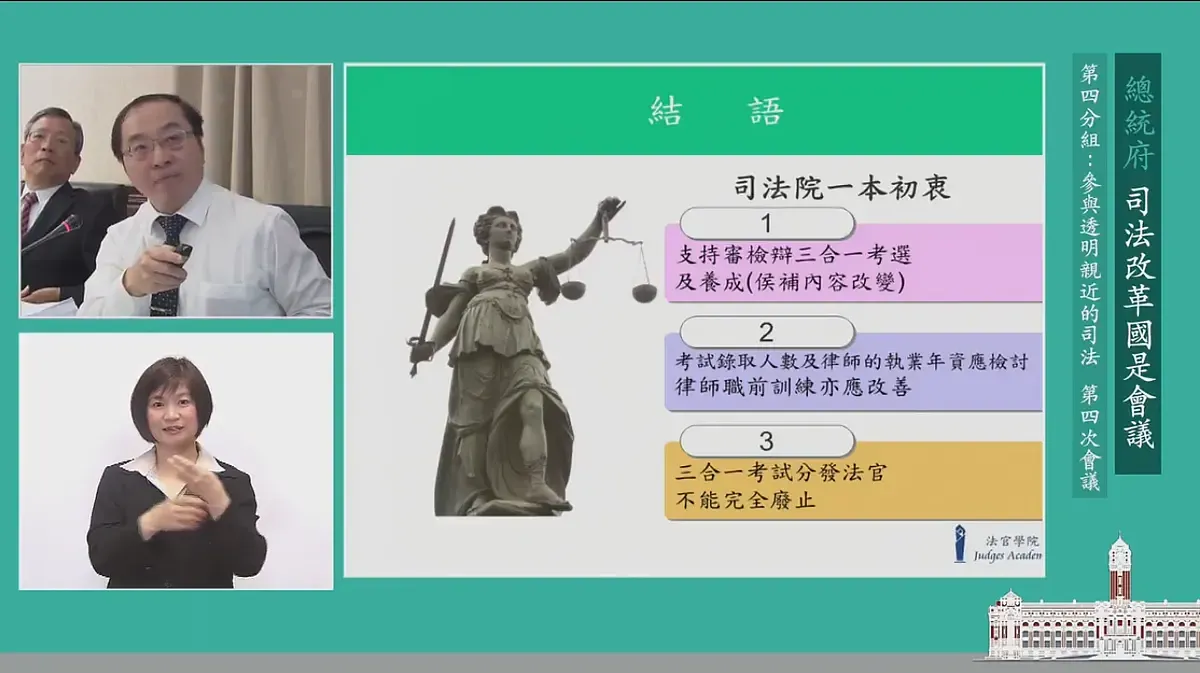
The acquisition of legal professional qualifications should be integrated (a unified, all-in-one examination). (Passed with 16 votes)
Following the examination, a one-year training program centered on practical institutions should be implemented, with costs borne by the state or provided via loans. (Passed with 15 votes)
Upon passing the one-year training, oral interviews for judges and prosecutors shall be conducted separately based on staffing quotas, scores, and personal preferences, and successful candidates shall be appointed as candidate judges and candidate prosecutors. (Passed with 16 votes)
The candidacy period shall be five years, during which they may not handle cases under their own name. Two of these years shall be spent gaining practical experience in domestic or foreign agencies and organizations (such as NGOs) outside of the courts and prosecutors' offices. (Passed with 16 votes)
Those who complete the candidacy period shall be selected based on a certain proportion to be appointed as probationary judges and prosecutors. (Passed with 16 votes)
Regarding the issue of "legal education reform," it is recommended that the Executive Yuan (Ministry of Education, Ministry of Justice), Judicial Yuan, and Examination Yuan jointly convene a national conference on legal education reform. (Passed with 16 votes)
Discussion Summary
4-2-2 Strengthen out-of-court dispute resolution mechanisms and establish diverse dispute resolution channels to reduce litigation sources and enhance judicial quality; 4-2-3 Establish non-litigious medical dispute handling and mediation mechanisms with appraisal first to promote rational dialogue between doctors and patients and extricate them from the quagmire of disputes
This topic's draft resolution was prepared by Committee Member Li Nien-tsu, who also assisted the chairperson in hosting the meeting. The topic was discussed for approximately 80 minutes. The discussion was primarily driven by legal professionals such as Committee Members Li Nien-tsu and Chen Hsien-yu, with little to no questioning from non-legal professionals regarding out-of-court dispute resolution mechanisms. Regarding medical disputes, the issue of whether to decriminalize professional negligence resulting in death in medical disputes was not discussed. Other issues concerning medical disputes also failed to elicit shared opinions from committee members during this meeting, which is regrettable.
Regarding Alternative Dispute Resolution (ADR) Mechanisms
Regarding Resolution 1: A Mediation Act should be enacted to regulate the following matters: standardized definitions of mediation, competent authorities for mediation, the legal effect of mediation, qualifications of mediators (professional mediator licensing system), mediator education and training, mediation fees, ethical obligations of mediators, recusal of mediators, and the scope of compulsory mediation.
Committee Member Li Nien-tsu
Mediation in current public sectors is amateur and part-time, lacking dedicated mediation commissioners. Furthermore, according to the law, mediation commissioners are only paid a very low travel allowance, making it difficult to encourage them to handle mediation seriously.
Committee Member Chiang Hui-min
Regarding township and city mediation, current practice is free of charge. If the resolution intends to shift toward "mediation should incur fees," will this disadvantage the public?
Committee Member Wu Kuang-lu
Should the provisions regarding mediation in the Code of Civil Procedure be deleted and transferred to the proposed "Mediation Act"? If we expect applications for mediation to be charged fees, should the fees be refunded if mediation fails?
Committee Member Li Nien-tsu
Regarding the idea that "mediation should incur fees," this is the correct direction to take, as there is no such thing as a free lunch. As for whether provisions regarding mediation in the Code of Civil Procedure should be deleted and incorporated into the "Mediation Act," this should be discussed during future legislative drafting.
Committee Member Lai Yueh-mi
According to foreign systems, mediation fees can also be determined based on the applicant's financial capacity.
Regarding Resolution 2: The Code of Civil Procedure should be amended to expand the scope of compulsory mediation, including disputes among residents of apartment buildings, consumer disputes (including travel contract disputes), and medical disputes. Compulsory mediation should not be limited to judicial mediation; it may also be conducted through administrative mediation and private mediation. Administrative mediation should be led by administrative agencies and conducted by qualified mediators using methods consistent with mediation principles. For private mediation mechanisms, the law should stipulate that cases subject to statutory compulsory mediation cannot enter litigation without undergoing mediation.
Committee Member Chen Hsien-yu
Paragraph 1, Subparagraphs 4, 7, and 11 of Article 403 of the Code of Civil Procedure already stipulate compulsory mediation for disputes among residents of apartment buildings, medical disputes, and consumer disputes (Subparagraph 10 covers property rights disputes under NT$500,000). If we further demand that apartment building resident disputes, medical disputes, and consumer disputes be included in compulsory mediation, the content of this resolution will make people think the committee members have never studied the Code of Civil Procedure.
Committee Member Li Nien-tsu
The current provisions in Paragraph 1, Subparagraphs 4, 7, and 11 of Article 403 of the Code of Civil Procedure are still insufficient, which is why we need to articulate this more clearly in the resolution.
Regarding Resolution 3: Government agencies should widely adopt alternative dispute resolution (ADR) clauses, such as mediation and arbitration, in standard contract templates issued by them (e.g., travel contracts, consumer contracts, apartment building bylaws) to encourage and facilitate public utilization.
Committee Member Chen Hsien-yu
Committee Member Tsai Yuan-shih
Directly stipulating mandatory arbitration clauses in contract templates may inadvertently cause citizens to waive their right to litigation. Under the arbitration system, victory or defeat is decided in the first instance; under civil litigation, there is a three-tier, three-trial system. Given that most ordinary citizens do not necessarily understand what the arbitration system is, requiring people to agree to contracts attached with mandatory arbitration clauses is truly imposing an unreasonable demand on the public.
Committee Member Li Nien-tsu
The question regarding whether mandatory arbitration clauses might cause citizens to waive their right to litigation simply reveals a lack of faith in the arbitration system among some members. When a dispute can be resolved once and for all through arbitration, why is that not a good thing? Furthermore, does the outcome of litigation necessarily guarantee a more favorable result for the public compared to arbitration? Although I am a lawyer, I am proposing this system from the standpoint of benefiting the public. Otherwise, for lawyers who seek fees based on case volume—where litigation can go through three instances while arbitration only goes through one—why would anyone support this resolution? If the public does not understand the benefits of the arbitration system, the government should all the more promote and educate the public about it! Finally, the resolution does not mandate that all contract templates must include mandatory arbitration clauses!
Regarding Resolution 4: Government procurement policies should encourage government agencies to utilize arbitration clauses. Before filing an action to set aside an arbitral award, government agencies must first conduct a cost-benefit analysis.
Judicial Yuan
Regarding the proportion of cases involving actions to set aside arbitral awards filed by government agencies, there is currently no data available.
Ministry of Justice
From 2000 to April 2017, data from the Taipei District Court regarding actions to set aside arbitral awards shows that government agencies filed 25 cases, winning 6 of them. As for the reasons why agencies file actions to set aside arbitral awards, most agencies mistakenly believe that filing an action to set aside an arbitral award has the same effect as filing an appeal. However, the threshold for applying for an action to set aside an arbitral award is actually higher than that for an appeal.
Committee Member Li Nien-tsu
Based on the Ministry of Justice's data, there is indeed a phenomenon where government agencies fail to respect arbitration outcomes.
Regarding Resolution 5: It is recommended that the Judicial Yuan study whether to amend the system of private prosecution in criminal proceedings, whether court fees should be charged for incidental civil actions in criminal proceedings, whether court fees should be waived for civil tort actions, whether a cap should be placed on civil court fees, and whether reasonable attorney's fees should be included in the court costs to be borne by the losing party.
Judicial Yuan
Regarding the private prosecution system, the Judicial Yuan believes it should be gradually phased out. Regarding whether "court fees should be waived for civil tort actions," the litigation aid system already exists to provide assistance. Regarding whether a cap should be placed on civil court fees, it is believed that court fees serve to deter frivolous litigation, and therefore a cap should not be established.
Committee Member Chen Hsien-yu
Regarding the resolution that "court fees should be waived for civil tort actions," there is a concern whether plaintiffs might opportunistically package non-tort lawsuits as tort lawsuits simply to avoid paying court fees.
Committee Member Li Nien-tsu
Regarding "waiving court fees for civil tort actions," a total waiver is indeed inappropriate; however, regarding "whether court fees should be charged for incidental civil actions in criminal proceedings," requiring full payment in all cases is also inappropriate. These two conflicting views await discussion during future legislation. As for the question of "whether a cap should be placed on civil court fees," setting a cap could benefit ordinary citizens when contending with powerful defendants in large-amount lawsuits.
Regarding Non-Litigious Medical Dispute Handling
Regarding Resolution 6: The Ministry of Health and Welfare (MHW) and the Ministry of Justice (MOJ), with respect to the "Pilot Project for Diverse and Two-Way Medical Dispute Resolution Mechanisms" released in March 2017, should refer to the following recommendations to clearly establish a promotion schedule, specify the expected target outcomes and follow-up evaluation mechanisms:
In addition to the MOJ proactively referring cases under investigation, the MHW should supervise health authorities across all cities and counties in adopting "mediation-first" approaches to actively and proactively assist parties involved in medical disputes in applying for out-of-court mediation.
Health authorities should strengthen preliminary appraisals for cases subject to mediation and provide thorough administrative investigation resources to alleviate the doubts of injured parties in medical practices and to provide legal and third-party medical experts with sufficient information to conduct mediation.
In addition to establishing a database of impartial third-party medical experts, the MHW should make good use of arbitration institutions and professional mediator resources.
The principle of "compulsory mediation first" in the Draft Medical Dispute Handling and Medical Accident Compensation Act should not be limited to civil litigation cases, but should also apply to complaint-dependent criminal cases under investigation by prosecutors or trial by courts.
Committee Member Chen Shu-lan
Medical dispute mediation has the function of healing trauma, and I hope everyone supports it, as well as hoping this resolution prompts the MHW to actively study the matter.
This resolution was adopted without controversy.
4-1-1 Review of National Examinations or Other Selection Methods for Judges, Prosecutors, Defense Counsel, and Legal System Personnel
This topic was hosted by Committee Member Lin Chang-ching, who assisted the chairperson. It was discussed for approximately 230 minutes. Regarding this topic, the 4th meeting of the 3rd Working Group also reached resolutions such as: "(1) Reform legal education and national examinations for judicial personnel. (2) Change the judicial precedent culture within the judicial system, and review the systems of precedents and resolutions of civil and criminal division meetings of the Supreme Court. (3) The internship locations for the Academy for the Judiciary should include, but not be limited to, courts, prosecutors' offices, and government agencies to increase judicial officers' understanding of current social conditions." The content of this meeting's resolution by the 4th Working Group was clearly more detailed than that of the 3rd Working Group. The issue of "legal education reform" is perhaps the foundational issue for how judges, prosecutors, lawyers, and other legal professionals can become more professional and empathetic. However, because this topic is too vast, this meeting did not intend to discuss it. Since the foundation of "legal education reform" failed to be established for discussion, subsequent pre-service training content could only abstractly use terms like "diversified training locations" and "joint examinations and joint training" as solutions to the apparent lack of professionalism among judges, prosecutors, and lawyers, mirroring the 3rd Working Group's resolutions. This shows that "legal education reform" was indeed a severely lacking foundation for discussion in this resolution. In addition, although Committee Member Lin Chao-chun submitted a 6-page paper titled "Prosecutor Positioning and Prosecutor Powers—A Comparative Law Observation," judging by the meeting conclusion that prosecutors, judges, and lawyers can take joint examinations and receive joint training, Committee Member Lin Chao-chun's written opinions seemed to offer little help to the discussion and were more suitable for the 3rd Working Group to discuss.
Regarding Resolution 7: The acquisition of legal professional qualifications should be integrated (a unified, all-in-one examination).
Judicial Yuan
The recruitment of judges should be diversified. Since the implementation of the Judges Act, the diversified appointment of judges has yielded poor results, leaving room to strengthen incentives for transfer. The number of scholars transferring to become judges is zero, and the proportion of lawyers applying for transfer is also skewed toward younger and more junior individuals. Therefore, our court still needs to recruit judges through examination and assignment to fill manpower gaps. We do not oppose obtaining qualifications for judges, prosecutors, lawyers, court clerks, prosecutorial investigators, and legal personnel through a single examination. However, the vacancy quotas for prosecutorial investigators and legal personnel are determined by the Examination Yuan, not arbitrarily decided by the Judicial Yuan.
Ministry of Justice
Germany, Japan, and South Korea all have a triple-in-one examination system for judges, prosecutors, and lawyers, and candidates who pass are trained together. The greatest advantage of joint examinations and joint training is the unified elevation of the quality of the nation's overall legal profession. Compared to our country's current lawyer training system, this will substantially enhance the quality and quantity of pre-service training for lawyers and imbue lawyers with more characteristics of a quasi-judicial organ.
Chairperson Hsu Yu-hsiu
The premise of current examinations is that those who pass as judges are suited to be judges but unsuited to be lawyers, while those who pass as lawyers are unsuited to be judges. However, such compartmentalized examinations restrict the flow of talent.
Committee Member Wu Kuang-lu
Written opinion: Regarding lawyers transferring to become judges or prosecutors, the Taiwan Bar Association held a seminar in 2015, where I presented "A Review and Improvement of the Mechanism for Lawyers Transferring to Become Judges and Prosecutors" (this article is available in the previous bar association electronic files; if not, please inquire) for reference. To this end, it is recommended that (1) How should the seniority of lawyers eligible for transfer be determined? I personally believe 6 years is appropriate. (2) Judges cannot all be selected from senior lawyers; judicial examinations must still be conducted because the number of lawyers transferring to become judges is still insufficient to meet demand, though training courses can be conducted together.
Regarding Resolution 8: Following the examination, a one-year training program centered on practical institutions should be implemented, with costs borne by the state or provided via loans.
Judicial Yuan
Regarding the triple-in-one training portion, the Judicial Yuan currently does not bear the cost of lawyer training. If the Judicial Yuan is to bear the cost of lawyer training in the future, based on the current monthly allowance of NT$48,000 per judicial trainee, and assuming 900 lawyers currently, the state might need to spend an additional NT$518 million-plus annually. In reality, the state could also fully bear the training costs for trainees who pass the examination.
Ministry of Justice
Disadvantage: Triple-in-one examinations and training are a costly reform proposal. Given that our country currently admits 800 to 900 lawyers annually, adopting joint triple-in-one training would require the state to expend massive human, material, and financial resources to accommodate the training capacity. With the current maximum training capacity of the Academy for the Judiciary at only around 200 trainees, expanding the trainee count to over a thousand would not only exceed the academy's capacity, but also pose high difficulties in subsequently arranging internships in courts and prosecutors' offices. Furthermore, judicial trainees currently in training receive a monthly living allowance of over NT$43,000; if lawyer joint training were also subsidized by the government with allowances, it would likely provoke controversy. This is an important reason why the 1999 National Judicial Reform Conference resolution adopting the triple-in-one examination and selection system has been unable to be implemented to this day. Regarding the triple-in-one training portion, it is necessary to let trainees know earlier which profession they can enter for employment. The Examination Yuan must also respond in a timely manner by providing annual vacancies for civil servants.
Committee Member Chen Hsien-yu
If lawyer training can be entrusted to private institutions, the state actually does not need to bear the cost of lawyer training.
Committee Member Tsai Yuan-shih
I support the joint training of judges, prosecutors, and lawyers to lower the threshold for mutual dialogue. How to enhance the humanistic literacy of judges, prosecutors, and lawyers should not be entirely entrusted to pre-service education; front-end legal education should focus more on cultivating this humanistic literacy.
Committee Member Li Nien-tsu
For those who wish to work in public-sector legal professions, state subsidies can be provided; for those who wish to work in private-sector legal professions, state subsidies can be omitted, and loans can be provided instead. The private sector may well be very willing to assist the government in training legal professional talent.
Chairperson Hsu Yu-hsiu
It is unacceptable for those wishing to become lawyers to understand nothing about the affairs of judges and prosecutors, or for those wishing to work in public-sector legal professions to understand nothing about the profession of lawyers. Such an approach is flawed.
Regarding Resolution 9: Upon passing the one-year training, oral interviews for judges and prosecutors shall be conducted separately based on staffing quotas, scores, and personal preferences, and successful candidates shall be appointed as candidate judges and candidate prosecutors.
Chairperson Hsu Yu-hsiu
Based on my experience as an oral interview committee member for the third tier of judge and prosecutor examinations, the third-tier oral interviews for current judge and prosecutor recruitment cannot actually determine whether candidates who pass the second tier are truly suited to be judges and prosecutors in the future.
Regarding Resolution 10: The candidacy period shall be five years, during which they may not handle cases under their own name. Two of these years shall be spent gaining practical experience in domestic or foreign agencies and organizations (such as NGOs) outside of the courts and prosecutors' offices.
Judicial Yuan
Regarding candidate judges and candidate prosecutors, there must be a weeding-out mechanism to urge candidate judges and candidate prosecutors to participate in training.
Committee Member Li Nien-tsu
In large law firms, young lawyers are still not deemed suited to handle cases independently. Since judges may hand down life-or-death sentences, it is difficult to accept that young judges can handle cases independently without being guided by senior judges.
Committee Member Chiang Yuan-ching
Regarding the humanistic upbringing of judicial officers, they are frequently criticized for lacking empathy. According to the training content of the 57th cohort of the Academy for the Judiciary provided by the Ministry of Justice, humanistic literacy accounts for only 16 hours, scattered across art appreciation and movie watching. It is hard to believe that a mere 16 hours can successfully cultivate the humanistic qualities of a judicial officer.
Regarding Resolution 11: Those who complete the candidacy period shall be selected based on a certain proportion to be appointed as probationary judges and prosecutors.
Chairperson Hsu Yu-hsiu
Trainees who are not selected will be discussed during future legislation.
Regarding Resolution 12: Regarding the issue of "legal education reform," it is recommended that the Executive Yuan (Ministry of Education, Ministry of Justice), Judicial Yuan, and Examination Yuan jointly convene a national conference on legal education reform.
Chairperson Hsu Yu-hsiu
This topic is complex and unsuitable for our discussion; therefore, it is recommended that the Executive Yuan (Ministry of Education, Ministry of Justice), Judicial Yuan, and Examination Yuan hold a joint meeting to discuss it. In fact, scholars are the ones who most need to participate in the reform!
Agenda for the Next Meeting
The next meeting is scheduled to be convened on April 28, where discussions will continue on topics such as "research and adoption of courtroom trial live-streaming," "research and adoption of judicial sunshine and transparency," and "citizen participation in trials."
This article is an AI-generated translation of the original Chinese text. In the event of any discrepancy, the Chinese version shall prevail.