
Brief Note: The 6th Meeting of the 5th Division of the Presidential Office's National Congress on Judicial Reform
Last edited: 2026-08-28
This meeting lasted approximately seven hours and reached numerous resolutions on the newly added topic of "Child- and Gender-Friendly Justice."
Although no experts or scholars were invited to give reports, this topic had already been discussed across seven previous meetings held on March 10, March 24, March 30, April 13 (first expanded meeting, visiting Mingyang High School and Changhua Juvenile Detention House), April 26, May 10, and May 15, involving many participating experts and scholars. A document titled "Subcommittee 5-5 Previous Meetings and Related Materials" was also presented to summarize past discussion proposals.
Committee member Chou Su-hsien's proposal regarding "police performance"—stating that "to improve the quality of law enforcement, the educational and training models of the Central Police University and Taiwan Police College must review the gap between quasi-military educational training models (including the cadre and spiritual education systems) and a democratic civil society, as well as their necessity, and should instead adopt educational and training models that conform to contemporary democracy, human rights, and professionalism. The reform of specific education and training methods should involve the establishment under the Ministry of the Interior of an 'Educational Training Curriculum Committee' composed of external personnel, which must include a certain proportion of experts outside the police system (such as adult educators, psychologists, human rights experts, physical training experts, student representatives, etc.) to assist in planning and supervision. Unspecified students (cadets) of the Police College and Central Police University should have channels to report actual school conditions to this committee, and the committee's minutes should be made public"—as well as the proposal regarding "police performance"—stating that "to help improve police quality and enhance law enforcement effectiveness, all police units should make public the calculation benchmarks, methods, and reasons for performance evaluation items so that experts in related fields can provide improvement suggestions. To improve the current performance system, which lacks scientific and rational basis, a Performance Indicator Committee should be established to confirm the rationality of the performance calculation methods. The committee members must include frontline police representatives and external members or experts outside the police system, such as labor rights experts and social science researchers, accounting for at least more than half of the total members. After the performance calculation methods are confirmed by the committee, frontline police should be allowed to express their opinions on the feasible parts to prevent implementation failures afterwards. Related practices can refer to the performance indicator discussion methods of social work units"—were passed in principle, with text condensation left for discussion at the next meeting.
Regarding the proposal "that the Ministry of Health and Welfare be petitioned to review and amend the Protection of Children and Youths Welfare and Rights Act and other related regulations, establish different institutional establishment and manpower standards according to the types of children and youths received, and adjust institutional fee standards according to the counseling needs of different types of children and youths received by welfare or upbringing institutions; and to plan public placement institutions of various types based on the nature and required services of special children and youths (such as children and youths who are unresponsive to all correction efforts or unsuitable for family upbringing). In addition, the Ministry of Education is requested to study and list the 'educational rights and interests of children and youths in placement institutions' as a teacher obligation, and review and amend related educational regulations as soon as necessary," both committee members Chi Hui-jung and Liu Shu-chiung noted that the resources subsidized by the government to private social welfare institutions are extremely scarce. The Chairperson temporarily tabled the proposal due to a lack of specific data, leaving it for discussion at the next meeting.
Regarding committee member Wang I-fan's proposal on "the feasibility of improving judicial treatment for children and youths who use drugs (including rebuilding social chains and coordination among administrative departments):
It is recommended that the Ministry of Health and Welfare integrate existing resources and related professional manpower (such as medical, psychological, educational, social, etc., referencing the Japanese Child Consultation Center system) to handle matters such as identification, assessment, screening, and counseling for pre-delinquent juveniles and children who use Category 1 and Category 2 drugs, and study the feasibility of establishing public child and youth drug addiction institutions.
It is petitioned that the Ministry of Justice formulate appropriate addiction assessment mechanisms for juveniles sent for observation and reformatory education, based on characteristics such as age, substance use habits, and appropriate treatment timing.
The Ministry of Labor is requested to list skills training and employment counseling for juveniles with special circumstances as a policy goal, and conduct courses suitable for juveniles to participate."
Wang I-fan emphasized that this proposal was submitted because the Ministry of Health and Welfare, the Ministry of Education, and the Agency of Corrections lack coordination regarding drug prevention. The Chairperson ruled that this resolution be temporarily tabled for discussion at the next meeting.
Regarding committee member Wang I-fan's proposal that "the Ministry of Labor list skills training and employment counseling for juveniles with special circumstances as a policy goal and conduct courses suitable for juveniles to participate," it was temporarily tabled. The Chairperson requested the Ministry of Labor to report again on the number of juvenile recidivists and recidivism rates.
The next meeting will be held on May 25. As it is the final meeting, it will discuss all pending issues, including "Current Status and Improvement Suggestions for Medical Care in Correctional Institutions," "Review of Anti-Drug and Drug Penal Severity Policies," "Improvement of Diverse Treatment Models for Drug Addiction Treatment," "Diverse Treatment for Drunk Driving," "Prevention of Crimes by Mentally Ill Patients," "Review of Anti-Corruption Legislation--Sunshine Laws for Legislative Bodies and Political Appointees," "Strengthening the Abscondence Prevention System," "Establishing Research Systems to Utilize Judicial Statistics and Enhance the Quality of Judicial Practice Operations," "Strengthening Research and Education on Crime Prevention," "Police Crime Prevention Strategies," "Review of the Adult Probation System," and others.
Discussion Subtopics and Opinions
Regarding "amending the law to authorize police agencies to arrest and detain fugitive sex offenders who cut off their electronic shackles," the discussion lasted about 18 minutes. Currently, because police agencies lack strong legal binding power over sex offender fugitives who cut off their electronic shackles, police are unable to promptly detain them, posing a public safety risk. Therefore, the Chairperson proposed that this issue belongs to the support of policy directions, and this preliminary resolution can provide the National Police Agency with the legislative momentum to amend the Code of Criminal Procedure or the Ministry of Health and Welfare to amend the Sexual Assault Prevention Act. Committee members present passed this preliminary resolution with 13 votes in agreement. However, committee members Hsu Shih-feng and Lu Ying-chieh opined that the Enforcement Act of Protective Measures should be amended instead.
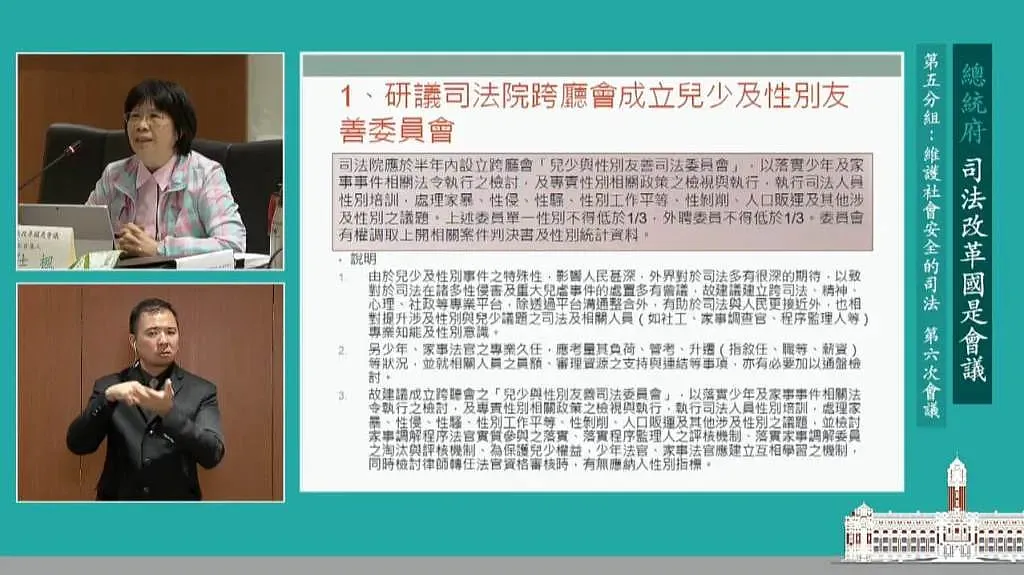
Regarding the establishment of a "Child and Gender-Friendly Justice Committee," the discussion lasted about 16 minutes. The Judicial Yuan expressed that it already has a "Human Rights and Gender Equality Committee," and the members' proposals might overlap with the existing system. Committee member Lai Fang-yu mentioned that she hopes this proposal will help integrate professional expertise, ensure the long-term tenure of family court judges, foster dialogue among people, and function to oversee judicial judgments in sexual assault cases; this proposal is also desired by many civil society groups. Committee members Li Ming-hung and Hsu Shih-feng expressed concern that the proposed "Child and Gender-Friendly Justice Committee" might have the power to retrieve finalized judgments for judgment research, which could interfere with judicial trials.
Regarding the establishment of a "Comprehensive Review of Child Abuse Prevention Policies," the discussion lasted about 50 minutes. Research by committee member Liu Shu-chiung and Dr. Lu Li found that among major child abuse cases, as high as 91% involve preschool children under the age of 6. In terms of resources, as of May 2017, local governments across Taiwan had only about 750 social workers handling child protection investigations and placements, tasked with handling over 50,000 reported cases each year, making their case load quite heavy. Moreover, social workers lack stronger coercive measures against abusing parents, and child protection cases are mostly "involuntary clients"; abusing parents and other perpetrators often refuse or passively cooperate with social workers' interventions. For example, regarding parenting education imposed through administrative sanctions, if parents refuse to attend, local governments can at best impose another fine, which fails to improve parenting functions. As another example, when social workers design family treatment plans for child protection families pursuant to Article 64 of the Protection of Children and Youths Welfare and Rights Act—setting service goals, specific practices, and execution time limits—that article in the Act carries no directly corresponding administrative penalty. Compared to parenting education imposed under Article 102, abusing parents have an even lower willingness to cooperate. Aside from utilizing social work skills—such as building professional relationships, leveraging family strengths, and motivating change—social workers can take few proactive and effective actions. Furthermore, if a child has injuries on their body, child protection social workers lack the professional capacity to determine whether they were caused by abuse; even when taking the child to a hospital for injury examination, they are often limited by hospitals lacking pediatric abuse diagnosis expertise, making it impossible to confirm whether injuries were intentional or consistent with the parents' accounts. All these factors make it difficult to hold abusing parents or caregivers truly accountable for their behavior. Finally, the attention, sense of mission, and cooperation regarding child abuse among central and local government units vary widely due to a lack of legal regulations, severely impacting the nation's child protection work and creating an unfair plight where Taiwanese children face "different fates in the same country." Therefore, members proposed a comprehensive review of child abuse prevention policies. Committee member Hsu Shih-feng mentioned that Article 56 of the Protection of Children and Youths Welfare and Rights Act is truly lacking in full implementation; committee member Chou Su-hsien mentioned that the problem of police failing to actively intervene stems from the same police performance calculation issues mentioned in the previous meeting. The Chairperson stated with a heavy tone: "We emphasize that children often do not know how to cry out for help; parents feel, 'How I beat my child is none of your business'; neighbors feel, 'This is the neighbor's child, none of my business'; and police feel, 'This is a family matter, none of my business.' This results in social administration personnel now being able only to knock on doors while unable to prevent injury cases. Without coercive intervention, prevention is impossible. That is why 72 children die from abuse every year. We call ourselves a progressive, civilized society, but frankly speaking, it is utterly barbaric!"
Regarding the "issue of decriminalization of adultery," the discussion lasted about 18 minutes. Committee member Chi Hui-jung mentioned that the crime of adultery fails to protect families and instead destroys them. Moreover, the practical application of the adultery crime tends to "punish women," running the risk of unconstitutionality; the number of wives prosecuted and convicted is higher than that of husbands, contradicting the public impression that it is a sharp weapon for "protecting married women." Paragraph 6, Article 10 of the Additional Articles of the Constitution explicitly stipulates that the state shall promote substantive equality between the sexes, and J.Y. Interpretation No. 666 also points out that even if a law uses gender-neutral regulatory phrasing, if its actual operation results in special disadvantages to a particular sex or penalizes only a specific sex, the legal provision is at risk of unconstitutionality. According to regulations, the crime of adultery punishes both "the spouse who commits adultery with another person" and "the other party to the adultery"; looking at the statutory text, regardless of wife or husband, as long as they engage in extramarital sexual behavior with another person, they are subject to punishment for adultery. According to Paragraph 1, Article 17 of the International Covenant on Civil and Political Rights: "1. No one shall be subjected to arbitrary or unlawful interference with his privacy, family, home or correspondence, nor to unlawful attacks on his honour and reputation." The concluding observations issued by the International Review Conferences on the Two Covenants in 2013 and 2017 clearly pointed out that the punishment of the crime of adultery constitutes arbitrary interference with private life, and recommended that the government take measures to abolish this provision from the Criminal Code. Chairperson Liang Yung-huang agreed at the May 15 working group meeting that "the law cannot protect affection; I support it but we must deliberate carefully. Alternatively, amend it so that if a withdrawal is made, it must be withdrawn entirely, not just for the spouse... Media is actually not important; what matters is whether we can effectively make substantive progress. According to polls from two years ago, about 60% still oppose it."
Committee member Lin Chih-chieh emphasized at both the May 15 working group meeting and the present meeting that "I strongly support the decriminalization of adultery. Over the past 20 years, there has already been ample protection for vulnerable spouses and children. The justification for current protection no longer exists, and the allocation of public power cannot intervene in everything; it does not comply with the principles of criminal law. Focusing on the fact that the Civil Code already has relevant provisions, and family law is no longer about urging reconciliation rather than divorce—adultery used to be the only way to protect, but it is no longer so... First, acknowledge the past important value of the adultery crime in protecting women and families, having made great contributions when nothing else existed; but after 20 years of Civil Code reform, it no longer has justification as a protection tool, and looking at current data, we find that it instead oppresses women... I strongly support the decriminalization of adultery because back then an assistant got dragged into it; the boss gathered a bunch of people claiming it was consensual, and in the end the judge acquitted the boss, but the legislator's wife filed an adultery charge and the adultery charge turned out to be guilty, requiring women's groups to pool funds to pay the fine. Now it forces victims to stay silent, because once initiated, they bear the risk of being found guilty. The assistant felt that 'the defendant raped her for 3 minutes, but the law raped her for 3 years.'"
Committee member Huang Hsu-tien mentioned at the May 15 working group meeting that "after the media criticizes, they finish criticizing; it shouldn't constitute a major setback for judicial reform, and what remains is the decisive battle in the Legislative Yuan, which might not matter as much to the media. Can we set a title to keep women from casually falling into prison cells, proposing the decriminalization of adultery first, but calling for at least abolishing the proviso of Article 239? That way, if the first point cannot be achieved, at least there is the second..." During this meeting, no other members expressed differing opinions, and the Chairperson instructed committee members Lin Chih-chieh, Chi Hui-jung, Liu Shu-chiung, and Lai Fang-yu to join the Chairperson in a post-meeting press conference to explain the reasons for the decriminalization of adultery to build public trust.
Regarding the "prioritized budgeting for child protection," the proposal's reasoning noted that child abuse incidents occur frequently. According to the operational outline of the National Taiwan University Children and Youth Protection Medical Center team presented by Dr. Lu Li, reports of child abuse and neglect are increasing year by year, averaging about one report every 10-15 minutes; in 2015, there were 5.7 child abuse-related deaths per month, and one child requiring emergency placement every day. This shows that child protection incidents urgently require attention. Since the government considers the declining birth rate an important issue, it should all the more recognize that today's children are tomorrow's Taiwan, and should list children as a core policy, showing the determination to uphold child protection with bold reforms. In particular, the problem of juvenile offenders being marginalized is extremely serious, and budgets for child care should be preferentially and generously allocated. No members present expressed differing opinions.
Regarding the "decriminalization of consensual sexual intercourse between youths of similar age," the discussion lasted about 20 minutes. The proposal's reasoning stated that although the Criminal Code already includes Article 227-1—allowing sentence reduction or exemption for offenses against sexual autonomy involving individuals under 18—and Article 229-1—making such cases complaint-preferred offenses—as long as this crime exists in the Criminal Code, parents can still file complaints, dragging underage couples who engaged in consensual sexual intercourse into the judicial process. In practice, many similar-age cases show that even though the boy and girl are boyfriend and girlfriend, parents insist on filing complaints against the other party, forcing minors to face judicial litigation procedures and bear criminal charges. Even in the juvenile court, this brings tremendous physical and mental pressure and negative labeling. The resulting tearing and conflict of parent-child relationships, emotional loss of minors, and interruption of personal physical and mental development are often greater impacts and harms. In terms of the judiciary, prosecutors and judges have also found that the similar-age clause mainly addresses parental anxiety rather than fundamentally solving children's problems, and the lawsuit process frequently increases parent-child conflicts while creating a dilemma for victims (wanting to extricate their partner, but parents wanting them to testify that they suffered sexual assault), which is also a predicament for law enforcement officers. Furthermore, once some parents discover their children have engaged in sexual behavior with others, they aggressively demand compensation from the other party and use the law as a threat. This not only violates the original intention of protecting minors, but compounded by the fact that the right of complaint for minors belongs to parents, parents often feel that resorting to the judicial path is the only way to seek justice for their children, neglecting their children's true needs and feelings. Child-of-similar-age cases require massive social costs every year, resulting in a waste of related manpower and preventing resources from being effectively used on cases that truly need them.
Committee member Hsu Shih-feng mentioned at the May 15 working group meeting: "Under 18 years old, they first enter the juvenile court, and protective measures are handled inside. Age gap is a problem; moreover, my concern is that juveniles are ignorant about sex, and we hope to protect them. Now saying that those under 18 are exempt from punishment based on sexual autonomy, I have reservations. With the decriminalization of adultery, there is still the issue of civil damages, but with the decriminalization of similar-age consensual sex, civil matters cannot be dealt with. Furthermore, has the society discussed this fully? I have some reservations... True consensual sexual intercourse between youths of similar age—because both parties have feelings, filing a complaint goes against one's conscience, but due to the insistence of both sets of parents, the two are separated and thus cannot meet, must go to court, must confront each other, and may be convicted as a result. However, schools may not understand judicial situations; once a case occurs, the school reports it, and once the judicial process is initiated, it cannot be stopped, which is harmful to children. Another situation is pseudo-consent, where it is actually against the will; how to handle this part requires further discussion."
Committee member Wang I-fan mentioned at the May 15 working group meeting: "What needs review right now is not the judiciary, but education. Do young people really understand sex? Consensual doesn't necessarily mean sexual intercourse; people don't know how to refuse. They might regret it only after it happens, so we should start with sex education." Committee member Huang Hsu-tien mentioned at the May 15 working group meeting: "I support the proposal and know that the social atmosphere might be difficult. The realistic practice is that laws often provide people with a basis of legitimacy; I hear nine times out of ten that people feel the daughter got the short end of the stick and want the boy to pay compensation. Society currently feels boys take advantage and girls suffer losses. If there is no moderate way out, often when the educational field handles it immediately, the children are already ruined with no buffer space." Committee member Lu Ying-chieh mentioned in this meeting: "Article 227-1 of the Criminal Code causes both parties to be simultaneously perpetrators and victims, which is a strange crime type that does not conform to criminal law theory. Moreover, Article 227-1 is designed as a complaint-preferred offense, often becoming a negotiation or retaliation tool for both sets of parents. Therefore, I support the abolition of the similar-age clause."
Regarding the issue of "protection of the reproductive autonomy of minors and women," the discussion lasted about 15 minutes. Committee member Lin Chih-chieh emphasized at the May 15 working group meeting: "This issue does not involve the entire chapter on abortion crimes, but mainly targets Paragraph 2 of Article 9 of the Genetic Health Act—requiring the consent of statutory agents for minors undergoing abortions—and Article 10—requiring the consent of spouses for married men and women. Current law completely disregards the wishes of minors; if the minor and parents disagree, the parents decide. Current directions for amendment include petitioning the court for a ruling and evaluations by professional units. However, because court rulings take a relatively long time, it may be too late, and even if the final decision permits an abortion, it may exceed the legal gestational age limit for abortion."
Committee member Lin Chih-chieh emphasized in this meeting: "The age at which one can independently have an abortion should be lowered to 16, because the Civil Code already allows marriage and childbearing; current regulations completely fail to comply with conventions protecting youth!" Committee member Lai Fang-yu mentioned in this meeting: "Failing to grant underage children certain rights regarding reproductive autonomy leads to the situations frequently seen in the news where babies are found in toilet bowls." Committee member Huang Hsu-tien mentioned in this meeting: "Regarding reproductive autonomy, I also feel that husbands should not be granted an unconditional right to consent to abortion; minors reaching a certain age should be able to independently decide their reproductive autonomy; and for minors under a certain age, when statutory agents do not allow an abortion, a third party should intervene to handle the matter."
Regarding the "right of sexual assault victims to participate in litigation," the discussion lasted about 20 minutes. Committee members Li Ming-hung and Hsu Shih-feng both mentioned that the 3rd expanded meeting of the 1st Division on May 13 already addressed: "2. 'Timely grasp' of litigation information: Crime victims are parties to the case and should have the right to understand litigation progress (e.g., being informed of investigation progress during investigation) and case records. Therefore, upon the conclusion of a case investigation (prosecution, non-prosecution, suspension of prosecution, etc.) and during the litigation process, mechanisms should be established to protect victims' rights to review files and receive notifications (e.g., notification of the offender's release on bail, parole, etc.) so that victims can understand and grasp the progress and contents of the proceedings. 3. Reserving a 'victim's seat' in the courtroom: To respect victims and protect their rights, a victim's seat should be set up within the courtroom trial area, and this seat should be close to the prosecutor to facilitate full communication in conducting related litigation activities and enable the court to fully hear the victims' opinions." Therefore, this division's proposal might overlap with the 1st division's resolution. Committee member Hsu Shih-feng additionally worried that this proposal might blur the victim's status with that of the prosecutor. Committee member Tsai Hsiu-juan expressed a different opinion: "Our division is different from the 1st division because this proposal involves gender." Committee member Lai Fang-yu also expressed a different opinion: "The 1st division seems to emphasize only the protection of victims' privacy rights, so the scope of our proposal will not completely overlap with the 1st division." Committee member Huang Hsu-tien reminded: "Our proposal includes notifying the victim when the sentence is executed, which is absent in the 1st division's resolution."
Regarding the issue of "whether juvenile detention houses, juvenile reformatory schools, and juvenile correctional schools should fall under the jurisdiction of the Ministry of Education," it involves whether keeping them under the Ministry of Justice under the current system can protect juveniles' right to education. Principal Chen Hung-yi of Mingyang High School (reformed from a juvenile reformatory school) mentioned at the April 26 working group meeting: "Mingyang High School is currently affiliated with the Ministry of Justice and lacks Ministry of Education staffing. As an affiliated institution, the Ministry of Education actually has more resources, but whether the Ministry of Education's custody capacity is sufficient remains questionable. The Ministry of Education has long paid little attention to correctional schools. Enrolled cooperative schools (high schools) are all begged for, and the Ministry of Education provides no subsidies."
Committee member Huang Hsu-tien mentioned at the April 26 working group meeting: "Regarding the educational responsibility for children, the Ministry of Education cannot abandon it. If staffed under the Ministry of Education, the Ministry of Education must invest all funding. Currently, the Ministry of Education is not yet prepared, and re-affiliation will not happen temporarily. However, for the protection of children and youths, Ministry of Education resources should enter. Space and field resources must be provided to the maximum extent by the Ministry of Education. Outstanding teachers should be able to be placed in. If treated as a legitimate educational concept where teachers' seniority is recognized, it might work. The problem lies in the Ministry of Education's layers of bureaucracy, which are mostly formalistic, making it difficult for good teachers to survive. The Ministry of Education needs to provide resources, money, venues, and manpower. Therefore, the Ministry of Justice should take primary responsibility, with Ministry of Education resources providing assistance."
The Chairperson mentioned at the April 26 working group meeting: "Where it is affiliated is less important; Mingyang's existence proves that being managed by the Ministry of Justice can also work well. In reality, it is a funding issue, and educational funds should be covered. It should be required that for every student head, educational budgets are allocated. The budget of correctional schools will be higher than that of reformatory schools, and teachers' money and experts' money should be paid by the Ministry of Education."
Committee member Wang I-fan mentioned in written comments: "Because both houses and schools lack special education teachers or life counseling staff, accommodated juveniles with special education needs are also difficult to properly care for. Therefore, to implement the spirit of the Convention on the Rights of the Child, it is recommended that before the reformatory schools are restructured, the Ministry of Education should first provide financial and teaching staff assistance, refer to the counseling staffing standards of halfway schools, assist reformatory schools in setting up full-time teachers in adequate numbers according to actual class sizes, fully subsidize personnel costs, and dispatch full-time counseling teachers to serve in the schools."
The Ministry of Justice's written opinion opposed belonging to the Ministry of Justice, stating: "In response to the amendment trend of the Juvenile Justice Act, pre-delinquent juveniles and law-breaking children should not continue to be accommodated in juvenile detention houses under the Agency of Corrections, Ministry of Justice; separate organs (institutions) should be established for accommodation. Furthermore, juvenile detention houses, juvenile reformatory schools, and juvenile correctional schools should be affiliated with the Judicial Yuan or reassigned according to business attributes to the competent health and welfare and education authorities respectively, so as to reduce penal colors and promote juvenile rights."
The Judicial Yuan's written opinion opposed the view of belonging to the Judicial Yuan, stating: "According to the Constitution, this Yuan and its subordinate organs hold the powers of interpretation, trial, disciplinary punishment, and judicial administration. As for the execution of criminal penalties and the accommodation and detention of custodial measures, they fall under the jurisdiction of the Executive Yuan (Ministry of Justice). The execution of reformatory education is managed by the Ministry of Justice, which complies with the constitutional system and aligns with the principles where trials and penalty executions are separately handled by courts and prosecutors as stipulated in the Criminal Code and Code of Criminal Procedure; the legislative precedent of Japan followed by the Juvenile Justice Act adopts the same approach."
Regarding "the comprehensive restructuring of juvenile reformatory schools into juvenile correctional schools," the proposal stated: "At the 2002 Ministry of Justice 'Seminar on the Current Status and Prospects of Juvenile Correctional Schools,' participants suggested that juvenile correctional education should be based on counseling education, followed by analyzing the causes of juvenile delinquency, personality, behavioral impulses, developmental history, cognitive distortions, and behavioral patterns to administer cognitive and behavioral correction. On this basis, students should be imparted basic academic or vocational knowledge and skills. Therefore, juvenile correctional schools should be listed as special education; although operated in reference to school curricula at all levels, flexible teaching should still be conducted based on the needs to enhance students' ability to reintegrate into society and adapt. However, the above opinions have not been implemented after more than 14 years, and the curricula and teaching of juvenile correctional schools differ little from traditional education. Considering that most juveniles in correctional institutions have a severe gap between their basic academic ability and actual educational level, in order to design curricula and teaching methods matching students' academic abilities and needs, it is recommended that the Ministry of Justice evaluate the feasibility of separately establishing a 'Juvenile Correctional Education Research Center.'"
Committee member Wang I-fan mentioned in written comments: "In recent years, accidents have frequently occurred in juvenile reformatory schools and Cheng-cheng High School (such as the murder case of a juvenile surnamed Mai at the Taoyuan Juvenile Reformatory School, the prolonged hanging of a juvenile in the laundry yard at the Changhua Juvenile Reformatory School, and bullying among students at Cheng-cheng High School as well as failure to provide special education services to students with disabilities lacking special education qualifications), causing juvenile reformatory schools and juvenile correctional schools to be repeatedly criticized. Seven days after members of this meeting's 5th Division visited the Changhua Juvenile Reformatory School (April 20, 2017), an unfortunate incident occurred where an accommodated juvenile struck a roommate in the chest with five heavy punches (seemingly a practice commonly known as 'nailing the gossip board'), causing the victim to collapse into a coma and pass away despite medical treatment. From this perspective, reformatory juvenile correctional education can no longer be resolved solely through restructuring; greater attention must be paid to issues such as planning correctional education content, professional training and tenure rewards for correctional personnel, selection and elimination of professional personnel (clinical psychologists, social workers, teachers, etc.), and the infusion of Ministry of Education funding and manpower. In addition to restructuring, it must be ensured that all institutional reforms and resource provisions are strictly implemented." Committee member Huang Hsu-tien mentioned in this meeting: "We truly lack dedicated personnel and dedicated curricula."
"Comprehensive review of the execution contents and counseling methods of juveniles in the aforementioned institutions (juvenile detention houses, juvenile reformatory schools, juvenile correctional schools) and the cooperation of various administrative departments, alongside perfecting the establishment for social reintegration," comprising 6 proposals, with discussion lasting about 60 minutes. They are detailed below:
Proposal 1, "Regarding treatment equality for female juveniles receiving institutional treatment," the reasoning explains: "Currently, all female juveniles receiving reformatory education nationwide serve their terms in the Changhua Juvenile Reformatory School. Because this school also accommodates male juveniles receiving reformatory education, for management convenience, a small section inside the compound is separated by a wall for female reformatory juveniles, leading to a severe shortage of spaces such as dormitories for female juveniles. As for female criminal juveniles, there is also no dedicated institution, and they currently serve sentences in Mingyang High School. Considering the larger number of female reformatory education juveniles, it is more appropriate to establish a dedicated female juvenile correctional school." The Director of the Agency of Corrections mentioned that due to budget constraints, this proposal to "specially establish a female juvenile correctional school" is quite difficult. Committee member Hsu Shih-feng mentioned that "dedicated correctional schools should be established evenly in the north, center, south, and east so that family members can also visit juveniles nearby." The Chairperson lamented that "perhaps one day we will strike oil, and these financial problems can be resolved."
Proposal 2, "Regarding the feasibility of adding diverse accommodation measures in juvenile detention houses," committee member Wang I-fan originally mentioned that such diverse accommodation measures could include "a system such as going to school on weekdays and being accommodated in the juvenile detention house on weekends and holidays," but because both the Judicial Yuan and committee member Li Ming-hung believed that "accommodated juveniles are unlikely to go to school," the specific content of this accommodation measure was deleted.
Proposal 3, "Regarding juvenile correctional schools, allowing convicted juveniles who reach the age of 23 before the expiration of their execution term to still complete their education," literal interpretation of Article 3 of the Prison Act might lead to the conclusion that the Agency of Corrections does not need to help convicted juveniles who reach 23 before their term expires complete their education. However, the Director of the Agency of Corrections promised that for those over 23, they will be allowed to complete their education as much as possible.
Proposal 4, "Regarding stabilization measures after juveniles leave school," the Judicial Yuan admitted that regarding such stabilization measures, the practices of juvenile investigation officers across various regions are not yet uniform. The Chairperson mentioned that since this resolution can be followed based on existing legal provisions (Article 27 of the Enforcement Regulations for Juvenile and Child Protection Cases, Article 68 of the Protection of Children and Youths Welfare and Rights Act), the focus lies on active implementation.
Proposal 5, "Regarding the protection of law-breaking children: recommending that the government promptly establish accommodation facilities for law-breaking children," the reasoning is: "Based on the spirit of J.Y. Interpretation No. 664, law-breaking children should not be accommodated in juvenile correctional institutions; it is recommended that the Judicial Yuan and administrative competent authorities (such as the Ministry of Health and Welfare, the Ministry of Education) consult on adjusting the treatment methods for law-breaking children, shifting to welfare services and educational counseling." Committee member Li Ming-hung stated that according to Interpretation No. 664 requiring amendments to the Juvenile Justice Act, in the absence of any amendments to the Juvenile Justice Act, judges find it very difficult to decide "how to accommodate runaways." Committee member Hsu Shih-feng mentioned that there is indeed a disconnect between the Judicial Yuan and administrative competent authorities, and this issue also involves whether law-breaking children can be effectively educated. The Chairperson mentioned that while J.Y. Interpretation No. 664 has good intentions, it fails to solve the problem of school-truant and runaway juveniles. The Grand Justices clearly stated only that law-breaking children should not be accommodated, but the competent authorities operated it as non-accommodation altogether.
Proposal 6, "Regarding the protection of privacy and counseling quality for accommodated juveniles," the explanation states: "Enthusiastic individuals, religious, public welfare groups, or volunteers often enter institutions with enthusiasm and love to provide services. Due to a lack of subordinate relationships, it is difficult to monitor and manage service quality. In the past, there were instances where volunteers helped juveniles smuggle messages and failed to properly protect the privacy of served juveniles. Furthermore, some groups, in order to extend services to juveniles leaving the institution, collected personal information of juveniles or their families through various methods. Therefore, to properly protect the privacy and rights of juveniles, it is recommended that the Agency of Corrections formulate a review mechanism and management regulations for private groups and volunteers entering institutions for counseling, in compliance with provisions such as Article 83-1 of the Juvenile Justice Act, Article 69 of the Protection of Children and Youths Welfare and Rights Act, Article 6 of the Personal Data Protection Act, and Article 40 of the Convention on the Rights of the Child." The Director of the Agency of Corrections stated that regarding privacy protection, there is Article 6 of the Volunteer Service Act to follow. The Chairperson instructed the Agency of Corrections to submit data on privacy protection measures at the next meeting.
Meeting Resolutions
5-4-1 Social Reintegration of Ex-offenders and Complementary Measures
Review preparatory measures provided by correctional institutions for inmates before social reintegration:
Understand market demand, review vocational training courses in correctional institutions, and do a good job in vocational training measures.
Fully convey relevant information on employment counseling.
Formulate diverse treatments for inmates before leaving prison, including establishing social transition halfway zones, to build deinstitutionalized living for inmates, enhance interpersonal interaction and independent living skills, and successfully transition back into society.
Encourage the private sector to promote social enterprise models to employ ex-offenders, and the government should grant rewards to those who hire ex-offenders without discrimination.
Strengthen the work and communication of the Agency of Corrections, Adult Probation, and the Rehabilitation Protection Association:
Establish halfway houses for ex-offenders to provide vocational training and job matching mechanisms; at the same time, provide necessary childcare assistance.
Actively establish a "rehabilitation family support system," focus on target groups, deepen service contents, and regularly implement performance evaluations to maximize the efficacy of family support.
Autonomous extramural work should be expanded in application:
If designed for the purpose of solving inmate overcrowding, administrative management manpower pressure, and social transition of inmates after leaving prison, the Agency of Corrections is requested to actively expand the quota for autonomous extramural work to have substantial significance.
State-owned enterprises open quotas for those undergoing reintegration treatment: Cooperative manufacturers of autonomous extramural work are hard to come by; it is petitioned that state-owned enterprises in various counties and cities open some job quotas to those undergoing reintegration treatment inside correctional institutions, introducing training, internships, and work adopting a cooperative education model, allowing reintegration treatment recipients to obtain living allowances and acquire a skill in the process. (Passed with 18 votes)
5-4-5 Review of the Adult Probation System
Enact the "Special Probation Act" to integrate the operation and development of the probation system, enhance the professional competencies of probation officers, and achieve professionalization of probation operations.
The government should moderately adjust probation manpower and resources, staff professional personnel such as psychologists, strengthen treatment measures for major cases such as sexual assault, and construct a tight social safety net. (Passed with 18 votes)
5-4-4 Police Crime Prevention Strategies
To enhance police professionalism and law enforcement effectiveness, please review and revise mission clauses and operational regulations in the Police Act and related police laws, and implement education and training for police personnel at all levels based on the Police Education Ordinance to cope with changing times. (Passed with 18 votes)
5-3-6 Corporate Crime
Petition the Ministry of Justice to review the possibility of recognizing corporate criminal responsibility and the establishment standards of subjective and objective elements for illegal acts such as environmental, food safety, financial, money laundering, and corruption crimes that impose dual penalties on corporations in special laws in our country.
Petition the Judicial Yuan to study the rights, obligations, and procedural participation of corporate defendants in the Code of Criminal Procedure, and handle issues such as whether conflicts of interest exist between corporate representatives and corporations in confiscation procedures requiring recusal. (Passed with 18 votes)
Preliminary Meeting Resolutions
Amending the law to authorize police agencies to arrest and detain fugitive sex offenders who cut off their electronic shackles
To ensure women's and children's safety and enable police agencies to immediately arrest and detain sex offender fugitives who cut off their electronic shackles, the Ministry of Health and Welfare is requested to add provisions empowering police agencies to arrest suspects without a warrant when amending the Sexual Assault Prevention Act. The Ministry of Justice is also requested to comprehensively review the Enforcement Act of Protective Measures regarding whether there are flaws in current protective measure regulations.
Studying the establishment of a cross-departmental Child and Gender-Friendly Committee by the Judicial Yuan
The Judicial Yuan should establish a cross-departmental "Child and Gender-Friendly Justice Committee" within six months to implement the review of the execution of laws and regulations related to juvenile and family affairs, inspect and execute gender-related policies exclusively, execute gender awareness training for judicial personnel, and handle issues of domestic violence, sexual assault, sexual harassment, gender employment equality, sexual exploitation, human trafficking, and other gender-related issues. Single-sex representation among the aforementioned committee members shall not be less than 1/3, and external members shall not be less than 1/3. The committee shall have the power to retrieve relevant publicly available judgments and gender statistics related to the aforementioned cases.
Comprehensive review of child abuse prevention policies
The government should actively protect the rights and interests of children and youths, and evaluate the feasibility of establishing a "Child and Youth Protection Office" under the Executive Yuan to integrate relevant institutions and resources across social administration, police, medical, educational, prosecutorial, and judicial systems.
Patterned after the existing high-risk case network meetings of the "Domestic Violence Safety Protection Network," study the construction of a network led by the prosecutorial system for "major child abuse cases" to strengthen current child protection mechanisms.
The Ministry of Justice is requested to study the construction of a "Child Death Review" mechanism and amend related regulations to report child death cases involving children under 6 to prosecutors for cause-of-death investigations.
The competent authorities are requested to study and amend related regulations such as Articles 53 and 56 of the Protection of Children and Youths Welfare and Rights Act, Article 11-1 of the Communication Security and Surveillance Act, and the Personal Data Protection Act. Regarding first-level emergency child protection and placement events and second-level first-class placement and assessment events under the "Regulations for Child and Youth Protection Notification, Categorized Classification Processing and Investigation," when visiting has obvious difficulties or the child's whereabouts are unknown, and it is necessary to apply for the retrieval of call detail records, health insurance, or medical records of the person caring for the child, they may report to a prosecutor to retrieve them or apply to the court for a retrieval warrant. Article 131 of the Code of Criminal Procedure should also be reviewed and amended to empower judicial police officers with the feasibility of conducting warrantless searches when necessary.
Abolishing Article 239 of the Criminal Code; if unable to be abolished immediately for any reason, the proviso of Article 239 of the Code of Criminal Procedure should be deleted immediately, reverting to the application of the indivisibility of complaints principle under the Code of Criminal Procedure. Reasoning:
The existence of the crime of adultery in the Criminal Code had its function of protecting vulnerable spouses in an era when gender equality awareness had not yet developed and our country's gender equality legal system lacked many aspects. However, today our country already has the Domestic Violence Prevention Act and Sexual Assault Prevention Act; within the Book of Family of the Civil Code, marital property regimes, fault-based and breakdown principles in divorce, and child custody all conform to standards of gender mainstreaming, taking the best interests of the child as the criterion for exercising parental rights. Therefore, the justification for the continued existence of the crime of adultery—which intervenes in private relationships with state penal power—is now weak.
The proviso of Article 239 of the Code of Criminal Procedure related to the crime of adultery is an exception to the principle of the "indivisibility of complaints." According to this provision, a spouse may withdraw a complaint solely against the adulterous spouse, and such withdrawal does not extend to the other party to the adultery. This provision violates the principles of criminal procedure and causes the number of women physically convicted for the crime of adultery to far exceed that of men, creating substantive inequality that oppresses women.
Moreover, there have been actual cases where a complainant alleging sexual assault failed to secure a criminal conviction due to insufficient evidence, but was conversely sued by the defendant's spouse for adultery and finally convicted. Consequently, it is common in practice for sexual assault victims to dare not report or file complaints about the fact that they suffered sexual assault out of fear of being sued for adultery by the perpetrator's spouse, affecting the protection of sexual autonomy and the exercise of victims' rights of complaint.
Child and youth human rights policies should be the nation's highest priority policy, and the government should preferentially and generously allocate child protection budgets.
Articles 227 and 227-1 of the Criminal Code
It is recommended that relevant competent authorities reference legislative examples of other countries to review current criminal penalties and reporting regulations regarding consensual sexual intercourse between "youths of similar age," replacing litigation procedures with educational counseling and replacing criminal liability with service provision.
Amendment Bill for Article 9 of the Genetic Health Act
It is petitioned to amend provisions concerning the right to decide on artificial abortion for minors and married women under Article 9 of the Genetic Health Act to implement women's autonomy, and moderately introduce judicial and administrative dispute resolution mechanisms when opinions differ. Reasoning:
In Paragraph 2 of Article 9 of the current Genetic Health Act, when a person under 20 years old becomes pregnant and wishes to undergo an artificial abortion, consent from a statutory agent is required without exception. This forces minors who wish to undergo an artificial abortion without their statutory agent's consent to seek unlicensed doctors or other illegal channels, violating child and youth physical and mental protection as well as international norms. Competent authorities should immediately study this: minors over 18 should be able to decide for themselves; when minors under 18 and their statutory agents disagree on the decision for artificial abortion, a mechanism for judicial or administrative intervention should be established to assist minors in making decisions and protecting their physical and mental health.
According to Paragraph 2 of Article 9 of the current Genetic Health Act, when a married woman wishes to undergo an artificial abortion pursuant to Subparagraph 6, Paragraph 1 of Article 9 (pregnancy or childbirth affecting her mental health or family life), the consent of her spouse is required without exception clauses, and without considering whether the woman suffers domestic violence in the marriage or has other circumstances where the marriage cannot be maintained. This forces battered women or women undergoing divorce proceedings to potentially be unable to undergo artificial abortions or suffer other unfavorable oppression due to this regulation, which should be amended together. It is recommended to add exception clauses not requiring spousal consent, and even without exception circumstances, when a pregnant married woman and her spouse disagree on whether they meet the conditions of Subparagraph 6, a dispute resolution mechanism by judicial or administrative organs should be established so that the reproductive autonomy of pregnant married women is guaranteed.
Right of sexual assault victims to participate in litigation
To enable sexual assault victims to retain judicial subjectivity and implement the intent of the Sexual Assault Prevention Act and its newly added provisions to protect victims, relevant units are petitioned to study designing various victim litigation participation systems in litigation procedures, including investigation initiation, prosecutorial screening, courtroom trial, and sentence execution stages.
Institutions accommodating juveniles, executing juvenile imprisonment and reformatory education (juvenile detention houses, juvenile reformatory schools, juvenile correctional schools) should belong to the Agency of Corrections, Ministry of Justice or the Ministry of Education
Institutions accommodating juveniles, executing juvenile imprisonment and reformatory education shall remain affiliated with the Agency of Corrections, Ministry of Justice; education for juveniles in correctional institutions shall be protected by the Fundamental Education Act, and their teaching, counseling, and personnel expenses shall be funded by educational budgets allocated by central or local governments, and competent authorities (such as the Ministry of Justice and Ministry of Education) are petitioned to study the feasibility of allocating independent budgets.
Evaluating the comprehensive restructuring of juvenile reformatory schools into juvenile correctional schools
The Ministry of Justice is petitioned to implement the provisions of the General Principles for the Establishment and Educational Implementation of Juvenile Correctional Schools, promptly complete the restructuring of juvenile reformatory schools into correctional schools, and formulate correctional education-related measures.
Adjust the structure of the Correctional Education Steering Committee to incorporate agencies and private representatives such as the Judicial Yuan, Ministry of Health and Welfare, and Ministry of Labor, and implement functions such as researching correctional education contents and teaching materials.
Establish selection, appointment, and elimination mechanisms for professional teachers (including principals) and counseling personnel in juvenile correctional schools; additionally, establish professional training and incentive systems for correctional personnel.
Request the Executive Yuan to study the feasibility of establishing a "Juvenile Correctional Education Research Center" across relevant ministries and departments.
Before the restructuring of juvenile reformatory schools, it is recommended that competent authorities such as the Ministry of Education provide abundant resources.
Comprehensive review of the execution contents and counseling methods of juveniles in the aforementioned institutions (juvenile detention houses, juvenile reformatory schools, juvenile correctional schools) and the cooperation of various administrative departments, alongside perfecting the establishment for social reintegration
Regarding treatment equality for female juveniles receiving institutional treatment:
The Executive Yuan is petitioned to provide sufficient resources to assist the Ministry of Justice in establishing dedicated female correctional schools; based on gender equality, vocational training for female convicted and reformatory juveniles should conduct diverse courses (such as automobile repair, painting, carpentry, etc.).
Regarding juvenile detention houses:
The Judicial Yuan is recommended to reference South Korea's diverse accommodation system and study the feasibility of adding diverse accommodation measures in the Juvenile Justice Act; additionally, to implement the identification function of juvenile detention houses, the Agency of Corrections of the Ministry of Justice should increase professional manpower such as medical, psychological, and social work personnel.
Regarding juvenile correctional schools:
The Executive Yuan is petitioned to assist the Agency of Corrections of the Ministry of Justice in classifying and setting up juvenile correctional schools according to the traits and needs of accommodated juveniles, develop juvenile treatment effect evaluation mechanisms (including regular evaluation, adjusting treatment contents and goals, etc.), and study the feasibility of setting up family co-residence facilities and halfway zones within schools, as well as conducting diverse treatment measures.
The Ministry of Justice is recommended to promptly draft amendments to Article 3 of the Prison Act and related regulations, allowing convicted juveniles who reach the age of 23 before the expiration of their execution term to continue being accommodated in juvenile correctional institutions until the completion of that educational stage based on their educational needs.
Regarding stabilization measures after juveniles leave school:
To strengthen stabilization measures after accommodated juveniles leave school, the Judicial Yuan is recommended to study amending Article 27 of the Enforcement Regulations for Juvenile and Child Protection Cases, requiring courts to dispatch juvenile probation officers to conduct on-site verification whenever they receive applications from juvenile correctional schools for the exemption or suspension of reformatory education.
The Ministry of Health and Welfare is requested to implement the spirit of Article 68 of the Protection of Children and Youths Welfare and Rights Act, assisting juveniles leaving school who have needs to move into independent living quarters or providing relevant allowances; the Rehabilitation Protection Association is recommended to assist convicted juveniles leaving school who are 18 or older to move into ex-offender halfway houses and provide services such as vocational training and job matching mechanisms.
Regarding the protection of law-breaking children: It is recommended that the government promptly establish accommodation facilities for law-breaking children. Before such facilities are established, the Judicial Yuan and administrative competent authorities (such as the Ministry of Health and Welfare, the Ministry of Education) are requested to consult on adjusting treatment methods for law-breaking children, shifting to welfare services and educational counseling.
Regarding the protection of privacy and counseling quality for accommodated juveniles: It is recommended that the Ministry of Justice formulate review mechanisms for private groups and volunteers entering schools (houses) for counseling to properly protect the privacy of accommodated juveniles and ensure the quality of counseling and services.
Commentary
This meeting raised many child and youth issues that usually go unnoticed, including children and youths suffering abuse, unexplained deaths of children and youths, abandoned babies forced by insufficient protection of reproductive autonomy, and severe resource shortages and low educational effectiveness in juvenile detention houses, juvenile reformatory schools, and juvenile correctional schools. Furthermore, activity spaces for female children and youths in juvenile detention houses and reformatory schools are even scarcer than those for males. Today's children and youths are the root cause of tomorrow's adult crimes; if sound corrective mechanisms for non-delinquent juveniles are not established during the educational stage of children and youths, it will be impossible to prevent serious crimes such as violent firearms, robbery, murder, and gang fights after these youths reach adulthood.
Although criticisms argue that children's reproductive autonomy and education have nothing to do with judicial reform, viewed from the perspective that juvenile crime and adult crime by juveniles heavily test the judiciary's ability to safeguard social safety, issues of child reproductive autonomy and education naturally relate to the judiciary.
However, how to increase resource allocation for child and youth issues as seldom-followed topics? Will juvenile reformatory schools have the opportunity to be fully restructured into juvenile correctional schools, and can juvenile correctional schools also be established nationwide? Just as the Chairperson lamented regarding these financial problems, if we strike oil one day, these financial problems will all be solved...
As for the issue of the decriminalization of adultery, although it seems unrelated to judicial reform, it belongs to a human rights issue. It involves whether family privacy will be humiliatingly exposed due to criminal prosecution, and whether the application of the adultery crime results in women being punished in substance, compounding factual inequality between men and women. If the judiciary fails to guarantee gender equality, it is certainly a serious judicial problem.
This article is an AI-generated translation of the original Chinese text. In the event of any discrepancy, the Chinese version shall prevail.