
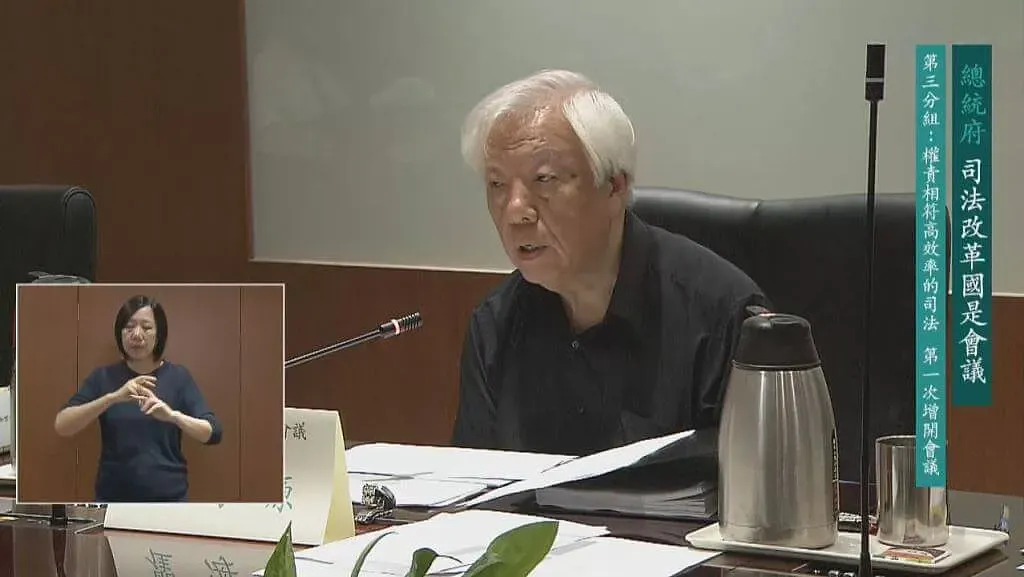
Brief Notes: First Additional Meeting of Group 3 of the Presidential Office's National White Paper on Judicial Reform
Last edited: 2026-08-29
- T
This meeting primarily discussed the issue of "reviewing supervisory mechanisms for prosecutors' indictments, suspensions of prosecution, and non-prosecution dispositions." According to the chairperson, issues from this point onward are matters that, in principle, should be handled independently by the judicial and administrative agencies. If time permits, committee members were still encouraged to discuss and offer their input. This development echoes the fierce debate during the first meeting regarding whether various issues should fall under "independent handling by judicial and administrative agencies." The course of the meetings proves that classification indeed affects the depth of discussion.
Compared to previous sessions, the atmosphere of this meeting was notably calmer. Although committee members held differing opinions on sub-issues, there were no intensely heated disputes. Members shared a consensus on strengthening the supervision of prosecutors' concluding dispositions, and their divergences can be summarized as follows:
Whether to maintain internal supervisory mechanisms (including applications for re-investigation and committal to trial)
Committee member Lin Meng-huang proposed abolishing re-investigations and committals to trial, replacing them with a citizen-composed Prosecutors Review Board and the courts to supervise non-prosecution or suspension-of-prosecution dispositions—fundamentally subverting the current system. Lin's proposal raised doubts: the professional competence of the Prosecutors Review Board's composition is insufficient, and even with the introduction of legal professionals for assistance, it would be inadequate to handle excessively large case volumes. Meanwhile, court intervention in reviewing the appropriateness of non-prosecution dispositions could blur the court's role, effectively making courts endorse prosecutors' non-prosecution or suspension-of-prosecution dispositions in disguise. Lin Meng-huang's proposal was not passed; remarks by non-legal committee members such as Liao Ying-tsang indicated that concerns regarding the professional competence of the Prosecutors Review Board are highly persuasive to non-legal members.
Whether the scope of review by the Prosecutor Review Committee should include non-prosecution cases involving professional negligence or misconduct
Committee member Li Chia-wen proposed that accountability mechanisms should be established for prosecutorial investigative negligence, regardless of whether they occur in indicted or non-prosecution cases, responding to opposing members by noting that applications for re-investigation and committal to trial fail to serve their purpose in cases where non-prosecution decisions are ultimately made due to investigative slackness. However, Li's proposal was not passed.
Whether to grant investigative powers to the Prosecutors Review Board
Opposing members argued that granting investigative powers to the Prosecutors Review Board might blur its positioning and mission, causing it to transcend the supervisory mechanism for non-prosecution dispositions and transform into an investigative agency. The opposing view gained support during the vote.
This meeting rather hurriedly discussed issues such as the "attorney disciplinary or evaluation system and competent authorities (3-3-1), assessing the establishment of an attorney professional liability insurance system (3-3-3), strengthening attorney pro bono requirements and professional ethics (3-3-3), and evaluating the adoption of a government attorney system (3-3-5)," but did not finish discussing them. Committee member Lai Kung-li raised a reminder: these issues simultaneously affect bar associations in central and southern Taiwan, yet the voices and information providers at the scene were all from the Taipei Bar Association.
During the voting at this meeting, a dispute arose regarding the calculation of voting thresholds: since committee members Chen Chung-yen and Lin Yu-hsiung had already stated through the media that they were withdrawing from the session, should these two individuals be deducted when calculating the absolute majority? Following discussion, the chairperson will bring this back to the Preparatory Committee to discuss whether to deduct them, and whether this affects the voting results of motions following the members' withdrawal.
This article is an AI-generated translation of the original Chinese text. In the event of any discrepancy, the Chinese version shall prevail.