
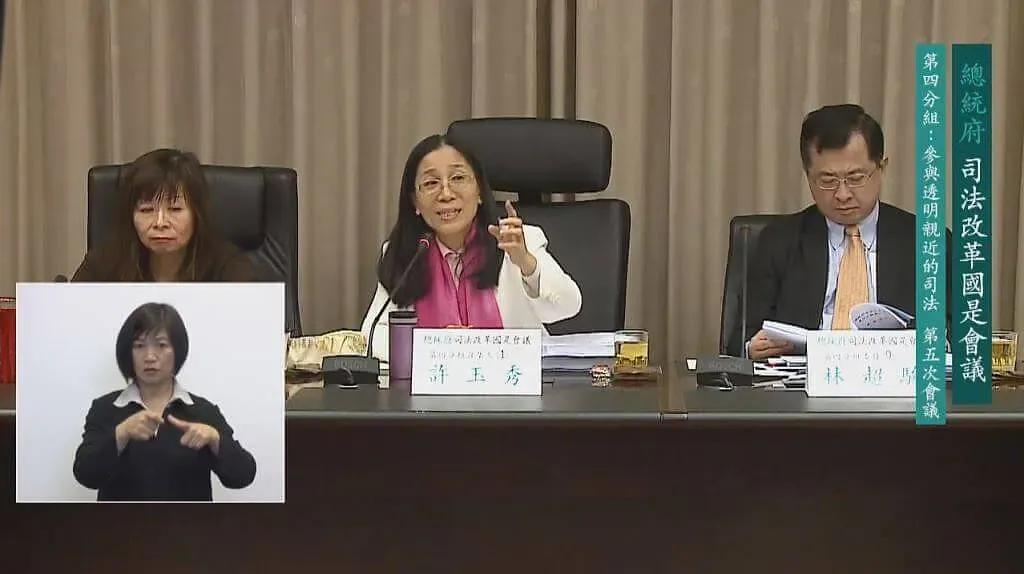
Brief Note: The 5th Meeting of the 4th Division of the Presidential Office's National Judicial Reform Conference
Last edited: 2026-08-29
Division 4 of the National Conference on Judicial Reform held its 5th meeting on April 28. After four and a half hours, the meeting reached resolutions regarding issue 4-3, "An Open and Transparent Judiciary."
Meeting Resolutions
Once our country's criminal procedure adopts the principle of a single indictment (the dossier-only system), the indictment shall be published online immediately after the announcement or publication of the indictment. Before the adoption of the principle of a single indictment, the indictment shall be published online after the first-instance judgment is rendered. However, if requested by the defendant, or if the prosecutor has already provided the facts of the indictment for media reporting, or if the media has proactively reported on it, it shall be published online immediately. (Passed with 11 votes)
It is recommended that the Judicial Yuan and the Ministry of Justice research and deliberate on whether to allow third parties to apply for video recordings, audio recordings, or case files and dossiers, as well as the relevant legal systems, after the conclusion of investigation and trial procedures. (Passed with 16 votes)
The lawyer information query system established by the Ministry of Justice shall be made public. Among this information, disciplinary records of attorneys—except for disciplinary sanctions of suspension from practice and disbarment, which shall remain public until the death of the disciplined person—shall not be made public after five years from the execution of the sanction. (Passed with 17 votes)
It is recommended that the Judicial Yuan and the Ministry of Justice set "rebuilding the relationship between the judicial system and the people" as their goal, formulate a five-year digital and open policy plan, and allocate relevant budgets and human resources. The plan must be reviewed every five years. Specific recommendations for formulating the plan are as follows:
Following the model of the Directions for the Establishment of the Government Data Openness Advisory Group, establish a dedicated digital task force and working group. Regularly publicize relevant meetings and policy information.
Adopt the "Public Policy Online Participation Platform" (JOIN) or similar mechanisms from the Executive Yuan's National Development Council "Open Government" policy to improve communication and dialogue with the public.
Understand the public's needs (via Google Analytics) and redesign agency websites and the writing and editing of their content.
Comprehensively enhance the information infrastructure and data processing capabilities of both the courts and the ministry from three dimensions: data governance, data-driven approaches, and data literacy.
Enhance the practicality of government information reuse (such as the value-added analysis and application of judgments) through quality control. Combine civilian creativity to make up for government shortcomings, maximizing the value of government information (and data). (Passed with 13 votes)
Discussion Summary
4-3-3 Full Disclosure of Indictments, Inclusion of the Prosecuting Prosecutor's Name in Criminal Judgments
Resolution: Once our country's criminal procedure adopts the principle of a single indictment, the indictment shall be published online immediately after the announcement or publication of the indictment. Before the adoption of the principle of a single indictment, the indictment shall be published online after the first-instance judgment is rendered. However, if requested by the defendant, or if the prosecutor has already provided the facts of the indictment for media reporting, or if the media has proactively reported on it, it shall be published online immediately.
Chaired by Chairperson Hsu Yu-hsiu, the meeting lasted for about 100 minutes of discussion. This topic was a continuation of the discussion from the 2nd meeting on March 10. The resolution process was extremely enthusiastic, with almost every committee member speaking. This reflects the debate over whether the public examining indictments for accuracy might clash with the public using indictments to mock defendants. Members more in favor of publishing indictments before the first instance argued that public scrutiny of an indictment's accuracy helps prevent wrongful or improper prosecutions, and provides more accurate information to eliminate the possibility of the public mocking the defendant. Members more in favor of publishing indictments only after the first-instance judgment were deeply concerned that the public would use indictments to mock defendants, doubted whether media reports on indictment contents would be appropriate, and worried about the issue of trial by media. Ultimately, considering that indictments for minor cases may not need to be made public, all members conditionally allowed the publication of indictments in cases where the media proactively reports or the defendant actively requests it.
Ministry of Justice
If indictments are made public for all citizens to search and obtain online immediately upon the conclusion of an investigation, media reports may foster public trials by public opinion, creating the negative effect of prejudgment. It also infringes upon the defendant's right guaranteed by the presumption of innocence. Since Article 83 of the Court Organization Act only stipulates the publication of judgments and not indictments, any publication of indictments should be explicitly provided for by law.
Member Chen Chin-hsien
If prosecutors are unwilling to subject defendants to unfair trials, why do they place indictments in the public relations office to give reporters the opportunity to see them or report on their contents in the media? Providing information to reporters while withholding it from the public also easily creates an information gap.
Member Chiang Yuan-ching
Only when information is fully disclosed will reporters avoid erroneous reporting. The prosecutor's indictment must be made public to reveal whether the prosecutor made any mistakes, because a prosecutor's indictment is not necessarily entirely sound. Very few reporters have a legal background. The truth is known only to the parties involved; judges and prosecutors are third parties. Both the defendant and the public should know why the defendant is being prosecuted.
Member Chen Yao-hua
If the general public can understand the discrepancy between the indictment and the judgment, they will not hold incorrect views about the defendant. The Ministry of Justice should enable the public to distinguish the difference between an indictment and a judgment!
Member Chen Shu-lan
The current situation is that indictments are published only for major cases and kept confidential for non-major cases, which seems somewhat strange. Only when information is completely transparent can everyone be encouraged to examine the accuracy of a prosecution. I am more in favor of publishing the indictment at the time of prosecution.
Member Yen Chueh-an
This is a choice between the fairness of a trial and the personal rights of the parties. Publishing the indictment slightly earlier allows everyone to inspect it. While earlier publication increases the risk of misunderstanding, it also strengthens the defendant's right to defense.
Member Ping Lu
The publication of an indictment is a double-edged sword. Taking the Hsu Tzu-chiang case as an example, if the indictment had been public at the time, would the prosecutor have dared to write in the reasoning section of the indictment that it was based on a co-defendant's confession? Would the prosecutor still have had such confidence to put that in the indictment? Making the indictment public actually protects the defendant, because prosecutors will write their grounds for judgment more cautiously. If an acquittal is handed down, looking back at the indictment becomes even more meaningful: why did this logic and legal application exist? It further enhances and trusts the public's discernment and cognition. A decision on publication cannot be made solely based on whether it conforms to the privacy of the defendant or the victim.
Chairperson Hsu Yu-hsiu
In cases like the Hsu Tzu-chiang case and the Su Chien-ho case, because the indictments were not made public, no one could discuss them, and when the media reported on them, I had no idea whether they had been wronged. In the Hsu Tzu-chiang case, I only learned about it after I became a Grand Justice. Had it been made public back then, it would have allowed everyone to discuss it, rather than just relying on whether the co-defendant's confession at the time was legally obtained to determine whether it should be made public. Regarding the discussions of the National Conference on Judicial Reform, there are no winners or losers, nor whose motions passed or failed; we only make the resolutions that are best for all citizens nationwide.
Member Chen Hsien-yu
Indictments mostly record matters disadvantageous to the defendant; therefore, making them public too early may prejudice the defendant.
Member Wu Kuang-lu
An indictment may also have a very detrimental impact on the defendant. A simple summary for reporters should suffice. Some defendants may strongly prefer that their prosecution not attract media attention, especially high-profile cases or celebrity property disputes, which draw media reports but have a huge impact on the parties involved. The parties' right to be forgotten must be considered.
Member Hsieh Ming-chu
Japan has experienced many miscarriages of justice stemming from reporters' misreporting of indictments. Publishing indictments prior to the first instance may indeed adversely affect the defendant. However, since the investigation has concluded and the prosecutor has already decided whether to prosecute, the indictment should be made public prior to the first instance so that everyone can examine it.
Member Tsai Yuan-shih
Case facts may constantly change during the trial phase. It is common for a defendant not to raise an alibi during the investigation, but to raise it during the trial. Therefore, publishing the indictment before the judgment does not necessarily provide accurate information, and it deals a heavy blow to the safeguarding of the defendant's right to the presumption of innocence. Publishing the indictment after the first-instance judgment is less controversial and makes it easier to compare the discrepancies between the indictment and the judgment.
Member Kao Ju-ping
For the general public, it is agonizing to decide whether the right to know is more important or the protection of the presumption of innocence. I believe that announcing judgments only when they are rendered is also less controversial.
Member Lin Chao-chun
The earlier an indictment is announced, the more disadvantageous it is to the defendant. An indictment does not record facts advantageous to the defendant, making it prone to bias against the defendant. Regarding the quality of indictments, judges must also remember to use dismissals as a check.
Member Lai Yueh-mi
When reforming, we look forward to solving a problem rather than creating one. Waiting until after the first instance to publish prevents the media from distorting reports and avoids the problem of social trial by public opinion.
Member Ho Cheng-cheng
Waiting until after the first instance to publish prevents the media from distorting reports. If I were a defendant, I would hope to avoid external sensationalism, interference, social trial by public opinion, or media interference.
4-3-1 Research and Adoption of Court Hearing Livestreaming
Resolution: It is recommended that the Judicial Yuan and the Ministry of Justice research and deliberate on whether to allow third parties to apply for video recordings, audio recordings, or case files and dossiers, as well as the relevant legal systems, after the conclusion of investigation and trial procedures.
Chaired by Chairperson Hsu Yu-hsiu, this topic was discussed for only 30 minutes. Due to insufficient discussion time, only 2 members expressed their opinions on this topic; therefore, the members merely resolved to recommend that the Judicial Yuan and the Ministry of Justice study the matter.
Judicial Yuan
Written Opinion
Furthermore, Article 90-1 of the Court Organization Act does not permit third parties unrelated to the case to obtain audio and video recordings of court proceedings. From a legal policy analysis, if the contents of court audio and video recordings are opened for third parties to obtain and utilize, aside from real-time broadcasting features, it is virtually indistinguishable from online livestreaming. This may trigger sequelae such as increasing the difficulty of fact-finding, causing nationwide trials by public opinion, making it difficult to assert the right to be forgotten, and the gossipy or tabloidization of court proceedings. Once third parties acquire audio and video recordings, they are even harder to control, allowing statements by litigants, witness testimonies, or the conditions of other persons present in court to circulate without restriction, and potentially even being deliberately edited and broadcast. This may cause some witnesses to avoid testifying, individuals whose rights have been infringed to become unwilling to seek remedies through statutory litigation procedures, and easily create prejudice effects that impede the administration of justice, misleading the public into thinking they are seeing the truth while taking things out of context, and impairing other co-defendants' right to a fair trial.
Ministry of Justice
Written Opinion
Most individual cases tried in court involve infringements upon personal legal interests between two parties, such as injury, adultery, and theft cases. The majority of cases do not rise to the level of concerning the general public interest, unlike the proceedings broadcasts of the Legislative Yuan. If cases involving personal legal interests allow unrelated third parties to obtain video and audio recordings, there is a fear of malicious use (e.g., for entertainment purposes, or uploaded online for unspecified persons to click and listen). The balancing of legal interests is clearly inappropriate.
Prosecutorial Reform Association
Prosecutor Pai Chung-chih
According to Articles 18(1)(2) and 18(1)(6) of the current Freedom of Government Information Law, government information shall be restricted from disclosure or provision if it "is likely to obstruct the investigation, prosecution, or execution of crimes, or sufficient to prejudice the criminal defendant's right to a fair trial, or endanger the life, body, liberty, or property of others," or "infringes upon personal privacy, occupational secrets, or the right of publication of a copyright holder. However, this shall not apply where necessary for the public interest, necessary to protect the life, body, or health of the people, or consented to by the parties." Therefore, if third parties apply to obtain video and audio recordings, it would likely fail to comply with the provisions of Article 18 of the Freedom of Government Information Law.
Member Lin Chang-ching
It is hoped that court video recordings, audio recordings, and dossiers can be appropriately disclosed for academic research. When scholars conduct research, academic ethics require de-identification and anonymization, so there should be no issue of personal data misuse.
Member Lin Chao-chun
Most countries make a distinction regarding audiotapes and videotapes. Applicants must submit a written motion and pay a fee. The United States is generally open; the United Kingdom is generally closed.
4-3-4 Disclosure of Information in the Attorney Market to Enhance Attorney Service Quality
Resolution: The lawyer information query system established by the Ministry of Justice shall be made public. Among this information, disciplinary records of attorneys—except for disciplinary sanctions of suspension from practice and disbarment, which shall remain public until the death of the disciplined person—shall not be made public after five years from the execution of the sanction.
Chaired by Chairperson Hsu Yu-hsiu, this topic was discussed for about 20 minutes. This topic continued the discussion from the 2nd meeting on March 10. The previous meeting discussed how information in the attorney market should be made public; this meeting did not discuss how to make it public, as members seemed to agree to let the Ministry of Justice formulate its own appropriate publication methods. This meeting only discussed whether attorney disciplinary records should cease to be made public after five years.
Taiwan Bar Association
Written Opinion
3. In addition to the Attorney Regulation Act, the practice of law must comply with the Code of Ethics for Attorneys. Regarding advertising and business promotion methods, our Association has further enacted the "Directions for Attorney Business Promotion." Article 4 of these directions explicitly stipulates that when promoting business, attorneys shall not engage in "risk of misleading or misrecognition," "exaggeration or causing excessive expectations," "expressly or impliedly claiming a special relationship with public agencies," etc.; Article 5 stipulates that they shall not publicly state "the winning rate of litigation," "consulting targets or clients," "cases currently under commission," "cases previously handled or participated in," "the name of concurrently held public office and title," etc. Therefore, data collection and disclosure by services like "Lü-Lü-Web" on the market, or disclosing information such as attorneys' clients, handled cases, or temporary concurrent public offices, is open to discussion.
Ministry of Justice
According to Article 99 of the draft amendment to the Attorney Regulation Act formulated by our Ministry, aside from the aforementioned four types of sanctions, attorney disciplinary sanctions now additionally include "ordering self-funded attendance of an additional 6 to 12 hours of attorney ethics seminars within a specified period" and "ordering payment of a fine ranging from NT$60,000 to NT$1,200,000 to the national treasury into the state treasury within a specified period." If Member Wu's proposal above is followed, then barring "suspension from practice," if any other new disciplinary sanctions are added in the future, they would also have to be made permanently public. Whether this is appropriate is questionable.
Member Wu Kuang-lu
The Ministry of Justice's opinion is not adoptable, because the Legislative Yuan will consider how the Attorney Regulation Act should ultimately be amended. The National Conference on Judicial Reform can make a preliminary resolution. Most importantly, disciplinary sanctions of suspension from practice and disbarment should remain public until the death of the disciplined person.
4-2-1 Public Participation in the Judiciary: Non-Prosecution, and the Lay Participation and Jury Systems for Trials
Chaired by Chairperson Hsu Yu-hsiu, this topic was discussed for about 60 minutes. This topic was not substantively discussed yet, but only heard reports. The focus of the discussion seemed to be whether, if a lay participation system is adopted, the public would be improperly influenced by judges. Regarding this point, the Judges Association, the Judicial Yuan, and the Ministry of Justice believe not, but the Legal Aid Foundation and Professor Huang Tung-hsiung believe it is possible. Regarding this debate, we will likely have to wait until the next discussion to see the committee members' thoughts.
Judges Association
Judge Chang Yung-hung
Japan's Saibanin system (3 judges + 6 Saibanin) and France's first-instance Assize Court (3 judges + 6 lay assessors) are appropriate compositional ratios under which our country should adopt a lay participation system. If a jury system is to be implemented, it should be the most orthodox one: 12 members, unanimous verdict, and trial standards should not be lowered. The United States deduced in the 1930 case of Patton v. United States (281 U.S. 276 (1930)) that defendants could waive jury trials, but mostly for cost considerations. If our country allows defendants to waive jury trials, it is tantamount to letting defendants choose their own procedures, which is disadvantageous to trial fairness. A jury system would replace judges with ordinary citizens for adjudication, requiring the utmost caution. Although the lay participation system suffers from the problem of authority bias—meaning lay assessors are easily swayed by professional judges—to avoid authority bias, aside from setting indicative rules or using it as a ground for post-trial relief (appeal, retrial, extraordinary appeal), more importantly, we must approach it from the perspectives of education and training and deliberation rules. Good education and training and deliberation rules also have the same efficacy in avoiding other cognitive errors. In addition, because professional judges still participate in deliberations under the lay participation system, current substantive criminal law and criminal procedural law provisions can theoretically continue to be maintained, with relatively fewer scopes and degrees of legal amendment.
Prosecutorial Reform Association
Prosecutor Pai Chung-chih
Our Association has no specific stance. However, the following 6 points must be considered during discussions: 1. Consider J.Y. Interpretation No. 392: "judges" defined in the latter paragraph of Article 8, Paragraph 1 of the Constitution do not include laypeople, raising constitutional doubts about lay participation in trials; 2. Account for national finances; 3. Strengthen the chapters on crimes against the administration of justice, attorney functions, and plea bargaining; 4. The public should have the right to decide whether they wish to be tried in a court with lay judges; 5. Judgments must be accompanied by reasons to avoid arbitrariness; 6. Procedural differences between lay participation and non-lay participation should not be overly drastic.
Judicial Yuan
Written Opinion
Adopting a lay participation system of "joint deliberation and adjudication" between the public and judges allows both sides to communicate and converse, shortening the gap between professional judges' thoughts and the general public; at the same time, it ensures professional trial quality and prevents unreasonable judgment outcomes in individual cases; it also reduces the burden on the public, as when participating citizens have doubts, judges can provide assistance at any time based on professional legal knowledge and experience, preventing laypersons from feeling at a loss or not knowing how to make judgments; furthermore, allowing the public to fully participate in the "determination of criminal liability" and "sentencing procedures" can fully incorporate the public's sense of legal justice, helping to enhance public trust in the judiciary. Moreover, it merely expands the scale of current trial panels by adding ordinary citizens, with judges not exiting the role of fact-finding; it differs little from the current system, bearing lower reform costs and risks. According to the regulations of Japan's Saibanin system, judges must ensure during deliberations that Saibanins can fully express their opinions, and deliberation rules also mandate that laypeople state their opinions first. In practical operation, judges also take care to ensure that their own views do not influence the Saibanins' mental impressions.
Ministry of Justice
Written Opinion
Compared to the Anglo-American jury system, our Ministry suggests that when initially introducing a public participation in trials system—considering our country's actual conditions and social and cultural aspects—we should first reference and adopt the continental European or Japanese lay participation system, which may have a higher probability of success. During the trial process and deliberations, professional judges and lay participants (the official name is still subject to future legal confirmation) should participate jointly rather than separately. Only in this way will there be an opportunity for professional judges to engage in dialogue and exchange with people from various backgrounds across society, bringing different observational perspectives through varied experiential backgrounds, and preventing professional judges from falling into established "legal professional stereotypes." Aside from hearing other citizens' thoughts, participating citizens can also listen to the judges' viewpoints, so that the final judgment outcome can better encompass the diverse values of both professional and non-professional opinions. This should also be one of the objectives of discussing the introduction of a public participation in trials system.
Legal Aid Foundation
CEO Chen Wei-hsiang
I recently visited Japan to observe their lay participation system. Under Japan's lay participation system, 90% come from publicly appointed defense counsel, with remuneration of 240,000 Japanese yen—three times the fee of hiring a regular lawyer—and requiring two defense counsel to appear in court together. Japanese national character is relatively disinclined to judge others' affairs, so mutual communication and persuasion among Saibanins rarely occur. Furthermore, the likelihood of Japan's Saibanin system decisions being overturned by higher courts is gradually increasing, causing nearly 60% of the public to refuse to serve as Saibanins today. In summary, it feels like the Japanese public does not harbor negative feelings toward the lay participation system, but neither do they particularly like it. Placed within Taiwan's context, the lay participation system requires a systemic context of deep trust in judges. Since we do not trust judges yet want a lay participation system, it feels rather strange. Our Foundation has not yet finalized which system Taiwan should adopt regarding public participation in trials. Lawyers from our Foundation who have participated in trial runs of the jury system and lay participation system feel that under the jury system, the defense target is only the public, making defense easier; under the lay participation system, the defense targets are both the public and the judges, which disperses the focus of the defense and makes it unclear who one is actually supposed to persuade.
Professor Huang Tung-hsiung
Public participation in trials is a global trend. The lay participation system has flaws, namely the authority effect. Even if the judge's opinion is put last, the public will still be drawn in. Many countries changed from a jury system to a lay participation system because they wanted to control trials, reflecting an authoritarian mindset. This is the same as how democratic countries can transform into authoritarian countries.
4-3-2 Research and Adoption of Judicial Sunshine and Transparency
Resolution: It is recommended that the Judicial Yuan and the Ministry of Justice set "rebuilding the relationship between the judicial system and the people" as their goal, formulate a five-year digital and open policy plan, and allocate relevant budgets and human resources. The plan must be reviewed every five years. Specific recommendations for formulating the plan are as follows:
Judicial Yuan
Regarding the proportion of cases filed by government agencies for actions to revoke arbitral awards, there are currently no data available.
Ministry of Justice
From 2000 to April 2017, data from the Taipei District Court concerning actions to revoke arbitral awards show that government agencies filed 25 cases, winning 6 of them. Regarding the reasons why government agencies file actions to revoke arbitral awards, most mistakenly believe that filing such an action has the same effect as an appeal. However, the application threshold for an action to revoke arbitral awards is actually higher than that of an appeal.
Member Li Nien-tsu
Judging by the Ministry of Justice's data, there is indeed a phenomenon where government agencies do not respect arbitration results.
Chaired by Chairperson Hsu Yu-hsiu, this topic was discussed for about 60 minutes. This topic was not substantively discussed yet, but only heard reports. The focus of the discussion seemed to be whether, if a lay participation system is adopted, the public would be improperly influenced by judges. Regarding this point, the Judges Association, the Judicial Yuan, and the Ministry of Justice believe not, but the Legal Aid Foundation and Professor Huang Tung-hsiung believe it is possible. Regarding this debate, we will likely have to wait until the next discussion to see the committee members' thoughts.
Following the model of the Directions for the Establishment of the Government Data Openness Advisory Group, establish a dedicated digital task force and working group. Regularly publicize relevant meetings and policy information.
Adopt the "Public Policy Online Participation Platform" (JOIN) or similar mechanisms from the Executive Yuan's National Development Council "Open Government" policy to improve communication and dialogue with the public.
Understand the public's needs (via Google Analytics) and redesign agency websites and the writing and editing of their content.
Comprehensively enhance the information infrastructure and data processing capabilities of both the courts and the ministry from three dimensions: data governance, data-driven approaches, and data literacy.
Enhance the practicality of government information reuse (such as the value-added analysis and application of judgments) through quality control. Combine civilian creativity to make up for government shortcomings, maximizing the value of government information (and data).
Chaired by Chairperson Hsu Yu-hsiu, this topic was discussed for only about 20 minutes. Chairperson Hsu Yu-hsiu and Member Chang Wei-chih merely confirmed with the Judicial Yuan and the Ministry of Justice whether they had any opinions on the proposals, while other members expressed no dissenting views. Regarding "the public's demand for judicial information" discussed in the 2nd meeting, members of this division seemed to reach no consensus, and thus it was only summarized in the third paragraph of the resolution as "Understand the public's needs (via Google Analytics) and redesign agency websites and the writing and editing of their content." Meanwhile, the Judicial Yuan only worried whether Paragraph 5 of the resolution—"Enhance the practicality of government information reuse (such as the value-added analysis and application of judgments) through quality control. Combine civilian creativity to make up for government shortcomings."—would pose a problem of profiteering certain businesses. However, Chairperson Hsu Yu-hsiu reminded that from the perspective of the government existing to promote the welfare of the people, the Judicial Yuan was worrying excessively.
Agenda for the Next Meeting
The next meeting is scheduled for May 12 to discuss issues such as public participation in trials, whether the Supreme Court and the Supreme Administrative Court should hold oral argument hearings in principle, and court livestreaming. Discussions next week will be extended. Regarding the principle of a single indictment and the role of prosecutors, whether they constitute new issues not permissible for discussion, the Chairperson neither acknowledged nor denied the possibility of discussing them.
This article is an AI-generated translation of the original Chinese text. In the event of any discrepancy, the Chinese version shall prevail.