
Op-Ed | Reforming the Taiwan National Bar Association: The First Step to Strengthen Attorney Ethics
Last edited: 2026-08-29
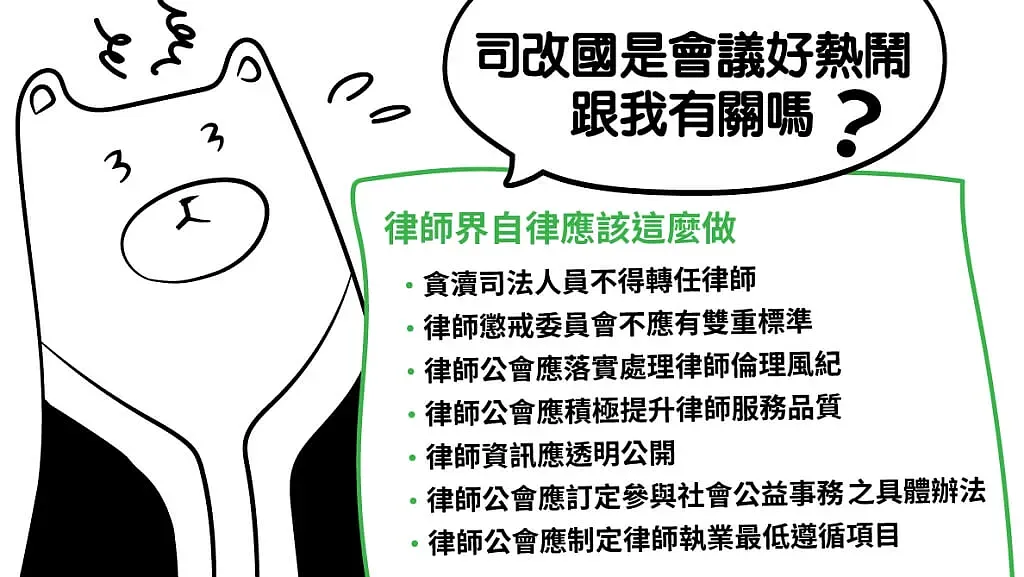
During the National Conference on Judicial Reform, the Third Working Group adopted two resolutions concerning attorney discipline and ethics. First, the Attorney Regulation Act should explicitly mandate that any attorney joining a local bar association automatically becomes a member of the Taiwan Bar Association. Second, the Taiwan Bar Association should establish an Attorney Ethics and Discipline Committee independent of its board of directors and supervisors, tasked with handling complaints regarding attorney misconduct. This committee must include a certain proportion of lay members to establish a credible, independent investigative mechanism that balances self-governance, self-regulation, and external oversight, thereby fulfilling the disciplinary function for attorneys. For the following reasons, if properly implemented, these two resolutions will effectively strengthen the enforcement of attorney ethics.
The Realization of Attorney Ethics Relies on a Sound Bar Association Structure
To fulfill their mission of safeguarding human rights, realizing social justice, and promoting democratic rule of law—whether by protecting clients' rights in individual cases or participating in public affairs in the public sphere—attorneys are inevitably required to monitor the lawful and proper exercise of public power, and may even find themselves in an adversarial relationship with the government. Therefore, the management of attorneys should not, in principle, be delegated to the government; otherwise, attorneys would be unable to function as judicial officers outside the state apparatus in protecting human rights and upholding democratic rule of law.
According to Article 24 of the United Nations Basic Principles on the Role of Lawyers: "Lawyers shall be entitled to form and join self-governing professional associations to represent their interests, promote their continuing education and training and protect their professional integrity. The executive body of the professional associations shall be elected by its members and shall exercise its functions without external interference." Attorneys should form independent professional organizations, practice self-governance through internal democratic procedures, represent the collective interests of the legal profession externally, and execute self-regulatory matters internally—such as enforcing professional ethical standards and disciplinary measures—thereby encouraging members to pursue continuing professional development.
The aforementioned professional organizations of attorneys that exercise self-governance refer to bar associations in most countries, including Taiwan. To enforce self-regulation, bar associations in many jurisdictions, such as the United States, Japan, and France, possess the disciplinary power to impose sanctions up to disbarment on their members. The bar associations of Germany and Taiwan, on the other hand, only possess the authority to initiate disciplinary proceedings. In Germany, the bar association applies to the prosecutor's office to initiate disciplinary proceedings before the attorney court, whereas in Taiwan, the bar association refers attorneys subject to discipline to the Attorney Disciplinary Committee established at the High Court. Regardless of which of these two disciplinary models is adopted, both are predicated upon the bar association's organizational capacity to effectively enforce professional ethical standards for attorneys.
The fact that attorney discipline and the strengthening of attorney ethics have become issues at the National Conference on Judicial Reform not only demonstrates public dissatisfaction with the effectiveness of bar associations in enforcing professional ethics, but also reveals that the organizational structure of bar associations is unable to effectively enforce ethical standards.
One of the Flaws of Weak Attorney Ethics: Inconsistent Enforcement Standards
Public dissatisfaction primarily stems from the suspicion that bar associations are constrained by internal personal relationships and protect their own members. From the experience of the United States, this is a universal problem. Facing widespread public criticism of the attorney disciplinary system, the American Bar Association formed a commission to evaluate disciplinary enforcement and conduct a review. The commission's 1992 report pointed out that when disciplinary procedures are administered by personnel elected or appointed from within the bar association, it results in disciplinary processes being influenced by internal association politics, conflicts of interest, or other improper appearances, rendering the attorney disciplinary system untrustworthy.
Under the current Attorney Regulation Act, local bar associations in Taiwan currently refer members to disciplinary proceedings through resolutions passed by joint meetings of their boards of directors and supervisors, which creates the same structural problem. In particular, the smaller the membership of a bar association and the more familiar members are with one another, the more susceptible the directors and supervisors are to personal ties. Furthermore, because attorneys under the current Attorney Regulation Act can only join local bar associations, only local bar associations possess the authority to refer attorneys to disciplinary proceedings. Theoretically, the national bar association representing the legal profession in dialogue with the government—namely, the Taiwan Bar Association (hereinafter referred to as the "National Bar Association")—is authorized by the Attorney Regulation Act to formulate professional ethical standards for attorneys, but because it is composed of local bar associations rather than individual attorneys as members, it lacks the authority to initiate disciplinary proceedings in individual cases.
Currently, there are 16 local bar associations across the country. Operating independently without uniformity, the result is inconsistent referral standards. In addition to creating unfairness, this further deepens the public perception that attorneys protect their own (once the public discovers that identical conduct results in disciplinary referral in some bar associations while going unpunished in others, they become even more skeptical that the associations dismissing the matter are shielding their own members).
Two of the Flaws of Weak Attorney Ethics: Ineffective Efficiency
Another source of public dissatisfaction is the inefficient handling of ethical cases by local bar associations. Because the directors and supervisors of bar associations serve on a part-time basis and operate under a collegial decision-making system, there are inherent limits to the time and frequency of their meetings (taking the Taipei Bar Association as an example, it holds only one routine joint meeting of directors and supervisors and one routine meeting of executive directors per month). Moreover, to ensure the normal operations of the association, priority must be given to discussing and handling general association affairs, leaving relatively little time to devote to professional conduct and ethics cases, which inevitably drags down the efficiency of handling ethics and discipline cases.
According to the written report submitted by the Taipei Bar Association to the Third Working Group of the National Conference on Judicial Reform, among the referral entities for the 175 resolutions rendered by the Attorney Disciplinary Committee from 2007 to March 2017, the Taipei Bar Association accounted for the most, but only 44 cases. It was followed by the Taipei District Prosecutors Office with 22 cases, the Taichung District Prosecutors Office with 19 cases, the Legal Aid Foundation with 17 cases, the Taichung Bar Association with 15 cases, and the Taoyuan Bar Association with 10 cases. The issue of inefficiency can likely be discerned from these referral numbers.
Three of the Flaws of Weak Attorney Ethics: Failure to Effectively Assist Complained-Against Attorneys in Improving
Aside from mutual protection, inconsistent referral standards, and inefficiency, another problem with the current attorney disciplinary system is that it offers little assistance in helping complained-against attorneys improve. Currently, for minor violations of attorney ethics, local bar associations may issue admonitions or warnings. For severe violations of ethical standards that even reach the level of violating the Attorney Regulation Act, upon referral for discipline, the Attorney Disciplinary Committee may impose sanctions ranging from light to heavy, including cautions, reprimands, suspension from practice for up to two years, and disbarment. However, based on the author's experience as a director of the Taipei Bar Association handling attorney ethics and discipline cases, the proportion of complaints filed by the public out of dissatisfaction with the quality of legal services is actually much higher than cases involving violations of professional ethical standards.
Poor legal service quality generally does not constitute a violation of the Attorney Regulation Act or professional ethical standards. Subpar service quality may stem from insufficient professional competence, a lack of communication skills, an inability to effectively manage a law firm, or even poor physical and mental conditions. When facing complaints due to poor service quality, a bar association should not simply close the case after determining that no ethical violation occurred or that the violation was minor; rather, it should substantively assist attorneys in improving their service quality through measures such as mandating attendance at specific continuing education courses, psychological counseling, anger management courses, or interpersonal relationship courses.
The Solution: Reform the National Bar Association and Establish a Credible Ethics and Discipline Committee
To resolve problems such as mutual protection, inconsistent referral standards, inefficiency, and limited effectiveness in improving attorney conduct—which currently stem from the bar association's organizational failure to effectively handle attorney ethics and discipline cases—we must naturally start with the organizational reform of bar associations. First, we should reform the organization of the National Bar Association by referencing the model of the Japan Federation of Bar Associations (hereinafter referred to as the "JFBA").
The JFBA is composed of 52 local bar associations and all practicing attorneys nationwide. Attorneys automatically become members of the JFBA upon joining a local bar association. Consequently, both the JFBA and the local bar association to which an attorney belongs have the authority to discipline attorneys. Furthermore, the JFBA may review disciplinary decisions made by local bar associations in response to appeals from complainants or disciplined attorneys, which can standardize enforcement practices across regions to a considerable extent. Taiwan's territory is far smaller than Japan's, and it operates under a single legal jurisdiction; therefore, there is truly no justification for allowing the enforcement of attorney ethics to vary by region. Consequently, the National Bar Association should be restructured to comprise all practicing attorneys and local bar associations nationwide as members, thereby gaining the authority to handle attorney ethics and discipline cases. In addition to unifying enforcement standards across regions, another advantage is that—unlike local bar associations which struggle to frequently hold continuing education due to remote locations making it difficult to find instructors, or smaller memberships making it hard to achieve economies of scale in teaching—the National Bar Association can pool national resources to organize more diverse and frequent continuing education programs, thereby providing better assistance to attorneys complained against for poor case-handling quality.
Secondly, to break free from internal personal entanglements within bar associations and dispel accusations of mutual protection, and drawing on the spirit of the American Bar Association's Model Rules for Lawyer Disciplinary Enforcement—which establishes an independent specialized attorney disciplinary agency composed of both lawyers and citizens outside the bar association—the National Bar Association should establish an Attorney Ethics and Discipline Committee independent of its board of directors and supervisors, which, in addition to lawyers, includes a certain proportion of external members (whose backgrounds may include citizens, or representatives of judges and prosecutors modeled after the Judges Evaluation Committee) to accept complaints regarding attorney violations of ethics and discipline.
The two resolutions concerning the strengthening of attorney ethics adopted by the Third Working Group of the National Conference on Judicial Reform are formulated based on these very considerations. They strike at the core of the problem of weak attorney ethics, and will not only effectively strengthen attorney ethics but even comprehensively elevate the quality of legal practice. It is earnestly hoped that they will soon be incorporated into the Attorney Regulation Act to safeguard the public's right to legal assistance.
※ Originally published in ETtoday on June 1, 2017.
This article is an AI-generated translation of the original Chinese text. In the event of any discrepancy, the Chinese version shall prevail.