
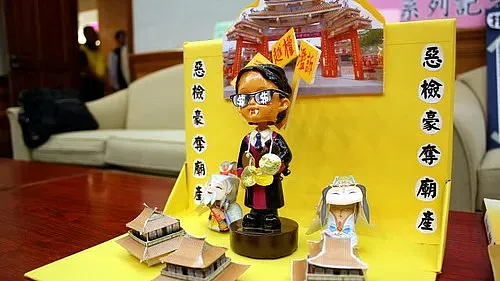
The Bewitched Nemesis of Judicial Officers
Last edited: 2026-08-29
On September 18, 2000, the Tainan District Prosecutors Office detained Judge Li Tung-ying for shielding illicit massage parlors; on April 28, 2004, the Taiwan High Prosecutors Office Tainan Branch detained Prosecutor Sung Tsung-i for shielding underground casinos; on June 30, 2006, the Tainan District Prosecutors Office requested a detention warrant for Judge Hsu Hung-chih, who was caught playing mahjong with a defendant; on March 8, 2007, the Tainan District Prosecutors Office detained Prosecutor Wang Chao-chen for taking bribes to issue illegal non-prosecution dispositions. While these crackdowns on judges and prosecutors protecting gambling and prostitution shocked society, this series of self-cleaning actions restored much of the public's trust in the judiciary.
Behind these gratifying cases stood a vanguard of law enforcement: Wu Wen-cheng, recipient of the Ministry of Justice's first award for "Outstanding Prosecutors." He dared to prosecute corrupt officials and, even more daringly, judicial officers involved in corruption and bribery, earning him the media's praise as the "Nemesis of Judicial Officers." Yet no one could have anticipated that starting in 2013, Wu Wen-cheng would face three consecutive individual prosecutor evaluations initiated by the Judicial Reform Foundation (JRF), ultimately leading to his ignominious retirement.
First Prosecutor Evaluation: The "Usurpation of Temple Property" Case
We first received a grievance against Prosecutor Wu Wen-cheng after concluding a press conference for the individual prosecutor evaluation of "Prosecutor Wu Wen-cheng of Hualien." A woman who saw the news report called to say she also wanted to file a grievance against "Wu Wen-cheng." We later learned that the person she was actually reporting was someone else entirely—Prosecutor Wu Wen-cheng, who had by then been transferred to the Pingtung District Prosecutors Office.
Wu Wen-cheng is a Hakka from Meinong. After graduating from college, he worked as a tax official at the Kaohsiung Customs for nearly ten years. Because he refused to accept bribes, he was bullied by his superiors, prompting him to study hard and pass the judicial officer examination at the age of 36—a success story celebrated throughout his hometown. After turning fifty, his service in Pingtung earned him even greater local respect.
However, the grievance materials we received were extremely unfavorable to Wu Wen-cheng, evidencing his improper intervention in the temple property dispute of the Chueh-shan Temple in Hsi-shih. Under the guise of convening an investigative hearing as a prosecutor, Wu Wen-cheng gathered the temple's administrative committee members at the Criminal Investigation Division of the Chaochou Precinct, acted as the meeting chair himself, and held an election for a new chairperson. Outrageously, he even used the interrogation transcript as the meeting minutes, recording the list of election winners. To support the newly elected chairperson, he even led a search on the home of the general affairs officer who kept the temple property, and on that very day "returned" the gold medallions, passbooks, certificates of deposit, and other assets obtained from the search to the newly elected chairperson for "safekeeping."
Prosecutors are charged with criminal cases and should not intervene in civil disputes. This was not zealous public service; it was an abuse of power! In particular, the fact that Prosecutor Wu Wen-cheng returned the seized items to a specific individual immediately after the search bore methods identical to those of "Chen Yu-chen, the most corrupt female prosecutor in history," which raised even greater suspicions! To investigate the truth, I traveled south to Hsi-shih Village, Chutien Township, Pingtung County. Upon seeing the sprawling grounds of the Chueh-shan Temple with my own eyes, I realized it was the largest Tiangong temple in Taiwan, and its forecourt served as the Hsi-shih Night Market. Beyond the immense value of its property, it is the center of faith for local Hakka people.
Originally, the devotees of Chueh-shan Temple were all locals, but in recent years a group of outsiders joined and elected a new administrative committee. To my surprise, the newly elected committee members attempted to contest the chairperson position right away, and those who refused to comply were tracked and intimidated by men in black. The original chairperson sought judicial assistance, never expecting to "invite a wolf into the house" and end up with a prosecutor escorting the election of a new chairperson. Looking at the video footage provided by local villagers—showing the new chairperson and men in black forcibly collecting night market rent—sent chills down my spine. To prevent the judiciary from degenerating into a tool for local factional struggle, the JRF submitted the first individual evaluation against Prosecutor Wu Wen-cheng. (See Resolution No. Chien-Ping-Tzu 102020)
Second Prosecutor Evaluation: The "Traffic Accident Forced Marriage" Case
We received another grievance against Prosecutor Wu Wen-cheng after a male college student in Neipu, Pingtung, collided with two female scooter riders and sustained injuries. During the investigative hearing, Prosecutor Wu attempted to persuade both parties to settle by saying: "Since you're both 23, why don't you just go get married? Otherwise, what are you going to do now?" When the complainant told me this, I was half-skeptical. To my surprise, when the Prosecutor Evaluation Committee pulled the recording disc of the investigative hearing, Prosecutor Wu had indeed said those exact words on the record. I thought to myself that riding a scooter in Pingtung must be truly dangerous; getting into an accidental traffic crash is one thing, but you might also be forced into marriage by a prosecutor.
Although this was only a minor case, a prosecutor's flippant attitude toward handling cases severely undermines public trust in the judiciary. Consequently, the JRF filed a second individual evaluation against Prosecutor Wu. (See Resolution No. Chien-Ping-Tzu 103014)
Third Prosecutor Evaluation: The "Ghost's Dream Depiction" Case
The third individual evaluation did not stem from a party's grievance; rather, judges of the Kaohsiung High Branch Court exceptionally determined that a prosecutor had conducted an illegal interrogation. The prosecutor had actually told a defendant during questioning: "If you aren't honest, his ghost will come back to settle scores with you... He appeared in a dream to tell me that he's going after anyone who isn't dishonest." Because the judges transcribed these remarks into the judgment, such absurd dialogue straight out of a Judge Pao TV drama appeared in 21st-century Taiwan, becoming a laughingstock in the legal community. Although the judges did not publish the prosecutor's name in the judgment, a helpful insider informed the JRF that the prosecutor visited by the ghost in a dream was none other than Prosecutor Wu Wen-cheng.
I do not know why Prosecutor Wu Wen-cheng claimed that the deceased appeared to him in a dream, but I do know that resorting to supernatural intimidation against a defendant indicates a severe lack of scientific evidence in the prosecutor's hands. Such unscrupulous investigative methods are the root cause of many miscarriage-of-justice cases. To demonstrate our serious regard for illegal interrogations—even though this case exceeded the two-year evaluation statute of limitations—the JRF still filed a third individual evaluation against Prosecutor Wu. (See Resolution No. Chien-Ping-Tzu 104009)
When we first held the press conference for the evaluation of Prosecutor Wu Wen-cheng, the JRF received expressions of concern from many friends in the legal community, reminding us that Wu Wen-cheng was a universally recognized outstanding prosecutor and urging us to check if there had been some misunderstanding. However, with ironclad evidence before us and one issue after another erupting, everyone had to face reality: the once-hailed "Nemesis of Judicial Officers" had become an unfit prosecutor. More importantly, it forced a reflection on what systemic flaws in the prosecution allowed a once-idealistic prosecutor to devolve into a bewitched, tyrannical charlatan.
Enacting the Prosecutors Act to Prevent Abuse of Power and Malicious Prosecution
Prosecutor Wu Wen-cheng is not an isolated case. Former Tainan District Prosecutors Office Prosecutor Yen Han-wen conspired with retired police officers to twice assassinate an abbot in a bid to seize the property of Kaohsiung's Chin-shan Temple, and was definitively sentenced to 14 years and 10 months in prison just this February. These incidents highlight the severe systemic flaw where individual prosecutors currently wield excessive, unchecked power. Although Group 3 of the National Conference on Judicial Reform, meeting on May 10 and May 24, adopted resolutions to restrict prosecutors' powers of compulsory disposition, establish supervisory mechanisms for abusive prosecution and legal actions, and improve the supervision system for non-prosecution dispositions, these measures remain insufficient to resolve the aforementioned problems of prosecutorial abuse without the complementary framework of the Prosecutors Act.
Because of his strong performance metrics, seniority, and emphasis on independent prosecution free from interference, Wu Wen-cheng operated in such a way that his peers and even the Chief Prosecutor neither knew nor dared to question the cases he handled. By the time problems were uncovered, the malpractice had become too deeply entrenched to fix. The solution to this problem is to enact the Prosecutors Act, abolishing the current "Chief Prosecutor system" and replacing it with a "Senior Prosecutor system." Senior prosecutors would be selected from those meeting seniority requirements via a democratic vote among prosecutors, responsible for leading teams in collaborative investigations, co-signing indictments, and assisting with court appearances post-indictment. Making prosecutorial independence the independence of an investigative team prevents individual abuses of power while enhancing investigative efficiency through teamwork, providing greater resilience against external, improper interference.
In discussing institutional reform, we cannot evade the lessons of individual cases. Prosecutor Wu Wen-cheng has already retired, and the public still remembers his achievements in punishing the wicked and eliminating evil. Yet his errors of abusing power and malicious prosecution also serve as a mirror for judicial reform that need not be concealed. We look forward to a sound Prosecutors Act that ensures prosecutors can realize justice while strictly adhering to the law and discipline.
※ This article was originally published on ETtoday News Cloud on June 2, 2017
This article is an AI-generated translation of the original Chinese text. In the event of any discrepancy, the Chinese version shall prevail.